LandOffer
Job search
Your College Closed: How to Locate Transcripts for a Job Application
If your college closed, look for the current custodian of its academic records rather than assuming the transcript no longer exists.
If your college closed, look for the current custodian of its academic records rather than assuming the transcript no longer exists. Start with the institution’s official closure information and the education authority for the state where it operated. Verify the school and campus, follow the custodian’s request process and confirm the employer’s required delivery method before paying for or sending a record.
LandOffer publishes this guide. When you browse recently posted jobs, note transcript requirements and deadlines early. This article focuses on locating records for US institutions; other countries use different authorities. The worked candidate records below are fictional, and no transcript request, identity verification or order was placed for this guide.
Identify the institution before searching for its records
Record the school’s name during attendance, campus, approximate attendance dates and any later institutional name. Distinguish the institution that awarded the credential from a training provider, satellite site or school that accepted transfer credit. Similar names can lead to the wrong custodian or order form.
Use an existing transcript, diploma, enrollment agreement or other reliable record to check the identity. These documents can help establish where to search, even if they do not satisfy the employer’s current transcript requirement. Keep the original institution name in your education history unless the application specifically asks for a different description.
A closure does not automatically change an awarded credential into one awarded by the records custodian. If another university now holds the records, it may deliver the transcript without becoming the institution you attended. Read the custodian’s explanation and preserve the distinction in your application.
An unavailable former website is a reason to check the official custodian route. Search for an official closure notice, state directory or designated successor. Conversely, a search result offering “replacement transcripts” does not establish authorization. Verify the provider from an official custodian route before entering personal information or paying a fee.
Follow the state or institutional custodian route
California’s Bureau for Private Postsecondary Education explains that covered closed schools must identify a records custodian and that the bureau holds some records itself. Its transcript page lists records in its possession and explains how to inquire when a school is not listed. BPPE’s page concerns its California private-postsecondary scope and should not be treated as a national college-records registry. BPPE transcript guidance
New York’s education department provides closed-college transcript information that points to different custodians for different institutions. That variation is the important lesson: the authority may identify where records went rather than issue every transcript itself. NYSED closed-college transcript directory
Use the jurisdiction and institution relevant to your case. If the school operated in several states, identify your campus and the record holder for that location. A similarly named school in another state may have a different custodian. If the official directory is unclear, ask the authority rather than choosing a vendor based only on a search advertisement.
Once you find a custodian, follow its current page for request methods, required identity details, fees and available delivery. Do not assume an old registrar’s mailing address or a closure-era form remains current. A dated announcement can explain the transfer of records while the current custodian page governs today’s order.
A completed real-route lookup with a fictional applicant
The candidate in this example, Avery, is fictional; the public records route is real. Avery attended The College of Saint Rose and needs a transcript for an invented employer. The University at Albany’s current Saint Rose records page identifies its records services and transcript-order route. Avery verifies that route before preparing an order. University at Albany: Saint Rose records
| Lookup item | Completed finding in this teaching case |
|---|---|
| Institution attended | The College of Saint Rose |
| Current public starting point | University at Albany’s Saint Rose records page |
| Application institution field | Remains The College of Saint Rose |
| Employer requirement | Official transcript delivered to its designated recipient, as stipulated here |
| Next action | Follow the current custodian’s ordering instructions |
| What has not happened | No real order, payment or delivery has been made |
Avery does not list the University at Albany as the degree-granting institution merely because it now provides the records route. The application can identify the school attended and, if needed, explain that the transcript is obtained through its current custodian.
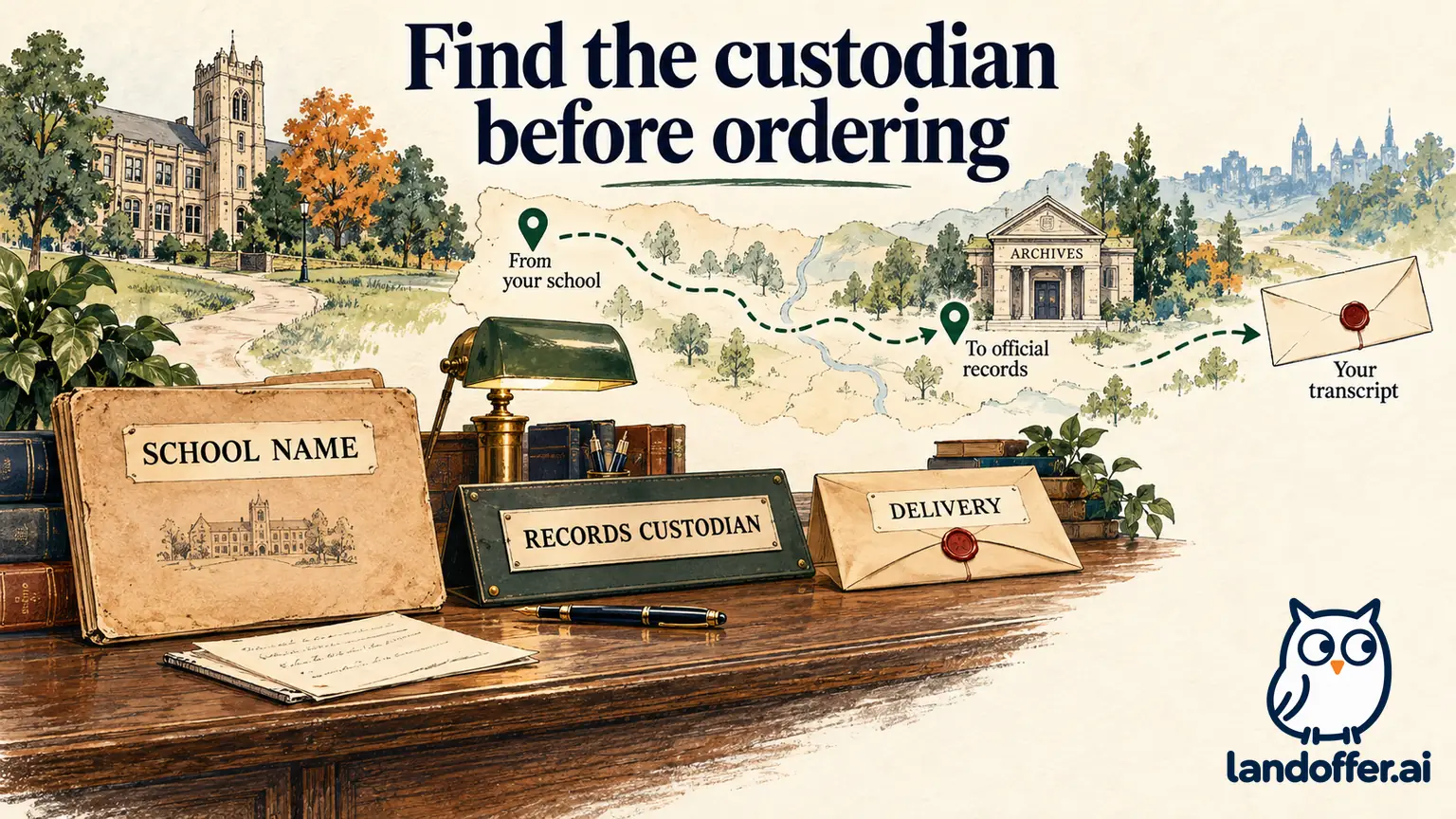
Avery also checks the employer’s recipient before placing the order. Sending an official transcript to a personal inbox first may not satisfy a requirement for direct delivery. Checking the custodian and recipient separately helps Avery avoid paying for a transcript sent through an unacceptable route.
The completed lookup stops at a verified route and a precise next action. The example establishes no real identity verification, individual transcript availability or guaranteed delivery date. Those facts would need confirmation through the actual request process.
Prepare identity details through the verified request process
A custodian needs enough information to locate the right record. Read its specific requirements for your name while attending, current name, attendance period, student identifier, signature or identity verification. Provide those details through the stated secure process, not to an unverified address from an advertisement.
If your name changed, follow the custodian’s instructions for connecting the records. Do not assume the current application name alone will locate an older academic file. Equally, do not send unnecessary identity documents to every contact you find. Start with the required method and ask about missing information through a verified channel.
If you do not remember a student ID or exact attendance date, identify what you do know and ask what alternatives are accepted. Do not invent identifiers. An old email, diploma or prior transcript may help reconstruct the details, but the custodian decides what it needs to authenticate and locate the record.
Keep the request and the application separate in your notes. A transcript-order confirmation identifies an order; an application receipt identifies an employer submission. Neither automatically proves the other step is complete. Record the recipient and delivery method so you can resolve a mismatch later.
Confirm what the employer wants before ordering
Ask whether the employer accepts an unofficial copy initially, needs an official transcript now or requires direct delivery from the issuer. Check whether all institutions, only the degree-granting institution or particular coursework must be documented. Ordering one familiar record may not satisfy a broader request.
USAJOBS provides a federal example in which the announcement controls whether a copy or certified transcript is required, with official records potentially needed later. That example does not establish a private employer’s policy. Read the actual role’s instructions before relying on a saved unofficial file. USAJOBS transcript guidance
Verify the destination precisely: department, email address, portal recipient or postal address, including any application identifier. If the custodian offers multiple delivery formats, choose one the employer accepts. Do not assume a vendor’s fastest option is appropriate if the employer requires another route.
Read the current fee and processing information before paying. Separate processing time from delivery time and employer review time. A request submitted today may not be issued today. If a deadline is close, ask the employer about an allowed interim document or extension before presenting an unsupported promise of arrival.
A completed deadline and interim-document case
This second case uses a fictional college, candidate and employer. Marcus attended Harbor Technical College, which has closed. A verified state response in the teaching scenario identifies an archive custodian. The employer’s application closes October 16, while the custodian has not yet confirmed a delivery date.
| Item | Marcus’s completed record |
|---|---|
| School identity | Harbor Technical College, correct campus and attendance period |
| Custodian | Identified through the verified state route in this stipulated example |
| Available document | An existing unofficial transcript saved while enrolled |
| Required document | Employer asks for an official record |
| Delivery status | Request submitted; issuance date not confirmed |
| Deadline action | Asks employer whether an interim copy is permitted |
Marcus prepares this message:
I am completing requisition ST-532 before October 16. My college has closed, and I have located its records custodian through the state education authority. The official-transcript request is pending without a confirmed issuance date. May I provide my existing unofficial transcript temporarily, and what official delivery deadline and recipient should I use?
The message distinguishes the document Marcus has from the one requested. It does not label the unofficial copy official or claim the employer has agreed to accept it. He retains the custodian’s response and order evidence, then follows the employer’s actual instruction.
If the employer declines the interim copy, Marcus does not upload it under a misleading filename. He asks what permitted options remain and accurately records the application state. If the custodian later reports that the record cannot be found, that is a new fact requiring a different discussion; the earlier order receipt cannot stand in for a transcript.
Handle missing records without recreating an official document
If the first custodian cannot locate your file, ask what search details or other repositories may help. Check former names, campus, program and attendance period. A mismatch in those details can lead to a failed search without proving that the record was destroyed. Keep a concise chronology of official contacts and responses.
If the relevant authority reports that records are unavailable, ask for a written explanation or the procedure it provides. Share the situation with the employer and ask what alternative evidence it will consider. A diploma, prior copy, degree verification or other record may answer a narrower question, but only the recipient can decide whether it satisfies this request.
Never manufacture an official transcript from memory, a template or an AI-generated document. Do not add a seal, registrar signature or invented grade history to make a substitute look authoritative. A personal list of coursework can be labeled as a personal summary if requested; it is not an institution-issued record.
Do not infer degree status solely from closure. Check the actual credential and award record you possess. If you completed coursework but no degree was awarded, describe that status accurately. Keep the education entry tied to the credential actually earned while resolving the missing record.
Track issuance, delivery and employer receipt separately
Retain the order number and stated recipient through the verified process. Check the custodian’s status information where available. “Ordered,” “issued,” “sent” and “received by the employer” are different events. Record the strongest evidence you have without upgrading an intermediate step into final acceptance.
If electronic delivery expires before the employer accesses it, follow the issuer’s and recipient’s instructions about resending. Do not assume the record was accepted because a delivery email was generated. If a paper record is returned, verify the destination before paying for another order.
Keep sensitive identity material securely. Your general job-search tracker can record the request date, custodian, deadline and status without storing full student identifiers or identity-document scans. Accurate tracking should help you follow up while minimizing unnecessary duplication of personal data.
Questions to settle before requesting the record
Does closure mean no transcript exists? No such conclusion follows automatically. Search the official records-custodian route first.
Should I contact the state where I now live? Start with the institution and the jurisdiction relevant to its operation, including the correct campus. Your current address does not establish custody.
Do I list the custodian as my college? Preserve the institution you attended and the credential it awarded. Explain the records route separately if needed.
Can an old unofficial copy replace a required official transcript? Only if the employer permits that alternative. Ask before treating the documents as equivalent.
What if the record cannot arrive before the deadline? State the verified situation and request an allowed interim route or revised deadline. Do not promise delivery the custodian has not confirmed.
When you review fresh roles on LandOffer, flag transcript requirements early. Before ordering, verify the custodian and required recipient; then track issuance, delivery and employer receipt as separate events.
Sources and Further Reading
- California BPPE: Transcripts — State-specific private-postsecondary records and custodian inquiries.
- NYSED: Transcripts from Closed Colleges — Institution-specific records routes in New York.
- University at Albany: The College of Saint Rose Records — Current example of a successor records route, checked October 12, 2026.
- USAJOBS: Transcripts — Federal example of announcement-specific document requirements.