LandOffer
Work Arrangements
Requesting Bereavement Leave: Confirm Covered Relationships, Timing, and Documentation
A current North Carolina policy comparison exposes an older documentation requirement that should not be copied blindly. A complete fictional policy-check record and leave request distinguish a confirmed family-equivalent category, dates taken, a future approved date, documentation acknowledgment, and hours not yet allocated.
Request bereavement leave by identifying the relationship in your actual policy, the scheduled work time you need off, and any timing or documentation requirements. Contact the designated supervisor or HR recipient as soon as practicable, confirm the specific dates and pay code, and submit later dates as separate requests. A public policy example does not establish your own entitlement or guarantee that every proposed date is approved.
This LandOffer.ai guide uses current North Carolina state-employee materials as a named example, then builds a complete fictional request and response. The policy applies within its stated employment scope; it is not a rule for all North Carolina employers or all U.S. workers. No real death, employee record, employer message, or leave request is involved.

Check the policy version before copying its requirements
A search result may lead to an older policy that remains publicly accessible. During this article’s October 28, 2026 review, North Carolina’s standalone Bereavement Leave FAQs still said supporting documentation was required. The Employee Leave Options Policy FAQs, however, say OSHR does not uniformly require it and agencies may establish their own procedures.
The governing document linked from the current policy page is revised September 24, 2026 and effective October 1, 2026. Its bereavement section says agencies may implement documentation procedures. The older standalone policy appears under the site’s archive path. Using the old FAQ alone could lead you to obtain a document your agency does not require; check the current policy and the agency’s own instructions.
Ask HR which version covers your appointment and event date, whether a local procedure supplements it, and what happens if information is not yet available. Keep the answer with the request. Do not silently choose the version that seems more convenient or combine the largest benefit from one policy with the easiest proof rule from another.
A company handbook, collective bargaining agreement, state law, or public-employer rule may produce a different answer elsewhere. This guide does not determine legal coverage outside the named example. Tell the designated contact what time you need while asking them to clarify the applicable process.
Clarify the relationship without supplying an entire family history
“Immediate family” is a defined policy term, not a measure of how much someone mattered to you. Read its categories and any family-equivalent or household provisions. If the relationship is not plainly listed, describe it honestly and ask which provision applies; do not relabel someone as a parent or spouse to fit a form.
The current NC policy’s relationship table includes specified family categories and a family-equivalent category based on a close association equivalent to a family relationship. That is a feature of this policy, not a universal definition. Another employer might use a narrower list, a broader personal-leave option, or a different process for someone outside its bereavement definition.
Initially state the relationship and that a death occurred; keep unrelated medical details and family disagreements out of the leave request. If HR needs information to evaluate a category, ask what is necessary and where to provide it. A project team usually needs the approved absence dates and coverage contact, not the deceased person’s history.
Do not assume that a colleague’s memorial and a family loss receive identical treatment. Even within the named NC example, they have different amounts and usage purposes. Confirm which category applies before entering a payroll code that happens to contain the word “bereavement.”
Completed policy-check record for a specific request
Noor is a fictional full-time, non-temporary employee of an unnamed North Carolina executive-branch agency covered by the current Employee Leave Options Policy. The example assumes HR has confirmed that scope. Noor’s aunt dies Monday, November 2, 2026. Noor describes their close relationship as family-equivalent and asks HR to confirm the relevant category rather than treating the word “aunt” as automatic approval.
Noor normally works eight hours Monday through Friday and is not scheduled on Saturday. The first proposed absence is November 4–5. A memorial is planned for Saturday, November 7, and an estate-related appointment is initially proposed for Monday, November 9.
The completed extraction record keeps source rules and agency answers distinct:
| Question | Named-policy reference or agency answer | Application in Noor’s fictional record |
|---|---|---|
| Which version? | September 24 revision, effective October 1, 2026 | HR confirms this version applies to Noor’s appointment and event |
| Covered relationship? | Current bereavement relationship table includes family equivalent | HR confirms Noor’s described relationship fits that category; not a rule for every aunt relationship |
| Amount and timing? | Full-time family-loss provision: up to 40 paid hours, used within 180 days; days need not be consecutive | Noor requests only identified scheduled work hours, not an immediate 40-hour cash or PTO credit |
| Documentation? | Current policy permits agency procedures | HR identifies its own procedure: memorial information accepted; submit by November 9 if available, or contact HR if delayed |
| Who confirms dates? | Supervisor authorization is required; requested purposes affect the policy’s scheduling provisions | Supervisor confirms November 4–5; the estate-appointment date needs a separate answer |
| Payroll category? | Current FAQ distinguishes family and colleague codes | HR confirms family code 9250 for the approved hours in this agency’s system |
The current policy PDF, Section 7, supplies the named-policy facts. Noor’s eligibility confirmation, relationship decision, documentation date and individual approvals are invented responses in the case. They are not claimed observations of a real agency’s workflow.
The Saturday memorial is still personally important. It simply does not generate eight absence hours in this example because Noor was not scheduled to work that day. If your actual schedule includes the event day, explain that schedule instead of copying the Monday–Friday assumption.
Completed request: necessary facts and specific dates
On November 3, Noor sends this fictional request through the designated supervisor-and-HR channel:
My aunt died on November 2. Our close association was equivalent to a family relationship, and I would like HR to confirm the applicable relationship category under the current bereavement policy.
I request bereavement leave for November 4 and 5, eight scheduled work hours each day, for arrangements and related needs. The memorial is November 7, when I am not scheduled to work. I also request eight hours on November 9 for an estate-related appointment; please confirm that date separately if it requires further discussion.
Please confirm the applicable policy, paid-leave category and entry code, and any agency documentation procedure. The memorial information is not yet available. Please tell me the appropriate recipient and what to do if it remains unavailable when the leave begins.
I will provide a brief work-status note for the assigned backup. Please limit the team update to the approved dates and coverage contact. I will send any changed dates through the normal leave channel.
This request does not promise constant availability, volunteer a coworker without agreement, or claim that submitting a form approves the dates. It supplies enough information for the decision while keeping the reason for the leave concise.
The same day, HR confirms the current policy, family-equivalent category and family code. It identifies the agency-specific documentation procedure recorded above. The supervisor approves November 4–5 but says the November 9 estate-appointment request conflicts with coverage needs and asks whether November 10 would work. The request concerns estate matters, not attendance at the memorial; the distinction is preserved rather than suggesting the supervisor can freely refuse every type of bereavement absence.
Noor checks the appointment and replies that November 10 is workable. The supervisor confirms that date on November 6. Noor supplies memorial information to HR the same day, and HR acknowledges it as sufficient under the fictional agency procedure. No death certificate is invented or obtained, and no document is sent to a real employer.
Read back dates, documents and hours as separate states
Noor’s November 6 follow-up closes the communication loop:
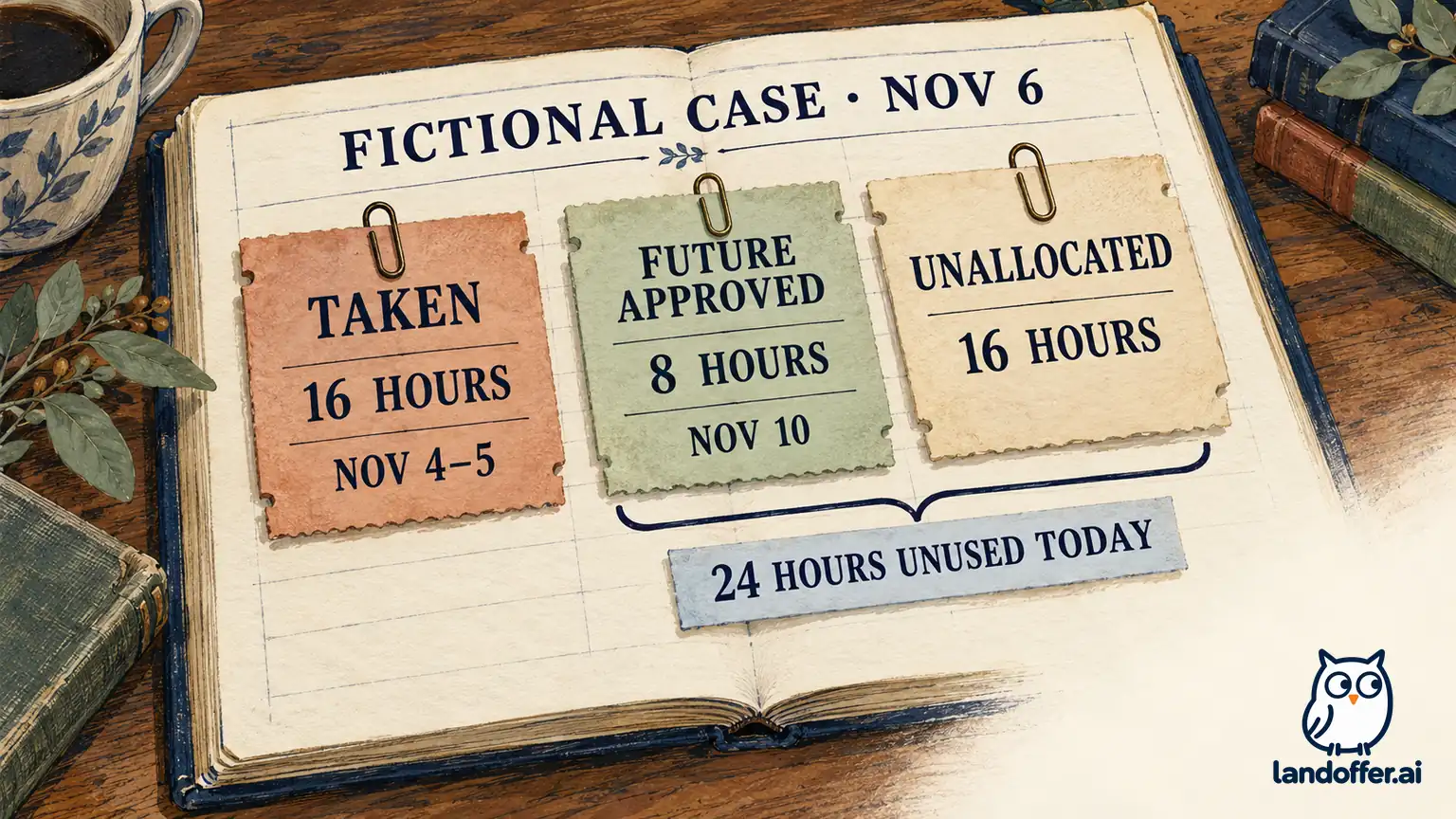
Thank you. My record is that November 4 and 5 were approved and taken, totaling 16 hours under family code 9250. November 10 is now approved for another eight hours; November 9 is no longer requested. HR has acknowledged the memorial information as sufficient for this request.
The Saturday memorial is not a leave entry because I was not scheduled. I understand that the unused portion remains subject to the policy’s timing and request requirements, rather than approval for unspecified future dates. Please correct anything in this recap that does not match the record.
The small ledger prevents an easy accounting mistake:
| Position on November 6 | Hours | Meaning |
|---|---|---|
| Approved and already taken: November 4–5 | 16 | Actual absence recorded in the fictional case |
| Approved but not yet taken: November 10 | 8 | A future approved absence, not completed usage |
| Taken plus future approved | 24 | Planned use if November 10 occurs as approved |
| Still unused as of November 6 | 24 | Includes the eight hours already approved for November 10 |
| Unallocated after reserving November 10 | 16 | No further dates have been requested or approved |
It would be misleading to write “16 hours remaining” without saying whether “remaining” means unused today or unallocated after a future reservation. The arithmetic is 40 − 16 = 24 unused now, and 40 − 16 − 8 = 16 not allocated to the named dates. It is an illustrative tracking distinction, not a claim that every employer’s system displays reservations this way.
Noor has not yet taken November 10, received the relevant pay statement, or requested any additional date. Documentation acknowledgment also does not prove that payroll posted the correct code. As of November 6, the record supports two days taken, one later day approved and documentation accepted; it contains no November 10 attendance or payroll result.
Handle later changes without reopening everything
If a ceremony or appointment moves, identify the changed date and ask how to amend the approved request. Retain the approval for the original date and the replacement confirmation so the timekeeper can identify which entry to change. If additional time is needed, ask which category and process apply rather than entering more bereavement hours without confirmation.
For documentation, use the actual recipient and instructions. An obituary, memorial program or other record may be sufficient under one procedure and not another. If the requested record is unavailable, explain that promptly and ask about an alternative or extension; do not fabricate a document, backdate it, or attach unnecessary private information simply to appear compliant.
After the pay period, compare the dates and hours with the time record and any relevant payroll statement. A leave category may be paid or unpaid depending on the applicable policy or law. Do not infer paid status from the name of a portal menu or treat payroll receipt as proof that all future leave is authorized.
If the relationship or timing is disputed, retain the policy version, your accurate description, and the written response. Ask the designated HR or employee-relations contact to identify the relevant provision and any available review route. General workplace templates cannot determine individual rights, agency coverage, or the outcome of that review.
Related workplace guides are available from LandOffer.ai. Use the current rule to request specific scheduled absences, provide the necessary relationship information through the right channel, and retain the actual date and documentation confirmations.
Sources and Further Reading
- NC OSHR: Employee Leave Options Policy, current landing page
- NC OSHR: Employee Leave Options Policy, revised September 24, effective October 1, 2026; Section 7
- NC OSHR: Employee Leave Options Policy FAQs, current bereavement and documentation answers
- NC OSHR: Standalone Bereavement Leave FAQs, retained for the documented older-page difference
- NC OSHR: Archived standalone Bereavement Leave Policy landing page