LandOffer
Work Arrangements
A Personal Leave of Absence: Agree on Return Dates, Benefits, and Contact Expectations
A completed fictional unpaid-leave agreement separates the approved dates and return terms from direct premium bills, administrative contact, a future handoff and unresolved retirement treatment. Named university policies show why eligibility, return conditions and employee premium shares must be checked with the actual employer.
For a discretionary personal leave of absence, obtain a written arrangement covering the exact unpaid period, expected return, job-return terms, benefits costs, and administrative contact expectations. Name the people who approve changes and list unanswered benefits or return questions before leave begins. A manager’s informal agreement to “take some time” does not settle insurance billing, leave accrual, or the position you expect to resume.
This LandOffer.ai guide uses named university policies to identify questions worth checking, then presents a completed fictional arrangement and readiness record. The example concerns nonmedical personal leave; it does not decide whether another employee’s circumstances qualify for protected leave or establish rights under their employer’s policy.
Identify the leave category before negotiating its terms
Explain the reason accurately to the designated HR contact, at the level needed to identify the relevant process. A period away for personal relocation logistics may follow a different path from leave for your own health condition, family care, military service, or another legally protected reason. Do not select “personal leave” simply because it appears to require less paperwork.
The University of Arizona’s active Personal Leave of Absence Policy, last revised January 1, 2020 and checked October 28, 2026, illustrates employer-specific terms. It covers specified full-benefits-eligible staff, permits discretionary unpaid leave up to one calendar year, and states that eligible FMLA leave takes precedence. Its return provision includes a funding contingency. None of those details is a universal personal-leave rule.
Read the policy that governs your appointment, including the conditions behind the leave label. Arizona’s policy requires applicable accrued leave to be exhausted before personal leave commences; its HR overview describes exhaustion before requesting leave. If the timing matters to your request, ask Leaves Administration which instruction governs instead of silently treating those phrases as identical.
Ask for the policy version, the approval authority, and any separate benefits instructions. If HR identifies another potentially applicable category, have that reviewed rather than treating a discretionary agreement as a substitute for it. The arrangement below deliberately assumes that the fictional employer has reviewed the stated nonmedical request under its personal-leave process.
Make the return arrangement as specific as the start date
Write down the last scheduled working day, the dates of leave status, and the first scheduled day back. An end date on a Friday and a return the following Monday may be perfectly consistent, but “six weeks starting in January” leaves room for misunderstanding.
Ask what the employer is actually agreeing to hold or restore. Is it the same position, a comparable position under defined terms, or a less certain opportunity to apply for openings? What conditions appear in the policy or approval? Request clarification before presenting an uncertain return provision as a guaranteed job.
For comparison, Cornell’s personal-leave provisions describe a written request and approval, holding the position during that leave, and supervisor approval for an early return. The same page describes a different university-leave category in which the position is not held. Those are distinct Cornell arrangements, not interchangeable rights attached to the word “leave.”
An extension also needs its own process. Agree when to raise it, who decides, and what happens while it is pending. Neither requesting an extension nor receiving an acknowledgment automatically changes the approved return date. If the employer’s answer is unclear, keep that question open rather than inserting reassuring terms into your own recap.
Completed arrangement: a bounded personal absence
Eli is a fictional operations analyst at Cairnfield Analytics. Eli requests time for temporary family-relocation logistics, not medical leave or outside employment. HR confirms the company is considering this stated request as discretionary personal leave. That is a stipulated case fact, not a legal classification of anyone else’s situation.
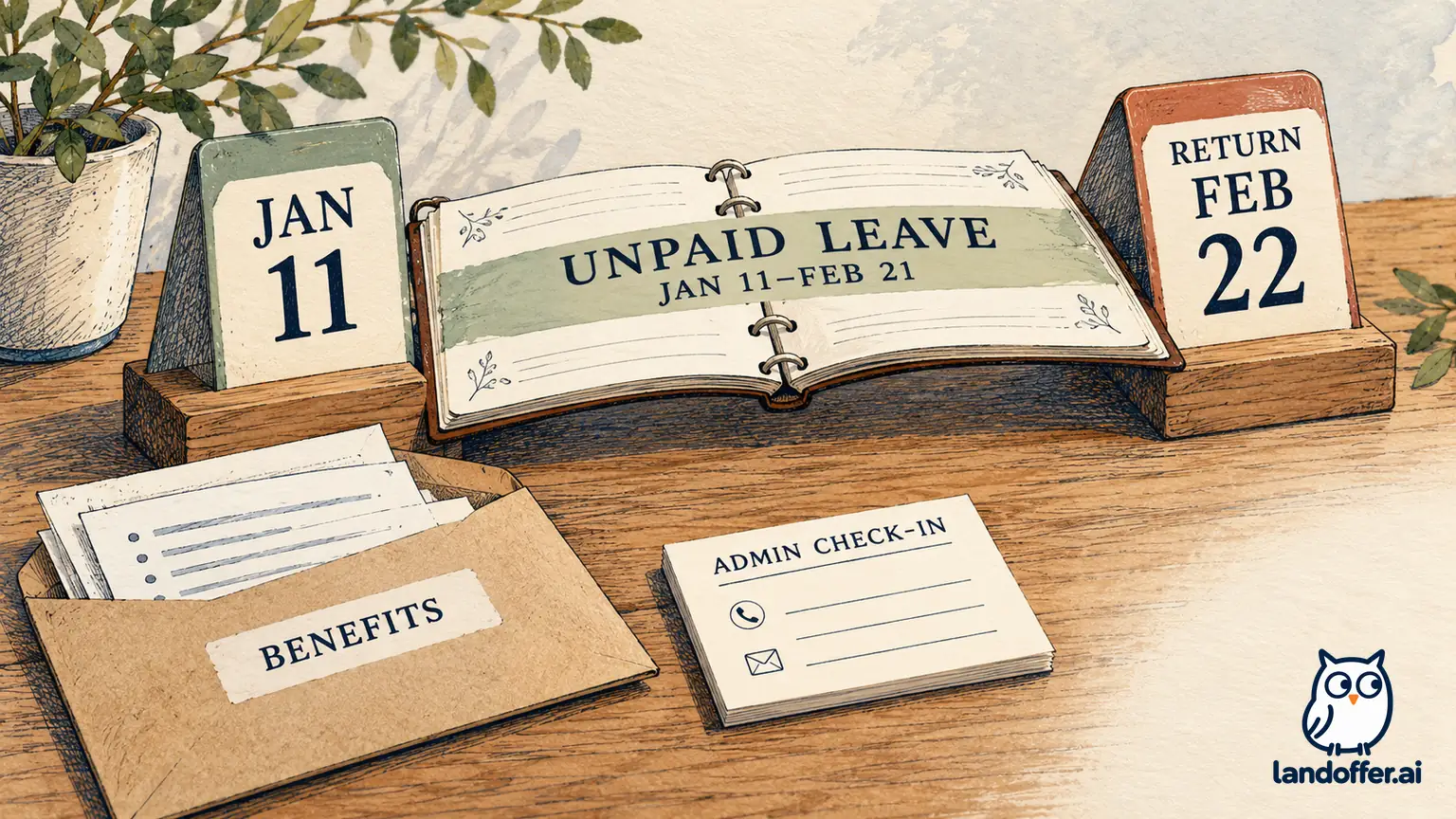
On December 14, 2026, HR and manager Tessa approve unpaid leave from January 11 through February 21, 2027, with return Monday, February 22. The last scheduled working day is Friday, January 8. The interval is six calendar weeks; the arrangement does not use that description to calculate wages or promise pay for holidays within it.
Their completed written arrangement contains these terms:
| Field | Confirmed term in the fictional agreement | Limit or follow-up |
|---|---|---|
| Leave dates | Unpaid status January 11–February 21; expected return February 22 | No extension is approved |
| Position and pay | Same operations-analyst position and base rate on return under this written approval | No promise about future promotions or unrelated employment changes |
| Leave balances | Company confirms no paid balances will fund this period; vacation and sick accrual pause during unpaid status | HR will confirm the restart transaction after return |
| Health coverage | Benefits issues a written continuation arrangement with direct employee billing for the selected coverage | Payment and coverage records must still be checked |
| Known employee bills | $240 for January, due January 8; $240 for February, due February 5 | These are invented selected-coverage amounts, not market premiums or the entire cost of leave |
| Other benefits | Retirement-contribution treatment is awaiting the benefits team’s written answer | Not assumed to continue, stop or receive a match |
| Administrative contact | One planned check-in January 27 through the approved personal contact channel; respond to administrative questions within two business days | No routine project work or ongoing team-chat monitoring agreed |
| Extension request | Raise a possible change with HR and Tessa by February 8 | A request does not change the February 22 return date |
| Coverage and access | Tessa owns work allocation; backup Maya accepts the assigned handoff role; routine work access will be suspended during leave | Restoration timing must be checked before return |
Every term here is a fictional employer decision or an explicit unknown. The example does not borrow Arizona’s eligibility rules, Cornell’s premium-sharing requirements, or a statutory restoration right and pretend they all govern Cairnfield.
Eli’s confirmation message reads:
Thank you for confirming the January 11–February 21 unpaid period and February 22 return to my current role and base rate. I will finish the agreed handoff by January 8. Tessa will own work allocation during the absence, and Maya has accepted the specified backup responsibilities.
I understand the separate benefits arrangement requires direct payment of the two itemized employee bills. I will retain payment receipts and ask Benefits to confirm posting. Retirement-contribution treatment remains unanswered; please provide that response separately.
Our January 27 contact is administrative, through the approved personal channel. I am not agreeing to monitor project messages or perform routine work while on leave. Any date change needs written approval from HR and Tessa; the current return remains February 22 unless they confirm a change.
HR confirms that this recap matches the agreed arrangement. It does not supply the missing retirement answer or certify that future premium payments have already occurred.
Confirm benefits through the responsible team, not the manager alone
Ask what happens to each elected benefit, which cost you must pay, the coverage period, payment method, deadline, and contact for a missing bill. A statement that “insurance continues” leaves important conditions unstated. If a cost is provisional, label it that way and ask when the final bill will arrive.
Arizona’s HR overview describes arrangements with Leaves Administration to pay employee premiums, followed by a continuation form, itemized bill and payment schedule. Its policy also says vacation and sick time do not accrue during unpaid personal leave. These are useful fields to verify, not instructions to assume another employer uses the same contribution split or accrual rule.
Cornell’s personal-leave guidance, by contrast, describes employees paying both their share and the university’s share of health premiums. Obtain your own itemized continuation schedule: another employer’s contribution split could leave a substantial cost out of your budget.
In Eli’s case, the two stated employee bills total $480. This is the amount on the fictional continuation schedule, not an estimate of lost earnings, tax effects, retirement changes, all insurance costs, or total financial affordability. The $480 total reconciles the two scheduled bills only; neither a payment receipt nor a coverage-posting confirmation exists in the example.
If a bill fails to arrive, contact the benefits administrator using the verified channel and ask what action is required before the deadline. Do not assume payroll will keep deducting premiums when no wages are payable, or that leave approval itself proves a bill was paid. Any actual lapse, continuation election, or reinstatement question needs the plan’s instructions and a specific answer.
Completed readiness record: approval is only one item
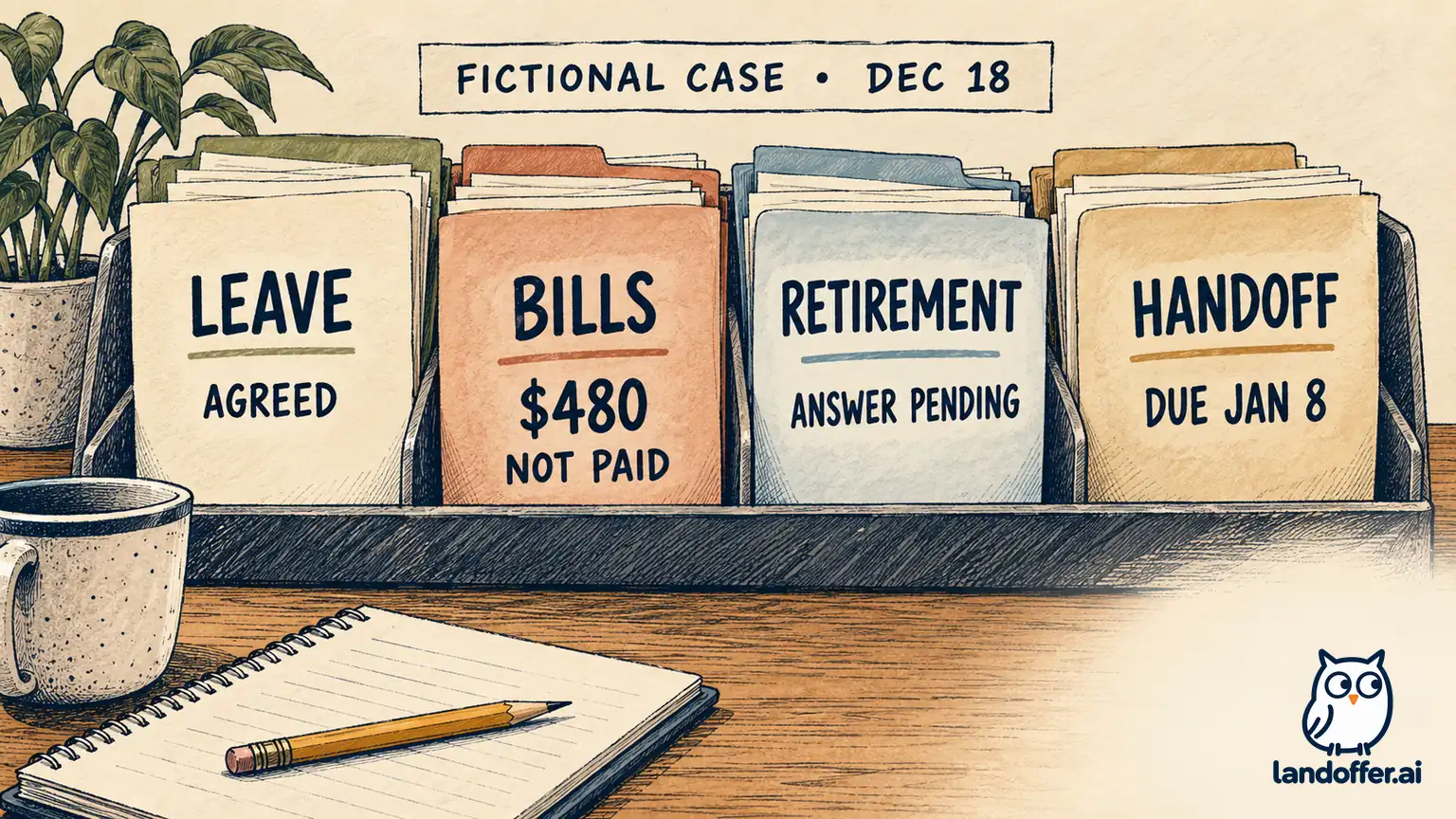
As of December 18, Eli has an approved leave and a benefits schedule, but has not begun leave, paid either bill, or returned. The readiness record preserves those states:
| Milestone | Evidence in the fictional record | Status on December 18 |
|---|---|---|
| Written leave and return terms | December 14 approval; HR-confirmed recap | Confirmed |
| Selected health-coverage billing | Benefits’ December 16 schedule, January and February itemization | Received; $480 total scheduled, not paid |
| Retirement treatment | December 17 question to Benefits | Answer pending |
| Work handoff | Tessa’s allocation note and Maya’s December 15 acceptance | Role accepted; final handoff due January 8, not yet completed |
| Administrative check-in | January 27 date and approved channel | Scheduled, not held |
| Return and system access | February 22 return in approval | Return confirmed as an agreement; access restoration and actual attendance remain future |
The second asset is this record plus Eli’s completed follow-up to the benefits team:
I received the December 16 continuation schedule showing $240 for January due January 8 and $240 for February due February 5. Neither is paid yet. Please confirm where posting will be acknowledged and whom to contact if a payment does not appear.
My December 17 question about retirement contributions and any employer contribution during unpaid status is still open. Please distinguish the unpaid period from the process for restarting deductions when pay resumes. I am not treating receipt of the health-coverage schedule as an answer about retirement.
No reply to that follow-up is invented. A different benefits administrator might use a different billing cycle or process. The record separates the approved absence from billing obligations, receipts still to be obtained, and unanswered questions; use your own dates and itemized costs.
Keep contact expectations administrative and actionable
Specify whether contact concerns return planning, a benefits bill, or another administrative matter, and name the person responsible. Confirming whether the return date remains workable is different from being available to finish a client report. Decide who may contact you, through which approved channel, how often, and what to do if personal contact details change.
Avoid an open-ended “available as needed” promise when the arrangement is an unpaid absence. If an unexpected request involves actual work, clarify it with the responsible manager and HR before treating it as a casual favor; any work performed needs appropriate recording and pay treatment. This article does not determine the wage-law result of a particular call or message.
Keep the final handoff bounded as well. Eli’s backup acceptance does not give Maya unlimited authority or prove all documentation is finished. Tessa remains responsible for allocation, and the January 8 handoff deadline is still a future action in the readiness record.
If plans change, send a clear request identifying the proposed new date and the benefits or work-arrangement questions it raises. Retain the reply. An unanswered email is not an approved extension, and a proposed early return is not automatically accepted merely because you can log in.
Before the planned return, confirm reporting arrangements and any access steps through the employer’s process. After return, check that pay, applicable benefit deductions and any agreed accrual restart actually appear in the relevant records. Do not label those outcomes complete from the original approval letter alone.
Related workplace guides are available from LandOffer.ai. Keep the written dates, return terms, itemized costs and responsible contacts together, and update each pending item when an actual response or event supplies the evidence.