LandOffer
Job search
Quinncia Review: University Resume Feedback and AI Interview Practice
Check your institution access and distinguish resume diagnostics, scored interviews and unrecorded basic practice.
Quinncia is worth checking before buying a separate resume or AI interview tool when your university already provides access. Its strongest use is connecting the resume you submit with rehearsal about the experience on that resume. The first decision is whether your school enables the modules you need for your current student category.
There is also an important feedback boundary. Quinncia's basic practice questions are described as unrecorded and unevaluated. A full mock interview follows a recording and analysis workflow. Neither route establishes that an employer would rate you the same way, or replaces a technical interviewer who can challenge your design decisions.
This review checks public university guidance, vendor help pages, and the current privacy policy on October 14, 2026. We read rendered instructions, but did not log in, upload a resume, record an interview, or receive a report. You can browse recent roles on LandOffer.ai to select a target role, then read the employer's requirements and decide which experience you need to explain before practicing.

Check your school and student category first
Quinncia's student page says access is for students at participating schools. A public sign-in page does not establish free access for every job seeker. Begin with your career center's current resource page rather than trying another institution's route. Quinncia students
USC currently describes access for enrolled students, with unlimited resume uploads and mock interviews while enrolled; alumni are excluded. Its LinkedIn review module has a separate ten-review allowance per school year. “Unlimited” in one module therefore does not describe every activity in the account. USC Career Center
East Carolina University separately describes unlimited resume review and AI mock interviews through its student access arrangement. These two campus examples are useful evidence of available university programs, not a universal entitlement or a guarantee that your department offers the same features. ECU Career Services
Confirm your cohort, login method, available modules, and access end date. If a page addresses current students but not alumni, treat alumni access as unresolved. If Quinncia is part of a class, read the assignment instructions as well as the general campus guide. Distinguish a requirement to complete a module for class from your personal decision about using the resulting feedback in an application.
An eligible student can start with the campus resource before paying elsewhere. Someone without confirmed access should ask about current institutional alternatives, then compare paid tools against the specific work left undone. A university email address alone does not prove that the account is provisioned.
Check the resume and the profile it creates
The vendor's upload guide, updated May 21, 2026, describes PDF uploads and DOCX for its in-app editor, recommends a fresh export, and says experience and education information populate into the profile for review. It also places the interview portion after resume analysis. These are documented steps, not upload or extraction results from this review. Quinncia upload guide
Read your campus entry instructions alongside that guide. A generic email registration and license activation sequence may differ from an institution's single sign-on route. Do not create duplicate accounts simply because a tutorial shows a different starting screen.
Once information has been extracted, check it against your editable source. A course project should remain a course project. A client company should not become your employer, and a tool listed in a job description should not become a skill you possess. Correcting the uploaded file without checking the profile can leave your resume and interview preparation describing different versions of the same project.
Worked example: reconcile a course-project packet
This is a fictional source-check exercise, not an observed Quinncia import. Inez is applying for a junior analytics role. Her resume contains an inventory-reconciliation project completed for a database course. Her project notes identify a team of three, a PostgreSQL schema, SQL queries she wrote to flag negative stock values, and twelve synthetic fixtures. Another teammate wrote the dashboard. There was no live warehouse deployment.
| Field to verify | Inez's source evidence | Completed preparation decision |
|---|---|---|
| Experience type | Database course project | Keep it under Projects, not Employment |
| Individual contribution | SQL exception queries and fixture checks | Name these tasks rather than the entire system |
| Technology | PostgreSQL and SQL | Keep both; exclude tools only named in the target job |
| Test scope | Twelve synthetic inventory fixtures | Say synthetic fixtures, not production incidents |
| Team ownership | Dashboard implemented by a teammate | Do not claim dashboard implementation |
Her two source-supported resume bullets are:
- Wrote PostgreSQL queries to identify negative inventory values in a team database-course reconciliation project.
- Checked exception-query behavior against twelve synthetic fixtures and documented discrepancies for the team's project review.
Inez keeps the schema and query notes beside these bullets. A missing Python keyword in the target description remains a qualification gap; she does not add Python to this project's stack. If an imported profile were to categorize the project differently, this packet would give her the correction to make before rehearsal. No such import error was observed in this review.
The exercise provides a factual starting point for interview questions. It does not forecast a resume score or claim that the vendor extracted any field incorrectly. Its value is preventing an ambiguous application claim from becoming the basis of an equally ambiguous interview story.
Read scores as preparation feedback
USC describes resume feedback across general, content, and formatting categories, with benchmarks that can differ by class year. That makes the score a campus preparation signal. It is not an employer's hiring threshold or proof of successful parsing by every applicant tracking system. USC Career Center
Prioritize the underlying issue. A misread date, confusing section heading, or vague task description may deserve correction. An optional wording suggestion may deserve a different response if it weakens the technical meaning. Keep the underlying work accurate while deciding which presentation changes help a reader.
A keyword recommendation is particularly easy to overinterpret. If a role asks for production data orchestration and your experience consists of classroom SQL, improving the resume cannot eliminate that experience gap. You can make the classroom work clearer and decide whether your other qualifications justify applying.
Also inspect the final application file after editing. Check dates, links, headings, and pagination in the actual PDF or other requested format. This review did not test exports or an employer's parser; it cannot certify that a particular file will pass a destination's checks.
Choose basic questions or an analyzed interview
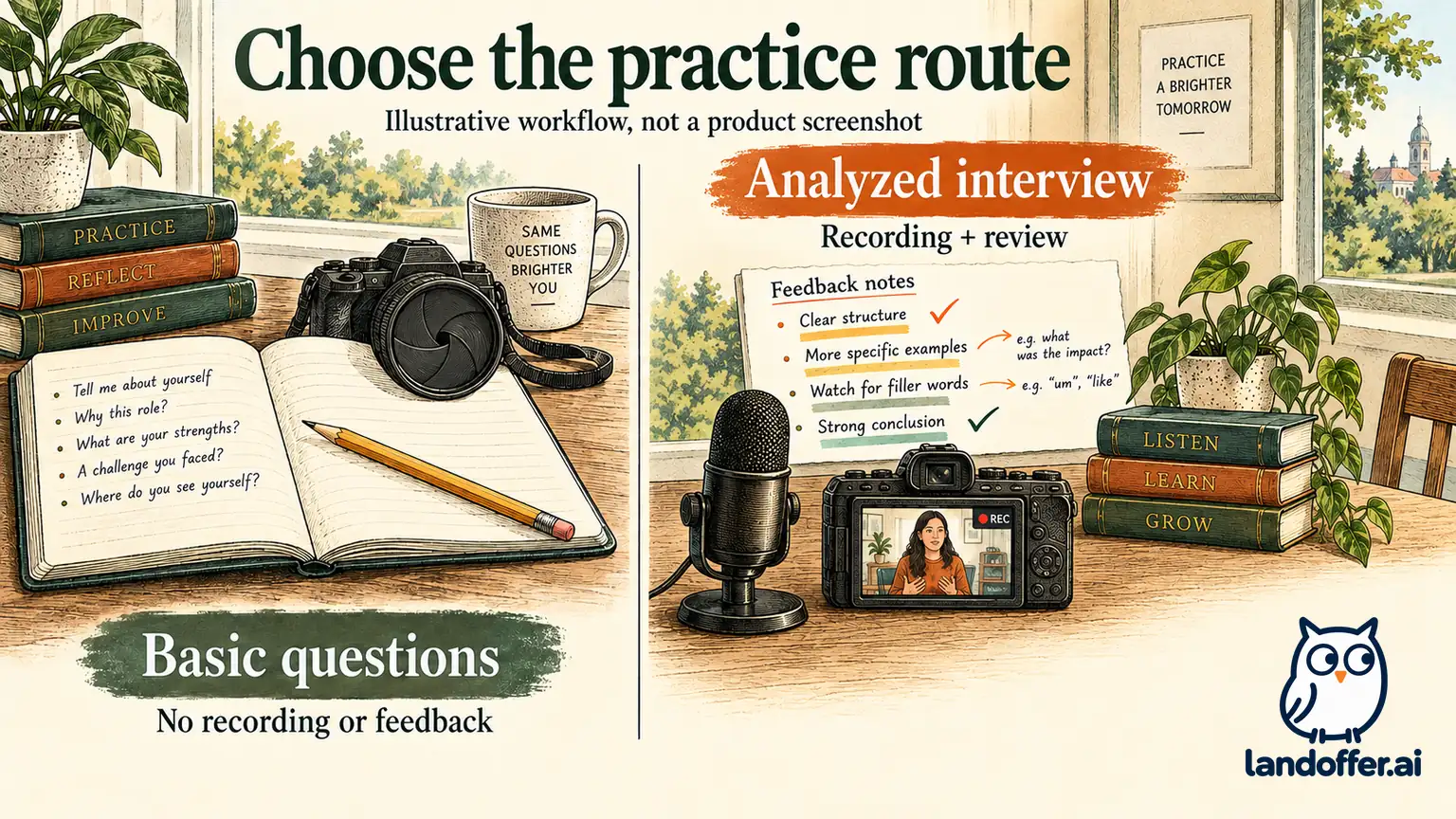
The help page updated August 13, 2025 describes a Practice Interview route with self-assessment, behavioral, analytical, and major or industry question categories. It explicitly says these sample questions are not recorded or evaluated. Use this route to become comfortable forming answers; do not expect an analysis report from it. Practice interview guide
The full interview guide, updated August 12, 2025, describes camera and microphone setup, a standard or real-time interview choice, and submission for server-side feedback analysis. Its documented session has seven questions, with two minutes for the first answer and ninety seconds for subsequent answers. Confirm the settings shown in your current session rather than assuming every mode remains identical to that guide. Interview experience guide
Choose the route according to your next task. If you cannot yet explain your project, begin with basic questions and your own notes. If you need to inspect a recorded answer and delivery feedback, check the full interview workflow and recording terms. If you need someone to probe a SQL tradeoff or challenge an architecture, arrange a human technical discussion rather than treating a delivery report as that evaluation.
Worked example: an answer with a clear ownership boundary
The following prompt and answer are original editorial practice material, not a question or response generated by Quinncia. Amir has a fictional part-time campus IT support role. His notes describe one login incident: he reproduced an error, checked which users were affected, collected timestamps, and escalated to an administrator who changed the configuration. Amir wrote the handoff note and verified access afterward. He did not implement the configuration fix.
Practice prompt: “Tell me about a problem you helped resolve and how you worked with someone else.”
Amir's draft answer:
During a campus support shift, several users reported that they could not log into a lab service. I reproduced the error on a test account and checked whether the problem affected one workstation or multiple users. I collected the error message and timestamps and sent the administrator a handoff note with the steps I had tried. The administrator identified a configuration issue and applied the fix. I then checked access with the affected users and updated the support note so the next shift knew what had happened. My contribution was making the problem reproducible and the escalation clear. I did not change the service configuration myself. Next time, I would use a more consistent incident-note template so another person could review the evidence faster.
His completed self-review is:
| Check | Evidence in the answer | Next rehearsal action |
|---|---|---|
| Specific situation | Lab login incident during a support shift | Keep the setting concise |
| Personal contribution | Reproduction, timestamps, handoff and verification | Explain what he checked without inventing diagnostic tools |
| Team boundary | Administrator identified and fixed the configuration issue | Retain that attribution |
| Reflection | More consistent incident-note template | Explain what the template would contain if asked |
Amir can rehearse this answer in an unrecorded question session, but that route will not score his response. In an analyzed session, he should inspect whether the recording preserves his explanation and whether the feedback identifies a useful delivery change. Neither route turns his support contribution into administrator-level ownership.
The next useful human follow-up is concrete: what evidence made the escalation actionable, and what did he leave for the administrator to investigate? That tests the story more directly than comparing an overall score with another student's result.
Leave time for analysis and review
The full interview guide describes an emailed link fifteen minutes before the scheduled interview and a forty-eight-hour window to use it. It says feedback typically arrives twenty to thirty minutes after submission, but may take up to twenty-four hours during busy periods. These are vendor instructions, not response times measured in this review. Interview experience guide
Avoid scheduling your first analyzed session immediately before an application or interview deadline. Leave time to receive the report, watch the answer that needs work, and rehearse a specific change, such as explaining your contribution before describing the team's result. Completing another session without reviewing the prior one may repeat the same unclear explanation.
The vendor's older analysis page, last updated May 11, 2022, separates audio, video, and content feedback. It discusses speech rate, filler words, answer length, topic mentions, and visual delivery. Use that page to understand the vendor rubric, then check the categories shown in your own report and interview mode. Interview analysis breakdown
Those metrics do not independently establish engineering competence, personality, or the way an employer will assess you. If a technical term is transcribed incorrectly, listen to the recording and check the transcript before revising the substance of your answer. A report can suggest a rehearsal target without becoming an authority on every aspect of your candidacy.
Check recording and campus visibility before uploading
Quinncia's September 2026 privacy policy describes personal-data collection, service-provider disclosures, and retention based on its stated purposes, with exceptions for obligations and disputes. It includes audio or visual information among its collected categories. The policy does not provide a verified institution-specific answer here about which staff can view a particular interview recording or how long that recording remains available. Quinncia privacy policy
Ask your school which staff roles can access resumes, reports, and recordings, whether a class assignment changes that access, and what happens when your license ends. Check any sharing control before selecting a reviewer. Basic unrecorded practice does not establish that no account or usage data exists.
Prepare examples without confidential customer details, internal credentials, or proprietary screenshots. You can explain your work while using an appropriate description of the system and your contribution. This is an input-selection decision, not a claim that the platform exposes everything publicly or keeps everything private.
Decide what remains worth paying for
Quinncia can be a useful institutional starting point for resume clarification and repeated interview rehearsal. Its value depends on your school enabling the relevant modules and on your reviewing the answers, rather than merely completing more sessions.
Before purchasing another tool, identify the remaining gap: document presentation, recorded delivery, or human technical judgment. Use the campus option for the work it actually covers, and bring a specific unresolved question to a reviewer. Explore LandOffer.ai as you organize applications around roles whose requirements your resume and interview evidence can support.