LandOffer
Product & Project Delivery
Prototype, Proof of Concept, or MVP? Agree on What the Work Must Prove
A filled evidence agreement and three original Frame Thread experiment records separate timestamp feasibility, review-version comprehension, and repeated-use value. Actual local conversion checks are distinguished from authored sessions and usage diaries, with unmet gates and remaining obligations visible.
Choose a prototype, proof of concept, or MVP by naming the uncertainty the work must resolve and the evidence that would change your next decision. A polished interaction can reveal a comprehension problem without establishing technical feasibility. A working technical demonstration can leave demand unanswered. A limited product needs evidence from use, not merely an impressive demonstration.
This LandOffer.ai guide uses a fictional timestamped video-review service to compare the three choices and complete their evidence records. The people, sessions, usage diaries, and business decisions are authored examples. A separate local timestamp-conversion check is actually executed, but no editor integration, prototype study, customer product, or live service was tested.

Agree on the question before agreeing on the label
The fictional product, Frame Thread, would let a video-production team attach review comments to a specific moment and review version. Its sponsor asks for an “MVP by Friday,” while the designer imagines a clickable screen and the engineer imagines a timestamp importer. Before work starts, the sponsor needs to distinguish a clickable representation, a technical experiment, and a service people can actually use.
Their product lead, Elena, rewrites the request: “Which uncertainty prevents us from deciding what to fund next?” Engineer Ravi is unsure whether the proposed timestamp format can be interpreted consistently. Designer Noor is unsure whether reviewers understand which version receives a comment. Elena is unsure whether teams would use the workflow again instead of returning to email.
Elena records three separate questions, each requiring its own evidence. They may justify different artifacts, and the team might stop after any one of them. The order below follows this fictional case's dependencies; it is not a required maturity ladder for every product.
Nesta's original explainer distinguishes feasibility-oriented proofs of concept, prototypes used to explore an idea, and MVPs used to learn from a minimal core in practice. It explicitly notes that terminology varies and the methods need not follow one fixed sequence. Use those distinctions to agree on purpose rather than treating them as universal contractual definitions.
Ask the sponsor to complete a sentence: “After this work, we can decide whether to ___ because we will have evidence that ___.” Then specify what the artifact will leave unproven. That second sentence prevents a convincing screen or successful calculation from acquiring claims it never tested.
Completed asset 1: the evidence agreement matrix
Elena, Ravi, and Noor fill in this agreement for Frame Thread before treating any artifact as evidence. All thresholds are fictional planning choices, not recommended statistical standards.
| Artifact | Decision question and evidence required | Deliberately excluded claim | Owner and possible next decision |
|---|---|---|---|
| Proof of concept | Can the specified whole-second timestamp notation be converted predictably? Retain exact input/output pairs, malformed-input behavior, supported range, and known integration gaps | A passing converter does not establish compatibility with every video editor, frame accuracy, real-file import, or service reliability | Ravi owns the technical record; proceed to a real export-format investigation, revise the format, or stop that approach |
| Interaction prototype | Can a reviewer identify the selected video version and place a comment against it? Retain task behavior, confusion, assistance, and contradictory observations | A convincing interaction does not establish persistent storage, authorization, delivery, performance, or willingness to reuse | Noor owns the task record; revise the version interaction or investigate further before implementing it |
| MVP | Will eligible teams complete a useful review workflow across repeated real work? Retain opportunity, actual use, assistance, fallback behavior, and operating burden | Initial use does not prove retention at scale, profitable demand, universal suitability, or production readiness for everyone | Elena owns the learning decision; continue a bounded investment, change the proposition, or stop expanding it |
The matrix prevents the sponsor from treating one successful artifact as proof of all three claims. A developer's successful timestamp conversion cannot answer the prototype question. A reviewer saying “I would use this” cannot replace repeated-use evidence. An MVP with real users also carries operational responsibilities that a disposable sketch does not.
GOV.UK's alpha guidance describes building only enough prototype to investigate risky assumptions, without treating that work as production-quality code. That guidance concerns government delivery; it does not grant permission to expose an unfinished service publicly or prescribe this team's schedule.
Completed asset 2: three experiments for the same product
The following records distinguish an executed local calculation from the fictional team's authored observations. Neither the fictional records nor the local check establish that Frame Thread exists as an operational product.
Experiment A: a narrow technical question
Ravi's authored technical brief specifies exactly HH:MM:SS, using two digits per field, hours 00–23, minutes and seconds 00–59. Frame counts, drop-frame timecode, fractional seconds, time zones, and durations of 24 hours or more are outside this example. An empty value must fail rather than silently becoming zero.
The retained Python script actually executes six manually authored supported timestamp inputs and two invalid inputs; its JSON receipt records the results and round-trip checks. Selected retained pairs are 00:00:00 → 0, 00:01:30 → 90, 01:02:03 → 3723, and 23:59:59 → 86399 seconds. 00:00:90 and an empty value are rejected. A round-trip check converts each supported result back into the original notation.
These inputs were typed for the article. They are not exports from an editor or evidence of importing a real media file. The function performs integer conversion only; it does not synchronize playback, locate a video frame, validate a provider integration, or demonstrate that a reviewer sees the right content.
Ravi's completed disposition is: “The defined whole-second mapping works in this local reference model. Compatibility with a real editor export remains unknown. Do not approve the integration on this record.” Elena accepts a further format investigation, rather than declaring the technical system feasible in full.
Experiment B: comprehension of the review version
Noor's fictional task uses a clickable representation with two versions, V1 and V2, and a clearly marked nonfunctional comment box. The prompt asks a reviewer to leave feedback on the revised cut. It does not tell them which control to select. Nothing is submitted or persisted.
| Authored record | Task behavior | What it supports and what it leaves open |
|---|---|---|
| R01 | Selects V2 and explains that the comment belongs to the revised cut | The represented version control is understandable in this case; persistence is untested |
| R02 | Opens a V1 link, types a comment, and assumes it will attach to whichever version is newest | A mismatch between link context and expectation; does not establish lack of demand |
| R03 | Notices the version label but asks the facilitator which cut is current | Visible labeling alone did not remove uncertainty in this case; assistance prevents an unassisted-success claim |
Noor's completed decision is to revise the representation so the active version and comment destination appear together, and to investigate how old links should behave. Retesting the revised representation remains outstanding; the revised screen cannot supply a new observation until someone actually examines it in the intended task. The team cannot turn “we changed the label” into “reviewers now understand it.”
Elena records the dependency: any later limited-use service must address version association and provide evidence for the revised interaction. The fictional sequence assumes that prerequisite is satisfied before the next record; it supplies no actual retest or deployed implementation proof. This assumption remains visible rather than being smuggled in as a result of the prototype.
Experiment C: repeated-use evidence for an MVP
For the final authored scenario, assume a limited service with appropriate authorization, support, and version handling has been approved separately. That is a fictional prerequisite, not an action performed here. The article does not provide private-beta setup instructions or authorize inviting real teams.
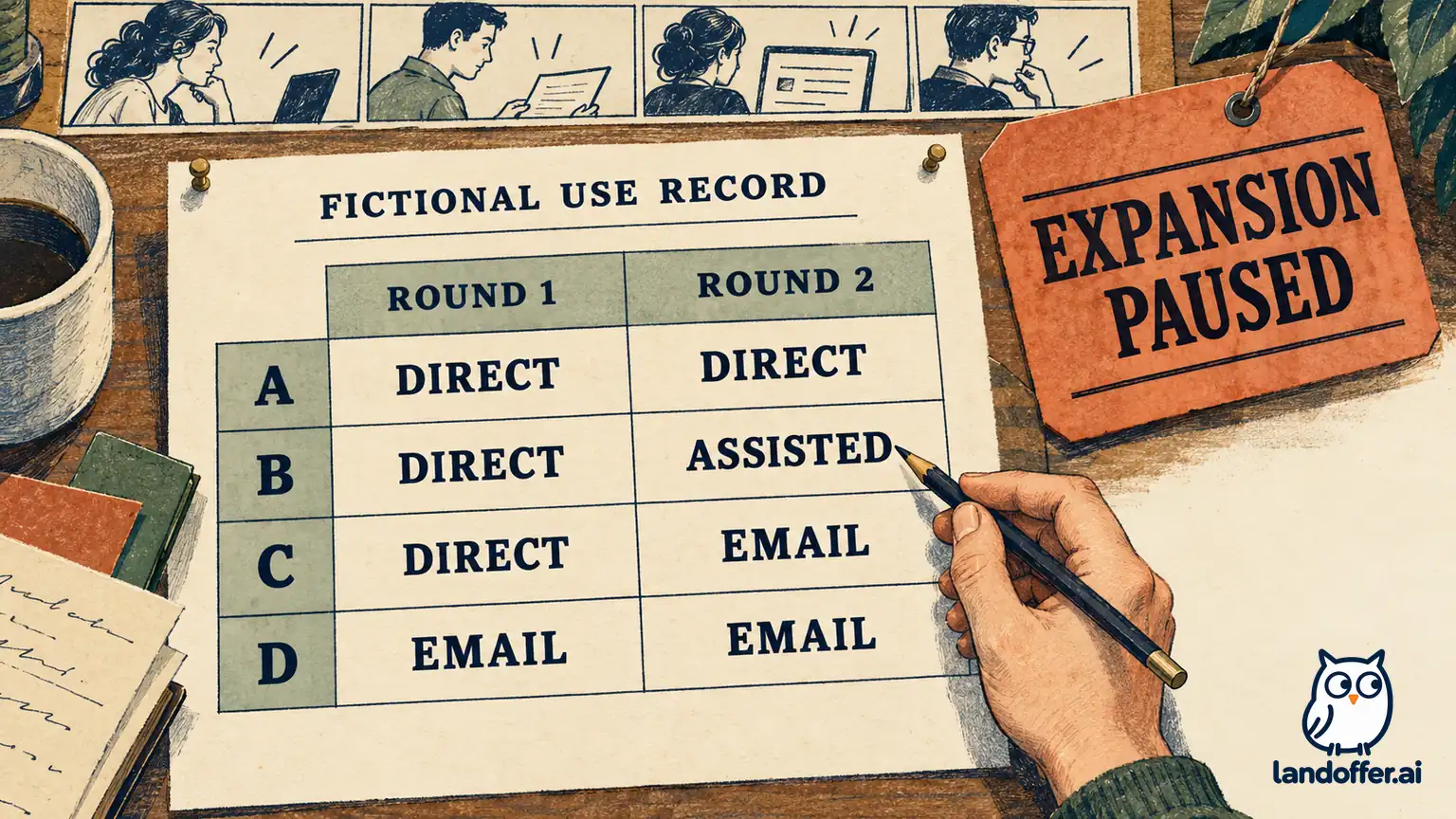
Elena defines a learning question: can participating production teams complete two successive eligible review rounds without staff transcribing their comments? Each of four fictional teams has two genuine review opportunities within the scenario. The illustrative continuation gate requires at least two teams to complete both rounds without that assistance; a serious unresolved version-association problem would also block expansion.
| Team | First eligible round | Second eligible round | Counts toward the unassisted-repeat gate? |
|---|---|---|---|
| A | Completes in the service without transcription help | Completes without transcription help | Yes |
| B | Completes without transcription help | Staff transcribes emailed comments into the service | No; assisted completion stays separate |
| C | Completes without transcription help | Returns to email; service round not completed | No |
| D | Uses email instead of completing the service round | Uses email again | No |
Three teams complete the first round in the service without transcription help. Two service rounds are completed in the second opportunity, but one is staff-assisted. Team A is the sole unassisted repeat team; Team B’s second-round service completion depends on staff transcription and therefore does not meet the stated gate. Counting Team B as repeat success would hide operating work inside apparent product adoption.
Elena's completed fictional decision is to pause expansion: one team meets a gate requiring two. She asks for an investigation of why B needed transcription and C returned to email before authorizing another investment. The record does not establish the cause, a revenue opportunity, representative demand, or a retention rate. No actual customer diary or product telemetry was collected.
Keep learning evidence separate from permission to operate
An MVP is not merely the smallest feature list someone can finish quickly. Agile Alliance's MVP guidance emphasizes learning from what customers actually do, and warns against minimizing functionality without enough quality to learn meaningfully. In this fictional internal-workflow example, the evidence concerns repeated task use, not demonstrated willingness to pay.
A limited service still needs an appropriate operating boundary: who may use it, what data it handles, what happens when it fails, and who can stop it. Those questions are separate from whether the team has learned something useful. A manual service can support learning, but its staff work must remain visible instead of being described as automation.
Likewise, changing the artifact's name does not change its evidence. Calling a sketch an MVP does not create real usage. Calling the timestamp function a proof of concept does not establish editor compatibility. Calling an initial service a prototype does not remove responsibilities toward people relying on it.
In the handoff, record the question, artifact version, inputs or audience, result, interpretation, exclusions, and next decision owner. State whether the evidence is an actual execution, an authored scenario, or a future plan. Keep unsuccessful and assisted attempts alongside apparent successes so the next person can evaluate the claim.
For your current request, replace “build an MVP” with the decision sentence and a filled evidence agreement like the one above. Choose the smallest appropriate artifact that can answer that question without pretending to answer the others. More practical workplace guides are available from LandOffer.ai.