LandOffer
Job search
Pre-Adverse Action Notice After a Background Check: Save the Report and Check the Response Process
Organize the screening-notice packet, separate employer review from report correction, and confirm the response process without assuming a fixed waiting period.
Save the notice, the background report, and the rights summary before responding to a pre-adverse action notice. Read whether the employer is considering an adverse decision or has already made one, identify the reporting company, and confirm the response instructions and stated deadline. Track the reporting company’s dispute investigation separately from the employer’s hiring review. Do not assume that contacting one automatically updates the other.
This U.S.-focused guide reviews FTC and CFPB sources checked October 23, 2026. It organizes documents and questions rather than deciding an individual’s legal rights. Every person, company, report entry, date, and message in the worked examples is fictional. LandOffer publishes this guide; browse recent roles separately from handling the notice, which requires the employer’s and reporting company’s official channels.

First identify which notice you actually received
The FTC distinguishes the steps before and after an employer takes adverse action based on a consumer report. Before the action, the employer must provide a notice including the report relied on and a copy of the FCRA rights summary. This advance notice gives the person an opportunity to review the information. A later adverse-action notice concerns the unfavorable action itself. FTC guidance on using consumer reports.
A portal label such as “review required” is not enough to establish which event occurred. Read the actual message, attachments, and employer instructions. A screening company’s completion email may simply say that a report is ready. A recruiter’s request for clarification may ask for documents without being the formal notice described in the FTC guidance.
If the wording is unclear, ask the employer to identify the current review stage and the process for responding. Save its answer with the original notice. Keep “considering action,” “response received,” and “final decision communicated” as distinct entries in your notes. Use those labels to describe the current stage without issuing your own legal compliance finding.
The CFPB’s employment-report explanation likewise distinguishes a report copy from the adverse-action notice issued when the employer makes its decision. It identifies the consumer reporting agency as a contact named in that notice. CFPB employment background-check explanation.
Save the packet and confirm what is missing
Download or otherwise retain the materials through the official channel available to you. Keep an unchanged report copy and make a separate working copy for highlighting. Save the received date, report date, version or reference, attachment names, and portal instructions so you can identify what was available when you responded. A screenshot of the status can supplement the packet, but it does not replace the report.
Check whether the report and rights summary are actually accessible. An email saying “attached” does not make a missing attachment available, and an expired link does not show what the employer reviewed. If you cannot obtain a file, record the problem and request the material promptly through the named contact. Describe the missing item rather than guessing what it contains.
The joint FTC/EEOC employer guidance describes providing the report relied on and the FCRA rights summary before an adverse employment action. It also notes that state and municipal rules may affect the use of background information. This article does not supply a single response deadline for every jurisdiction or employer. Background checks: what employers need to know.
Use a private, access-controlled folder for the packet. Do not paste the full report, government identifiers, or another person’s records into a public discussion. If a provider needs identity verification, use its designated verified process. Confirm the recipient and required scope before uploading additional documents.
Worked packet: Nora separates a date error from the notice
Nora is a fictional software candidate. On October 23, 2026, she receives a message explicitly labeled as a pre-adverse action notice. In this invented case, it asks for a response by October 27 at 4 p.m. Eastern and names the employer’s secure review portal. The October 27 cutoff is invented for this case; it does not state a nationwide legal waiting period.
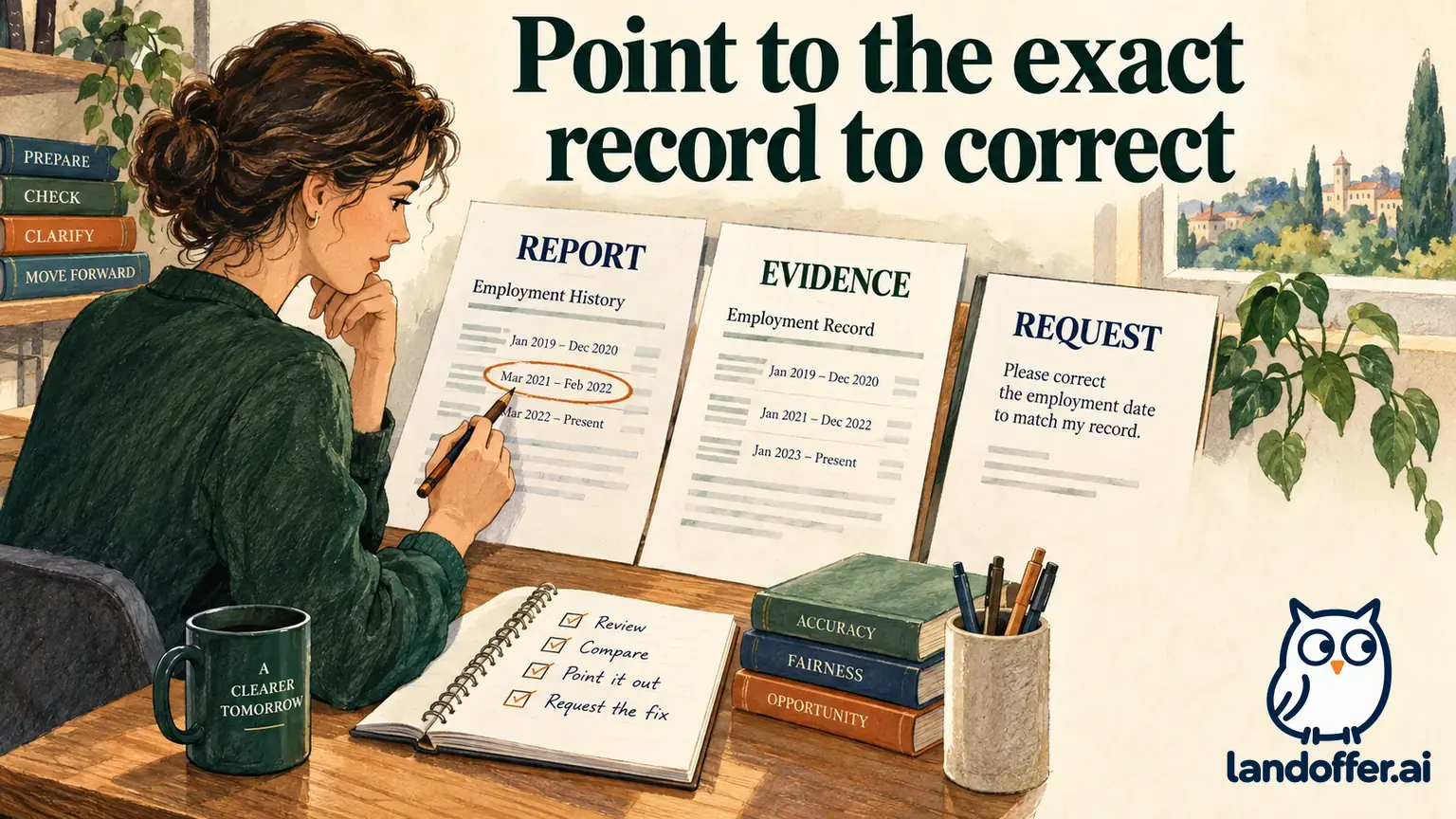
Her report, dated October 20, lists a degree award year of 2020. Her application says 2021. She has an existing registrar-issued confirmation letter and transcript identifying the award year as 2021. The report and rights summary are accessible. She records the following completed packet inventory without changing the original report:
| Packet item | Nora’s recorded finding | Completed preparation step |
|---|---|---|
| Notice | Pre-adverse wording; October 23 receipt | Save original message and its stated October 27 response instruction |
| Report | October 20 version; education entry on page 3 | Preserve original; mark only a working copy |
| Rights summary | Accessible with the notice | Save alongside the report, not as a substitute for it |
| Disputed fact | Award year 2020; application says 2021 | Isolate the year rather than disputing the entire report |
| Supporting records | Transcript and registrar letter both identify 2021 | Prepare relevant copies through the verified dispute route |
| Employer route | Secure review portal named in the notice | Prepare a review-process question and keep its acknowledgment |
| Reporting-company route | Dispute contact identified on the report | Prepare a separate factual dispute; do not assume the employer files it |
Nora’s working note reads: “Award year disputed; source documents prepared; employer review timing needs confirmation.” It does not say “report corrected,” “offer restored,” or “employer must wait until my dispute is complete.” Her preparation is complete even though the investigation and hiring decision have not occurred.
If her transcript instead described attendance dates rather than an award date, she would need to resolve that distinction before asserting that it proves the requested correction. A different value is a reason to inspect the source, not permission to invent a supporting explanation.
Check the employer’s clock and the reporting company’s clock
Read the notice’s date and time carefully, including its time zone and submission instructions. Ask which deadline applies to your response and how to supply information that is still pending. If you need more time or an accessible copy, request it promptly and save the answer. A request is not an approved extension.
Do not replace the employer’s stated response process with a number found in another candidate’s story. The CFPB’s background-screening handout explains that reporting companies generally have 30 days to investigate a dispute, with an additional 15 days in some circumstances. That is an explanation of the reporting company’s investigation process, not a promise that an employer will keep a position or offer open for that period. CFPB background-screening handout.
Maintain separate entries for the employer’s requested response, the date the reporting company receives the dispute, and any later investigation result. If the employer provides a revised review date, retain that confirmation. If it does not, do not silently rewrite the original deadline in your notes.
For Nora, the immediate task is to respond to the October 27 instruction while asking how the employer handles a pending correction. Waiting for a reporting-company investigation to finish could leave the employer without her explanation by its stated date. Conversely, uploading her explanation to the employer would not establish that the reporting company received a dispute.

Worked responses: two recipients, two concrete requests
Nora prepares two different messages. These completed fictional drafts are examples of factual communication, not legal notices guaranteed to satisfy every process. They have not been sent. She would use only the actual contacts and identifiers required by her own verified channels.
Draft to the employer’s review contact
Subject: Pre-adverse review — response process and disputed education year
I received your pre-adverse action notice on October 23. I have saved the report and rights summary. The education entry in the October 20 report lists an award year of 2020; my application lists 2021, and my registrar confirmation and transcript identify 2021.
I am preparing a separate dispute with the reporting company. Please confirm whether October 27 at 4 p.m. Eastern is the deadline for my response, where I should upload the supporting records, and how I should provide a correction or investigation result that arrives later. Please also confirm receipt of this explanation and the current review stage.
Thank you, Nora
Draft to the reporting company’s dispute contact
Subject: Dispute of education award year in October 20 report
I dispute the award year in the education entry on page 3 of my October 20 background report. The report lists 2020. My registrar-issued confirmation and transcript identify the award year as 2021. Please investigate the year and correct inaccurate information as appropriate.
I have prepared a marked copy identifying the entry and copies of the two supporting records for your verified submission process. Please confirm the information needed to locate my file, acknowledge receipt of the dispute, and explain how I will receive the investigation result and any revised report. Please advise how the corrected report will reach the employer.
Thank you, Nora
The employer message addresses review timing and receipt. The reporting-company message identifies the disputed item, the source documents, and the requested investigation. Neither asks the reporting company to make the employer’s hiring decision. Neither says a correction has already been accepted.
Nora retains the original transcript and registrar letter and prepares copies for the dispute. She records only documents actually submitted as “submitted”; a prepared attachment remains “prepared” until the channel confirms transmission. If the official process requires additional identity information, she supplies it privately there rather than adding it to a reusable public template.
Follow the result instead of assuming the dispute worked
The FTC’s consumer guidance tells applicants to contact the reporting company about mistakes, provide supporting documentation, inspect any revised report, and ask that the corrected report be sent to the employer. A submission acknowledgment is useful evidence of receipt, but it is not an investigation result. Employer background checks and your rights.
When a revised report arrives, compare the specific field with the original and check the surrounding entry. Record the new report date and what changed. If the disputed year remains unchanged, keep the written explanation of the result and identify what remains unresolved. Do not label the whole report “clear” merely because one item changed.
Separately confirm whether the employer received the revised version and what review stage it now reports. An acknowledgment from the reporting company and an acknowledgment from the employer answer different questions. If the employer’s process accepts a personal explanation about accurate information, follow those instructions without calling the accurate entry a factual error.
The CFPB publishes its prescribed consumer-rights summary in the current Appendix K to Regulation V. Keep the summary actually supplied with your notice as part of your packet; an online reference does not establish what you received. CFPB’s current Appendix K. A disagreement with the employer’s evaluation does not, by itself, prove the report is false. For questions about the legal effect of accurate records, local protections, or a particular decision, use qualified legal assistance with the actual documents.
If a final notice arrives, preserve it as a new event
Save the final notice even if a dispute remains open. The FTC says an adverse-action notice must identify the reporting company, explain that it did not make the unfavorable decision, and describe dispute and additional-free-report rights. Its guidance specifies requesting that additional free report within 60 days. That request period is different from the employer’s earlier response deadline. FTC adverse-action requirements.
Record the notice date, the decision described, the reporting company’s contact information, and any continuing dispute reference. If the final notice appears to rely on an earlier version, ask the employer which version it reviewed. Keep the question factual; a comparison of dates alone does not establish the legal conclusion about what happened.
If materials are missing, an error remains unresolved, or you need advice about rights and timing, consult the relevant official consumer resources or a qualified attorney. A complaint or consultation is a separate step and does not itself reverse a decision. This guide has not filed a complaint, transmitted records, or contacted an employer for anyone.
Close your working note with the facts: materials saved, disputed fact identified, recipient and response instructions confirmed, receipts retained, and result still pending or received. Once you have recorded the current response step, you can separately browse recent roles on LandOffer.ai; the service does not provide legal representation, background-check adjudication, or access to the employer’s screening process.
Sources and Further Reading
Official public documentation checked October 23, 2026. Fictional worked examples are not actual report disputes or individual legal determinations.