LandOffer
Workplace Communication
Write a Personal User Manual That Helps Colleagues Work with You
A completed fictional personal manual pairs communication, focus, feedback, and uncertainty preferences with reciprocal responsibilities. A two-person adjustment record checks Pacific–Eastern times, preserves the actual decision owner, and updates the manual after partial approval and a sensitive feedback discussion, without treating preferences as policy.
A useful personal user manual describes how you currently work, what helps you collaborate, what you will do in return, and where a preference needs discussion. Write concrete requests about communication, focus, feedback, and uncertainty. Then compare them with a colleague’s needs and the team’s actual obligations. Use the manual to discuss preferences; record separately what the other person actually agrees to do.
This LandOffer.ai guide completes a fictional manual and a two-person adjustment record. It avoids personality labels, mandatory personal disclosure, and claims that a preferred work style excuses missed commitments. The aim is to make collaboration easier to discuss, not to require colleagues to memorize instructions for dealing with you.

Write for the work you will do together
Choose an audience and a situation. A short manual for close project partners may need your working hours, preferred request format, and how to raise an urgent question. It probably does not need your medical history, family circumstances, or a catalogue of personality-test results. You can explain what helps you without explaining every private reason behind it.
Atlassian’s personal user manual play offers prompts about work arrangements, communication, and feedback, and says people can choose what they are comfortable sharing. That is a useful starting point, not an obligation to answer every prompt or reveal personal information. This article does not adopt its optional personality-test variation or promise that a shared document creates a safe environment by itself.
Replace labels with observable requests. “I am a perfectionist” leaves a colleague guessing what to do. “For a design review, please identify the decision you need and link the current version; I will separate launch-blocking concerns from later refinements” gives both people something to discuss.
Check whether a statement describes a preference, an agreed arrangement, or a genuine organizational requirement. “I prefer written context” is a preference. “Our incident escalation uses the duty channel” is a team process that you must verify locally. Your personal manual should not quietly turn the first into a requirement or replace the second.
Include your responsibilities alongside your requests
A manual that says only what others must do makes collaboration one-sided. Pair a request with a commitment you can sustain: you prefer a short written agenda, and you will read it before the agreed discussion; you prefer focused work blocks, and you will flag when a promised response needs another route.
Manual of Me’s own practitioner guidance argues that the value lies in reflection and conversation rather than emailing everyone a document and expecting compliance. Use a few relevant points to discuss the work in front of you. Do not make reading a long manual a test of a colleague’s respect for you.
Avoid absolute claims you cannot maintain. “I never take calls” may conflict with a role that includes live coordination. “For non-urgent questions, I prefer written context first; if a short call is needed, let’s agree a time” leaves room to work out the actual need. Explain why a preference matters, then ask how to meet the work need when that preference conflicts with another person’s.
For access needs or a formal adjustment, use the appropriate organizational process if one is needed. A user manual can communicate an arrangement you choose to share; it is not a substitute for that process or permission to publish sensitive details. No colleague needs to disclose a diagnosis to justify an ordinary discussion about work preferences.
Completed manual: Iris’s current working preferences
All people, workplace arrangements, messages, dates, and outcomes below are fictional. Iris is a product designer at Vela. She is preparing a short manual for engineer Sam and the other partners on an upcoming interface-review task. The document has an owner, a date, and a clear status.
Iris: working with me, version 1, November 2, 2026. Audience: current project partners. These are my preferences unless I identify an existing team arrangement. Please tell me where they conflict with yours. I will revise the manual when we agree something different. This document is not a change to our team’s response or escalation rules.
| Topic | Iris’s completed entry |
|---|---|
| Hours and overlap | My agreed working hours are 09:00–17:00 America/Los_Angeles. Sam works 09:00–17:00 America/New_York. For this November collaboration, our overlap is 09:00–14:00 Pacific, or 12:00–17:00 Eastern. Please propose ordinary meetings inside that overlap; I will check the calendar rather than assume you can stay late |
| Focus | I prefer 09:00–10:30 Pacific for uninterrupted design work on days without an agreed meeting. This is a preference, not an unbreakable block. I will flag a conflict early and discuss another block rather than silently miss a time-sensitive review |
| Requests | Please send the decision needed, current artifact link, desired date and time zone, and the consequence of waiting. I will say whether I own the decision, need context, or need to involve someone else |
| Discussion | Written context helps me think, but a long thread is not always useful. If we are talking past each other, I will suggest a short conversation and write down the resulting decision or open question |
| Feedback | For ordinary design feedback, one concrete example and the affected task help me respond. I prefer discussing sensitive feedback privately. I will ask questions and distinguish what I accept from what still needs investigation |
| Uncertainty and disagreement | A pause usually means I am checking an assumption, not agreeing or dismissing the point. I will say what I am checking and when I can return. If you need a decision sooner, please say what depends on it |
| Urgency and boundaries | A personal direct message is not our emergency route. Use the existing verified team escalation process for an incident. For a time-sensitive project question, describe the impact and ask for an agreed response point; my notification status does not prove availability |
| Sharing and review | I am sharing work preferences, not personal health or family details. Please discuss a relevant point with me before treating it as a commitment in another project. Let’s review this after two weeks or sooner if our arrangements change |
The time-zone names matter because abbreviations alone can be misread, and offsets can change during the year. The five-hour overlap applies to these November dates and named zones; check the actual calendar when dates or locations change. A calendar invitation should carry the actual date and named time zone.
Iris leaves hobbies, personal history, and personality labels out because they do not help this task. She also does not promise an instant response whenever she appears online. Her manual gives Sam a way to ask for what he needs while making her own responsibilities visible.
Compare the manual with the other person’s constraints
The Cabinet Office’s October 2026 Ways of working guidance describes a short “manual of me” covering work patterns, communication, skills, and interests, alongside discussion of shared working arrangements. Its public-policy team context differs from Vela’s. It supports discussing preferences together, not assuming one person’s manual overrides collective decisions.
Sam reads the relevant entries with Iris rather than approving the whole document as a contract. He explains that he prefers a live sketch review to a large written comment batch. He also needs the upcoming review decision before 13:00 Eastern on Thursday, November 5, to prepare an already scheduled discussion. That is 10:00 Pacific, inside Iris’s preferred focus block.
Neither treats the conflict as evidence that they are incompatible. Sam needs a decision at a particular time; Iris needs enough context to give a useful answer and a replacement focus block. They consider those needs separately from their preferred formats.
Their initial exchange is deliberately specific:
Sam: “Your manual says mornings are focus time. I need the review decision before 13:00 Eastern Thursday. Can we make an exception, or should we find another decision owner?”
Iris: “I can move that day’s focus block. Please send the current sketch and the two questions by 17:00 Eastern Wednesday. I can read them at 09:00 Pacific Thursday, then discuss at 09:30. I can recommend an answer, but product owner Mara still owns the final scope decision.”
The extra authority boundary matters. Making a time for discussion does not give Iris a decision right she does not have. Mara must separately accept a decision slot; the manual cannot create her availability.
Completed adjustment record: negotiate both sides
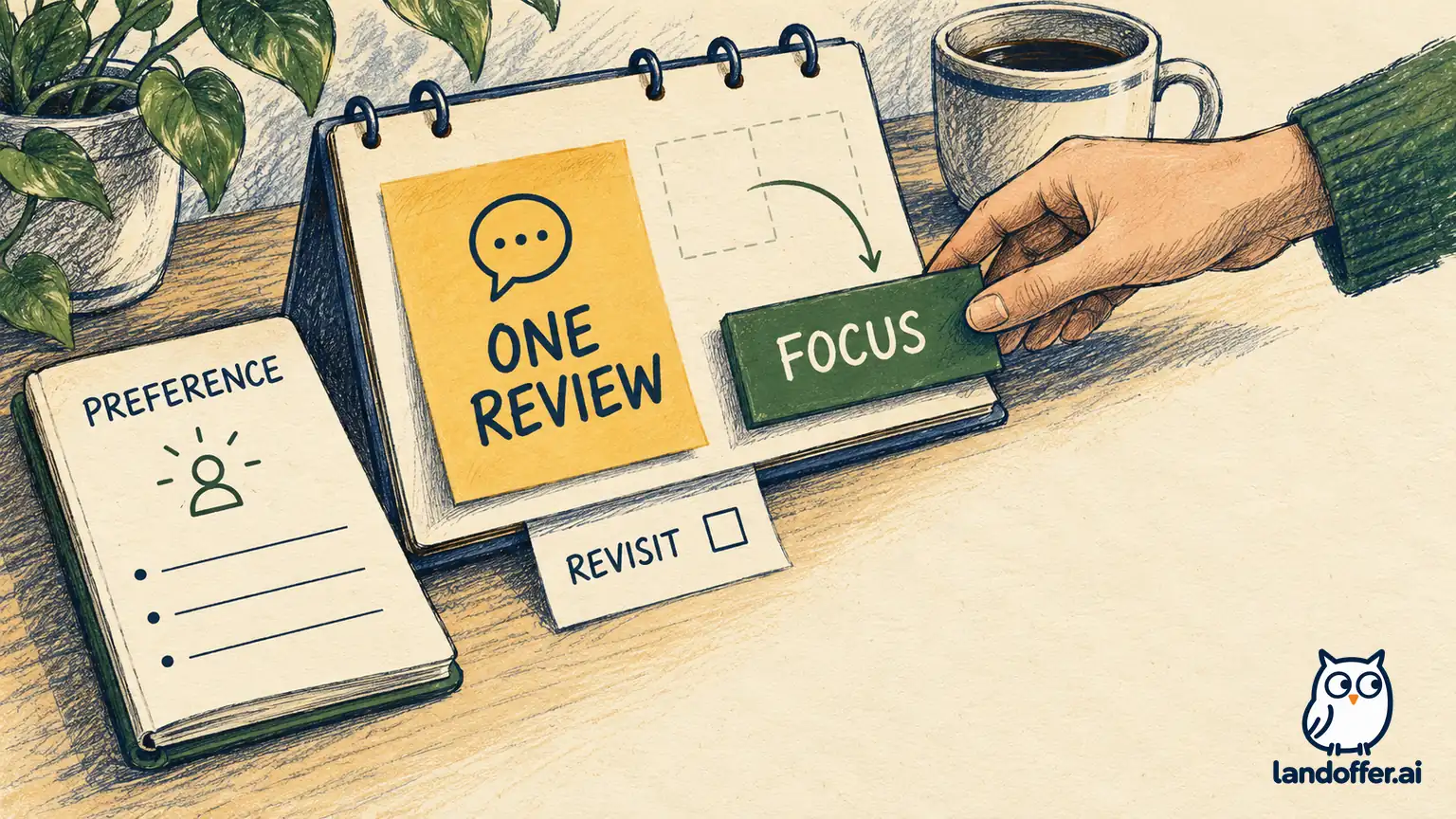
The pair and Mara agree the following limited arrangement for this review. These are fictional accepted commitments, not actual messages, meetings, or calendar changes.
| Question | Agreed adjustment |
|---|---|
| Context before the call | Sam accepts sending the current sketch and two decision questions by November 4, 17:00 Eastern / 14:00 Pacific; no large pre-read is requested |
| Iris’s preparation | Iris accepts 30 minutes at 09:00 Pacific / 12:00 Eastern on November 5 to read and identify unresolved assumptions |
| Live discussion | Both accept 09:30–09:45 Pacific / 12:30–12:45 Eastern; Sam will show the relevant sketch rather than repeat the entire project history |
| Decision authority | Mara accepts a 09:45–10:00 Pacific / 12:45–13:00 Eastern slot to decide or explicitly leave a question open; the deadline does not force approval |
| Focus adjustment | Iris moves her 90-minute block to 10:00–11:30 Pacific that day. Sam does not acquire a standing right to interrupt every morning |
| Record and review | Iris will distinguish the recommendation, Mara’s decision, and open assumptions in the task record. The pair will review the collaboration on November 16 |
In the fictional follow-up, the discussion occurred, but the sketch omitted an exception state. Mara accepted the ordinary path and left the exception open pending another input; the pair did not record full scope approval. Iris’s preparation and the live sketch both informed the discussion, but no productivity gain or reduction in misunderstandings was measured.
A second preference conflict appeared during the call. Sam gave brief critical feedback while another project partner was present. Iris asked to keep the task correction in the shared record and discuss the wording of the feedback privately afterwards. Sam agreed to a short private follow-up; neither claimed that the manual prohibited all public correction of work.
Their November 16 review recorded the boundary they agreed: urgent task facts may need to be addressed with the people doing the work, while personal feedback can be moved to a more appropriate setting. The separate conversation occurred within the fiction, but it did not establish that every future feedback exchange would be comfortable. Iris retained the request for concrete examples; Sam retained the ability to raise a relevant task concern promptly.
Revise the sentence that caused the misunderstanding
Iris’s version 2 adds the Thursday exception beside the focus entry: “For a specific time-sensitive review, ask early with the deadline and impact. I can discuss moving a focus block; please do not assume that one exception changes our standing arrangement.” The feedback entry adds: “Please raise relevant task corrections with the people doing the work; I prefer a private conversation about how we give each other feedback.”
The revised manual remains Iris’s self-description. The adjustment record is the place where Sam, Iris, and Mara’s accepted commitments are recorded. Keeping these separate prevents a later reader from mistaking a personal preference for a team-wide response standard or a permanent obligation on another person.
Share the current version only with the audience who needs it, and remove superseded copies from places that could confuse colleagues. If a statement no longer fits your role or working arrangement, change it. When a colleague raises a conflict, ask what the work requires and what they can accept before proposing an adjustment.
Write a short manual for your next collaboration, then discuss two or three relevant entries with the other person. Ask what you can each do, who else must agree, and what will happen when the preferences cannot both be met. More workplace guides are available from LandOffer.ai.
Sources and Further Reading
- Atlassian: How to create a personal user manual for work — checked October 27, 2026; optional sharing of work, communication, and feedback preferences. No personality-test result or guaranteed safe-space outcome is used here.
- Manual of Me: Why sending your manual might be the wrong approach — original practitioner guidance checked October 27, 2026; reflection and conversation rather than unilateral directions or mandatory pre-reading.
- Cabinet Office: Ways of working — published and updated October 19, 2026; short personal manuals and discussion of shared working arrangements in its multidisciplinary public-policy context.