LandOffer
Workplace Communication
Blocked by Another Team? Write an Escalation That Helps Someone Act
A fictional training-workspace conflict shows how to align on the blocker, present checked alternatives, request a priority decision, and retain delivery ownership.
When another team blocks your work, escalate the decision that is stuck: what dependency is missing, what both teams have tried, what the impact is, and which trade-off needs a decision from someone with the authority to make it. Give the other team notice, represent its constraints accurately, and ask for a specific decision. A list of unanswered reminders does not explain what someone should do next.
The goal is to make a shared trade-off visible, then connect the decision to named follow-up work. This guide from LandOffer.ai uses a fictional training-workspace conflict to show a completed evidence timeline and escalation message. It describes no real team dispute, system access, or message that was sent.
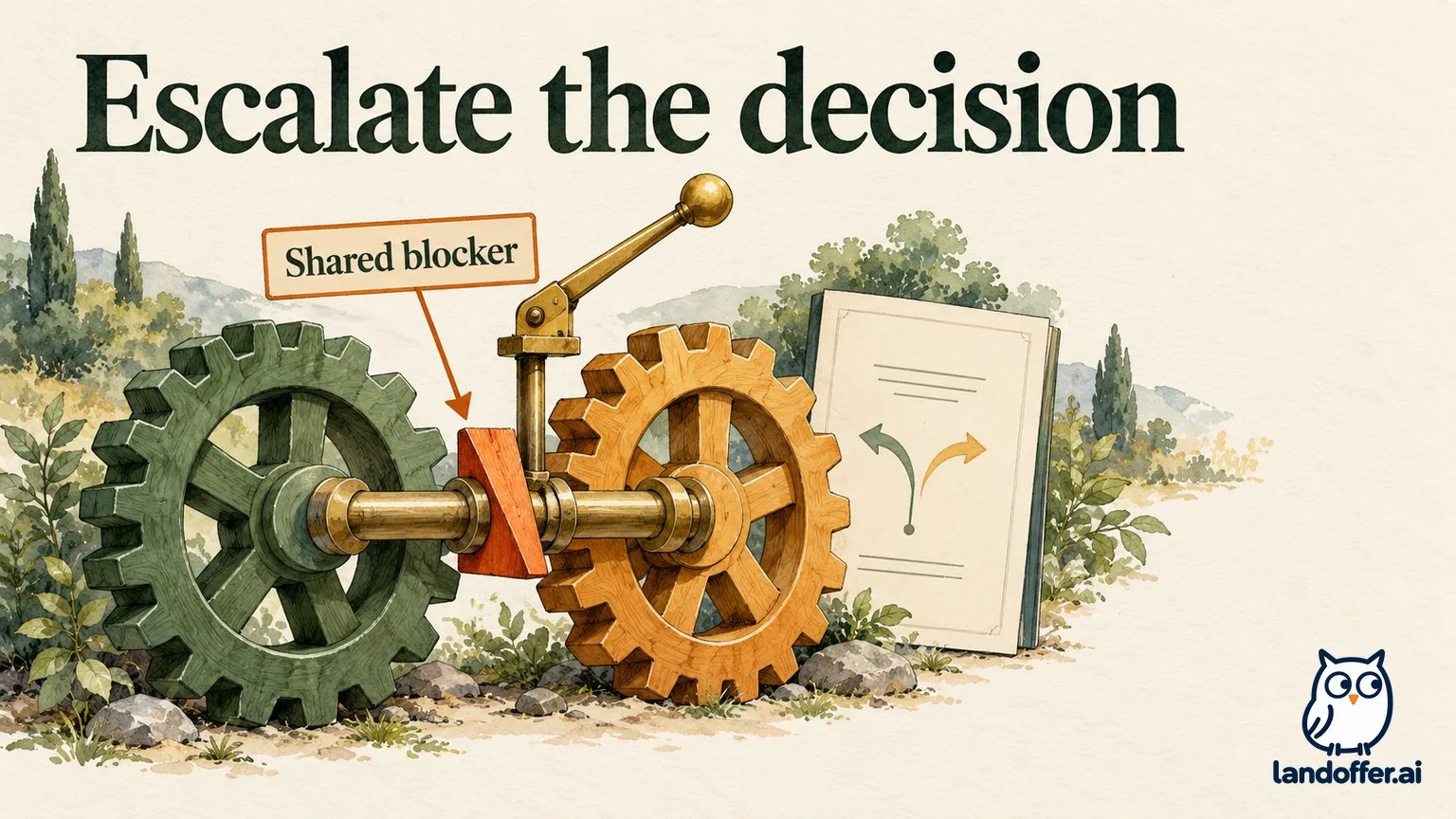
Check that the blocker needs a decision beyond the two teams
First identify what cannot proceed and why. “Infrastructure is slow” names a team, not a dependency. “The workshop rehearsal needs a reserved training workspace, and no setup owner is allocated” identifies a missing resource and responsibility. You can then ask whether direct coordination can solve it or whether competing priorities require someone else’s authority.
Atlassian’s clean-escalation play recommends aligning on the problem, understanding viable options and trade-offs, and telling the other party before going to a common decision-maker. It is a working method, not your organization’s escalation policy or a promise of resolution within a fixed number of days.
Ask the counterpart how they understand the problem. They may have a different commitment, missing information, or an incident consuming the same people. Acknowledge that situation without pretending your dependency has disappeared. Describe the missing dependency and the other team’s competing priority together.
Use the appropriate specialist process for an urgent security concern, safety issue, or active incident. This article’s routine planning example is not a reason to delay a required report while arranging a friendly alignment meeting. The message format below concerns a cross-team resource decision that the participants can discuss openly.
Build an evidence timeline that explains the constraint
Collect the few records that change the decision: the agreed dependency, its needed-by point, the actual status, the counterpart’s explanation, and options already checked. Keep timestamps and name who confirmed each fact, so the decision-maker can distinguish an estimate from a commitment. An acknowledged request is different from an accepted delivery commitment; a tentative estimate is different from a confirmed allocation.
The following is a fictional teaching case. Enablement engineer Hana is preparing a hands-on workshop for twelve employees on Friday, November 6, 2026. Infrastructure lead Ravi manages the approved training workspaces. All names, dates, resource facts, and confirmations are invented; no workspace or employee record was accessed.
| Date and record | What the fictional evidence establishes |
|---|---|
| October 26, request E1 | Hana asks for a dedicated training workspace ready for the November 5 rehearsal; Ravi acknowledges the request but does not commit a setup owner |
| October 30, planning note E2 | Ravi reports that the engineer who could prepare the workspace is assigned to an incident follow-up; setup would require two hours of reprioritized work |
| November 2, joint check E3 | Hana and Ravi confirm the workbook can run in an existing approved shared training workspace, limited to six simultaneous stations; twelve attendees would work in pairs |
| November 3, options note E4 | Ravi confirms a later dedicated-workspace slot is available for a November 13 lab; Hana can provide a recorded walkthrough on November 6 if the lab is separated |
| November 3, shared summary E5 | Both agree the unresolved choice is between infrastructure reprioritization, paired practice, and separating the walkthrough from the hands-on lab |
| November 3, notice E6 | Hana tells Ravi she proposes taking E5 and the three options to their shared engineering director, Morgan; Ravi reviews the summary and joins the discussion |
This timeline supports a resource-and-format decision. It does not establish that Ravi broke a promise on October 26: E1 records acknowledgment only. Nor does it show that the incident follow-up is less important than training. That priority comparison is part of what Morgan needs to decide.
The dates also show what is still possible. A decision by noon Pacific time on November 4 leaves time to prepare the November 5 rehearsal. Waiting until the November 6 workshop would remove useful options. The requested decision point is based on the fictional preparation sequence, not a universal response-time rule.
Repeated reminders could help locate a conversation, but their count is not the case for escalation. The useful evidence is the unallocated owner, the competing assignment, the checked alternatives, and the consequence of leaving the choice unresolved. If a claimed option has not been checked, label it as a proposal requiring confirmation.
Name the common decision owner and give notice
Choose someone who can resolve the actual trade-off. A person senior to you may still lack authority over the other team’s priorities. In this fictional case, Morgan can prioritize work across enablement and infrastructure. Morgan cannot waive required access or security controls just because the workshop matters.
GitLab’s leadership handbook describes effective escalations through relevance, details, prior attempts, and the help needed, while encouraging notice to relevant people. That is GitLab’s documented practice, not permission to bypass your employer’s channels. Its guidance also recognizes that ordinary advance notice may be inappropriate where someone feels unsafe; use the applicable confidential route in such a situation.
For a routine dependency like Hana’s, notice can be simple: “We have checked these options and still need a priority decision. I propose asking Morgan to choose between them tomorrow. Please correct the summary or join the discussion.” Give the counterpart a real opportunity to identify an error, without making agreement on every preference a prerequisite for surfacing the issue.
If you disagree about the facts, preserve the disagreement explicitly. “Ravi estimates two hours; Hana has not independently validated that estimate” is clearer than presenting disputed effort as settled. A common owner may need to request more information before choosing. Notice is preparation for a decision, not a guarantee that your preferred option will win.
Completed escalation message with three workable options
Here is Hana’s fictional escalation message, based on E1–E6. It is an original writing example, not a message sent on anyone’s behalf. The options are stipulated as feasible within this scenario; a real message needs the relevant owners to check feasibility.
Subject: Decision requested November 4: training workspace for November 6 workshop
Morgan, Ravi and I need a decision on the workspace arrangement for the twelve-person workshop. The dedicated workspace has no setup owner allocated. Ravi’s available engineer is assigned to incident follow-up, and setup would need two hours of reprioritized work. We have aligned on this description and reviewed the alternatives below.
Please choose an option by noon Pacific time on November 4 so we can prepare and rehearse on November 5. The workshop needs an explicit format decision; I cannot promise individual hands-on stations under the current allocation.
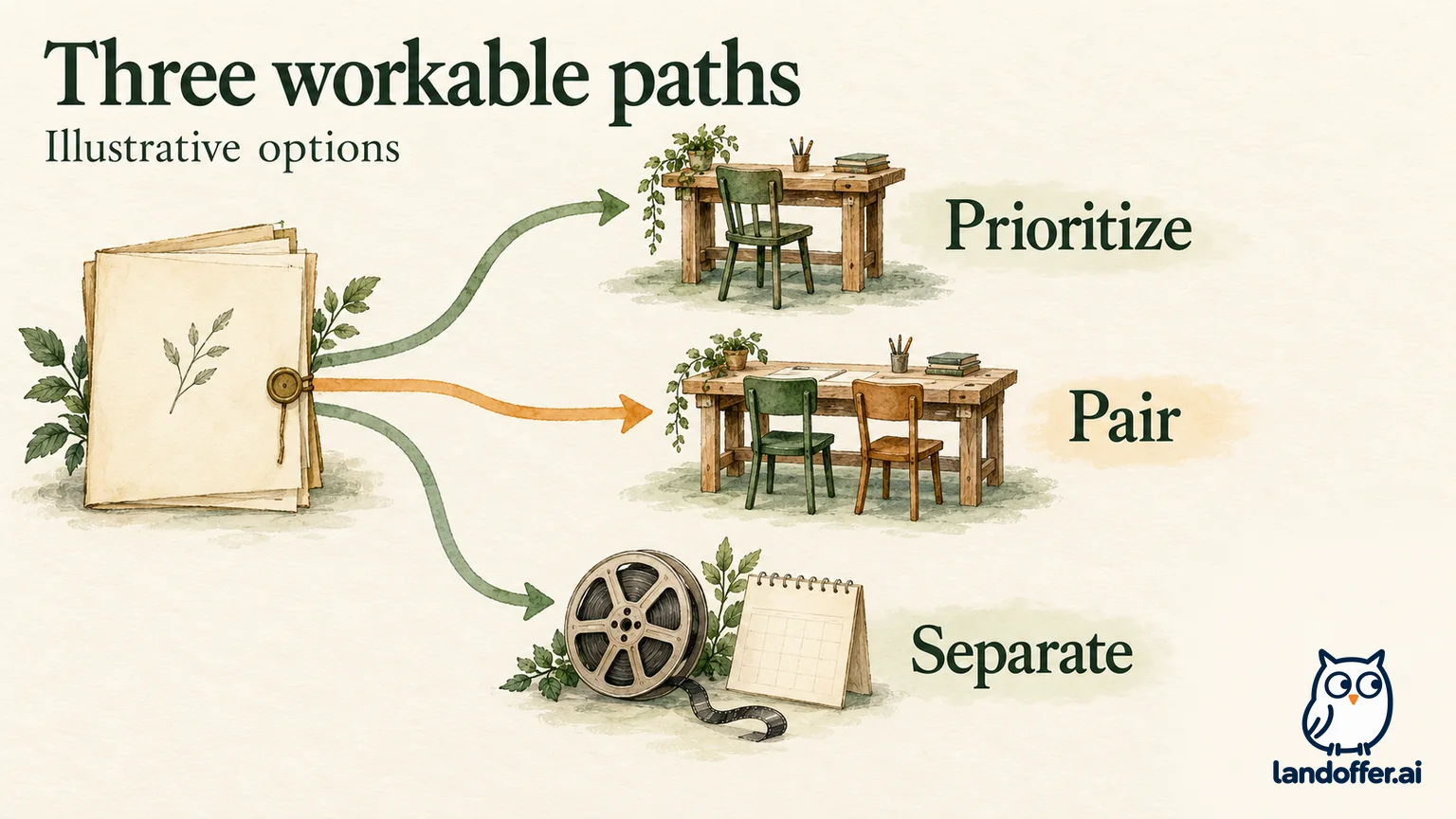
A. Prioritize the dedicated workspace. Reallocate two infrastructure hours from the incident follow-up, with you confirming that priority trade-off. Ravi assigns the setup owner; I prepare the original individual-practice exercises. Required access checks still apply.
B. Use the existing approved shared workspace. In our option check, Ravi confirmed six simultaneous stations and we confirmed that the exercise can be adapted for six pairs. No dedicated setup is needed. I adapt the exercise and the facilitator explains the paired format. This preserves live practice but reduces individual keyboard time.
C. Separate the session and lab. I provide the recorded walkthrough on November 6, and Ravi uses the available dedicated-workspace slot for a November 13 hands-on lab. Attendees would need a second session; they would not receive live practice on November 6.
I recommend B for this workshop because it preserves live practice without moving the incident follow-up. Ravi prefers C because it preserves individual stations at the later lab. Both are viable; we need your decision on the trade-off. E1–E6 contain the request, capacity explanation, option checks, and shared summary in the approved project record.
Once you decide, I will update that record and the exercise plan. Ravi will confirm the workspace and access owner; our facilitator Tessa will update attendee instructions. Please confirm who owns the decision if it needs to go elsewhere. Until a choice is recorded and the workspace is checked, the rehearsal dependency remains open.
The message asks Morgan to choose, rather than telling Morgan to make Ravi comply. It names what each team would give up and preserves both preferences. Option B is not equivalent to twelve individual stations; C does not deliver a live lab on the original date. Hiding either difference would weaken the decision.
Option A also exposes the real cost. Two hours must come from an existing priority, and someone with authority must approve that change. “Just find two hours” would conceal the same conflict that caused the escalation. None of the options relies on sharing credentials, skipping controls, or assuming another team’s work is free.
Turn the decision into an explicit responsibility handoff
Sending the escalation does not complete the blocked work. Record the selected workspace arrangement, Morgan’s decision, the change to individual practice, and who accepts each preparation step. If a manager says “Sounds good,” confirm which option that means. A decision about priority and a confirmed implementation handoff are separate events.
For a fictional continuation, Morgan selects B and accepts the reduced individual keyboard time. The follow-up record is specific:
| Owner | Accepted next action and check |
|---|---|
| Morgan | Records the option-B decision and paired-practice trade-off on November 4; resolves any new priority conflict |
| Ravi | Confirms the approved shared workspace and access owner by November 5 at 11 a.m. Pacific time; raises any readiness issue immediately |
| Hana | Adapts the exercise for six pairs by November 5 at 3 p.m.; checks the workshop flow during the 4:30 p.m. rehearsal |
| Tessa | Updates attendee instructions by November 5 at 4 p.m. to state the paired format and the supported access route |
The six-pair arrangement accounts for all twelve attendees. It does not prove that the rehearsal succeeds. Hana can mark the dependency resolved only after the necessary workspace and exercise checks are actually complete. If access fails at rehearsal, record the failure and return with the revised consequence and remaining options.
Ownership should not disappear after the issue reaches a director. Hana still maintains the dependency record and verifies the workshop flow; Ravi still owns infrastructure readiness within the selected arrangement. Morgan owns the priority choice. The decision owner and the delivery owners retain different responsibilities after escalation.
Make the next escalation easier to handle
Afterward, review why the issue needed escalation. Was the initial request mistaken for a commitment? Was the resource owner missing? Did a competing incident change the plan? Separate those process questions from a judgment about someone’s willingness to help.
Atlassian’s working-agreements guidance suggests defining the decider, escalation handling, transparency, and communication of decisions. Use your team’s equivalent to improve the next request: name the resource owner, distinguish acknowledgment from commitment, and agree on the point at which a cross-team priority decision is needed.
Start with the blocked dependency in front of you. Write its current status, the consequence of waiting, and the decision someone must make. Ask the counterpart to correct that summary, give notice of the proposed escalation, and attach feasible options with the follow-up owner each would need. LandOffer.ai publishes this workplace guidance; the real organization’s priorities, authority, and reporting requirements govern the action.