LandOffer
Job search
Federal Direct Deposit Setup: Confirm SF-1199A, Employee Express, and the First Payment
Confirm the agency’s direct-deposit route, current SF-1199A handling and Employee Express timing, then distinguish LES destination from actual first-payment receipt.
Verify federal direct-deposit setup by checking that the required instruction has been processed and the payment reaches the intended account. A prepared SF-1199A, an Employee Express confirmation and a Leave and Earnings Statement establish different parts of that sequence. Keep each record separate when checking your first payment.
This guide uses an agency served by the Interior Business Center, or IBC, as a specific payroll example. Its forms, processing guidance and Employee Express availability are not universal instructions for every federal employer. We reviewed public sources on October 23, 2026, without entering bank details, signing a form or changing payment instructions. For separate career plans, browse recent roles on LandOffer.ai.

Confirm the payroll provider and authorized channel
Ask your onboarding or payroll contact which office processes your salary and which direct-deposit method applies. An offer from a federal agency does not by itself identify its payroll provider. A general onboarding task can collect information without proving that the payroll office has accepted a payment instruction.
For IBC-served employees, the direct-deposit FAQ describes SF-1199A and an Employee Express alternative for participating agencies. The form route goes through a timekeeper, payroll coordinator or personnel office. Confirm the agency’s secure delivery instructions and processing owner before preparing a sensitive packet.
Employee Express’s public overview likewise says the servicing personnel-payroll office can identify available agency transactions and access arrangements. Do not assume that an existing government login means your new employee record is ready or that the direct-deposit option is enabled. Ask about the outstanding prerequisite rather than repeatedly trying to enroll through different routes.
Keep a setup record with the agency, payroll provider, assigned contact, approved channel and next confirmation needed. It can say “bank certification pending” without holding the account number. Your job-search tracker should not become a second bank-information repository.
Check the current SF-1199A and the bank’s role
GSA’s current form listing identifies SF1199A, revision October 2024. The linked four-page PDF includes government, financial-institution and payee copies plus instructions. It is a payment authorization, not a sample you should sign before reviewing the agency’s requirements. GSA current form listing.
The form labels Section 1 for the payee, Section 2 for the payee or financial institution, and Section 3 for the financial institution. Its directions tell the institution to verify the first two sections and complete its certification. That certification is separate from the employee’s authorization. Do not fill a bank representative’s signature area yourself or treat an unsigned preview as ready for processing. Current SF-1199A PDF.
IBC’s direct-deposit FAQ, updated August 21, 2024, describes completing Section 1 and taking the form to the institution for Sections 2 and 3, then returning it through the agency contact. The current form permits payee completion of Section 2. Preserve that handling difference when asking the agency which fields and return route it expects; it is not a reason to bypass bank verification.
Obtain the current form and applicable agency instructions together. A search result can still point to an older revision or a benefits-payment example. In our review, an older Treasury PDF URL redirected to its current forms directory, which links onward to GSA. Confirm the actual document, rather than assuming a familiar filename proves its revision.
Understand acceptance, effective date and payroll loading
Employee Express’s public overview distinguishes the transaction’s effective date from its email confirmation: the email confirms transmission of the action to the servicing office. It does not establish that money has arrived. Keep the stated effective date and the latest expected earnings-statement appearance with the confirmation.
IBC’s Employee Express page, updated October 21, 2026, describes a weekday transmission cutoff of 3 a.m. Eastern Time and loading into its Federal Personnel and Payroll System after 6 p.m. on the receipt day. Its discussion says ordinary business-day input is transmitted the next business day. These describe IBC processing; they do not promise that a new employee receives a deposit the following morning. IBC effective-date guidance.
The same page describes periodic information returning from payroll to Employee Express after calculation. A view that has not yet refreshed therefore needs a timing question, not an immediate second payment instruction. Do not submit both paper and electronic changes merely to increase the chance that one takes effect. Employee Express instructs users to use the same method for a reversal rather than both methods; coordinate an unclear or duplicate instruction with the servicing office.
The page also retains an April 2007 teaching calendar and generic pay-period examples. They explain transaction timing, not the current year’s actual salary dates. Use the relevant payroll schedule and ask which period will first reflect your instruction. Do not copy the historical example’s April dates into your start-date plan.
Completed channel decision: new-hire access is not ready
Fictional case: Mae is joining an invented agency that confirms it uses IBC payroll. Her onboarding contact says the agency participates in Employee Express, but Mae has no confirmed access yet. No employee account, form or banking record exists in this exercise.
| Setup item | Filled hypothetical record | Mae’s completed decision |
|---|---|---|
| Payroll provider | IBC, confirmed by the fictional agency contact | Apply this example’s IBC scope only |
| Employee Express | Agency participates; employee access not confirmed | Do not treat participation as personal access |
| Available alternative | Contact offers SF-1199A through its secure onboarding route | Request the current form and agency handling instructions |
| Document revision | GSA listing shows October 2024 | Check the served form rather than an old attachment |
| Payee versus bank action | Payee information and bank certification are separate | Ask the institution to complete its required part |
| Local packet state | Prepared-information checklist only | No completed authorization or submission claimed |
| First-pay question | Date and affected pay period not supplied | Ask payroll to identify them explicitly |
Mae’s completed decision note is: “Use the agency-confirmed form route if payroll directs it, while Employee Express access remains unresolved. Obtain the current form, bank certification and secure return instructions. Record agency receipt and processing separately. Do not submit a second electronic instruction without checking how payroll will handle it.”
Her complete unsent clarification reads:
To: Verified agency onboarding/payroll contact, role placeholder only
Subject: Direct-deposit setup route and first-pay confirmation
Hello Payroll Team,
I am preparing the direct-deposit item for my new appointment. My onboarding record identifies IBC payroll and agency participation in Employee Express, but I do not yet have confirmed access to the employee service.
Please confirm whether I should use SF-1199A for this initial setup and provide the current agency instructions and secure return route. The current form identifies bank certification separately from the payee sections; please clarify your expected handling of Section 2 and who should return the completed packet.
Could you also identify the processing cutoff, first affected pay period and expected first salary date? Please tell me what acknowledgement will confirm receipt and what later evidence will show the instruction was processed.
I have included no bank details, identification numbers, login credentials or signed form in this draft. Please identify the approved process for any sensitive information required.
Thank you,
Mae Example
This record assigns the form route, certification handling and first-pay questions to the agency payroll contact. It does not announce that Mae has enrolled, that her bank certified anything, or that payroll accepted the instruction. The first-pay date remains unknown until the responsible office supplies it.

Independent first-payment reconciliation: the LES is not the deposit
Fictional case: Andre’s setup is further along than Mae’s. His example packet includes a stipulated Employee Express acceptance on November 16, 2026, at 10 a.m. Eastern Standard Time. His fictional agency identifies November 27 as the first pay date. These dates and observations are invented; they are not a live IBC payroll calendar, transaction or bank result.
The record uses a bank alias, Example Institution A, and an internal account label, PAYROLL-ACCOUNT-EXAMPLE. Neither is a financial destination or a realistic account suffix. The example contains no account or routing numbers and provides no instructions for moving money.
| Reconciliation field | Supplied hypothetical observation | Completed finding |
|---|---|---|
| Transaction acknowledgement | Employee Express acceptance recorded November 16 | Evidence of the stated employee action, not a bank credit |
| Effective-date record | Fictional notice names the first affected pay period | Preserve that period separately from the submission date |
| LES availability | Correct agency and period identified | This is the intended earnings record, not another employer’s document |
| NET PAY destination | TO shows BANK; NAME shows Example Institution A | Institution matches the intended alias in the exercise |
| Net-pay amount | Invented LES net pay is $1,842.50 | Compare net pay, not gross salary, with the relevant credit |
| Bank evidence at first review | No posted-credit observation supplied | Deposit remains unconfirmed |
| Later stipulated observation | Example ledger shows a posted $1,842.50 credit | Amount difference is $0.00 in this fictional comparison |
Andre’s first completed finding is “payroll statement destination appears consistent; actual receipt not established.” The later supplied credit changes only the receipt finding. It does not prove that we inspected a bank account or that every deduction on the LES is correct.
IBC’s FAQ identifies the LES’s NET PAY destination fields as a way to validate the direct-deposit update and separately suggests confirming receipt with the financial institution on payday. These checks answer different questions. A bank name on a statement is not itself proof of a posted credit.
Andre’s hypothetical 10 a.m. EST acceptance is 15:00 UTC on November 16, and the stipulated pay date is eleven calendar days later. Those calculations help distinguish timestamps and dates; they do not derive a payment promise from the 3 a.m. transmission cutoff. The agency’s actual pay period and salary date are still the authorities for a real employee.
Route missing information or missing pay precisely
If the LES is unavailable, ask for the correct period and permitted access or duplicate route. IBC’s LES FAQ identifies Employee Express access and a separate duplicate-statement process. A missing document should not immediately be labeled a failed bank deposit.
If the LES NET PAY block is blank, IBC’s Missing Salary FAQ directs employees to the timekeeper or personnel office promptly to establish the cause. It gives examples, but a reader should not diagnose a missing appointment or time report from this article. The responsible office must inspect the actual payroll record. IBC missing-salary guidance.
If an expected electronic payment is absent, the same guidance starts with checking whether the designated financial institution received it, then routes any reissue request through the agency’s timekeeper, payroll coordinator or personnel office. Do not send a full bank-information packet to a general chat or treat an ordinary support email as a reissue authorization. Obtain the current secure handling instructions from the responsible office.
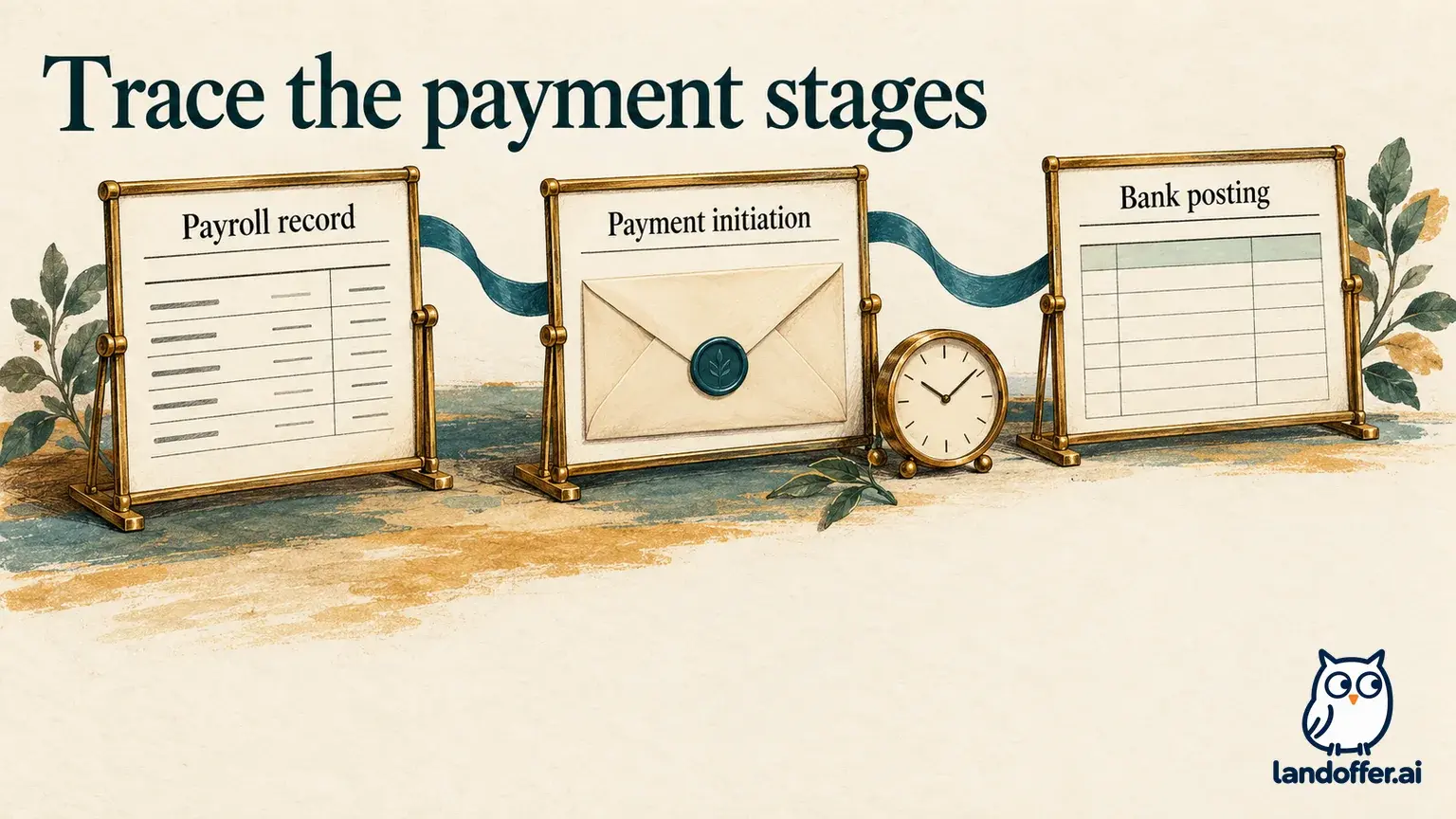
Record the verified stages separately: channel confirmed, required form or transaction acknowledged, effective period identified, correct LES reviewed and receipt separately verified or still open. If changing institutions, ask how to avoid disrupting the transition before closing the old destination; the form’s instructions address continuity while the new destination begins receiving payments.
Once the first-payment question has a documented owner and next action, browse recent roles on LandOffer.ai for independent career planning. LandOffer does not handle bank details, authorize direct deposits or verify payroll payments.
Sources and Further Reading
Checked October 23, 2026. Current official public guidance and the actual served four-page form were reviewed; no employee account, bank information, form signature or payment instruction was entered or submitted.
- IBC direct-deposit FAQ, updated August 21, 2024.
- IBC Employee Express timing guidance, updated October 21, 2026; historical teaching calendar distinguished.
- Employee Express public overview, agency availability, effective dates and confirmation scope.
- GSA SF1199A listing, current revision October 2024.
- Current served SF1199A PDF, four pages.
- IBC LES FAQ, updated August 21, 2024.
- IBC missing-salary FAQ, updated August 21, 2024.