LandOffer
Pay & Benefits
Your Paycheck Is Missing Work Hours: Build a Timesheet-to-Paystub Reconciliation
Connect disputed shifts to timesheet versions, original workweeks, and paystub earnings. A complete fictional reconciliation and payroll request distinguish an export omission from a late correction, then verify the later adjustment without assuming legal timing.
If your paycheck arrived but appears to omit work hours, reconcile the work dates, timesheet versions, payroll cutoff, and paystub earnings lines before naming the cause. Keep each disputed shift attached to the workweek in which it occurred. Track a later correction on its new statement while keeping the hours assigned to the original workweek.
This LandOffer.ai guide uses a fully fictional US hourly-employee packet and public sources checked October 27, 2026. It supplies an administrative reconciliation method, not a ruling on anyone’s classification, wage entitlement, tax treatment, or payment deadline. No payroll account was accessed, records changed, employer contacted, or payment verified. The worked arithmetic assumes a covered, nonexempt employee and a simple stated rate; actual state, local, contract, and employer rules need separate review.
Identify the period and the missing earnings line
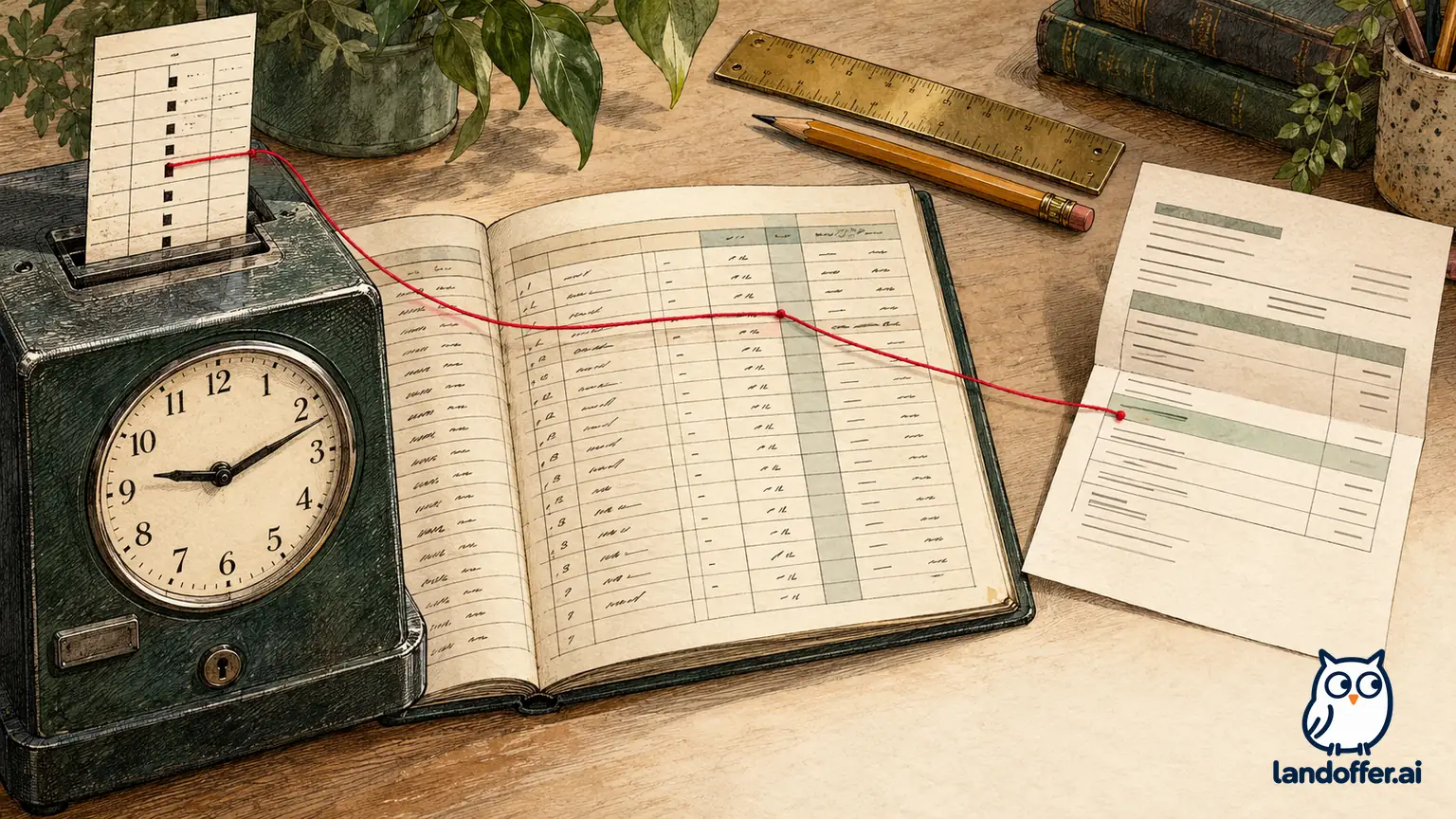
Start with the statement’s covered work dates rather than its deposit date. A Friday payment may cover an earlier interval. Save the statement, the time record used for that run, and any later correction as distinct versions. Record the payroll calendar’s submission and approval cutoffs, including timezone. A schedule shows planned work, while a submitted or approved timesheet shows a particular recorded version; neither should silently replace a reconstruction of what actually happened.
The Department of Labor’s recordkeeping guidance lists daily and weekly work hours, the start of the workweek, pay rates, straight-time and overtime earnings, deductions, total wages, and the payment date and covered period among required records for covered nonexempt workers. These fields make a useful reconciliation spine. The employer’s recordkeeping obligation does not depend on the employee creating a perfect private spreadsheet first.
Separate three questions: Were the hours recorded correctly? Did the payroll run include the accepted record? Was the correct earnings calculation applied? Trace the difference to an earnings category and work date before deciding whether the run omitted it. Do not use the difference in bank deposits alone to calculate missing wages; deductions and withholding can change net payment independently of hours.
For clients using its platform, ADP directs paycheck errors to the employer’s payroll department. That support instruction applies to ADP clients; use the correction route designated by your actual employer. Use your employer’s approved payroll channel and retain the reference it supplies.
Build a versioned record without inventing precision
For each questioned interval, preserve the work date, start and end, any nonwork interval, task description, and supporting record you can appropriately retain. Add the timesheet entry identifier, submission time, approval time, and the statement line it should reconcile to. If an interval is reconstructed rather than clock-recorded, label it accordingly and explain the supporting evidence. A calendar invitation or an open application is not, by itself, a stopwatch.
DOL’s hours-worked fact sheet explains that work suffered or permitted can be compensable even when not specifically requested. It also distinguishes short rest breaks from qualifying meal periods and says an employee performing duties while eating is not completely relieved. A missing approval marker or a timekeeping rule therefore does not alone settle whether actual work must be paid. Describe the actual work and the approval history separately so payroll can investigate both questions.
Do not automatically subtract lunch, add all computer activity, or discard a disputed interval to make a total match. If the disagreement concerns training, travel, on-call restrictions, or classification, identify that issue and ask for the applicable explanation. This article’s case avoids those complexities; a simple example cannot decide them for a real worker.
Retain original evidence and make corrections through the approved process. A replacement timesheet should have a reason and a traceable link to the earlier version. Do not edit an old screenshot to make it resemble a newly approved record. Keep unrelated coworker information, full bank numbers, tax identifiers, and confidential customer material out of a broad email thread.
Completed reconciliation: two causes in one paycheck
Nico is a fictional service-operations employee paid $24 per hour. For this exercise, the employer’s fixed workweek is Monday through Sunday, overtime applies after forty actual work hours at $36 per hour, and there are no bonuses, differentials, paid leave, or additional applicable premiums in the calculation. Those are teaching assumptions, not findings about a real worker or jurisdiction.
Pay period P1 covers September 21 through October 4, 2026, with payday October 9. The employer’s hypothetical payroll cutoff is October 5 at 10:00 a.m. local time. Nico receives the October 9 deposit and checks the earnings statement: seventy-four straight-time hours at $24 produce $1,776 gross. The concern is the earnings calculation, not an absent transfer.
His completed workweek record is:
| Workweek | Daily actual work hours, Monday–Friday | Supporting timesheet history | P1 statement allocation |
|---|---|---|---|
| September 21–27 | 8, 8, 8, 8, 10 = 42 | T1 records all 42; supervisor approved October 2, before cutoff | 38 straight-time hours; no overtime |
| September 28–October 4 | 8, 8, 8, 8, 6 = 38 | T2 initially records 36; October 6 correction adds two October 2 hours after cutoff | 36 straight-time hours |
The fictional packet stipulates that the daily intervals already exclude genuine unpaid nonwork time. Nico has matching shift notes and time-entry history; the exercise does not infer these hours from a schedule. In the authored export comparison, T1’s last four September 25 hours are absent despite its October 2 approval. T2 has a different history: the initial submission omitted two hours, and the correction arrived after the run’s stated cutoff. Nico records both histories without declaring that a missed cutoff excuses a payment delay.
The weekly calculation matters. Under the stated assumptions, the first week contains forty straight-time hours and two overtime hours: $960 plus $72, totaling $1,032. The second week contains thirty-eight straight-time hours, totaling $912. Expected P1 gross is therefore $1,944. Subtract the $1,776 already shown on P1 and the reconciliation difference is $168.
| Difference tied to original workweek | Missing earnings categories | Gross difference |
|---|---|---|
| September 21–27 | Two straight-time hours at $24, plus two overtime hours at $36 | $120 |
| September 28–October 4 | Two straight-time hours at $24 | $48 |
| Total pending reconciliation | Four straight-time hours plus two overtime hours | $168 |
Multiplying six missing hours by $24 would yield $144 and miss $24 of the illustrated overtime calculation. Averaging eighty hours over the two weeks would also hide the forty-two-hour week. DOL’s overtime fact sheet explains the federal workweek basis and prohibits averaging across weeks. The regular rate can require more than a single base rate in other pay arrangements, so this table is deliberately limited to Nico’s stipulated simple case.

Send a specific correction request with an answerable timeline
Nico’s second completed asset is a written request prepared October 12 through the fictional employer’s private payroll case channel. It requests a review and an explanation of the payment route; it is not an accusation, a legal demand template, or an actual message sent to an employer.
Subject: P1 September 21–October 4: review six missing hours and earnings categories
Hello Payroll,
I received the October 9 payment. The P1 statement shows 74 straight-time hours and $1,776 gross. My attached workweek reconciliation and time-entry history show 42 hours for September 21–27 and 38 for September 28–October 4.
T1 was approved October 2 before the October 5, 10:00 a.m. cutoff, but its final four September 25 hours are absent from the export. T2’s two October 2 hours were added in a correction submitted October 6, after that cutoff. Please review these separately and confirm the source version used in the run.
At the stated $24 rate and the case’s weekly overtime treatment, my reconciliation difference is $168 gross: four straight-time hours and two overtime hours. Please confirm or explain the hours, rates, earnings codes, and original workweek attribution.
Could you acknowledge the case by October 13 and provide the correction plan by October 14, including the payment date, any off-cycle option, and how the adjustment will appear? Those are requested response dates. Please identify any approval or evidence still needed and who owns it.
Attached: P1 statement, T1 approval/export comparison, T2 version history, and the two-workweek reconciliation. Thank you, Nico.
The requested dates organize communication; they are not a universal payroll response deadline. Nico asks for the confirmed hours and rates, the proposed earnings codes and payment date, and evidence when the adjustment is paid. If another department must confirm a shift, payroll should identify the owner and the specific unresolved interval rather than sending back a generic “ask your manager.”
In the fictional October 13 response, payroll confirms the T1 export omission and T2 late correction, assigns case C-14, and proposes an adjustment on October 23. Nico asks whether an earlier off-cycle payment is available and which payment-timing requirements apply. DOL’s overtime guidance says overtime normally belongs on the regular payday for the period earned; an internal cutoff or proposed later run should not be treated as establishing lawful timing. The case’s legal-timing question remains open for the appropriate reviewer.
Verify a later adjustment against the original workweeks
On October 23 in the authored case, statement P2 covers October 5–18. Its current-period work is seventy-six straight-time hours, split into two thirty-eight-hour weeks, producing $1,824 gross. Separate prior-period lines identify four straight-time adjustment hours at $24 and two overtime adjustment hours at $36, both tied back to P1’s workweeks. Those lines add $168, bringing the statement’s gross to $1,992 before deductions and withholding.
Nico’s completed closeout record marks the $168 gross earnings difference reconciled to the correction lines. It preserves the original P1 statement and adds P2 as the adjustment evidence. The six earlier hours are not added to either of P2’s actual workweeks. A statement that displays eighty-two total hours across current and adjustment lines would therefore need that category explanation, rather than a conclusion that Nico worked eighty-two hours during P2.
The case stipulates that Nico also identifies the corresponding payment in his account; no amount of net withholding is invented here. A promised adjustment, a revised statement, and a received payment remain separate checkpoints. The completed record closes the modeled earnings difference while retaining the unresolved payment-timing review. It does not claim that receiving a later correction resolves every possible wage issue.
If an adjustment appears only as an unexplained dollar amount, ask for its original dates, hours, rate, and category before marking the difference resolved. If a partial payment arrives, subtract only the supported portion and leave the rest open. Preserve a short version history so a repeated inquiry does not start from the incorrect premise that all six hours are still missing.
Keep unresolved questions on the right route
A useful reconciliation ends with a specific state: explained and matched, confirmed but unpaid, partly corrected, or still disputed. Ask for the next owner and response date when the record remains open. You do not need to calculate every legal consequence yourself to describe the shifts and request an investigation.
For questions about federal wage protections, DOL’s Wage and Hour Division contact and complaint guidance provides an official assistance route. State or local requirements may need a different authority. The internal request in this article is not a required waiting period before seeking appropriate outside guidance, and no response date here replaces an applicable filing or payment deadline.
Return to LandOffer.ai for more current-work administrative guides. For this task, preserve the original records, attach the questioned hours to their original workweeks, and ask payroll to identify each correction line and payment reference, then close only the differences those records actually resolve. That leaves payroll with something it can investigate and leaves you with a record of what is still unresolved.