LandOffer
Job search
One-Off Career Coaching or Monthly Mentorship? Define the Work Before Booking
Buy a focused decision review when it can finish; consider monthly mentorship when changed work creates a new review need.
Choose one-off career coaching when you can name a decision, bring the evidence, and use the answer independently. Consider monthly mentorship when doing the work will create new questions that need repeated review. A monthly charge pays for the selected ongoing arrangement. Confirm its calls, written deliverables, and work boundaries before treating them as included.
This guide compares current official service descriptions checked October 20, 2026. We did not book, apply, attend a session, or test private support. Its worked examples are fictional. LandOffer.ai publishes this guide. Start with the roles you actually want: browse recent roles on LandOffer.ai, then identify the decision or missing evidence for which you need help.

Compare the work, even within the same marketplace
“Coach” and “mentor” are imperfect purchase categories. A coach can offer a continuing program, and a mentor can sell a single consultation. On MentorCruise, the sessions guide explicitly distinguishes focused, fixed-price calls from recurring collaborations. You can therefore compare these formats without assuming one platform or professional title always means one type of support.
The public sessions directory lists defined services, including a forty-five-minute Career Roadmap & Promotion Strategy session at $119 and a sixty-minute Interview Preparation session at $149. We read these public listed offers but did not verify checkout totals or an individual mentor's calendar availability. They show why “one session” alone is insufficient: different tasks and durations are sold under the same overall format.
Monthly mentorship adds continuity, but the selected plan determines its contents. MentorCruise's payment guide says mentors set their own USD prices and describes recurring monthly billing. Plans can involve calls and chat. The useful comparison is the exact review scope, call allowance, response expectation, and renewal commitment, rather than a universal hourly rate for mentorship.
The Muse makes a similar distinction between service scope and professional tier: its coaching page directs buyers to individual service deliverables and notes that time or interactions can vary by coach level. A more expensive title does not by itself tell you whether a written review or another conversation is included.
Use a decision that can actually finish
A focused coaching task has a recognizable end. “Help me with my career” does not; “help me choose which of these three role directions fits the evidence I can currently show” does. The decision may be important even if it takes only one session to resolve.
Other examples include choosing which experience to emphasize for a particular vacancy, deciding what to ask before accepting an internal transfer, or diagnosing why a portfolio explanation is confusing. A provider still needs relevant expertise, enough context, and an appropriate service. Small scope does not mean every available person can handle it.
An ongoing task behaves differently. You receive feedback, implement something, encounter a new constraint, and return with changed evidence. Learning to explain progressively harder design choices, building a credible transition project, or revising a promotion case after manager feedback may benefit from continuity. Continuity is useful when the mentor can compare changed work with the earlier version and challenge the next decision.
You can also combine formats in sequence. Buy a focused diagnosis if needed, do the resulting work yourself, and consider continuing support only when the next review need becomes concrete. You do not need to purchase a month just because the broader career transition will take longer than a month.
Worked diagnosis: choose a direction before commissioning a program
Tess is a fictional backend engineer considering three directions. She has a public API project with tests, a small SQL reporting script, and experience explaining service incidents. She has not built a hardware project or operated a production data pipeline. The following requirements are invented excerpts for this example, not claims about every job with these titles.
| Role option in her example | Evidence the example posting asks for | Tess's current evidence | Diagnostic conclusion |
|---|---|---|---|
| Backend engineer | API changes, tests, service reliability | API project and an incident explanation | Strongest immediate application direction |
| Data engineer | Repeatable ingestion, failure recovery, data checks | Reporting script; no recovery demonstration | Plausible development goal with missing evidence |
| Firmware engineer | Device interaction and timing constraints | No relevant hardware example | Requires investigation beyond her current record |
Her original shopping request was “a mentor who can help me switch into anything.” The completed one-off brief becomes:
I want to choose my immediate application direction and one longer-term skill experiment. I can bring the three example role requirements, my API project summary, and my SQL script. Please challenge the evidence match and identify the most important missing demonstration. I will make the applications and build any follow-up work myself. I am seeking a decision review, not a rewritten resume or a complete training program.
A useful result would be a defensible direction plus a reason to revisit it. In this fictional case, she chooses backend roles for the current search and a small data-pipeline experiment before buying transition mentorship. She does not conclude that firmware is impossible; she lacks enough relevant evidence to justify choosing it now.
Her acceptance check is concrete: can she explain why backend comes first, name the missing data-engineering demonstration, and describe what new evidence would change the decision? If yes, the diagnostic task can end. She does not need another meeting merely to keep receiving reassurance about the same choice.
This is a worked purchasing decision, not an assessment of an actual coach. An expert might reasonably disagree after seeing richer evidence. The brief gives them something specific to challenge and keeps Tess from buying a program before deciding what it should accomplish.
Monthly support needs feedback that changes the next step
Tess later completes an initial ingestion experiment and discovers a recurring problem: her explanations focus on successful runs, while reviewers ask about reruns, failures, and verification. Now she has a reason to investigate ongoing mentorship. New work will create new review questions, and the same mentor could follow how her reasoning develops.
She should look for relevant data-engineering experience and a plan that explicitly accommodates the intended material. Chat access is not automatically a repository audit. A live discussion is not automatically a written design review. Ask whether the mentor will inspect a short diagram, read a small example in advance, or review it only during the call.
Separate the candidate's work from the provider's work. Tess will implement and document her experiment; the proposed mentor will question decisions and review agreed artifacts. If she needs production-quality code written for her, she is shopping for a different service. If she needs a finished resume, coaching feedback and a commissioned writing deliverable also need different scope.
The candidate's preparation time matters alongside the mentor's availability. She cannot benefit from repeated reviews if she cannot produce the next artifact. During a busy work month, Tess may not be able to prepare enough new work to use an intensive plan. Define what she can prepare before agreeing to a cadence, instead of choosing the largest call allowance as a proxy for commitment.
Worked continuation: a change ledger with an exit decision
The following ledger is Tess's fictional review plan and completed teaching example. No mentor has agreed to it, and no technical artifact has been independently evaluated. Its purpose is to show what continuing work would need to change.
| Artifact | Initial gap | Revision after a hypothetical review | Evidence that would justify another review |
|---|---|---|---|
| Pipeline explanation | Describes only the successful path | Adds a duplicate-input case and explains intended rerun behavior | An implementation choice changes how duplicates are handled |
| Failure note | Says “retry on errors” without distinguishing cases | Separates a temporary source failure from invalid input requiring investigation | A new failure does not fit either explanation |
| Verification note | Says “the job ran” | Specifies the expected record count and a deliberately invalid input to inspect | The observed output disagrees with the stated expectation |
This ledger does not claim the design is correct merely because the notes improved. Tess still has to implement the work, observe results, and explain limitations. The mentor's contribution is a clearer question and a critique of the evidence, within the purchased scope.
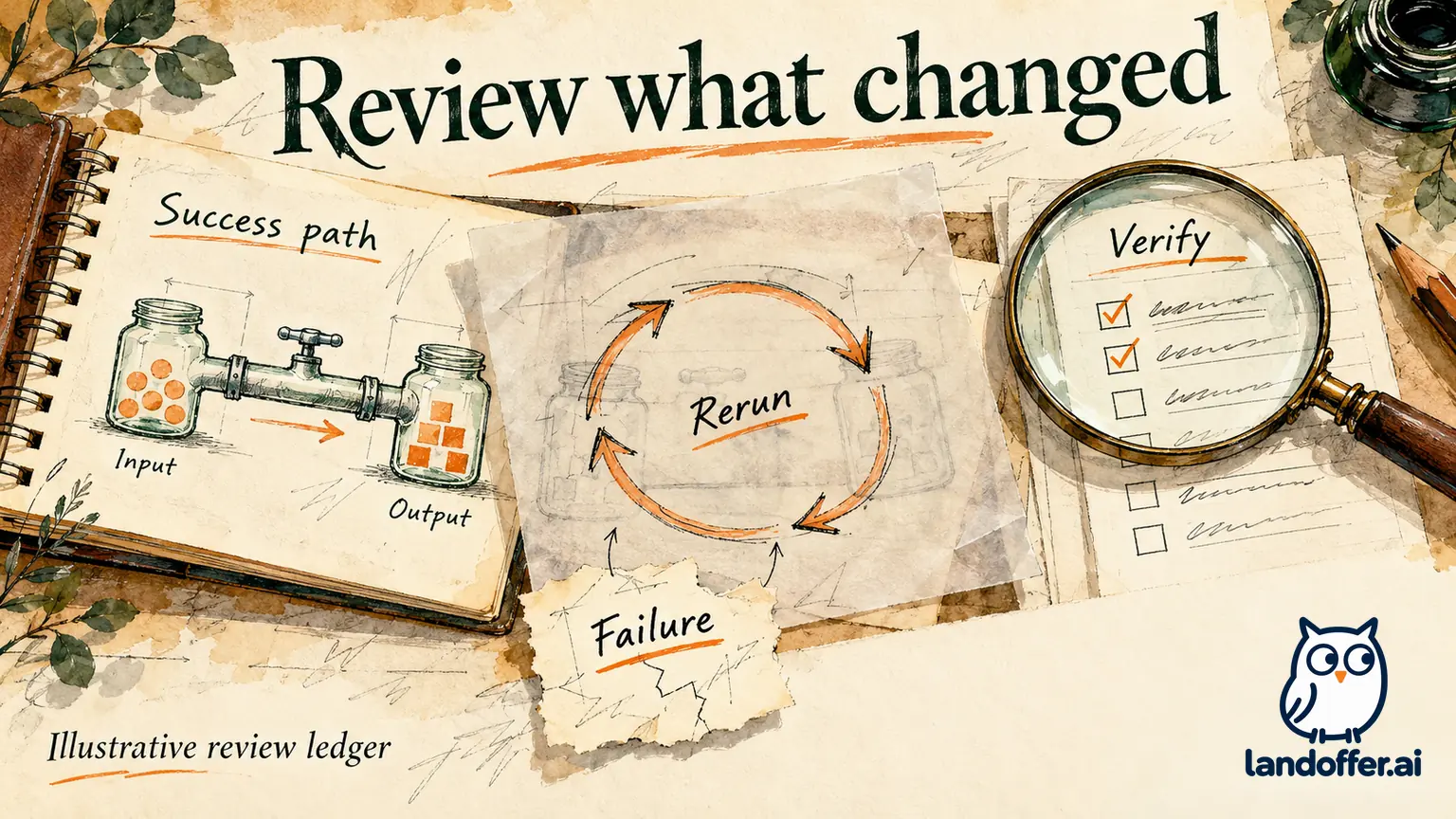
At the review point, Tess makes a completed continuation decision. If she can explain these three distinctions independently and the next task is simply implementing the agreed changes, she stops buying meetings for that task and works on it. If a materially different design decision emerges, she can propose a new review scope. If repeated conversations produce no usable critique, she revisits fit before renewing.
The stopping condition is therefore neither “got hired” nor “finished every topic in data engineering.” It is whether the current review loop still needs another person's judgment. That is a narrower, assessable purchase criterion. Job offers depend on many factors beyond this engagement and should not be the only evidence used to judge a month of useful work.
Check the commitment before comparing the price
For monthly support, record when billing begins, what renews, and how many calls must be used during the period. MentorCruise says included calls do not carry over. Its payment guide also says billing continues without scheduled conversations. Unused access does not itself turn a subscription into stored session credits.
A trial and an introductory call can create different commitments. The standard trial guidance describes acceptance followed by payment details and chat access, with automatic billing after the trial even when no call was scheduled. The separate intro-call route describes meeting first and starting paid mentorship when ready. Read the actual offer rather than transferring one route's terms to another.
For one-off calls, cancellation rules deserve the same attention as price. MentorCruise's sessions directory advertises a twenty-four-hour cancellation boundary, while its dated detailed policy describes forty-eight hours for scheduled sessions. That discrepancy remains unresolved in this review. Before booking, obtain the applicable cancellation terms and plan around them; the public pages do not resolve the conflicting notice periods.
We have not tested cancellation, refunds, scheduling reliability, or support resolution on either service. A listed price is not proof that a particular expert has an appropriate opening before your interview. If timing is critical, confirm the appointment and any material deadline before committing money.
Keep the agreement and the evidence usable
Before booking, retain the selected service description and a short record of what you expect to bring and receive. Distinguish an included follow-up message from unlimited future questions, a discussion from a document rewrite, and an introduction from a substantive review. If an essential deliverable is missing from the offer, resolve it before treating it as part of the purchase.
Use your own public or invented examples for initial fit discussions. A coach's professional background does not authorize sharing employer code, private incident details, customer information, or another person's resume. Agree on recording and transcription separately if those matter to you; we did not compare the providers' private session controls.
For recurring support, review your own notes before deliberately ending access. MentorCruise's pause and end guide distinguishes a pause with a resume date from ending the connection and chat immediately. Do not assume ending leaves the same access until month-end. These operational terms affect how you retain your own work and close the engagement.
One-off coaching is a sensible first purchase when the evidence is ready and the decision can finish. Monthly mentorship becomes more persuasive when a new artifact repeatedly creates a new review need, and both people can sustain that loop. Keep existing university, employer, peer, or mentor support if it already supplies the needed judgment. Use LandOffer.ai to ground your search in relevant roles, while choosing coaching by the work it can reasonably help you do.
Sources and Further Reading
- MentorCruise: What are sessions?
- MentorCruise one-off session directory
- MentorCruise monthly payments and cost
- The Muse coaching services and deliverables
- MentorCruise subscription-call rollover
- MentorCruise standard trial
- MentorCruise introductory-call route
- MentorCruise session cancellation policy
- MentorCruise pause and end guidance