LandOffer
Job search
Mendix Developer Portfolio: Explain the Domain Model, Access Rules, and Deployment
Make domain relationships and access decisions inspectable, then distinguish a completed local reference deployment check from unperformed Mendix platform work.
A Mendix developer portfolio should explain how the domain model supports a business action, which objects and members each role can access, and what happened when the application was packaged and checked in its target environment. Show a completed workflow and rejected operations alongside the visible pages. A certification badge or an administrator’s successful demonstration cannot establish those boundaries.
This article includes an original, actually executed Python/SQLite reference for equipment lending, with 20 local HTTP cases, process-restart evidence, and a rejected overbroad configuration. It is not a Mendix application: no Studio Pro model, Mendix Runtime, .mpr project, .mda package, or cloud deployment was created or tested. The reference makes design reasoning inspectable while leaving platform implementation visibly unfinished. Use recent roles on LandOffer.ai to match your demonstrated work to the role’s responsibilities.
Start with the business relationship, not the page count
Our synthetic Tool Crib case asks whether an available asset can be borrowed and later returned without creating two active loans for the same item. It also needs separate visibility for technicians, custodians, and auditors. This gives the portfolio a concrete beginning, state change, persistence requirement, and failure condition.
The Mendix domain-model guide describes entities, attributes, and associations within modules. Persistable entities retain business data; non-persistable entities serve temporary needs. For a genuine Mendix implementation, explain why the loan history belongs in persistent data rather than presenting a screen’s temporary values as a durable record.
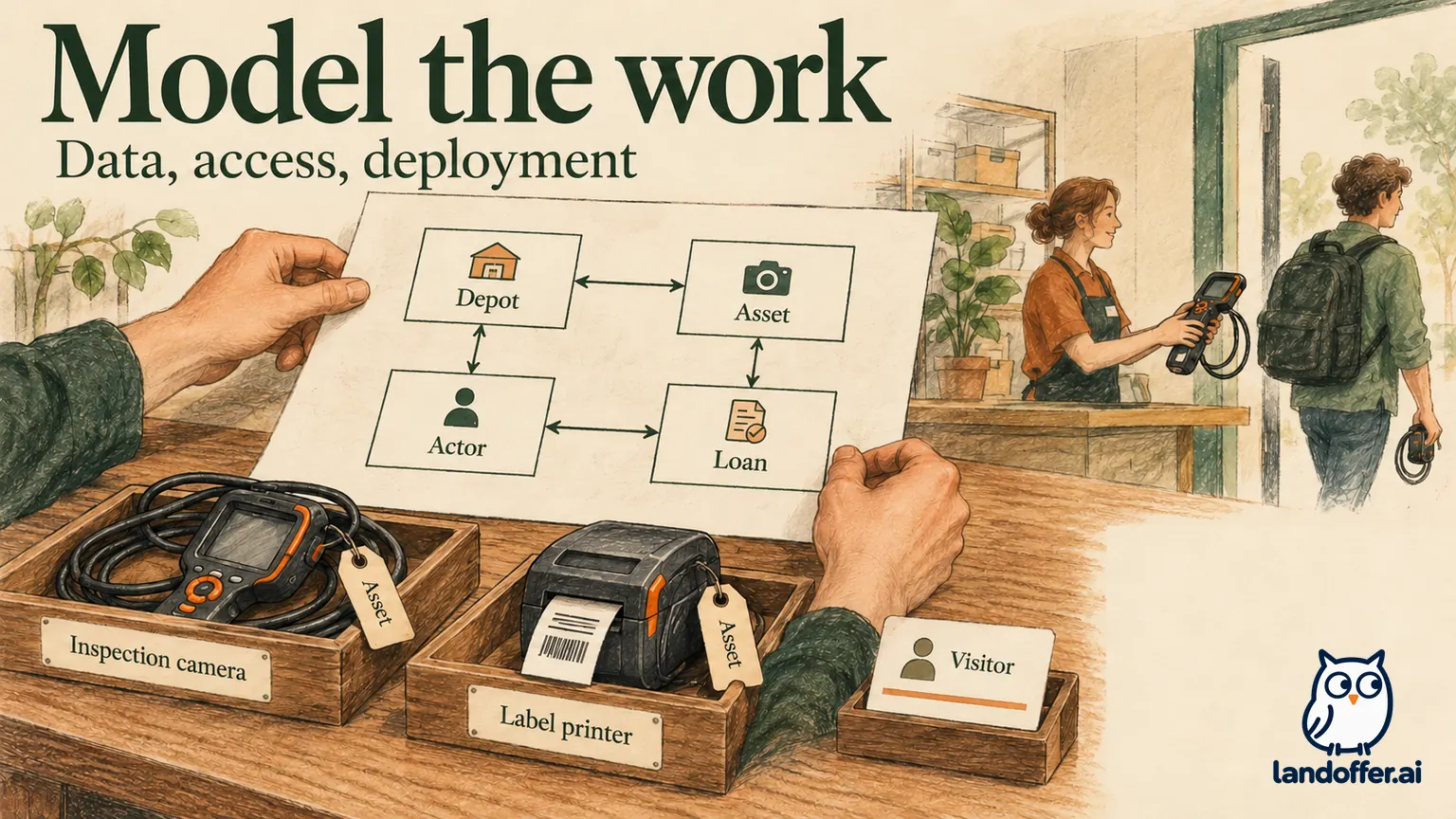
Our completed model map contains four business entities plus an operational event log:
| Business entity | Concrete contents and relationship |
|---|---|
| Depot | Harbor and Ridge; each depot has actors and assets |
| Actor | Five fictional principal keys, each associated with one depot and one reference role |
| Asset | N501 inspection camera and N502 label printer at Harbor; R501 portable display at Ridge |
| Loan | One asset and one borrower, a checkout step, and an optional return step; an asset can have historical loans but only one active loan |
The actual local implementation stores these relationships in SQLite tables and foreign keys. Its Actor is a fictional principal record, not a configured Mendix System.User specialization. That is not a generated Mendix database schema or an executable Mendix domain model. The diagram and mapping are design artifacts; the SQLite files and HTTP results are evidence for the separate reference implementation.
Explain object access and member access separately
A technician should see available assets in their depot without receiving the synthetic internal service note. A custodian can see that note for the same depot. An auditor can inspect asset availability but cannot borrow equipment or read loan details. Those are distinct object, member, and action decisions.
Mendix’s Access Rules reference describes entity rights, attribute and association rights, and object constraints. Its rules grant access additively: another applicable rule can broaden effective access. A restrictive rule does not cancel a separate broader grant. Include every applicable grant in the review packet so the reviewer can assess their combined effect, not just the narrowest rule.
The documentation also distinguishes existing-object constraints from creation. XPath constraints are not applied to create operations, and non-persistable entities cannot have XPath constraints. Do not write that an owner constraint alone validates every newly supplied association or makes a create action safe. Explain how the business operation selects and validates its related objects.
In our reference, checkout accepts an asset key only. It derives the borrower from the selected fictional actor, rejects a caller-supplied borrower field, and checks that the asset belongs to that actor’s depot. Those are actual Python checks. They illustrate a design requirement; they do not prove how a configured Mendix create activity would execute it.
Record the role and microflow execution context
Mendix user roles aggregate module roles. For a proposed ToolCrib module, map each Technician, Custodian, or Auditor app role to its corresponding module role, then list its entity and action rights. This is a filled design mapping, not a configuration we created in Studio Pro. Also identify whether the observed session is a technician, an administrator, or a demonstration user. Their successful actions can establish different things.
For microflows, Apply entity access is a separate property and is disabled by default in the current reference. When enabled, the current user’s entity access applies to retrieving and manipulating objects. The same documentation says Allowed roles are checked for client execution, while a microflow calling another microflow does not trigger that role check.
A real portfolio therefore needs the entry path and execution properties beside a result. “The button was hidden” cannot explain a server-side operation’s access context. Record the object being retrieved, the association being changed, and the actual user context that ran the flow. Our Python routes are not Mendix microflows and do not exercise those properties.
The current App Security reference distinguishes Prototype/demo from Production security. Prototype/demo permits access to all data despite page and microflow controls. Production security is required for licensed Mendix Cloud nodes; the reference separately names local, Free App, and certain development-mode exceptions. Do not turn a working demo or a generic cloud statement into evidence of production entity access.
Worked asset one: run the domain and role cases
The first completed asset combines the schema, policy, executable reference, and saved HTTP observations. The test harness built a real Python zip application and launched it on a random port bound only to 127.0.0.1. All assets, notes, depots, and actors were authored for this article; no real equipment booking or organizational data was involved.
Nia and Cole are Harbor technicians, Dara is a Ridge technician, Orin is a Harbor custodian, and Pax is a Harbor auditor. In the baseline configuration, the list response for Nia contains N501 and N502, without internal_note. Orin’s same-depot response includes that member. Dara sees R501 rather than the Harbor assets.
| Actual local request | Observed result | Completed interpretation |
|---|---|---|
| Nia supplies Cole as borrower while checking out N501 | HTTP 400; store unchanged | Borrower association is not accepted from that request body |
| Dara tries to borrow Harbor’s N501 | HTTP 404; store unchanged | Cross-depot create path rejected by the reference operation |
| Pax tries to borrow N502 | HTTP 403; store unchanged | Read access does not grant checkout rights |
| Cole reads loans while Nia has borrowed N501 | Empty list | Another technician’s loan is outside Cole’s reference visibility |
| Cole tries to return Nia’s loan | HTTP 404; store unchanged | An unrelated borrower cannot complete that return |
For all 20 HTTP cases, the harness saved before-and-after snapshots of the four business tables and the event log, alongside the request path, selected fixture actor, response status, and body. A denied response alone would be insufficient if the operation had already changed a record. The saved observations show the selected rejected operations left the synthetic store unchanged.
Every observed role case uses the caller-selected X-Fixture-Principal header; the harness does not establish a signed-in user session. This is a test identity selector, not authentication: a caller could choose another fictional actor. There is no login, TLS, session management, or production authorization claim. Do not place private data in this reference or describe its role selector as secure user identity.
Complete the lifecycle and test persistence
Nia’s successful checkout of N501 creates loan 1 in CheckedOut state. Cole’s attempt to borrow the same asset while that loan remains active returns HTTP 409. The reference database has a partial unique index preventing a second loan for an asset when the existing loan has no return step.
We also attempted a duplicate insert directly against the local database, separately from the HTTP route. SQLite rejected it with an integrity error, and the store remained unchanged. That checks the declared database constraint; it is not evidence of a Mendix transaction strategy or simultaneous-user performance.
The running process was then stopped and a new process started with the same local database. Nia’s active loan was still present. She returned it successfully; an immediate repeated return was rejected. Availability became true again, and Cole could then create loan 2. Orin, as same-depot custodian, completed that loan’s return.
The final saved database contains two returned loans and four successful action events: checkout, return, checkout, return. Twenty declared HTTP cases passed in each fresh harness execution. Their count describes this finite reference, not comprehensive security coverage or a real business acceptance rate. No concurrent load, failed-network retry, schema migration, backup restoration, or high-availability test was performed.
Worked asset two: reject a deployment that still looks healthy
The second completed asset is an independent acceptance gate outside the application implementation. It consumes observed HTTP responses, comparing runtime identity, schema version, visible asset IDs, and member exposure with explicitly stated expectations. It does not import the route functions to ask them whether they passed.
The baseline local application reports reference-1.0 and schema version 1. Its Harbor-technician response contains exactly N501 and N502 and omits the internal note. The gate accepts that bounded local record. A separate check expecting reference-2.0 rejects the observed version rather than accepting an unspecified “running” application.
For the more important negative case, we restarted the same executable with an added reference read grant for technicians across all depots. The original same-depot grant remained. The health response was unchanged, but Nia’s actual list now included R501. The gate rejected the configuration for unexpected object visibility; the saved database contents did not change.

This is an actual local demonstration of an additive-grant mistake in our reference policy. It is not an exploit or permission test against Mendix. The completed decision is to retain the narrow baseline configuration and reject the broader one. The healthy endpoint returned the same version and schema under both configurations, while the role-specific response exposed the additional R501 record.
The executable, source, policy, database, HTTP ledger, and result hashes are retained. Two fresh-process harness runs reproduced identical normalized results and the same saved synthetic database bytes. That supports repeatability for this environment and input sequence; it does not validate another platform or every possible operation.
Keep actual Mendix deployment acceptance open
Mendix’s Environments and Deployment documentation separates deployment packages from environments and shows package name, version, and runtime information. It also describes building and uploading a package without deploying it when no target is selected. An uploaded package and an observed running environment are different evidence states.
For a genuine Mendix case, retain the source revision, built package identity, runtime, selected environment, relevant configuration, and observed business checks after deployment. Pair environment status with role-specific reads and writes. A promoted package or a green status icon does not by itself reproduce a successful borrower-and-return workflow.
Our platform record is complete with a NOT EXECUTED status: there is no Mendix build, platform login, entity-access test, deployment package, or target environment. The executable here is .pyz, not .mda. No account was created, no license entitlement was inferred, and no hosted review link is offered. Keep those unperformed platform steps visible in the portfolio summary. The local reference does not establish Mendix authoring, identity management, entity-access enforcement, or deployment experience.
Package the readable domain map and observed reference cases before describing the platform work still needed. As you compare recent roles on LandOffer.ai, describe this contribution as a tested standalone business-workflow reference informed by Mendix documentation. Claim Mendix implementation or deployment experience only when you have corresponding platform evidence you can actually show.
Sources and Further Reading
- Mendix domain model: entities, associations, persistence, and underlying storage distinctions.
- Mendix access rules: object/member rights, additive grants, and create-operation boundaries.
- Mendix user roles: user-role to module-role aggregation.
- Mendix microflow properties: Apply entity access, Allowed roles, and execution context.
- Mendix app security: current security levels and deployment-context restrictions.
- Mendix environments and deployment: package identity, environment state, and deployment stages.
Official documentation and original synthetic local reference reviewed October 23, 2026. No Mendix application, cloud deployment, real identity, private data, or employment outcome was tested.