LandOffer
Job search
Developer Advocate Resume and Portfolio: Show Technical Teaching and Community Impact
Build a developer advocate resume and portfolio around checked code, technical teaching and specific feedback. Separate authored work from community outcomes.
A developer advocate resume and portfolio should connect technical work to teaching, developer support and a documented feedback loop. Select evidence from the actual role's responsibilities: runnable code, a usable explanation, a specific friction report and the outcome you can establish. Identify the parts you authored, revised and checked. Keep reach, participation, learner behavior and product changes separate so that a follower count does not become an unsupported impact claim.
LandOffer publishes this guide and offers job-search tools. We checked current primary guidance and an employer's public role description on October 14, 2026. Cressida is fictional; her original lesson-index script was executed locally, while its feedback comments are invented teaching inputs. No real community, event or hiring outcome was measured. Start with recent roles on LandOffer and choose the responsibility your evidence should demonstrate.
Read the role's work before choosing the samples
Developer Advocate can describe different combinations of engineering, education and community work. The title does not establish the weight of each responsibility. DeveloperRelations.com's hiring guide discusses this variation. Use the posting's concrete responsibilities to establish the selection criteria for your packet, and ask about an unclear ownership boundary during the hiring process.
For a current example, Exa's Developer Advocate description names working demos, technical teaching, community support, maintained integrations and specific developer feedback. It also separates those activities from responsibilities owned by its DevRel lead, product team and other functions. That is one employer's role, not a universal definition or a claim that an introductory sample meets its technical requirements.
Cressida targets an invented education-focused role that asks for a small demo, a quickstart and an example of turning friction into a useful report. Her lesson-index exercise fits those tasks. It does not establish fluency in Exa's API, agents or retrieval systems. Naming the real posting's responsibilities helps explain evidence selection; it does not make her a qualified applicant for that posting.
| Responsibility in the target role | Evidence to lead with | Boundary to retain |
|---|---|---|
| Working technical examples | Code, inputs and recorded behavior | Dependencies and unimplemented behavior |
| Developer education | Audience, prerequisites, complete task and expected result | What was checked versus understood by learners |
| Developer support | Reproduced symptom and specific correction | Private information and unresolved causes |
| Product feedback | Reproduction record, proposed action and disposition | Reported, accepted and shipped are different events |
| Community programs | Activity record tied to the program's purpose | Reach alone does not prove participation or adoption |
Give the demo a task a reader can complete
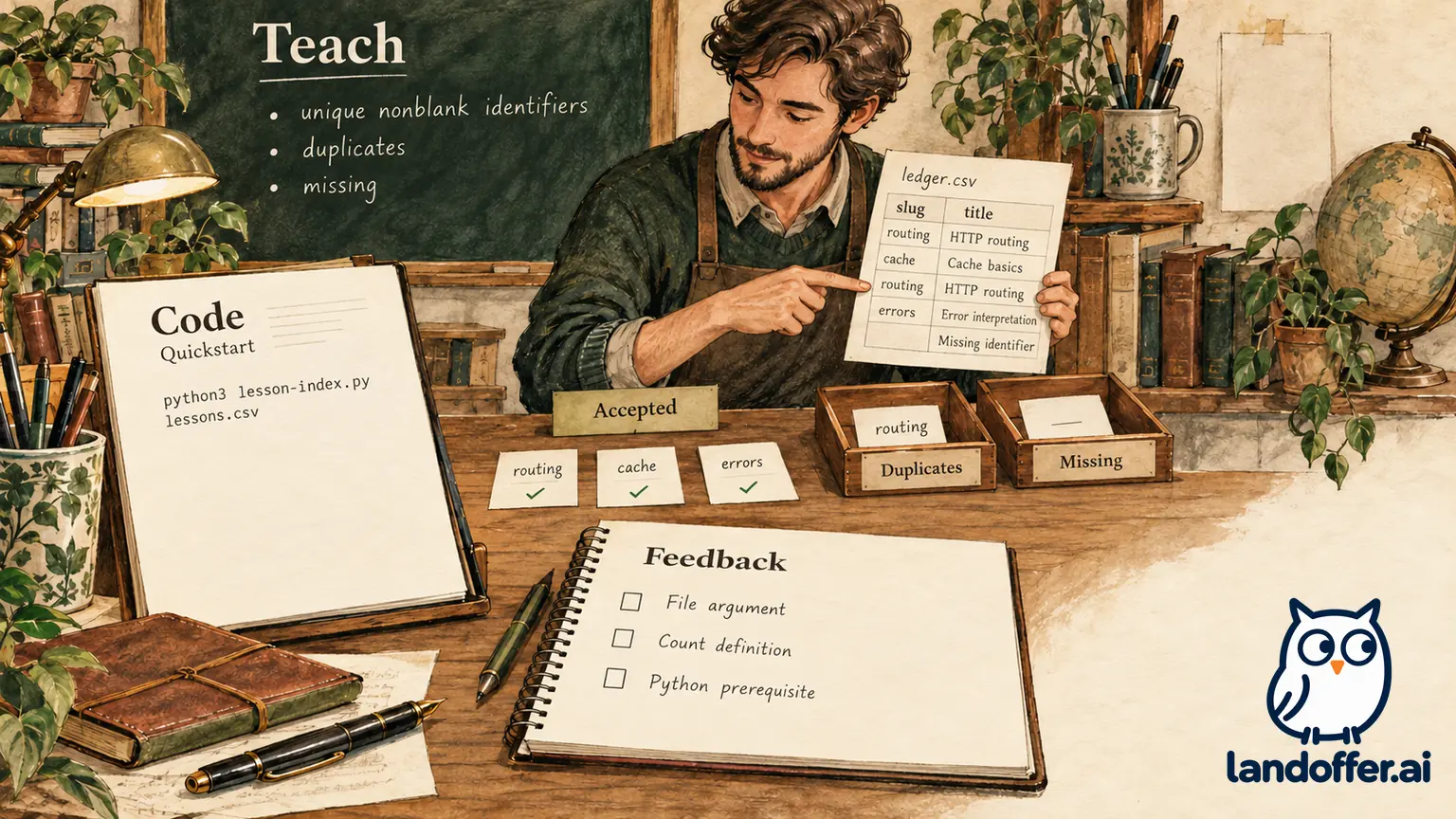
A demo needs a purpose smaller than “show Python.” Cressida's original exercise checks a local lesson index for unique nonblank identifiers. Its reader can run the supplied script against the supplied CSV and interpret three categories. It is an educational command-line example with no service, account or network dependency.
The input has five data rows. The routing identifier appears twice, cache and errors appear once each, and the final identifier is blank. The policy accepts the first occurrence of each nonblank identifier, counts subsequent occurrences as duplicates and counts blank identifiers separately. A title column supplies context but is not validated.
We ran the actual supplied script locally. The result was three accepted identifiers, one duplicate and one missing identifier across five rows. The retained input hash matched before and after the run. This is an observed local behavior record; it does not establish that every malformed CSV is handled correctly or that the checker is a production validation system.
The central command is short enough to inspect:
python3 lesson-index.py \
  lessons.csv
The expected output names accepted, duplicates, missing_ids and rows. Keep the categories beside the values. A number called “count” would leave the reader guessing whether it includes the duplicate, the blank row or only unique entries. Explain the counting policy so the reader can interpret the successful command.
For a real product demo, retain the relevant setup and version information, example inputs and expected behavior. If the example requires credentials, provide a safe setup route and keep real credentials out of the packet. If an integration is unfinished, say which task works and which remains open. A recording of a successful path does not certify every configuration.
Make the teaching artifact usable on its own
The original guide is titled “Inspect a local lesson index.” Its audience can open a terminal and read a CSV but has not used this checker. The prerequisites name Python 3 and both local files. The starting instruction says to place the files together and open a terminal in that folder. The command reads the file and prints a summary without changing the input.
Write the Docs' portfolio guidance recommends relevant samples and a description of the creation process. For this education-focused role, the useful sample is a complete small task. Include the decisions behind its sequence: why the prerequisites come first, how the reader recognizes completion and which failure needs a separate correction.
Cressida's guide explains why five rows produce only three accepted entries. The duplicate and blank categories account for the other two rows. It also distinguishes a missing file from an input-definition problem. A reader facing a missing file should verify the folder and supplied path; the minimal checker does not claim to diagnose every malformed column or encoding.
The guide's completion condition is interpreting the local summary. It is not publishing lessons, fixing a content system or proving learner comprehension. We exported the authored guide to local HTML and read its rendered headings, command and explanation. The code execution and document inspection are separate checks, and neither substitutes for observing a learner use the lesson.
Turn feedback into an inspectable revision
The second completed asset is a synthetic feedback record. We authored three comments to demonstrate triage. They are not copied from a forum, a customer or an actual workshop. The record classifies the question, identifies an action and preserves the evidence boundary.
| Synthetic question | Completed response in the sample | What is established |
|---|---|---|
| Which file do I pass? | Add the complete command and starting folder | The revised instruction now names both files |
| Why are five rows only three accepted? | Explain duplicate and missing categories | The local result reconciles as 3 + 1 + 1 = 5 |
| Which Python version is needed? | State Python 3 and standard-library dependencies | The local runtime is recorded; other versions are untested |
The original authored passage says, “Run the checker and read the count.” The completed revision is: “From the folder containing lesson-index.py and lessons.csv, run python3 lesson-index.py lessons.csv. Read accepted, duplicates and missing_ids separately; the command does not change the input.” The after passage resolves an instruction gap and defines what the reader should inspect.
An issue-style note retains the input, expected instruction, observed omission, change and status. Its status is a local documentation revision, with no public issue filed or product change shipped. GitHub's issue-template guide describes structured fields for useful reports. Our original note uses that reporting idea without claiming a deployed GitHub form.

Distinguish community reach from a supported outcome
Choose a metric with a unit, period and counting rule that answers the program's question. A view count can describe exposure to a tutorial. Attendance can describe participation in an event. Completed exercises can describe a task result when the completion definition and records exist. A resolved support issue can describe a specific correction. These observations have different units and cannot be exchanged merely because each produces a large number.
For example, a real workshop record might retain registrations, attendance and completed task checks separately. Record the period, denominator and counting rule. A repeat attendee should not silently become another unique developer. If you claim that a revised lesson improved completion, preserve the before and after method and consider what else changed. The revision itself does not prove causation.
Cressida has no such community measurement. Her three synthetic comments cannot become three developers helped, and the five CSV rows cannot become five workshop attendees. The local checker has a known result, while the teaching artifact's comprehension remains unmeasured. Keep those limits in the sample cover note and the resume wording.
Qualitative evidence can still be useful when authorized. An actual, specific report of a blocked task can explain why a change mattered. Describe your response and the recorded disposition instead of converting the story into an invented percentage. Do not expose private conversations or identify a user merely to make a portfolio claim sound more persuasive.
Convert the evidence into truthful resume bullets
MIT's skills-writing guidance connects an activity with its project context and result. Apply that structure to the evidence available. For an independent educational sample, the result can be a checked behavior or completed document. It does not need to be a commercial adoption number.
Cressida's finished sample bullets read:
Authored a Python lesson-index checker and technical quickstart, recording three accepted slugs, one duplicate and one missing ID from a five-row synthetic input without changing the file.
Turned three synthetic feedback scenarios into a documented quickstart revision and issue-style handoff, separating verified local behavior from unmeasured learner outcomes.
These bullets identify original authoring, technical scope and verification. They do not imply an employed advocate role, live workshop delivery or community growth. A candidate with actual work would use the real context and evidence, rather than copying the exercise's counts or synthetic label into an unrelated experience entry.
If the real project was collaborative, identify your component. Teaching a teammate's demo, authoring its setup instructions and maintaining its integration are different contributions. Credit the underlying work and state what you personally changed. When a claim depends on a merged change or a released version, preserve that event instead of treating a proposed revision as completed deployment.
Assemble a packet that follows the reader's question
Cressida leads with the small runnable example and its quickstart for the invented technical-education role. The feedback record comes second because it shows how she diagnoses an instruction gap and records a bounded change. The contribution note names the script, CSV, guide, local output and three invented comments. An application asking for a speaking sample would still require a relevant speaking artifact; this packet does not quietly stand in for one.
Her cover note reads: “Independent educational exercise. I authored the checker, synthetic input and quickstart, then prepared three synthetic feedback scenarios and a specific documentation revision. The script's local result and unchanged input were checked. No live teaching, user comprehension, public community or product adoption was measured.” The reviewer can inspect the claim without reconstructing the whole project.
For employer-owned work, establish permission and follow the owner's restrictions before sharing. Write the Docs discusses authorized samples and unrelated original content when workplace work cannot be shared. A recreated example should preserve the relevant skill without carrying private product details into a new file. Redaction alone does not establish permission.
Verify the actual delivery route separately from the artifact. Open the intended link in its reader context, follow the starting task and inspect any downloadable file. Our packet remains local; no public repository or recruiter access was tested. The local HTML inspection confirms the authored page; public recipient access remains untested.
Choose a responsibility in recent roles on LandOffer, then lead with the checked demo, teaching task or feedback record that supports your contribution.