LandOffer
Product & Project Delivery
Use Jobs-to-Be-Done Interviews to Understand Why Customers Changed Tools
A complete fictional room-booking tool switch separates first concern, workaround, evaluation, approval and adoption. An evidence-linked four-forces map leads to a specific follow-up exercise while preserving uncertain dates, unverified product behavior and unapproved research.
To understand why a customer changed tools, reconstruct a specific past decision: what first made the old arrangement difficult, what they tried, what delayed them, and what finally happened. A Jobs-to-Be-Done switch interview produces a dated account of that change, with evidence for both attraction and resistance. It does not establish that everyone wants the same feature or that the customer will buy your next release.
This LandOffer.ai guide demonstrates the method with an entirely fictional customer, interview and research record. The named sources support the interview approach; neither the software nor the buying story represents a real customer study. The two completed assets show how to turn an account of switching into a limited, testable product question.
Choose a completed switch and define what actually changed
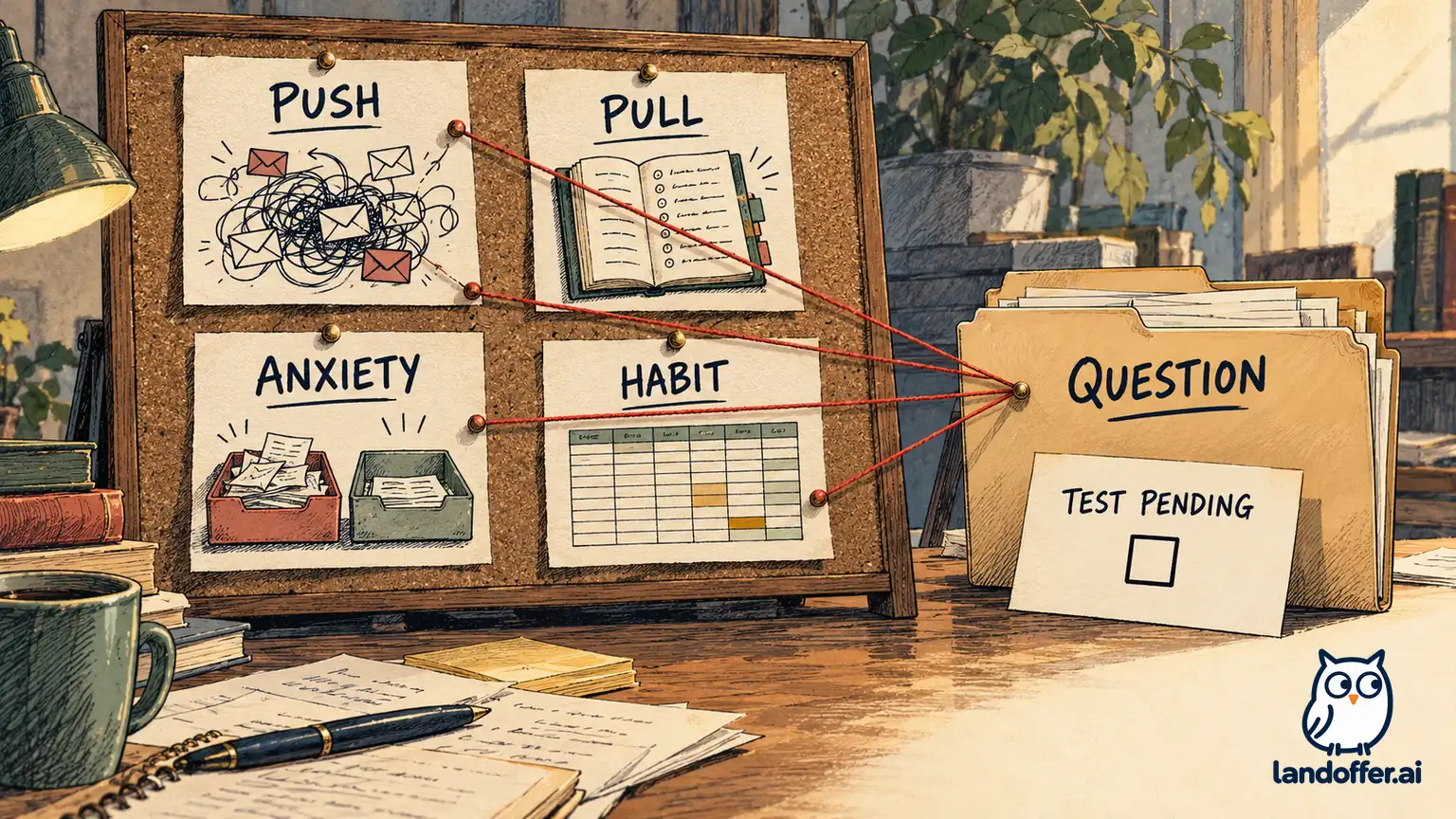
Moesta and Spiek's switch-interview guide recommends reconstructing concrete events around a recent decision. It distinguishes this conversation from a satisfaction survey or feature-request list and introduces four forces: pressure from the old situation, attraction to the new option, anxiety about changing, and habits that sustain the old arrangement. Treat these as analysis lenses rather than labels participants must understand.
The Christensen Institute's explanation places the desired progress in its circumstances, including functional, emotional and social dimensions. A tool category alone is insufficient. “Project management software” says little about the event that made someone willing to reorganize their work.
Specify the decision or adoption milestone that qualifies a participant before recruiting. Did the person authorize payment, start a trial, move one workflow, or stop using the previous tool? A trial can reveal evaluation barriers; an authorized purchase can reveal spending decisions; adoption can reveal transition concerns. Interviewing a trial user can illuminate evaluation, but their account does not establish a completed purchase or migration. Record who chose, who paid and who had to adopt the change.
For your study, document the question, the relevant customer circumstances and the milestone required for inclusion. Include contrasting outcomes where useful, such as someone who evaluated the alternative but stayed. Keep those outcomes separate during synthesis. Do not recruit only enthusiastic customers and later describe their reasons as representative of everyone who considered switching.
Ask for the sequence before asking for an explanation
Start with an open invitation: “Tell me about the change from your previous arrangement to the one you use now.” Then locate the first remembered event. Ask what happened next, who was involved, what the person did, and what they considered at that point. Avoid inserting your proposed reason into the question.
The GOV.UK interview guidance recommends informed consent, open and neutral questions, real examples, clarification and secure handling of collected personal data. Agree on recording and quotation use through your research process. Permission to discuss work does not automatically authorize copying employer documents or recording other people named in the story.
Use a discussion guide without requiring an uninterrupted chronological speech. People often remember the purchase first and the earlier trigger later. Return to gaps with a neutral prompt: “You mentioned a trial. What had happened between first hearing about it and starting that trial?” Mark uncertain dates as approximate. Keep approximate dates approximate when you put the conversation into a table.
Ask about alternatives outside the product category. The customer may have considered hiring a coordinator, extending a spreadsheet, reducing service volume or doing nothing. The existing workaround competes for their time and trust even when it has no subscription price.
Completed switching timeline: a room-booking coordinator changes tools
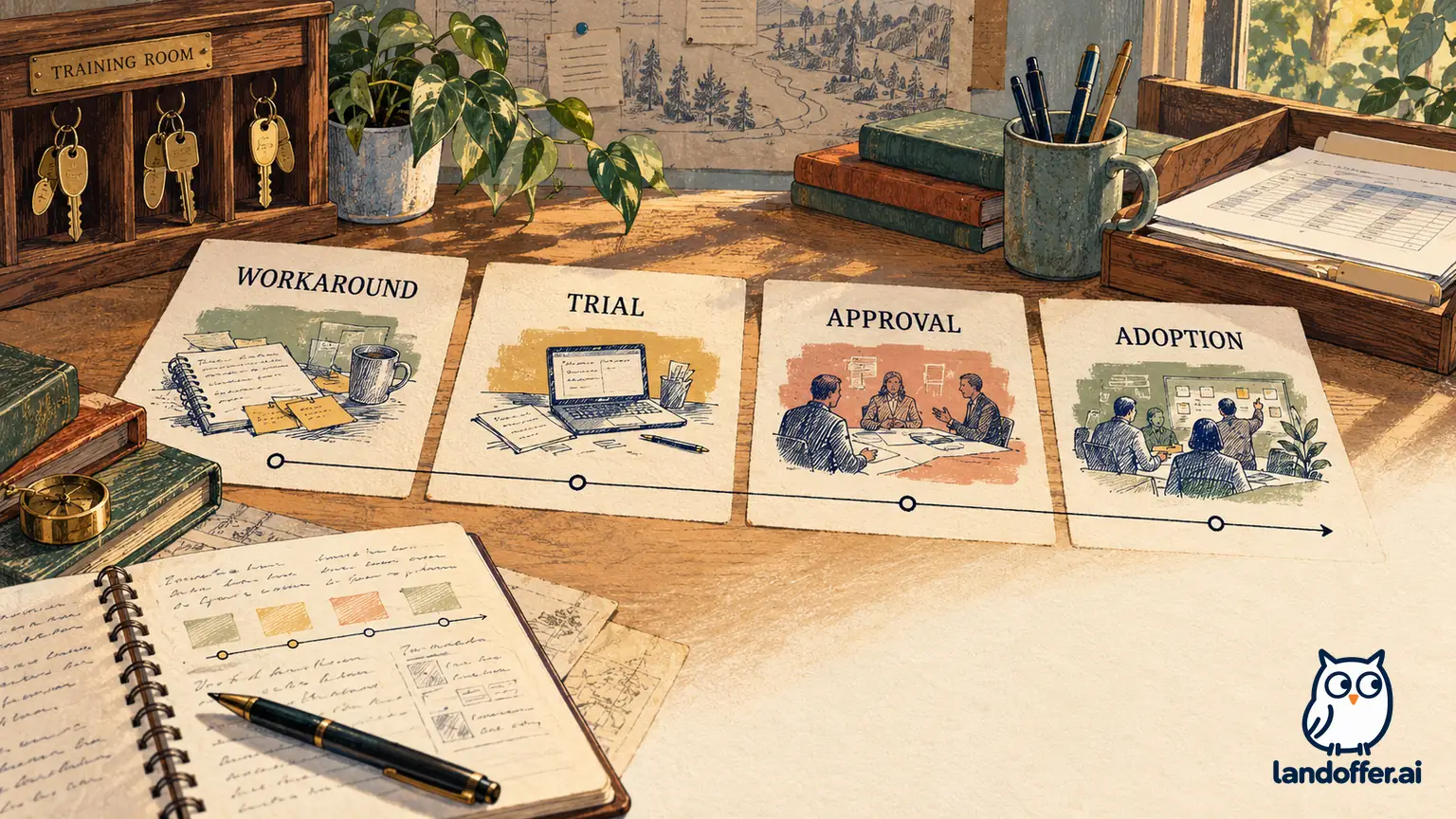
In this fictional case, June coordinates training rooms for CedarPier Learning. She previously used a shared spreadsheet plus emailed room-change confirmations. In October 2026, her team moved room requests to the invented RoomBridge service. Researcher Tomas interviews her on October 27 about that completed workflow change. He is investigating why this particular switch occurred, not measuring RoomBridge's performance.
June handled the evaluation. Operations director Inez authorized the purchase; two coordinators adopted the workflow. The completed switch means new room requests entered RoomBridge from October 19. Historic requests stayed in the spreadsheet, and instructors still received email confirmations. The team did not migrate every communication or erase its old records.
The following reconstruction is fully authored fiction, including its dates, statements and document references. “Shown” means shown within the fictional interview, not inspected in a real account.
| When | Event and action described in the interview | Basis and remaining uncertainty |
|---|---|---|
| Around September 8 | Two instructors arrived expecting the same room. June checked email against the spreadsheet and reassigned one session. | June's recalled first concern; she cannot confirm the date or the root cause of the conflicting expectations. |
| September 15 | June added a confirmation column to the spreadsheet and asked the second coordinator to initial changes. | June shows a dated blank-layout revision in the fictional session. It supports the attempted workaround, not proof that everyone followed it. |
| Around September 22 | A peer mentioned RoomBridge after June described difficulty tracing who had confirmed a change. June bookmarked it but did not start a trial. | Recalled conversation; no exact day or independent peer account. |
| October 2 | A late room change required June to search several email threads before answering an instructor. She asked Inez for time to compare alternatives. | June's account; she reports feeling exposed when she could not give a clear answer. No search-duration measurement exists. |
| October 5–9 | June tested a sample week in RoomBridge and separately considered keeping the spreadsheet with one designated change coordinator. | Fictional trial notes show both options. Trial participation does not establish security or reliability approval. |
| October 12 | The second coordinator completed a sample request and change exercise. June checked whether history remained available after a reassignment. | June recalls the exercise; the interview does not independently verify the tool's actual history behavior. |
| October 14–15 | June recommended RoomBridge; Inez approved the stated purchase on October 15. | Fictional recommendation and approval dates distinguish June's preference from spending authority. |
| October 19 | The team began entering new requests in RoomBridge while retaining the historic spreadsheet. | June's account of adoption; completeness of all new entries remains unchecked. |
The purchase did not immediately follow the first problem. June first tried to repair the existing arrangement and delayed investigating another tool. The September revision shows an attempted repair in the fictional record; retaining it prevents the analysis from treating purchase as June’s only plausible response.
Follow up when the customer's first answer hides a distinction
Tomas initially hears June say, “We needed fewer booking mistakes.” He avoids translating that immediately into a validation feature request. His completed follow-up exchange reads:
Tomas: Tell me about the last event before you decided to compare options.
June: The October room change. I could not tell the instructor whether the revised room had actually been confirmed. I was opening emails while they waited.
Tomas: What did you do after that conversation?
June: Asked Inez for time to investigate. We also discussed having only one person make changes in the sheet.
Tomas: What made you hesitate about moving?
June: My colleague already knew the sheet. I worried we'd end up with new requests in one place and updates somewhere else.
Tomas: What happened before Inez approved the purchase?
June: My colleague tried a request and a reassignment. I wanted to see whether we could follow the change afterward. I still don't know whether every instructor reads the confirmation email.
The final sentence limits the interpretation. A coordinator's confidence in tracking changes does not establish that instructors receive, read or understand notifications. Preserve that open question instead of converting it into a successful end-to-end communication claim.
There is also an unresolved cause in the first incident: conflicting room expectations could arise from several processes. The interview explains June's account of the struggle and her subsequent actions. It does not prove that the spreadsheet caused the conflict or that the replacement eliminated it.
Turn the account into a forces map and a bounded opportunity
After the conversation, Tomas writes this completed analysis. The interpretation column belongs to the researcher; it is not another set of customer quotations. The competing explanation column keeps attractive interpretations open to challenge.
| Lens | Specific fictional evidence | Research interpretation | Competing explanation or gap |
|---|---|---|---|
| Push from the old situation | October 2 email search before answering the instructor; earlier spreadsheet repair | Difficulty reconstructing a room-change decision created pressure to change the arrangement. | June's workload or unclear change ownership could contribute independently of software. |
| Pull toward the alternative | Sample request, reassignment and history check before recommending purchase | Traceable change history appeared relevant to June's evaluation. | Other purchase criteria may be missing; this interview does not rank every feature or establish decisive causality. |
| Anxiety about changing | June worried requests and updates would split across places | Adoption consistency was a concern to investigate during transition. | The second coordinator's own view has not been collected. |
| Habit supporting the old arrangement | September confirmation column; colleague's familiarity with the sheet | Existing knowledge and a workable repair made staying plausible. | Familiarity is June's account of her colleague, not that colleague's direct testimony. |
Tomas drafts a provisional job statement: “When room changes arrive after an initial booking, help me reconstruct the current decision so I can answer the instructor without piecing together several threads.” This is a working synthesis of the fictional interview, not a validated market segment or a verbatim customer statement.
His first proposed opportunity, “Build better notifications,” jumps from June’s difficulty reconstructing confirmation to a change in delivery behavior that the interview has not established. He replaces it with a narrower question: “Can a coordinator correctly identify the current room and who confirmed its latest change from a sample change record?” That question addresses June's described task while leaving instructor receipt and adoption consistency separate.
The completed next-step record assigns Tomas to prepare a synthetic changed-booking exercise for research lead Ana to review on November 3. The proposed exercise includes an original room, a reassignment and a later unconfirmed request. It asks participants to identify the confirmed room and explain their evidence. Ana has accepted reviewing the exercise; recruiting and running sessions remain unapproved and unperformed.
Tomas also records two further interview needs: speak with the second coordinator about the transition, and interview someone who evaluated a replacement but retained a spreadsheet. Neither person has yet been recruited. The record supports follow-up research; it does not yet justify prioritizing change history over other work.
Keep synthesis useful without overstating the evidence
Maintain a traceable distinction among what the participant recalled, what an artifact supports, and what you infer. A dated approval can support the purchase milestone without revealing every motivation. A remembered feeling can matter to the story without becoming a measured effect. Preserve contradictions for follow-up rather than silently choosing the version that fits your product pitch.
Across interviews, compare circumstances, alternatives, delays and actual decisions. Do not count several quotes from June as several customers supporting a finding. Nor does one non-switcher invalidate every switcher's account. Differences may expose purchasing authority, transition costs or circumstances that require separate research questions.
Further workplace guides are available from LandOffer.ai. Finish each switch interview with a usable timeline, evidence-linked interpretations and named unknowns. Assign a specific follow-up question and owner, and distinguish permission to prepare that work from permission to recruit, test or build.
Sources and Further Reading
- Jobs to Be Done, Moesta and Spiek: How to Run a Switch Interview — concrete historical decisions, event timelines and four forces; checked October 28, 2026.
- Christensen Institute: Jobs to Be Done Theory — progress in circumstances and functional, social and emotional dimensions; no source case reused.
- GOV.UK Service Manual: Using In-Depth Interviews — consent, neutral questions, examples and research-data handling; published February 21, 2017; checked October 28, 2026.