LandOffer
Job search
JobWinner Review: Tailored Documents, Practice Allowances, and Plan Duration
Budget document generation and timed mock practice separately; reconcile plan duration and refund conditions before buying.
JobWinner is worth considering when you need tailored application documents and interview preparation in one workspace. The purchase decision changes when you add timed mock interviews: the current public plans describe unlimited resumes, cover letters and prep kits, alongside a finite allocation of practice credits. Plan duration and practice allowance need separate budgets.
This review checks documentation and public pages viewed in a browser on October 14, 2026. We did not upload a resume, generate documents, run a mock interview or buy a plan. Download formats, editing tools and feedback are vendor descriptions; their quality remains untested. Several public price and refund statements also differ, so the offer at checkout matters.
LandOffer publishes this review and provides job-search tools. You can browse recent roles on LandOffer.ai to select a suitable vacancy before paying for a preparation bundle. Save the employer's description so the resume, letter and interview practice all address the same role.
What the application toolkit is meant to do
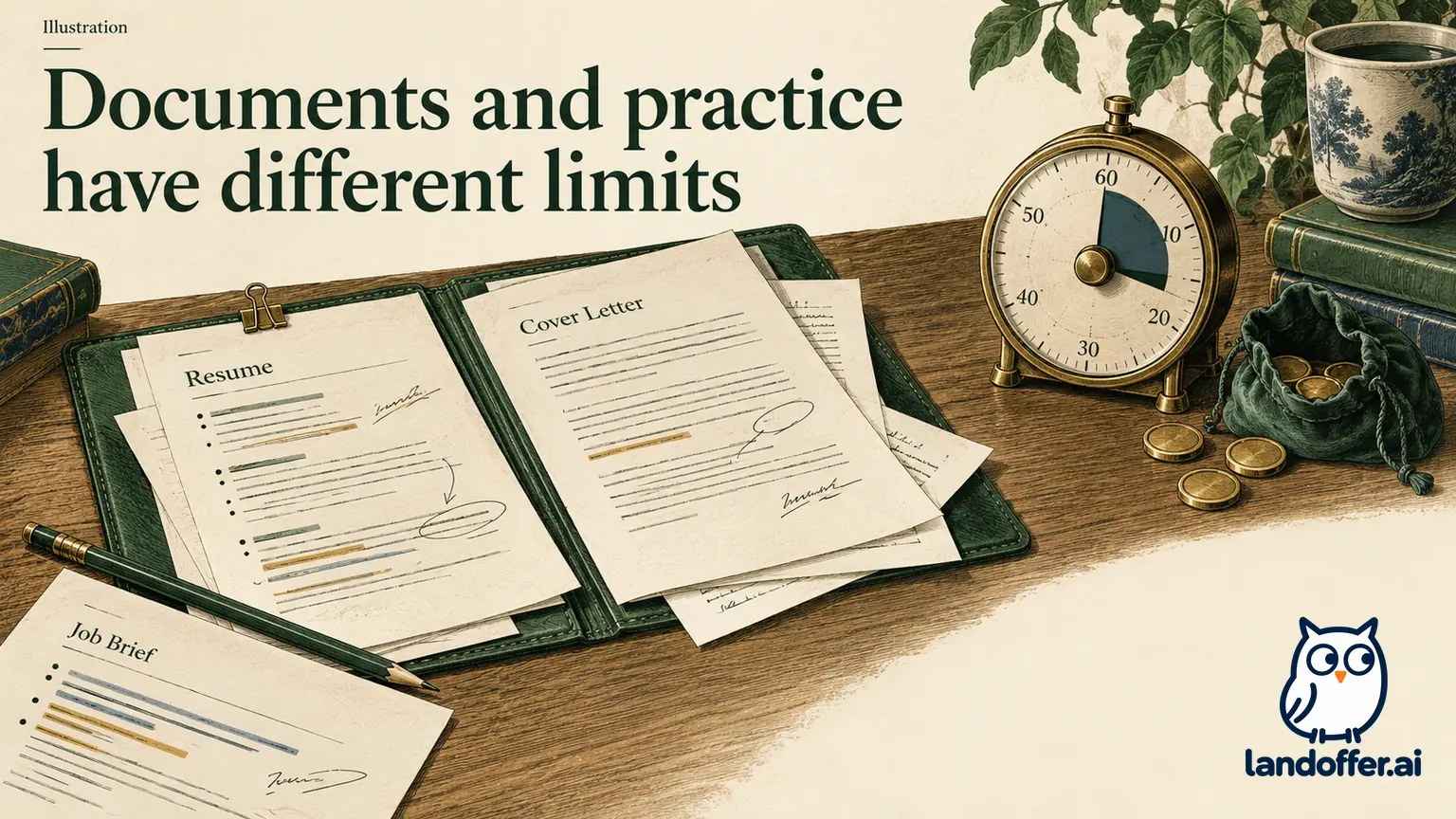
JobWinner's resume-tailoring page describes starting with an existing resume and a job description, reviewing the resulting version, editing it and downloading it. Its expanded download FAQ names PDF and Word DOCX. Another FAQ describes one free Application Kit without a credit card, although the same answer still cites a starting weekly price that differs from the current main pricing display.
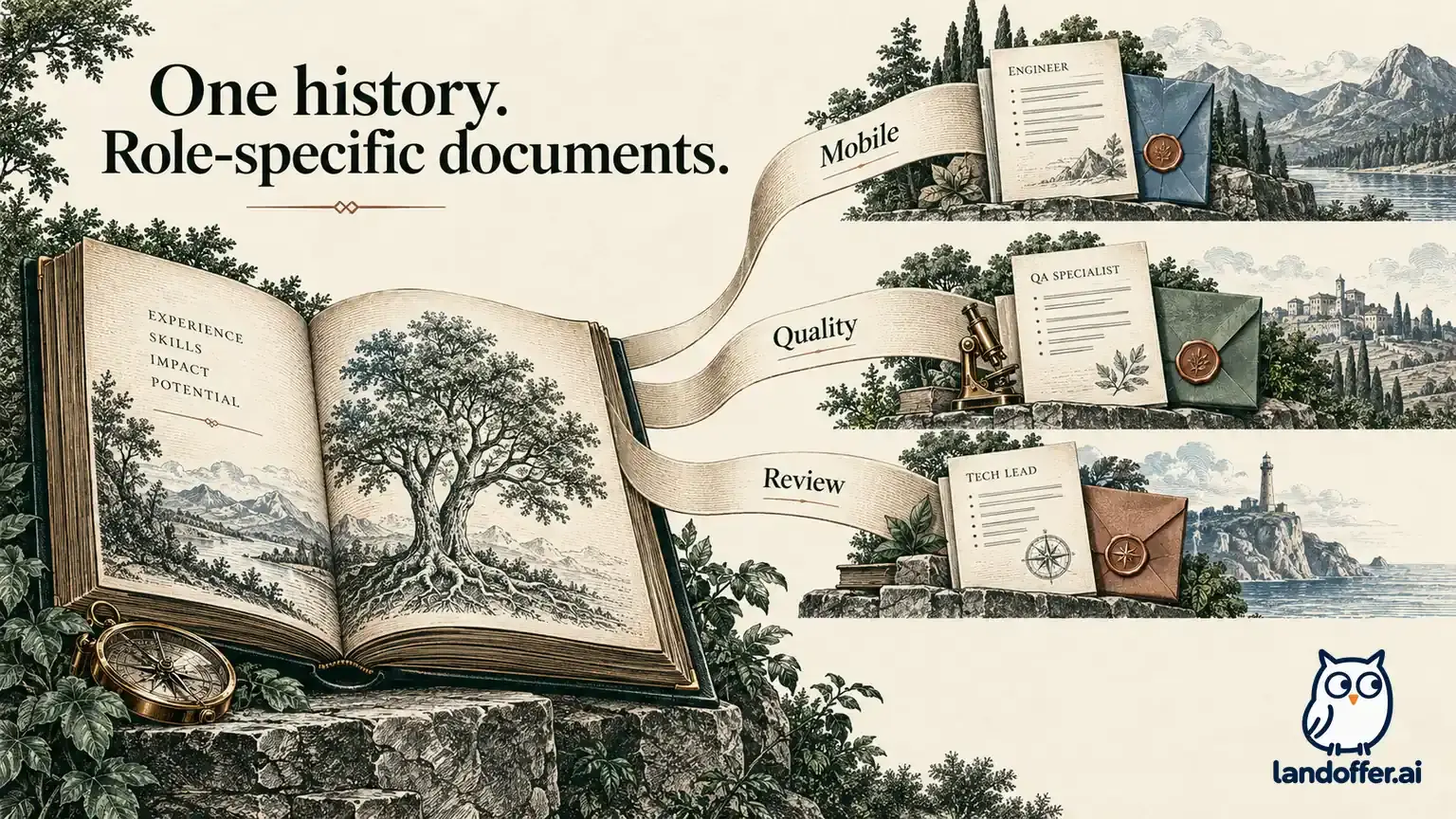
For several related roles, keeping the same experience available across documents and practice can reduce repeated setup. The same experience can support a resume bullet, a cover-letter explanation and an interview story. That is useful only if the three versions agree about your contribution. As you generate more material, compare the claims across the documents before using them.
Prepare your evidence before supplying a job description. Identify the project, your responsibility, the actual result and the limits of what you can claim. Decide which details are relevant to this vacancy. An AI draft should not turn a requirement you hope to learn into a skill you already possess.
A free kit can help you judge the workflow before choosing a duration. Inspect whether you can correct the material and obtain the files you need under the displayed offer. This review does not establish which export or practice actions a newly created free account can complete. A free preparation description is not proof of free timed mock minutes.
A completed example across three materials
Mina is a fictional early-career developer targeting a desktop-support engineering role. During an internship, she wrote a C# utility that compared two CSV equipment inventories and flagged duplicate serial numbers for manual review. She documented how blank serial fields were handled. Her supervisor decided which inventory records to change. Mina did not own the asset-management system or measure a reduction in support tickets.
Here is a completed editorial example of how that evidence could carry through an application. These are original teaching materials, not outputs observed from JobWinner.
| Material | Mina's reviewed wording | What stays consistent |
|---|---|---|
| Resume bullet | Built a C# utility to compare CSV equipment inventories and flag duplicate serial numbers; documented blank-field handling for the support team's manual review. | Implementation, input and review boundary |
| Cover-letter paragraph | Your role's emphasis on reliable support tooling interests me. In my internship, I built a C# inventory-comparison utility and documented how it handled missing serial numbers. I would bring that habit of making exceptions visible to the team's desktop-support work. | Relevant motivation without claiming ownership of the whole system |
| Interview story | Explain the duplicate-record problem, the utility Mina built, the exception handling and the supervisor's correction decision. | Same responsibility and outcome as the documents |
Her spoken answer could be: “We had two equipment inventories that could contain repeated serial numbers. My task was to make those possible duplicates easier for the support team to review. I wrote a C# utility to compare the CSV files and separated blank serial fields so they would not be treated as confirmed duplicate devices. I documented that behavior and gave the results to my supervisor, who decided which records to correct. I learned to distinguish a suspicious record from a verified data error. I would use the same approach when building a support tool: show the exception clearly and preserve a human decision where the data is uncertain.”
The answer gives the interviewer something concrete to follow up on. Mina should be able to explain how serial numbers identify possible duplicates and why two blank fields do not prove two records describe the same device. She should not replace those details with a claim that she transformed inventory accuracy across the company.
When reviewing a generated kit, compare the verbs across all three materials. Built, supported, led and owned describe different contributions. If the letter says she led a system migration while the resume describes a utility, correct the letter before rehearsing it. Remove an inflated claim before using that story in practice.
A useful kit therefore ends with a consistent factual account and editable files. It does not need to maximize every available keyword. Mina can leave out a requirement such as managing enterprise device policy when her evidence does not support it.
Prep kits and mock interviews serve different tasks
The Interview Preparation page describes job-specific questions and suggested answers. Its expanded FAQ says answers can be edited and saved, and a prep pack can be exported as PDF. It also describes a free tier without specifying a precise allowance in that answer. These are preparation materials to study and adapt.
The separate AI Mock Interview page describes interactive practice using the role and resume, with sessions from five to sixty minutes. It presents competency role-play and a question-picker option, plus feedback on competence, depth, structure and delivery. The page describes spoken practice in English or Spanish; its microphone FAQ also says the question picker can be used without speaking. We did not operate either mode.
For Mina, the prep kit helps assemble the inventory story. A practice session would help her try explaining it under follow-up questions. A clear script and a strong spoken explanation are different deliverables. She can prepare the first without spending every available minute on the second.
Treat an AI score as feedback to examine. Ask whether the comments identify a missing example, unclear responsibility or an answer that wandered away from the question. A higher score is not evidence that an employer would advance the candidate. The four labeled dimensions describe the vendor's report; we found no independent validation here that establishes technical judgment or hiring accuracy.
For a coding-heavy interview, check whether the practice actually addresses the work you need to perform. A spoken explanation of a utility cannot establish whether your implementation handles malformed CSV input. You may still need code review, a coding exercise or a person who can challenge your design decisions.
A worked budget for minutes and plan duration
The public pricing page displayed $9 weekly, $29 monthly and $145 lifetime when checked. Its plans listed unlimited tailored resumes, cover letters and prep kits, but ten, forty and one hundred mock-interview credits respectively. The footnote defines one credit as five minutes.
Those allocations translate to fifty, two hundred and five hundred minutes. They do not establish when credits refresh, whether unused credits roll over, how partial sessions are charged or whether failed sessions consume time. Lifetime access does not establish an endlessly replenished practice balance.
Mina plans a nine-day search period, with three practice sessions during the first six days. Her completed budget is deliberately based on five-minute blocks, avoiding an assumption about rounding.
| Planned work | Minutes | Credits at five minutes each |
|---|---|---|
| Explain the inventory example and answer follow-ups | 20 | 4 |
| Rehearse a second role-specific conversation | 20 | 4 |
| Repeat the weakest answer after revision | 15 | 3 |
| Total within the first six days | 55 | 11 |
A ten-credit allocation covers fifty minutes, leaving one credit short of her planned practice. Unlimited prep kits do not close that gap. A forty-credit allocation is large enough for the fifty-five-minute schedule if those credits are available under the offer she actually buys. She should confirm that before relying on it.
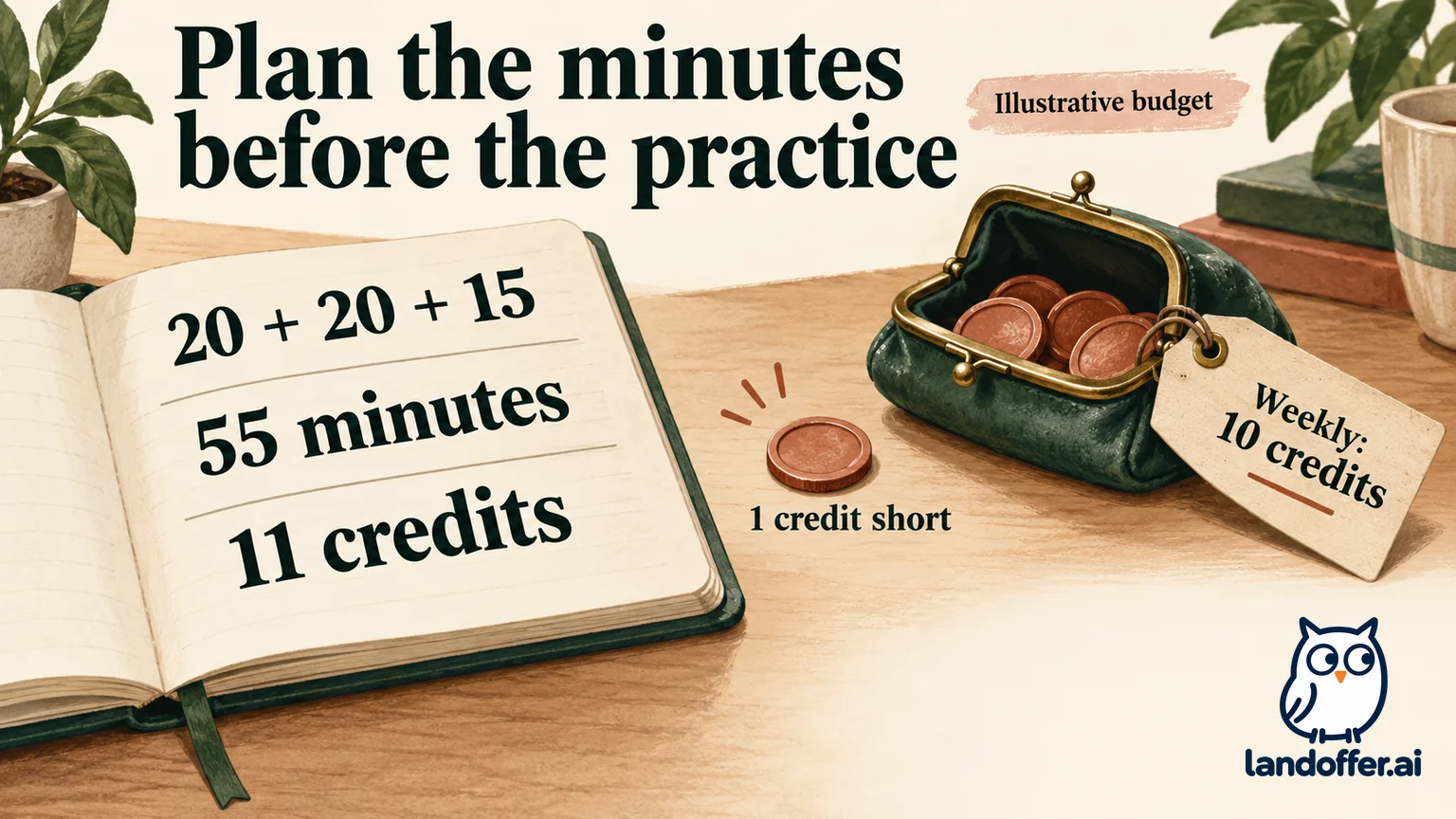
Duration creates a second decision. At the observed prices, two weekly payments total $18, compared with $29 for one monthly payment, before any taxes or currency differences. A nine-day access window could cross a weekly renewal. That arithmetic does not prove the second payment grants another ten credits, nor does it solve a shortage during the first six days.
Mina's reason to consider monthly access would be the practice allocation and breathing room for later preparation. If she shortens the plan to fifty minutes and confirms the weekly offer meets her document needs, a shorter purchase may be sufficient. She should use the actual renewal date and time shown in her account rather than assuming cancellation follows her local midnight.
Contrast that with Joel, another fictional candidate, who needs six days of document editing and two fifteen-minute rehearsals. Thirty minutes require six credits. His schedule fits within a ten-credit allocation, subject to access and charging rules. Paying for a larger allocation would leave more unused capacity. If free preparation materials and peer rehearsal already meet his needs, he may not need a paid plan at all.
Resolve offer differences before paying
Public copy is inconsistent. The tailoring FAQ still mentions €7 weekly, while the main pricing page showed dollar-denominated prices. The user terms say fees are in euros unless otherwise stated and describe automatic renewal. Do not combine an older starting price, current unlimited-document wording and a different plan's credits into one assumed offer.
Refund wording also needs care. Pricing badges advertise seven days, but the detailed terms say a used lifetime subscription is nonrefundable. They distinguish an unused account from one that has been logged into or used for paid features. Renewal wording is less clear than the broad badge suggests. Treat lifetime access as a larger commitment until the applicable conditions are confirmed.
Save the order's price, currency, period, included credits and refund conditions before committing. After purchase, retain the receipt and cancellation confirmation if you end the subscription. Canceling future renewal and receiving money back are separate outcomes. This review did not test either process.
Privacy and the practical use-or-skip decision
JobWinner's direct-user privacy policy covers uploaded documents, job descriptions, practice answers and usage data. It names providers including OpenAI for personalized outputs, describes personalized course offers with opt-out controls, and uses purpose-based retention language. It does not give a precise account-deletion deadline. Organization-sponsored access has a separate policy.
Use an approved description of confidential work, including the details you plan to say during practice. Mina could explain the inventory utility without uploading an employer's equipment export. The interview answer itself can disclose information even when the resume has been sanitized. Consider both inputs before using a voice or text practice tool.
JobWinner fits best when you want related application materials and preparation together, can review the claims yourself and have a defined search window. Its documented editable exports and separate practice modes are useful reasons to investigate it. They do not establish that every candidate needs the largest plan.
Keep your existing document workflow and human practice if they already solve your problem. If your main gap is technical feedback from an experienced engineer, a broader AI bundle may leave that gap intact. Decide whether you need better materials, more rehearsal time or deeper judgment before choosing access length.
Write down one target role, the documents you need and a realistic minute budget. Use LandOffer.ai to explore job-search options, then save the employer's requirements beside that plan. Compare that document list and minute budget with the offer you can actually access, then choose whether a paid period adds anything you need.
Sources and Further Reading
- JobWinner pricing — displayed plans and credit footnote.
- JobWinner resume tailoring — documented workflow, free kit and PDF/DOCX descriptions.
- JobWinner interview preparation — prepared questions, editable answers and PDF kit.
- JobWinner AI mock interview — modes, session lengths and feedback descriptions.
- JobWinner user terms — billing, renewal and detailed refund conditions.
- JobWinner direct-user privacy policy — inputs, service providers and retention descriptions.