LandOffer
Job search
Interview Query Review: Data Questions, Code Runs, and Take-Home Practice
Match data interview practice to SQL, analysis, or take-home work, then inspect code-run and paid-access boundaries before choosing a plan.
Interview Query is worth considering when your preparation spans data questions, executable SQL or Python, and a longer analysis deliverable. Choose the practice format that matches the actual round: a query result, a reasoned metric decision, and a take-home report require different work. The current offer separates a coding-focused Coder tier from a broader Premium tier; choose the extra content you need, then compare billing periods. Start with public material and inspect the specific paid increment rather than assuming that a larger question bank, an AI allowance, or a company label makes the purchase useful.
This review uses official sources and public pages checked October 13, 2026. We inspected loaded plans, a public SQL question and the take-home directory, then ran one unchanged public starter query while logged out. We did not submit a solution, buy a plan, use paid feedback, or download a take-home. The learner and invoice-credit data below are fictional; our aggregation example was checked locally with SQLite. LandOffer publishes this guide. Use recent data and tech roles and the employer's interview instructions to identify the work you need to rehearse.

Match the question format to the round
The public question directory separates technical coding, case studies, system design, and behavioral questions. Topic entries extend beyond SQL to statistics, experimentation, product metrics, data pipelines, and other areas. That breadth can help you find relevant practice, but it is not evidence that every data role requires every category.
The main offer lists SQL and Python practice for IQ Coder. IQ Premium adds broader case, design, and behavioral content, courses, and fuller company-guide access. Those are advertised entitlements. We did not evaluate all paid explanations or establish that the catalog covers a particular employer's current assessment.
Use a task map before deciding which tier matters:
| Round described by the employer | Practice output to produce | Additional work beyond a correct code result |
|---|---|---|
| SQL screen | Query and checked result at the stated grain | Explain joins, missing rows, and aggregation assumptions |
| Analysis discussion | Metric definition and reasoned interpretation | Define the population, limitations, and decision supported |
| Python exercise | Working transformation or function | Check inputs, missing data, and changed requirements |
| Take-home | Reproducible analysis plus the requested summary | State assumptions and distinguish findings from recommendations |
This map is editorial guidance, not an employer rubric. A named job title alone does not tell you whether the round emphasizes queries, experiments, modeling, or a presentation. If the invitation is unclear, obtain the task format and expected deliverable before scheduling a large mixed practice queue.
What we observed when running a public query
We opened Empty Neighborhoods from the public list. The page exposed the prompt, schemas, an editor, and separate Run code and Submit solution controls. The selected environment displayed MySQL 8.0.35. We ran the unchanged starter query that selected all rows from one provided table.
The run returned output and displayed one test, zero passed, and one failed. That is consistent with a starter query that does not yet implement the question's requirement. It establishes that this public Run action executed and reported a result in that session. It does not establish unlimited free runs, successful solution submission, or access to every question or engine.
Run and Submit are different controls. An execution result helps you inspect what the current query produced. Passing the supplied checks would be another observation, and an official explanation or tutor response would be another source of help. We did not use those controls to claim a completed solution or inspect paid feedback.
The directory's company column displayed locked signals, while the selected question's prompt and editor remained visible. A locked company label therefore should not be read as proof that the whole question is inaccessible. Inspect the particular page and account state. Likewise, visible controls do not establish how every free or paid account's allowances behave.
Take-home practice is a different deliverable
The take-home directory displayed a counter of zero out of one free take-home accessed. Its listings covered analytics, SQL, machine learning, and other tasks, with duration estimates and deliverable descriptions. This was a logged-out directory observation, not a test of the files, solution access, or free-account allowance. One listing explicitly described a practice adaptation of a reported assessment. A company label is not proof that you have received that employer's current assignment.
We inspected the directory without opening a limited-access project, downloading data, or viewing its solution. The public FAQ describes take-home access among Premium resources. The current main comparison table did not establish a separate Coder take-home entitlement. Confirm the selected project's access and supplied materials before buying specifically for it.
For a useful rehearsal, name the final artifact. A query exercise may ask for a result table. An analysis take-home may also ask for a notebook, dashboard, written explanation, or several files. A provided solution can help you compare your reasoning, but its existence does not establish that a coach will review your own submission.
The listed duration is also a planning estimate. Leave time for checking the data, explaining the result, and reviewing assumptions. Do not treat a practice adaptation or a reference answer as permission to reuse it in a live employer assessment. Follow the employer's actual rules for that assignment.
Worked preparation choice: Noor needs SQL and an analysis summary
Noor is a fictional analyst with three weeks, eighteen study hours, and a $90 preparation budget. In this example, the employer describes a SQL screen followed by a small analysis assignment and a written summary. Noor can write basic queries but has difficulty explaining what the resulting total measures.
She allocates six hours to queries and result checks, four to metric definitions and interpretation, six to an original notebook-style analysis brief, and two to explaining the result without consulting a reference. The total is eighteen hours. This is her own plan, not a vendor completion estimate or evidence of interview readiness.
Her paid choice follows that split. If only SQL and Python practice need additional access, the observed $29 Coder month is the narrower offer. If relevant cases, explanations, or the selected take-home materials add useful work, the observed $79 Premium month fits her budget. She first verifies those specific resources rather than paying for a tier based on its name.
The pricing page separately advertised Premium at $199 per year and $299 for lifetime access. Both exceed her limit. She does not convert a displayed yearly monthly equivalent into a cheaper one-month purchase. A coaching option observed on the annual offer was an add-on, with no coaching selected by default; Noor does not count a human review as part of her base purchase.
Noor's completed choice is public practice first, then at most one month of the tier that supplies the named missing work. Her notebook-style brief must contain the question, data grain, query, check, conclusion, and a limitation. Those definitions let Noor explain whether the total measures invoices or joined event rows. A syntactically valid query alone would leave that question unresolved.
Worked analysis correction: a join changes the grain
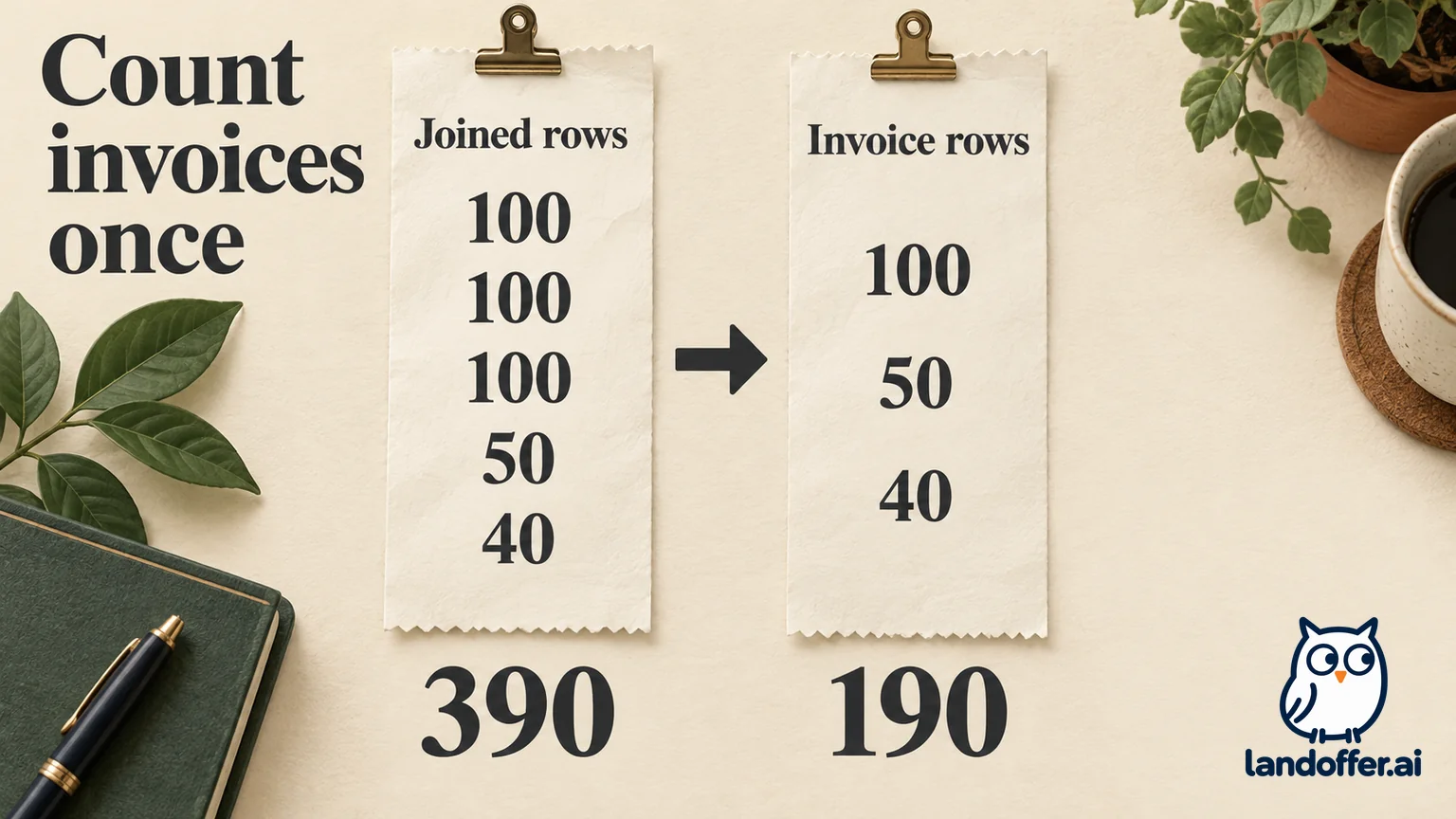
Use our original fictional invoice-credit example. Each invoice represents a credit amount once. Delivery events are separate records: one invoice can have several, while another has none. The requested report needs each invoice's credit amount and its event count, followed by a total across invoices.
The baseline data are:
| Invoice | Credits | Delivery events |
|---|---|---|
| 1 | 100 | 3 |
| 2 | 50 | 0 |
| 3 | 40 | 1 |
The correct invoice total is 190 credits. A direct join to individual event rows repeats invoice 1's amount three times. Summing those joined rows produces 390. The query executes on the teaching dataset, so the useful next check is what one output row represents. Here the joined event rows repeat invoice amounts.
Noor corrects the grain by reducing events to one count per invoice before joining them to invoices. The left join preserves invoice 2, which has no events:
WITH event_counts AS (
  SELECT invoice_id, COUNT(*) AS events
  FROM delivery_events
  GROUP BY invoice_id
)
SELECT i.id, i.credits,
  COALESCE(e.events, 0) AS events
FROM invoices AS i
LEFT JOIN event_counts AS e
  ON e.invoice_id = i.id
ORDER BY i.id;
In the local result, the rows are invoice 1 with 100 credits and three events, invoice 2 with 50 credits and zero events, and invoice 3 with 40 credits and one event. Summing that invoice-level credit column gives 190. This is a completed correction with a stated result, not a future check Noor hopes to perform.
There is a tempting accidental repair: summing distinct credit amounts also gives 190 on this dataset. Add invoice 4 with another 100 credits and no events. The correct total becomes 290, while the distinct-amount calculation remains 190. Invoice 1 and invoice 4 each have 100 credits but different IDs. Removing one amount loses a valid invoice; the identity to preserve is the invoice ID.
We checked both datasets locally using Python's SQLite interface. These are fictional credit units and our own schemas, not Interview Query's tables, a query submitted to its MySQL environment, or real customer records. We did not establish cross-engine compatibility, production data quality, or financial correctness outside the stated teaching model.
Noor's revised summary is: “The report counts each invoice amount once and attaches its delivery-event count. The original join inflated the credit total because event rows repeated one invoice. Aggregating events by invoice restores the intended grain. Distinct amounts are not a substitute for invoice identity.”
Her limitation is equally specific: the exercise does not define cancellations, time cutoffs, missing credit amounts, or duplicate event identities. A real assignment would need those rules before its total could support a decision. This separates explaining a checked result from claiming that the result answers every business question.
Compare plan scope and actual billing
In the native price selector, Monthly showed $29 for Coder and $79 for Premium. Yearly showed rounded monthly equivalents of $10 and $17, billed yearly; another Premium call-to-action explicitly displayed $199 per year. Lifetime showed Premium at $299 as a one-time payment. We did not verify Coder's exact annual checkout total, taxes, discounts, or account-specific terms.
The FAQ, published March 27, 2026, describes a yearly plan using contradictory monthly billing wording. That differs from the loaded annual selector and $199-per-year call-to-action. We retain that inconsistency rather than presenting the FAQ line as a verified annual charge. Confirm the final tier, total payment, and billing period in the actual purchase flow.
The current Coder and Premium cards also advertise three and ten AI interviews per month respectively. We did not use the AI interviewer or compare its feedback. An allowance does not establish quality, a human coaching entitlement, or a successful diagnosis of Noor's aggregation mistake. Buy for the practice resource you will use rather than assigning automatic value to every included feature.
The FAQ says there is no Premium free trial and describes a free-account route. Free access is not a promised trial period for every paid resource. Our public Run observation and the take-home counter show particular entry points; they are not a complete audit of free-account limits.
Keep cancellation, access, and refunds distinct
The terms describe automatic renewal for monthly and annual plans. They require cancellation to be received at least forty-eight hours before the cycle ends. The FAQ describes a cancellation form and confirmation email, with access continuing through the paid period. We did not test those account actions.
The terms describe payments as non-refundable once included digital content has been accessed, with limited exceptions and a fourteen-day request deadline for those exceptions. That is not a general fourteen-day free trial. The FAQ's broader case-by-case wording about renewal refunds does not establish that Noor can recover a payment after using content.
Lifetime is described in the terms as access to content available at purchase, with no renewal. Do not assume that it includes every future tool, permanent offline copies, or unlimited paid coaching. Confirm any future-content or format entitlement you specifically need.
Browse recent roles on LandOffer.ai, identify the interview deliverable, and complete one small result-and-explanation check. Name the paid question, explanation, or take-home material that would improve the next attempt. Confirm its tier, total charge, access end date, renewal date, and cancellation lead time; keep the free route when it already supplies the work.