LandOffer
Job search
Interview Cake Review: Guided Explanations, Short-Term Access, and Refund Scope
A public-lesson inspection, original coding exercise, and completed access-window comparison explain who benefits and why the refund deadline needs clarification.
Interview Cake is most useful when you can follow a coding solution but struggle to derive one alone. Its public lessons expose that teaching approach through progressive explanations, and its paid options buy different access periods to the same course. At the October 20, 2026 check, the choices were three weeks for $249, 12 months for $349, or lifetime access for $999. The main purchase risk is conflicting refund wording: the pricing page and terms say five days, while the homepage says 30. Resolve that before paying.
This review combines current official documentation with a signed-out inspection of the public Apple Stocks exercise; it does not include a paid-account trial or a measured hiring outcome. LandOffer publishes this review. If you are also organizing applications, you can browse recent roles on LandOffer.ai; course access and finding suitable openings solve different problems.

What the course is actually selling
Interview Cake describes a problem-based path through data structures and algorithmic thinking. Its course contents organize readings and questions around topics such as arrays, strings, hash tables, greedy algorithms, trees, and graphs. The central attraction is the explanation between the initial problem and the finished solution: how to simplify a problem, discover a useful observation, and justify the improvement.
That structure suits a candidate who repeatedly reaches the editorial, recognizes every line, but cannot start a nearby question independently. Another finished solution may look familiar while leaving you unable to choose the first step yourself. A guided breakdown can provide smaller reasoning steps to attempt, provided you stop and do the work before revealing the next step.
The pricing FAQ says access to full questions is the paywalled feature. It also says the three purchases provide the same course, with access duration as the difference. The extra $100 for 12 months buys more calendar time. It does not establish a different teaching tier, a coaching allocation, or individual feedback on your reasoning.
There is a separate coaching link in the navigation. We found no basis for treating a human interview session as included in these course prices. If your difficulty is explaining trade-offs under interruption, you may need another person to observe a practice interview even after the written lessons start making sense.
What we observed in a public exercise
On the signed-out Apple Stocks page, the browser displayed a problem statement, language choices, a code editor, and a Run control. It also displayed a notice that three free questions remained, including the current one. That is one browser-session observation, not a promise of a permanent free allowance for every account or visitor.
Selecting “Tell me more” revealed a Breakdown heading and an initial prompt to work through an example manually. After that click, the editor showed starter code and named tests; their presence does not establish that our own code would pass the runner. This is useful evidence of the teaching sequence: a reader can try an intermediate thought before moving straight to the final explanation. We did not submit code to the vendor runner or verify every language option.
The page's language menu also included older version labels, including Python 2.7 and Python 3.6. If a particular runtime matters for your upcoming assessment, inspect its selector and test behavior before choosing this as your main environment. A readable explanation and an employer's execution environment are separate requirements.
Interview Cake also advertises a free seven-day email crash course. This review did not subscribe. Use the accessible problem first to judge the explanation style; an email sequence is not evidence that every paid lesson or tool is available without a purchase.
Worked example: make the explanation earn its place
The following is an original teaching exercise, not an Interview Cake question or an account of its grading. It makes the proposed benefit concrete: can a hint help you articulate why an algorithm works, then reproduce that reasoning without the page?
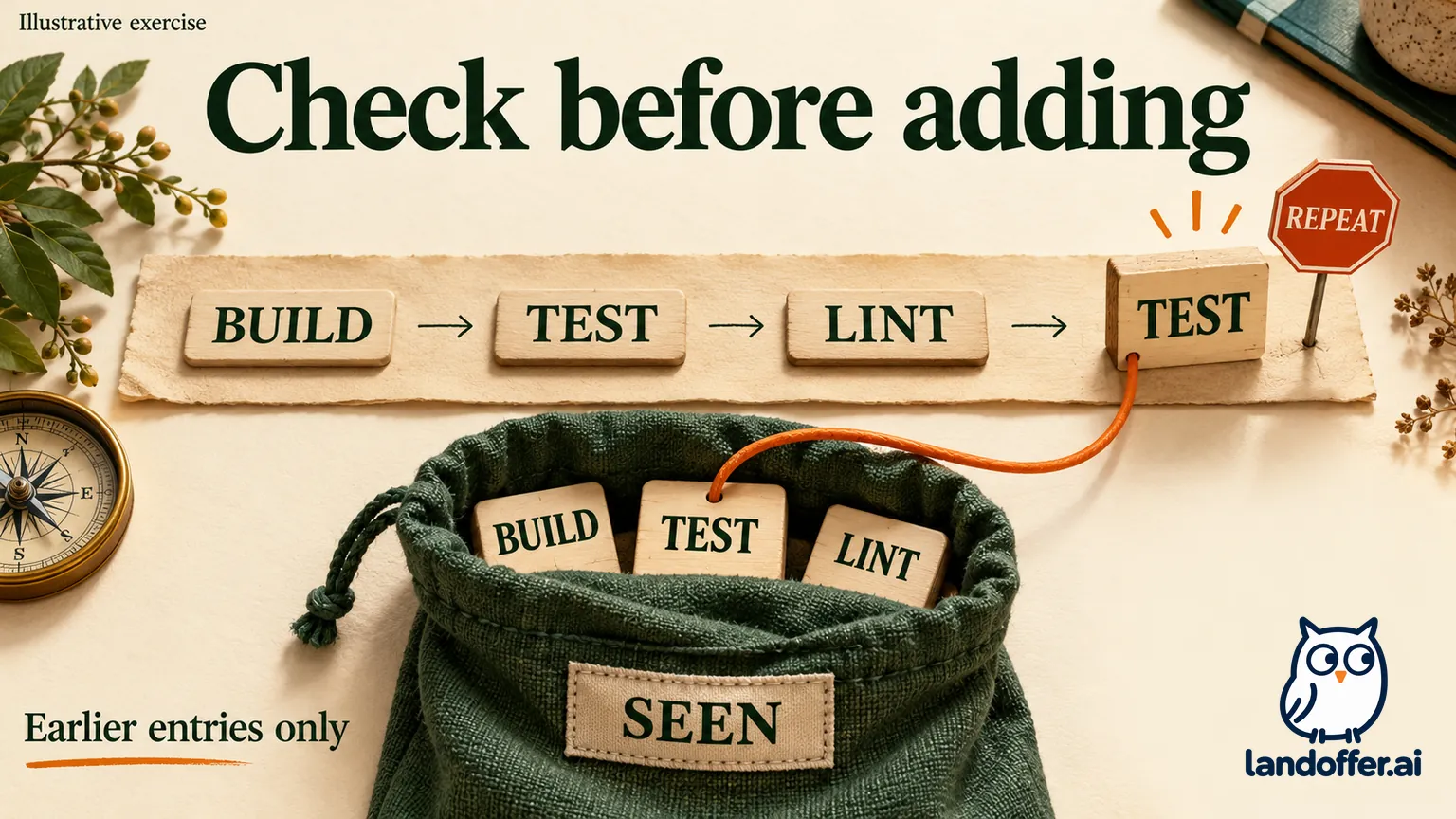
A build log contains job identifiers in arrival order. Return the identifier whose second occurrence appears first, or None if no identifier repeats. Inputs are strings. For ['build', 'test', 'lint', 'test', 'build'], the answer is 'test': its second occurrence arrives before the second 'build'.
A first attempt could compare every identifier with earlier entries. That respects arrival order but repeats comparisons, taking quadratic time in the worst case. Before reading the code below, ask what information from the processed prefix would answer the next membership question.
The useful observation is that the exact earlier positions are unnecessary. A set of previously encountered identifiers is sufficient. The invariant is precise: immediately before inspecting the current identifier, the set contains exactly the identifiers from earlier positions. Check membership first, then insert the current value. Inserting first would make every value look repeated.
def first_repeat(jobs):
    seen = set()
    for job in jobs:
        if job in seen:
            return job
        seen.add(job)
    return None
For the example, processing 'build', 'test', and 'lint' adds three values. The next 'test' is already present, so the function returns immediately. It never needs to inspect the final 'build'. The first return therefore corresponds to the earliest second occurrence, rather than alphabetical order or the earliest first occurrence.
| Input | Expected result | What it checks |
|---|---|---|
[] |
None |
Empty input reaches the final return |
['build'] |
None |
A value is not its own earlier occurrence |
['test', 'test'] |
'test' |
Adjacent repetition is detected |
['build', 'test', 'test', 'build'] |
'test' |
Second-occurrence order controls the result |
We checked the implementation locally against a separate quadratic reference across all 9,841 lists of length zero through eight over three identifiers. They agreed throughout that bounded input set. With ordinary hash-set assumptions, the algorithm uses expected linear time and up to linear additional space. That does not establish constant-time behavior for every possible hashing implementation.
Now close the solution and explain the invariant aloud. Change the requirement to returning all repeated identifiers in order of their second occurrence, each once. You would need to distinguish “seen before” from “already emitted”; returning early would no longer solve it. That small transfer task exposes whether you learned a reasoning tool or just memorized six lines.
Choose the access window from your actual calendar
The upgrade page displays one-time purchases, with no recurring subscription to cancel. Current listed prices are $249 for three weeks, $349 for 12 months, and $999 for lifetime access. The terms say prices are in US dollars and applicable taxes may be added. The figures below compare listed course prices before tax.
Here is a completed illustrative decision for two fictional candidates. Leah has 18 usable study days before an interview on day 19. Omar expects an eight-week preparation period with travel interruptions. Both have tried a public exercise and specifically want written derivation practice; neither needs a coach included.
| Candidate | Actual use plan | Decision at current listed prices |
|---|---|---|
| Leah | Twelve 75-minute sessions plus six 30-minute recall sessions: 18 hours across 18 days | Three weeks covers her planned use; $249 is the lower listed purchase |
| Omar | Three 60-minute sessions weekly across eight weeks: 24 hours | Twelve months at $349 covers the calendar; three weeks would end before his plan finishes |
Leah's plan is feasible only if the calendar really is concentrated. If her interview moves to week six and she buys a second identical $249 access period at the same listed price, two purchases total $498, which is $149 more than $349. That is a conditional comparison, not a quote for an extension. The FAQ says time can stack, but confirm the actual extension offer before relying on a particular price or duration.
Omar pays $100 more initially for a much wider window. The reason is predictable interruption and planned reuse, not a claim that he will finish more lessons or get a better job. For Omar, the three-week purchase leaves five weeks of his eight-week plan outside its initial access period.
Lifetime costs $650 more than the 12-month option today. The terms define lifetime as the service's lifetime and say access ends if the service is discontinued. Buy that option only if long-term reference use justifies the extra money under that limitation. It is not a guaranteed personal-lifetime archive.
Read the refund window separately from the access window
The homepage currently describes a 30-day refund period. The upgrade page repeatedly says five days, and the terms also say five days. These are conflicting official statements observed on the same check date. We cannot establish which promise the seller would apply to a particular transaction, and we did not request or receive a refund.
Before purchasing, ask support to confirm the refund deadline for the exact offer in writing. Keep that confirmation with the checkout terms and receipt. Until the discrepancy is resolved, do not budget around 30 days of evaluation or interpret the job-oriented marketing headline as an open-ended refund after an unsuccessful search.
The terms also limit the policy to one refund per customer and direct requests to the support email listed there. They say a request will not be honored after a customer submits and loses a card dispute. Those are specific stated restrictions; a broad money-back headline does not erase them.
For Leah, the practical review point is within the first few days, while the shorter stated window is still relevant. After two real sessions, she should know whether the intermediate explanations help her independently rebuild an answer. Waiting until the interview on day 19 would make her evaluation schedule incompatible with the five-day language, even though her course access might still be active.
Who should buy, wait, or choose another format?
Consider Interview Cake if you have basic coding fluency, can reserve uninterrupted practice time, and need a guided path from brute force to a justified improvement. The public lesson gives you a direct way to assess that fit before committing money. Prefer the access period that covers your realistic calendar, including planned review.
Wait if you have not yet attempted an accessible exercise. Also wait if the unresolved refund wording changes your willingness to pay. The vendor's testimonials and satisfaction language describe its marketing evidence; they do not measure your probability of receiving an offer or show that the course caused a salary increase.
Choose another practice format when your main gap is already clear: broad timed repetition, a particular employer's assessment environment, or feedback from a person watching you explain. A written course can contribute to preparation without supplying all three. Keep a free resource that already helps you derive and transfer solutions; buying access is useful only when it adds something your present routine lacks.
Start with one public problem, write your invariant before revealing the answer, and reproduce it later. If that independent recall improves, confirm the refund deadline for your offer before buying the access window your schedule supports. Then connect preparation to applications: browse recent roles on LandOffer.ai and inspect each role's actual interview expectations.
Sources and Further Reading
- Interview Cake upgrade page — listed prices, one-time access, paid boundary, and five-day refund wording.
- Interview Cake terms and conditions — refund restrictions, tax language, and service-lifetime definition.
- Interview Cake homepage — the conflicting 30-day refund statement.
- Course table of contents — publicly described curriculum structure.
- Apple Stocks public exercise — signed-out lesson and hint inspection.
- Free email crash course — advertised seven-day email option; not enrolled in this review.