LandOffer
Job search
Handshake AI Fellowship Review: US Eligibility, Project Terms, and Unpaid Setup Time
Handshake AI eligibility and earning rules differ from older broad overviews. Three fictional category decisions and a completed 165-minute ledger show authorization and compensation boundaries.
Handshake AI Fellowship is worth investigating when your work authorization fits its current policy, an actual project fits your expertise, and you can absorb unpaid setup and uncertain matching. The word fellowship does not establish an employee position or guaranteed paid hours. Review the project's terms before onboarding: initial account setup is unpaid, and project onboarding is compensated only when explicitly included.
This documentation review was checked October 13, 2026. It prioritizes Handshake's newer, dedicated eligibility and earning guides over broader older descriptions. We did not apply, sign a contract, task, or test payouts. All candidates and time records below are fictional. LandOffer publishes this review and offers recent tech roles; those listings require their own eligibility checks and do not demonstrate an advantage over Handshake.

Evaluate this AI program as its own opportunity
The application-to-project guide, updated June 18, 2026, describes matching fellows to AI lab projects. Applications enter matching, an invitation requests interest, selection follows, and project onboarding precedes approved tasking. Invitations typically contain the work, estimated duration, compensation, and participation conditions. There is no fixed invitation timeline.
That sequence changes what a developer should infer from an email. A request to express interest can be relevant and worth answering while still leaving selection unresolved. An assessment or work sample can demonstrate fit without reserving paid tasks. Record whether the message requests interest, confirms selection, or authorizes tasking, so you know which decision remains.
Inspect the requested output as carefully as the title. Someone hoping to build and maintain a software service should ask whether the assignment actually involves that responsibility. Evaluating responses, preparing examples, or reviewing technical reasoning can use coding expertise without providing ongoing product ownership. This is a distinction to investigate in the invitation, not a claim that every fellowship project has the same deliverable.
A relevant invitation can make your expertise useful on a specific AI project. The practical limitation is that project selection and continuity cannot be inferred from a complete profile. Your search plan should reflect both. Do not reserve a full workweek solely because you have entered the matching pool.
Use the current work-authorization guide
Handshake's dedicated eligibility policy, updated September 28, 2026, requires a US person to have an SSN or ITIN and supported work authorization. International participation is currently invitation-only. The policy supports citizens and lawful permanent residents; ordinary F-1 CPT or OPT is conditional. It currently excludes STEM OPT, J-1, H-1B, and TN. These are platform participation rules, not an individualized legal determination.
Read the exact category rather than relying on a loose phrase such as “student visa accepted.” Ordinary OPT and a STEM OPT extension appear separately in the current policy. A broad description of eligible students does not settle which category applies to an individual or whether a particular assignment can support it.
For CPT or OPT, the guide requires the relevant approval before accepting a project invitation or signing its contract and notes that project supervision may be unavailable. It says DSO letters are available only after an invitation to an eligible project. A prospective applicant should involve the appropriate school official and program support at that stage.
The timing can be frustrating: you need enough project information to evaluate authorization, but interest in a project should not become premature acceptance. Keep “request project eligibility information” separate from “accept project.” Having an SSN or ITIN does not by itself establish supported work authorization.
Three fictional candidates reach different decisions
Amir, Jo, and Lee are invented candidates, with only the limited facts stated here. These examples demonstrate how to read the current program policy; they do not determine real immigration eligibility, project acceptance, or legal compliance.
| Candidate's stated situation | Completed decision under the example | What remains unresolved |
|---|---|---|
| Amir is a US citizen with the required identifier | Continue reviewing a relevant invitation | Project selection, terms, and task availability |
| Jo has ordinary F-1 OPT and a project invitation | Request project support details and required school approval before acceptance | Whether this assignment and authorization can be supported |
| Lee is on a STEM OPT extension | Do not treat ordinary-OPT wording as permission to participate | Current program policy does not support that category |
Amir's citizenship resolves only the category question in this limited example. It does not establish that the project's skill requirements, schedule, or payment conditions fit him. He still reads the invitation before deciding whether the opportunity deserves preparation time.
Jo does not assume that receiving a message supplies approval. She preserves the invitation and asks about the exact project's supervision and documentation. If the necessary support cannot be established, she does not move forward merely because another student participated on a different project.
Lee's decision is specific to the program's current published boundary. This article does not recommend another visa category or a workaround. If his circumstances change, the facts and then-current policy would need a new review. An older generic introduction is insufficient evidence to override the dedicated rule.
These cases also show why sharing a referral link with a classmate is not an eligibility assessment. The same degree and coding skills can coexist with different authorization conditions. Resolve that gate before investing in project-specific preparation.
Initial setup, project onboarding, and tasking have different rules
The Earning on Handshake AI guide, updated June 18, 2026, says initial account setup and access-checklist work is unpaid and should not be tracked. Project onboarding is paid only when explicitly stated in Project Terms. Hourly task work can include required preparation, submission, and revisions, subject to a stated time cap and successful submission.
The same guide excludes optional meetings, community interactions, off-task communication, and technical downtime from payable activities. Meeting compensation requires the project's explicit terms. For uncertain activities, it directs fellows to ask the project lead before logging time and to consult section 4 of the Contractor Agreement alongside Project Terms.
The editorial implication is straightforward: “required to get started” does not by itself mean “paid.” An access checklist can be necessary while still excluded. A project briefing and general account setup can look similar on a calendar while following different rules. Identify the activity before assigning it a payment category.
A useful offer record has the project name, payment unit, rate, onboarding provision, task cap if any, and the permitted way to record work. For example, write “onboarding compensation not stated” when the terms do not explicitly include it; do not convert that gap into paid time. Do not enter a favorable guess because the program's marketing describes paid opportunities overall.
If an older overview appears to promise paid onboarding broadly, compare its audience and update date with this dedicated guide. For this review, the newer earning instructions define the documented boundary. Read section 4 of the Contractor Agreement and the exact Project Terms before accepting; this review has not inspected an agreement issued to your account.
A completed 165-minute time record
Rina is a fictional fellow on an invented hourly project. Assume her terms explicitly pay 45 minutes of project onboarding at $30 an hour and cap one assigned task at 60 payable minutes. She successfully submits that task. Initial account setup takes 30 minutes; onboarding takes 45; the task takes 90. There are no other payable activities or adjustments in this teaching case.
| Activity | Actual minutes spent | Eligible minutes in this example | Reason recorded |
|---|---|---|---|
| Initial account and payment setup | 30 | 0 | Initial setup is excluded |
| Project onboarding | 45 | 45 | Invented terms explicitly include it |
| Successfully submitted task | 90 | 60 | Invented task cap applies |
| Total | 165 | 105 | Keep actual effort and eligibility separate |
At the assumed rate, 105 minutes divided by 60 and multiplied by $30 gives $52.50 eligible gross compensation. Multiplying all 165 minutes by the same rate would produce $82.50, which the stated example does not support. Neither number is an actual Handshake offer or payment received by us.
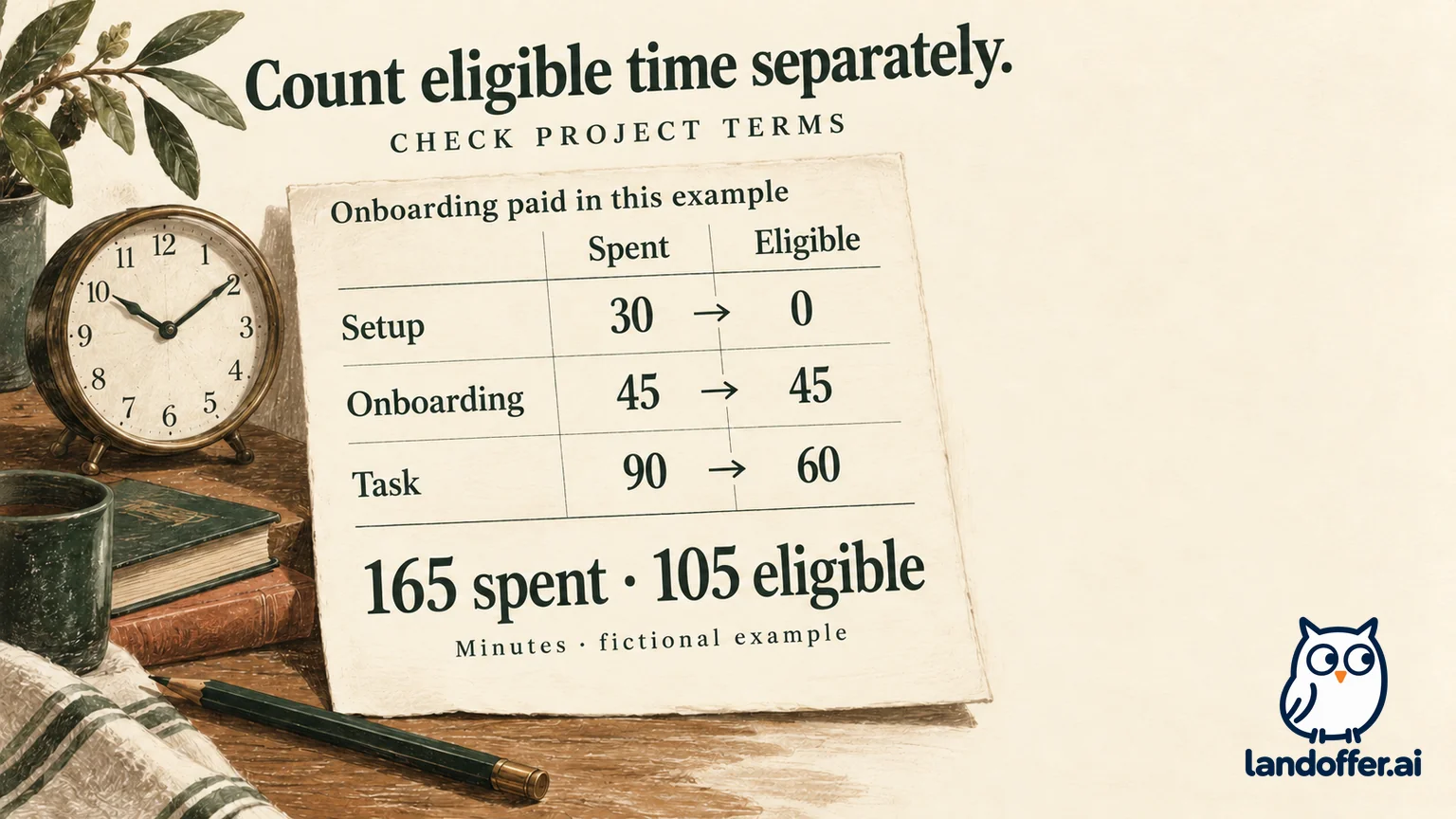
Rina's personal effort record still includes all 165 minutes. She needs that information to decide whether the work fits her available time. Her payable record follows the project's narrower rule. Keeping both records avoids the opposite mistakes of overstating billable time or hiding the real effort required.
The worked result changes her decision. She can afford one limited trial, but she does not schedule future work using $30 multiplied by every hour she is online. She first considers whether the task's difficulty and cap are workable for her. A larger task count would multiply the uncertainty if the preparation burden remains unresolved.
Now change one assumption: the same project does not explicitly offer paid onboarding. Her eligible minutes would fall to 60, or $30 gross under this invented rate. This sensitivity check explains why the onboarding clause matters before starting. It is not evidence that Handshake removed an actual promised payment.
A match, authorized work, and a payout are separate milestones
For Amir's fictional search record, an invitation becomes “interest requested,” his response becomes “interest submitted,” and a later selection message becomes “selected.” He records authorized tasking only when the project permits it. That vocabulary keeps a paused invitation from appearing to be an ongoing job.
The application-to-project guide says Handshake uses Stripe for payouts and requires a valid configured payout method before processing. We did not test payment timing, deductions, or resolution of a missing transfer. An account setup step and a payment receipt remain different pieces of evidence.
If Amir sees an amount associated with work, he compares it with the applicable unit and eligible activities before calling it received income. He uses permitted task references and dates for questions. He does not copy private lab material into an unrelated tracker or publish client examples as a portfolio without authorization.
The fellowship expectations guide, also updated June 18, says projects can start, pause, or end on short notice. That is relevant even after a successful first project. A favorable first payment does not establish that another batch will arrive on the same schedule.
Who should continue, and who should skip?
Continue investigating when you can establish supported authorization, demonstrate the specific expertise, and evaluate the compensation provisions before spending substantial time. A well-matched assignment may be useful project work. Its value should rest on the actual deliverable and terms rather than the prestige or familiarity of the Handshake name.
Skip or defer when a current eligibility gate does not fit, required project support remains unavailable, or unpaid preparation would displace work you urgently need. Keep a conventional employment search active when predictable employment is your goal. The program's contractor model should not be interpreted as a guaranteed replacement for that search.
For an existing fellow with suitable projects and satisfactory payment records, switching platforms is not automatically helpful. Compare the unresolved need: a different task type, a more usable schedule, or clearer terms. Another AI platform can introduce another qualification process without resolving the original constraint.
Before responding to the next invitation, record your supported eligibility basis and the project's paid activities, cap, and onboarding rule. Resolve authorization before acceptance, then clarify payable activities before logging project time. That creates a decision you can explain from evidence instead of a promise based on a program label.
For a separate employment search, browse recent roles on LandOffer.ai and use each employer's own authorization requirements.