LandOffer
Job search
GreatFrontEnd Review: UI Coding, Framework Support, and Interview Practice Plans
Match frontend interview practice to the actual UI task and framework rules; current public plans and a completed async-state example show what to verify.
GreatFrontEnd Interviews is worth considering when your preparation needs include building an interface, implementing JavaScript behavior, or discussing frontend architecture. Match it to the employer's actual round and framework rules. A generic algorithm queue may help with a stated DSA round, but it does not automatically cover UI state, browser behavior, or accessible interaction. Start with a public question and inspect the workspace before deciding that Premium adds work you need.
This review uses official sources and public pricing, FAQ, and question-page observations checked October 13, 2026. We inspected a Svelte starter workspace and its framework menu without changing code, submitting an answer, buying access, or viewing the paid solution. The two worked cases are fictional; the search-response model was checked in local JavaScript. LandOffer publishes this guide. Use recent tech roles and the employer's instructions to establish what you will actually be asked to build or explain.

Select the interview task before the practice list
The Get Started page organizes UI coding, JavaScript functions, frontend system design, quizzes, and algorithm practice. Its focus areas include async operations, forms, DOM manipulation, state management, and accessibility. These categories let you choose a task more precisely than treating every frontend interview as a React question or an algorithm problem.
A function exercise asks you to implement behavior with a defined input and output. A UI exercise also asks how users interact with the component and what they see as state changes. A design discussion asks how the client is organized and how it interacts with other parts of a system. The appropriate practice output changes with that task.
| Actual preparation need | Useful practice output | What a completion label alone misses |
|---|---|---|
| JavaScript behavior | Explain the contract, implement it, check changed inputs | Whether the approach transfers to a different requirement |
| UI construction | Build visible states and operate the interactions | Keyboard behavior, stale results, and empty or error states |
| Frontend design | Trace client state, data flow, and design tradeoffs | Whether you can defend the chosen boundaries |
| DSA coding | Implement and explain the required algorithm | The additional browser and interface work in a UI round |
This is an editorial task map, not a claim that every employer uses those four formats. Ask for the interview setup, permitted tools, and expected deliverable when the invitation is vague. A React role can still have an assessment that requires direct DOM work. Obtain the round's framework rule before choosing the practice environment.
Inspect a real public workspace and its framework boundary
We opened the public Transfer List question in Svelte. The page exposed the description, starter files named App.svelte and styles.css, a browser preview, and a framework chooser. The chooser listed React, Vanilla JS, Angular, Vue, and Svelte. We inspected the menu without switching frameworks or editing the starter.
The same page marked the solution as Premium and gated company signals. Bookmarking and cloud saving pointed to sign-in. That is a concrete public boundary: an exposed prompt and starter environment do not establish that the official explanation or every account feature is free. We did not test authenticated saving, the paid solution, or the platform's evaluation of a finished answer.
The inspected question also included accessibility requirements for its controls and keyboard operation. A visual match to the sample image therefore would not be the entire task. Read the selected question's current requirements rather than assuming that making something clickable satisfies them.
The pricing page advertises coding support for Vanilla JavaScript, React, Vue, Angular, and Svelte. The UI question directory provides a way to find relevant exercises. Confirm the environment on the individual question you plan to use; a platform-wide framework list does not establish identical coverage, versions, packages, or solutions for every exercise.
Worked preparation choice: Jordan has a vanilla JavaScript round
Jordan is a fictional React developer with an assessment in fourteen days, twenty study hours, and a $50 budget. In this example, the employer's instructions explicitly require a browser interface built with vanilla JavaScript. His day-to-day framework experience is useful background, but the assessment asks him to work directly with DOM events and state.
He writes a preparation map tied to that instruction:
| Work block | Hours | Completed planning decision |
|---|---|---|
| JavaScript and DOM refresh | 4 | Revisit event handling and how state reaches the rendered interface |
| Small UI implementations | 8 | Build in the permitted environment, including empty and disabled states |
| Async-state exercises | 4 | Explain and check stale-response and error behavior |
| Timed joint rehearsal | 2 | Build and narrate one complete task without consulting a solution |
| Review | 2 | Revisit the specific failure found in that rehearsal |
The total is twenty hours. This is Jordan's fictional allocation, not a GreatFrontEnd completion estimate or evidence that he is ready for the employer's assessment. The map makes his framework choice and the work he will review explicit. It reserves async and review time that an eight-hour block of visual construction alone could miss.
He starts with a public question to inspect the editor and prompt. If free material supplies the exercises he needs, he spends nothing. If he identifies a relevant paid question or explanation, the observed $39 monthly plan fits his budget and short window. The $85 quarterly, $120 annual, and $180 lifetime payments exceed his limit. He chooses a month only for the named paid increment.
Jordan does not buy GreatFrontEnd Projects to prepare for this timed task. The FAQ says Projects and Interviews are separate products with independent access. Building a portfolio project may be useful for another goal, but that does not make its subscription the same purchase as interview practice.
His completed choice is public inspection first, a vanilla JavaScript practice map, and at most a month of Interviews access. If the employer later permits a framework, he revisits the relevant environment. He does not infer permission from the job title or change his entire preparation plan because another framework appears in a menu.
Worked UI correction: the older response arrives last
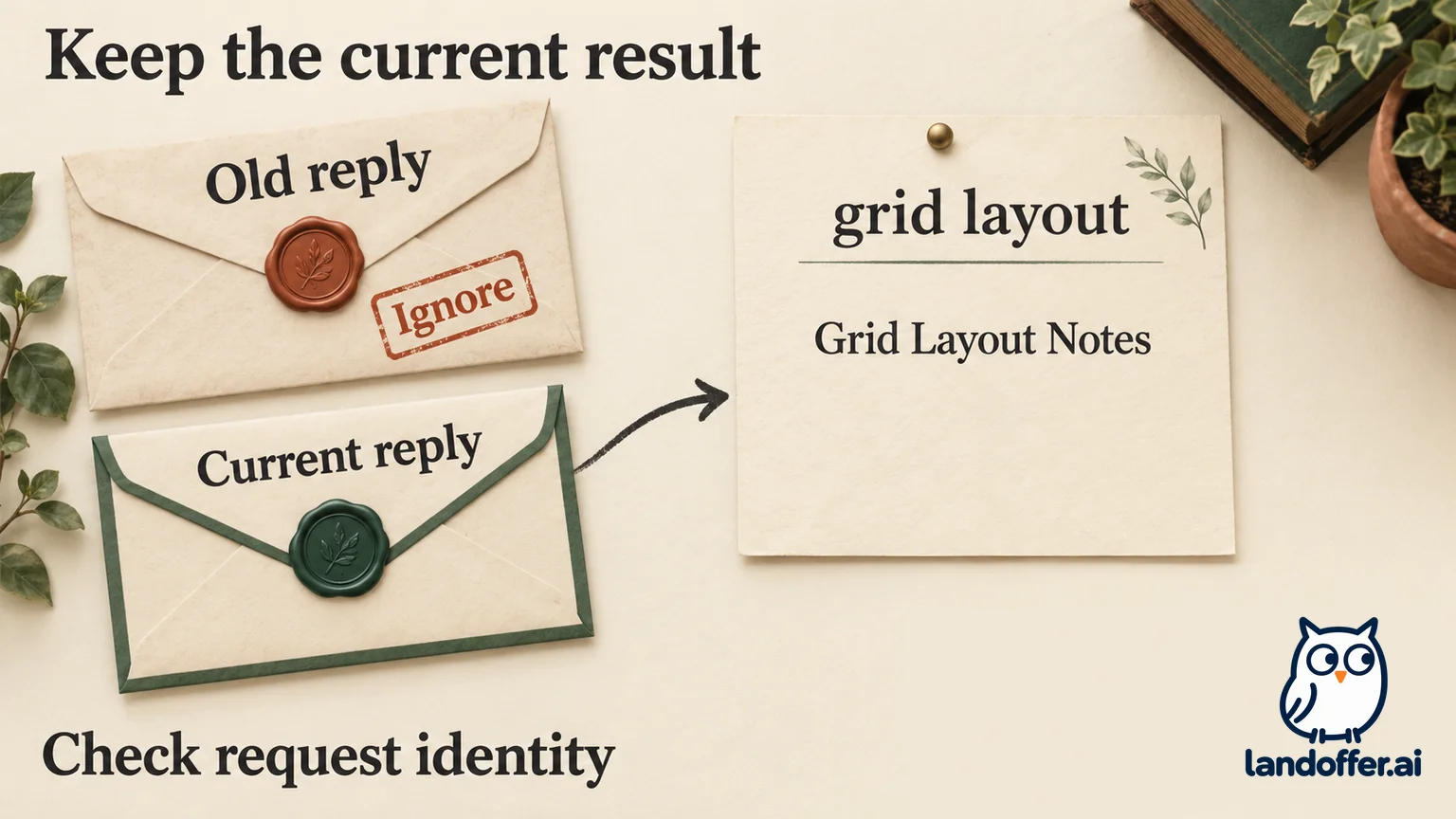
A small search interface can look correct while still showing results for the wrong query. Use an original fictional notes-search model. The current query becomes grid layout. Its response contains Grid Layout Notes. An earlier request for grid completes later with Grid Utilities.
An implementation that writes every completed response into the displayed results ends with the newer query beside the older result. The arrival order has replaced the meaning of the current input. A debounce delay alone does not establish which already-started response may update the view.
| Event | Naive result assignment | Assignment tied to the active request |
|---|---|---|
| Start request 1 for grid | Await a result | Record active identity 1 |
| Start request 2 for grid layout | Await another result | Record active identity 2 |
| Response 2 arrives | Show Grid Layout Notes | Accept identity 2 and show those notes |
| Response 1 arrives later | Replace results with Grid Utilities | Ignore identity 1; preserve the current result |
The revised teaching model increments a request identity when the query changes. It accepts a success or an error only when that identity still matches the active one. Rejecting an old error also prevents it from ending the newer request's loading state in this model. Clearing the query also changes the identity and clears the results. Otherwise a pending response could repopulate an input the user has already emptied.
We checked four local JavaScript scenarios: the initial late-response overwrite, retaining the latest result while ignoring the old response, clearing the query while an earlier response is pending, and ignoring a stale error while presenting a current error. The output files retain the current query and resulting state. These are in-memory state transitions, not actual fetch requests, browser interactions, or tests run in GreatFrontEnd.
Jordan's corrected explanation is: “The result belongs to the request that produced it. I track which request belongs to the current input before applying either its result or its error. A late response from an older input cannot replace the active result. Clearing the input also invalidates pending work in this model.”
That explanation gives him something to implement and check in a real component next. He still needs to decide how actual cancellation, timeouts, caching, component removal, and accessible status announcements behave. The local model isolates the arrival-order mistake. Jordan can investigate the remaining requirements separately before deciding whether this guard fits his component's lifecycle and data flow.
The lesson is broader than choosing a framework. A component can render attractive rows in React or Svelte and still have the same state error. Practice should include the changed-input and completion-order cases that reveal it. We did not copy a GreatFrontEnd prompt or solution, and we have not claimed that its editor or explanation produced this correction.
Treat study plans as scope suggestions
GreatFrontEnd's public roadmap offers one-week, one-month, and three-month study plans. The Get Started page recommends two hours daily, six hours weekly, and three hours weekly respectively. Those are published schedules, not measured completion times for you. The shorter plan's label does not remove the need to implement, inspect, and revisit difficult work.
For Jordan, the right question is which planned exercises fit his vanilla JavaScript assessment. A complete plan may contain useful topics outside that immediate need. He selects relevant exercises and leaves time to review their behavior, rather than scheduling every question in the larger plan.
Keep an attempt record that distinguishes an independent implementation from one completed with a hint or solution. After consulting an explanation, change a requirement and attempt the behavior again. For the search example, clearing the input or delivering an error from an older request gives you a different state transition to explain.
The platform advertises authored solutions and study-plan certificates. A certificate records completion under the platform's rules; it does not establish an employer's assessment of your implementation or communication. Similarly, company signals can help you select material, but we did not audit their coverage or establish that a listed exercise will appear in your next round.
Compare the payment and renewal with your calendar
The observed quarterly card displays $29 per month but bills $85 quarterly; use the stated billed total for the purchase comparison. The annual card displays $10 per month with a $120 yearly payment. The lifetime card displayed $180 paid once with $500 crossed out. These are public USD offers; we did not verify checkout taxes, account-specific discounts, or future prices.
A promotional popup and other discount offers appeared during inspection. We closed the popup to read the FAQ and did not apply a code or complete promotional tasks. An untested discount should not be the basis of your budget calculation. Confirm the final charge in the purchase flow if you choose to buy.
The current FAQ says monthly, quarterly, and annual subscriptions renew on their respective schedules. Lifetime is a one-time purchase. Cancel before the next renewal to stop the subsequent payment; access continues through the current paid period. Purchases are described as non-refundable, and paid content becomes unavailable after the subscription ends. We did not test cancellation or a refund request.
The inspected monthly card listed premium content and updates while active. The quarterly, annual, and lifetime cards additionally listed study-plan certificates and private Discord. These are public card descriptions; we did not test those entitlements. Do not assume that the monthly card grants every extra listed on a longer plan. Private-community access, where included, does not by itself establish a dedicated coach, a response-time commitment, or a personalized mock interview. We did not join the community or assess its support.
Choose a task, inspect a relevant public question, and write down the environment and UI behaviors you will check. Browse recent roles on LandOffer.ai, confirm the assessment instructions, and identify the specific paid material that would change your next attempt. Write one independent implementation check you will repeat after studying it. Then confirm the total payment, access period, and renewal date against the hours you will actually use; keep the free route when it already supplies that practice.