LandOffer
People Management
Write an Employee Performance Review That Connects Results and Behaviors
Write one employee’s review from the full period: connect agreed expectations, accepted results, observed behavior, and specific support using a completed example.
Write an employee performance review by comparing the person's work with the expectations communicated for the review period. Explain both the results and the observable behaviors behind them, using specific examples, appropriate context, and clear attribution. Then describe what should continue, what should change, and what support you will provide. A personality label or a list of deliverables cannot do that work on its own.
Start from the whole period and your organization's form, rating definitions, and review process. This manager-side guide from LandOffer.ai develops a fictional engineering case into usable review language. It is not an employee self-evaluation, promotion recommendation, disciplinary finding, or instruction to upload private employee records to an external service.

Establish the expectations and the evidence you can use
Confirm the employee's role, review dates, goals, and relevant behavior expectations. Identify changes agreed during the period: a canceled project, a revised deadline, different responsibilities, or a dependency outside the employee's control. Compare performance with those actual expectations rather than an idealized assignment that no longer existed.
MIT's Performance Reviews guidance recommends preparing from job information, self-assessments, prior conversations, and notes accumulated during the year. Its writing guidance emphasizes observable performance, examples, and actionable feedback. These are useful principles from one employer; your own company's current form and process govern the review you submit.
Build a short evidence outline before choosing polished adjectives. For each important judgment, identify the expected result or behavior, what happened, when it happened, and how you know. A deliverable record, your direct observation, and feedback from a collaborator provide different kinds of information. Preserve those differences instead of presenting every statement as something you witnessed.
Invite the employee's context through the established process. Their self-assessment can point to work you missed, but it does not replace your assessment. Where accounts conflict, check the relevant record or seek clarification. If the evidence remains incomplete, narrow the conclusion. A confident tone cannot make an unverified interpretation more accurate.
Describe results and behavior without collapsing one into the other
A result explains what happened against an agreed objective. Behavior describes how the employee acted while doing the work. They can reinforce each other, but a strong result does not erase a collaboration problem, and a communication concern does not erase an accepted contribution.
The University of Wisconsin–Madison's Manager Writing Guide, updated April 29, 2026, recommends tying comments to expectations, giving specific examples, and addressing behavior rather than personality. Its rating categories belong to its own review context. Do not import them as your organization's definitions.
Replace “not strategic,” “difficult,” or “a natural leader” with the action you can describe and why it mattered. “Requested the downstream team's input before finalizing the schema” is observable. “Has excellent judgment” needs supporting examples. Likewise, silence in one meeting does not tell you that someone lacks commitment or communicates poorly across their work.
Explain an observed effect without guessing motives. If a handoff omitted units and a teammate requested clarification, you can describe that exchange. Unless the record establishes the consequence, do not turn it into a quantified delivery delay or lost revenue. The behavior can be worth improving even when no financial effect has been measured.
Completed rewrite: from labels to reviewable observations
All names, records, dates, and outcomes in the following teaching case are fictional. Devon Lee is a Data Engineer whose manager, Priya, is writing a January 1–June 30 review. No private employee file, review system, or real colleague feedback was accessed.
The invented expectations were to deliver three approved metric dictionaries and include field definitions, units, and ownership information in handoffs. Two dictionaries met their original dates. The third met a revised date agreed after a source-system dependency changed. Two April–May handoffs omitted units; in two later June handoffs, the fictional manager's notes record the required units. These stipulated facts support mixed, specific feedback within the example, not a judgment about a real employee.
| Initial comment | Completed rewrite grounded in the fictional case | What the rewrite preserves |
|---|---|---|
| “Devon delivered everything perfectly.” | “Devon delivered three accepted metric dictionaries; two met their original dates and the third met its agreed revised date after the source dependency changed.” | Completion, acceptance, and deadline context; no claim of perfection. |
| “Devon is careless with details.” | “The April 2 and May 7 handoffs omitted units required by the agreed handoff checklist. The receiving analysts requested clarification before using those fields.” | Specific omission and observed response, without a personality diagnosis or invented delay. |
| “Collaboration improved a lot.” | “The June 4 and June 18 handoffs included units in the versions recorded in my review notes.” | A bounded later observation; it does not establish every handoff was complete. |
| “Devon needs to communicate better.” | “For the next two handoffs, include units and the field owner before requesting review. I will provide a completed example and review the first draft with you.” | Changeable action, limited observation window, and manager support. |
The table is a finished wording exercise, not a prescribed rating. It shows how praise can become more accurate as well as how criticism can become more useful. Removing “perfectly” gives Devon credit for the work actually accepted; removing “careless” avoids claiming knowledge about an enduring personal trait. Devon can now identify the handoff behavior to change, while another reviewer can trace the manager's judgment to a specific example.
The June examples are encouraging, but two examples do not prove a permanent change. Keep the review's claims proportional to its evidence. Recognize the later work while asking for continued consistency. An employee who corrected a problem should be able to see that effort reflected in the account; repeating only the earlier concern would omit part of the period.
Write a complete assessment that carries the same evidence
Once the evidence outline is sound, arrange the review around the most important responsibilities. Explain the period's overall pattern, then the examples that support it. Connect development points to a clear expectation and a feasible next step. Use your required rating definitions if a rating is necessary; the paragraph should explain that judgment rather than contradict it.
If a form asks for a rating and a narrative, review them together. A narrative that describes several unmet responsibilities cannot explain an unqualified top rating unless the applicable definition and context support it. Conversely, one isolated development point does not determine the whole-period rating by itself. Apply the actual definition, assess the importance and pattern of the work, and explain the connection. Do not invent a numeric averaging rule for a system you have not checked.
Here is Priya's completed fictional written assessment. It intentionally contains both recognition and an unresolved development point:
During January–June, Devon delivered the three metric dictionaries agreed for the reporting-data project. The accepted versions establish a consistent reference for the fields covered by those dictionaries. Two deliverables met their original dates. The third met the revised date we agreed after the source-system dependency changed. I assess that work against the revised plan, rather than treating the approved change as a missed commitment.
Devon's contribution was defining the fields, resolving review comments, and preparing the dictionary handoffs. The analytics leads approved the definitions, and the source-system team owned the upstream changes. This review recognizes Devon's contribution without assigning the entire project's outcome to one person. We did not measure a revenue or processing-time effect from the dictionaries during this period.
Handoff completeness was inconsistent in April and May. The April 2 and May 7 versions omitted units required by our checklist, and the receiving analysts requested clarification. We discussed that expectation after each handoff. The June 4 and June 18 versions recorded in my notes included units; that is a useful improvement to recognize, while continuing to check consistency.
For the next two handoffs, Devon should include the field definition, units, and field owner before requesting review, and explicitly flag information that remains unknown. I will supply an annotated completed example and review the first draft with Devon. We will discuss the two handoffs at our August 6 check-in and decide whether this support should continue or change.
Before finalizing this review, I would like Devon to identify any relevant context or contribution missing from this account. If a record changes the factual description, I will correct it. We will retain any unresolved difference through the organization's review process rather than describe a disagreement as a settled fact.
The example is complete prose, but it is not a substitute for an employer's form or required overall rating. It makes the basis of the assessment visible and does not imply promotion, a pay change, or formal disciplinary action. The August date is an invented follow-up point, not a recommended company schedule.
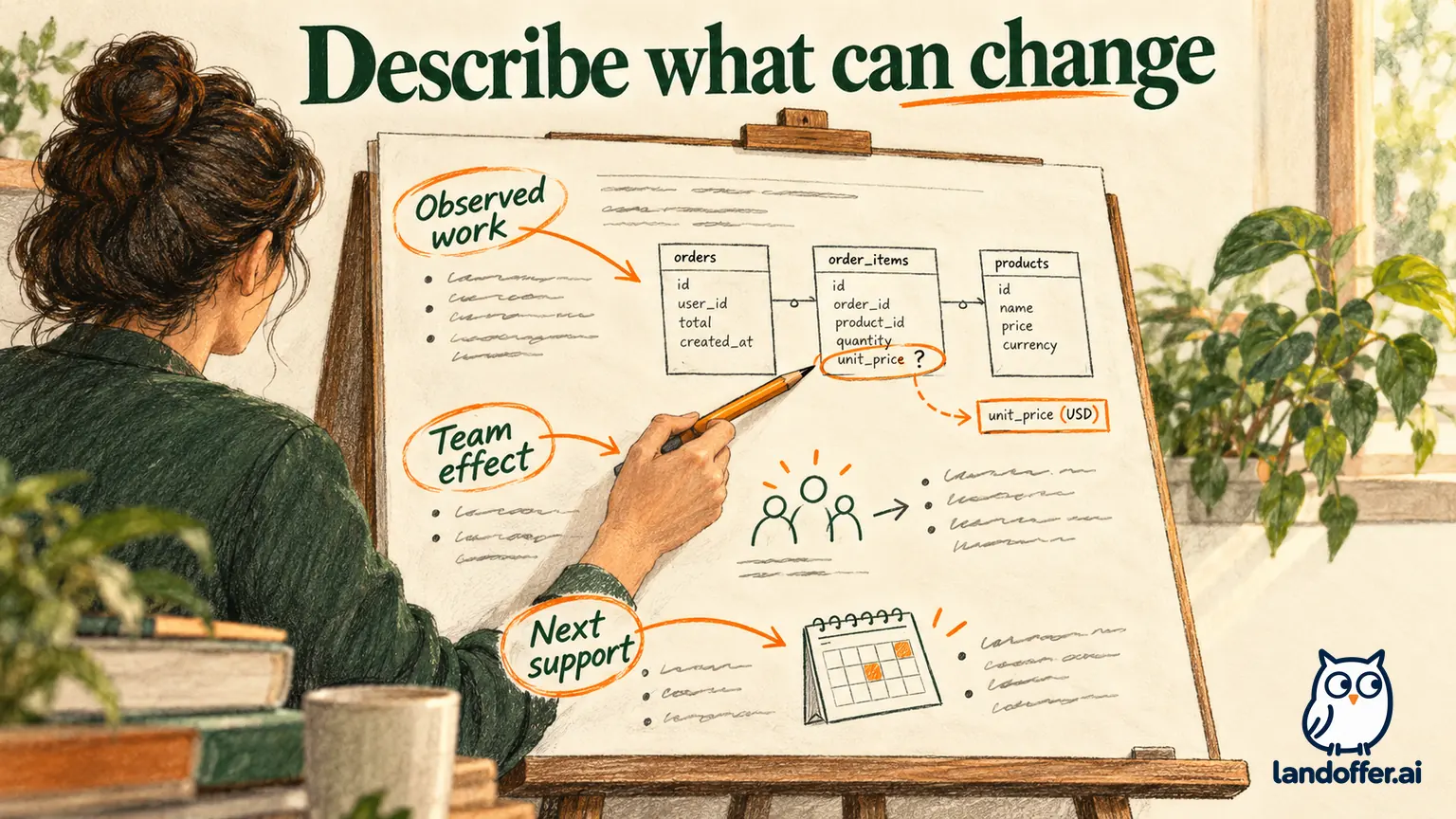
Test for recency, attribution, and inconsistent standards
Read the draft against notes from the beginning, middle, and end of the period. A recent mistake can dominate memory, just as a recent success can make earlier difficulties disappear. If the examples all come from the last few weeks, check whether that reflects the assignment window or a gap in your evidence collection.
Review similar work against the same communicated standard. Do not praise one employee for being “assertive” while calling the same observable behavior “abrasive” in another without explaining a relevant difference. This check is about the reasoning in your review, not assigning comparative ratings across an entire team. Follow your organization's calibration process separately where required.
Distinguish the employee's behavior from the conditions you controlled. If you did not provide access, a decision, or a usable requirement, include that context before assigning responsibility for the outcome. Context does not automatically excuse every missed expectation, but excluding it can produce an inaccurate account.
Finally, ask whether each adjective is doing work that an example should do. Keep concise evaluative language where your form requires it, supported by the record. Remove claims about attitude, motivation, health, or personal circumstances that you cannot substantiate and should not be evaluating in this document. Use your organization's advice route when a sensitive issue needs specialist handling.
Make the next steps a shared responsibility
MIT's Ongoing Coaching and Feedback guidance emphasizes specific, changeable actions and continuing two-way conversations. Use that principle to connect the written review with support during the next period. A request to “improve” offers little direction unless the employee understands what action will be different and how you will help.
For each important development point, name the behavior, the opportunity to practice it, your contribution, and the check-in. In Priya's case, the employee supplies more complete handoffs, while the manager provides an example and an early review. If the next assignments change, revise the observation plan rather than judging Devon against work that never occurred.
Prepare to hear a correction during the discussion. Ask what context is missing and which next step is unclear. For a factual correction, identify the sentence, the supporting record, and the change needed; for an unresolved interpretation, record the disagreement through the permitted process. A submitted document or acknowledgment does not necessarily establish agreement with every sentence; use the meaning specified by your organization's system.
Before you submit, take one positive comment and one development comment through the same test: expectation, observation, effect, and next step where needed. Revise any sentence whose meaning depends on a personality label or an unsupported outcome. Keep that working draft in the authorized location while resolving factual questions. This guide is from LandOffer.ai; the final review belongs in your employer's authorized process, with access limited appropriately.
Sources and Further Reading
- UW–Madison Human Resources: Manager Writing Guide for Performance Review Comments — specific, expectation-based comments; updated April 29, 2026.
- MIT Human Resources: Performance Reviews — preparation across the period, observable performance, examples, and actionable feedback.
- MIT Human Resources: Ongoing Coaching and Feedback — specific actions, observations, and ongoing two-way conversations.