LandOffer
Job search
Employbl Review: Company Funding Data, Tech Stacks, and Verified Job Links
Trace company funding and job-derived technology signals to primary sources, then check the actual employer role and current access terms.
Employbl is useful when you want company context alongside a job: financing history, technologies mentioned in hiring, investors and related openings. Its value depends on keeping those signals separate. A funding round is not a cash-balance statement, a company technology tag is not an individual role requirement, and an ATS-derived link still deserves a check at the employer's destination.
This review checks public pages on October 20, 2026, including current access terms and a completed Waymo company-to-job source trace. No account, subscription, application, AI-chat request or integration was created or tested. For a second source of opportunities to compare against the same criteria, browse recent jobs on LandOffer.ai.

What Employbl adds to a job search
The current Employbl overview presents a tech-company dataset with funding, technology, hiring and team information. Use company, investor, location and stack filters to discover organizations, then assess their individual openings. Its map is primarily company geography; an HQ pin does not establish where every employee works.
The product describes technology stacks as extracted from job descriptions rather than simply self-reported. That makes the stack useful as a discovery index, with an important limit: a technology mentioned in hiring can belong to one team, appear as an alternative or be part of an experience requirement. It does not necessarily describe the architecture of the role you would join.
Employbl also advertises saved jobs, company watchlists, an application tracker and research chat. Those are documented features, not tools this review exercised inside an account. There is no measured application-time saving, recommendation accuracy or hiring advantage established here.
Current candidate access differs from older membership articles
The current pricing page says new candidate accounts are free without a card or expiry. It lists company research, jobs, saved-search alerts and tracking, with five AI-chat messages daily. Public pages can show useful research before registration, while some sections explicitly invite you to create a free account for fuller access.
The same page says Candidate Premium is no longer sold to new accounts. It describes existing subscriptions at $25 monthly or $250 annually as continuing, with uncapped chat as the extra. A new visitor should therefore not treat an old paid-membership or lifetime-access article as today's purchase requirement. Existing subscribers should check their own active plan; this review verified public wording and did not inspect private billing.
Company Premium is separate. The observed founding offer was $67 total for one year, alongside an $804 annual list price. The later $804-per-year ladder is also expressed as $67 per month billed annually. Those are different amounts and stages of company pricing, rather than a $67 monthly charge for the current founding offer. A job seeker need not buy a company's branding product to research roles.
The public page contains inconsistent API-quota wording, including uncapped access in one section and a 100-call allowance in another. This review does not promise an integration allowance. No MCP connection, API key or installation was attempted.
Read funding as a source trail
A useful funding record names the company, amount, date and underlying announcement or filing. Record the funding event date separately from the date you checked the profile. A round announced months ago can be relevant background without being a new event this week.
Employbl's public Waymo profile listed a $16 billion February 2, 2026 funding event and linked to Waymo's own announcement. The company announcement confirms that amount and date. That is a stronger trace than repeating an unlabeled “recently funded” card.
It still does not establish today's cash balance, burn rate, revenue, profitability or budget for a particular team. Total capital raised is not interchangeable with money remaining. You cannot calculate runway by dividing a historic fundraising total by an assumed monthly burn and presenting the result as company information.
This matters when ranking employers. Funding can suggest a company worth investigating; it cannot guarantee organizational stability, a funded requisition or protection from future restructuring. The next useful evidence is the specific opening and its actual requirements.
A completed company-to-employer audit
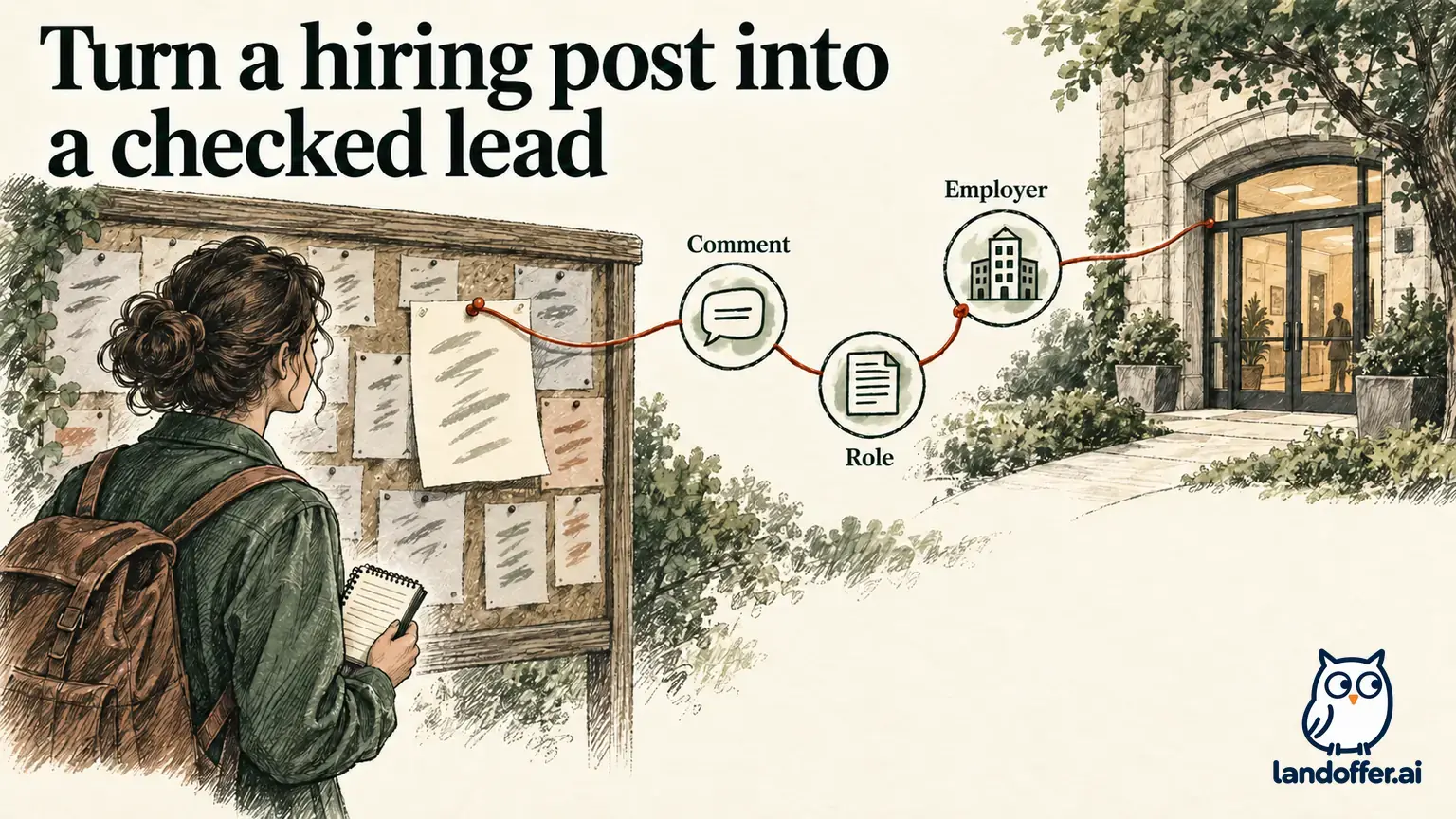
For a bounded test of the research route, I followed one Waymo role from Employbl to the employer. The Employbl job page identified Senior Machine Learning Engineer (Infra), Driver Understanding and Evaluation, displayed an October 2 update and exposed a job URL with gh_jid=7819951.
That destination resolved to a Waymo careers description with the matching title, Mountain View location and employer reference 4757. Its body described large-scale ML infrastructure, model training and evaluation. I read the public description without opening an application or submitting information.
| Signal under review | Source check completed | What the check actually establishes |
|---|---|---|
| Funding event | Employbl entry followed to Waymo's dated $16 billion announcement | Amount and announcement date supported; current runway remains unknown |
| Company stack | Profile describes technologies extracted from tracked job postings | Search context across company hiring, rather than a complete team architecture |
| Individual role identity | Employbl title and external ID matched the Waymo destination, employer reference 4757 | One functioning employer-description route at the time checked |
| Role substance | Employer names ML infrastructure and distributed-training experience | More specific work requirements than a broad company Python or cloud tag |
| Location | Employer description identifies Mountain View | No verified permission here for a New York-only remote arrangement |
The employer body asks for five or more years of ML-infrastructure experience and contributions to relevant tooling. It names distributed training techniques such as gradient sharding. Those requirements are not satisfied merely because someone has used Python or because Employbl places the company in a matching stack filter.
This one-company audit confirms a functioning source chain at the time checked; it does not measure freshness across Employbl. It does not establish how quickly every closed job disappears, whether the team is still interviewing, or whether a particular candidate meets all conditions. Repeat the destination check when you actually decide to apply.
What “verified” should mean in your notes
Employbl's job-search product page describes direct synchronization from Greenhouse, Lever and Ashby and makes strong claims about removing closed listings. Treat those as the provider's description of its collection process. This review did not monitor the feed over time or deliberately close a test vacancy to measure removal latency.
A usable link to a real employer is valuable evidence, but it answers only part of the question. It does not prove the date of original publication, the employer's internal approval status, how many candidates it has, or whether the recruiter intends to hire immediately. A relative “posted” label and a page-update date can describe different events.
In the Waymo example, keep Employbl's October 2 update as an Employbl timestamp. Do not silently relabel it as the employer's original posting date. Likewise, a salary band in an aggregator brief is best checked against the employer's own compensation wording before becoming a personal expectation.
The Waymo employer body listed a US base-salary range of $213,000–$263,000, with starting pay dependent on job-related factors. That is a published range, not a guaranteed offer or a total-compensation calculation. No equity package or individualized salary discussion was verified.
Worked example: keep company interest separate from role readiness
Consider Devon, a wholly fictional ML-infrastructure engineer with six years of relevant work, including distributed PyTorch training and deployment. He wants a New York-based remote arrangement and is unwilling to relocate to Mountain View. These are stipulated preferences and experience, not facts about the reader or a finding that he qualifies for the vacancy.
A company-level search could make Waymo interesting to him: relevant technologies, a traceable funding event and a role involving ML systems. His completed research packet nevertheless distinguishes information that is answered from information that remains missing:
| Question in Devon's packet | Completed finding | Decision recorded |
|---|---|---|
| Is there a sourced funding event? | Yes: amount and date trace to Waymo's announcement | Retain as company background, without inventing cash runway |
| Is the actual role technically relevant? | Employer describes large-scale ML infrastructure and distributed training | Retain for substantive comparison; do not infer full qualification |
| Is New York-only remote work approved? | Mountain View is listed; no specific approval for his requirement was verified | Hold this role rather than treating a general company location or remote-related footer as permission |
| Does the listed range settle his offer? | It is a published US base range, with individual factors | Do not turn the top of the range into expected compensation |
| Is a paid candidate plan needed for a new account? | Current pricing describes free candidate research | No purchase decision is needed for the documented new-account research layer |
His finished shortlist has two different statuses: company worth following; specific role on hold for location. That is more useful than a single “strong match” label that conceals a nonnegotiable requirement. He has not applied, contacted an employee or changed his resume to imply autonomous-vehicle experience.
His unsent clarification note is precise: “The role is listed in Mountain View. Before I consider applying, is there an approved New York-based remote arrangement for this specific requisition?” It asks about an unresolved term rather than claiming that company-wide remote work exists for every team. The clarification is an unsent fictional note; no employee or recruiter was contacted.
Devon can continue looking for another relevant role without discarding the company research. Conversely, a future answer permitting his location would resolve that one question, not every qualification, work-authorization or compensation issue. Separate fields let him retain useful company research while keeping an unresolved role requirement visible.

Public research has access and provenance limits
The inspected Employbl job page displayed some account-gated profile sections while exposing a role description and the external employer link. A “free with an account” label describes registration, not proof that every section is publicly available without one. No hidden section, interview rubric, hiring-manager identity or team plan was verified here.
One direct company-profile visit showed a browser security checkpoint, and direct automated fetches returned rate-limit responses. Those blocks were preserved; no challenge was solved or bypassed. The review used the readable public profile extract, current native pricing/job bodies and the employer's own announcement and careers page. It does not pretend that every route loaded consistently.
Company branding is another provenance distinction. The pricing page explains that companies can pay to publish their own profile content. A company-authored story, Employbl-maintained data and an employer's job description are different kinds of evidence. Read a claimed profile as a source to evaluate, rather than treating the ability to publish it as an independent endorsement.
When Employbl is useful
Use Employbl to discover companies and assemble research questions, especially when stage, sector or technology matters to your search. Follow the funding source, inspect the actual role and keep location, experience, compensation and unresolved facts in separate fields.
Its current free candidate offering makes a new paid-membership decision unnecessary for the documented research layer. Judge the research layer by whether its company context answers questions that matter to your own shortlist. Compare those leads with LandOffer.ai, and return to the employer before acting on a “verified” listing or a promising company tag.
Sources and Further Reading
- Employbl overview, current pricing and job-search sourcing description.
- Waymo company profile and Employbl ML-infrastructure role.
- Waymo funding announcement, February 2, 2026 and employer job destination, ID 7819951.
Public sources checked October 20, 2026. Single-company audit only; no account, purchase, integration, application, employer contact or hiring outcome was tested.