LandOffer
Job search
How to Use Hacker News Who Is Hiring to Build a Verified Tech Job Shortlist
Use Hacker News Who Is Hiring to preserve role comments, verify employer links, check location restrictions, and build a shortlist with visible unknowns.
Use Hacker News Who Is Hiring as a source of dated employer leads, then verify each role before adding it to your application queue. Save the individual comment, extract location and responsibility details, and follow the stated employer route. A monthly post can be useful and still leave an opening's current status unresolved. Keep an unconfirmed opening in a clarification list until its current role and application route are established.
LandOffer publishes this guide and offers recent job discovery. We read the October 2026 thread, HN's own rules, and one linked employer destination on October 13, 2026. The PrairieLearn check below is a limited public observation. Rohan's other leads and correspondence are fictional teaching examples. We did not verify poster identities, contact employers, or submit applications.
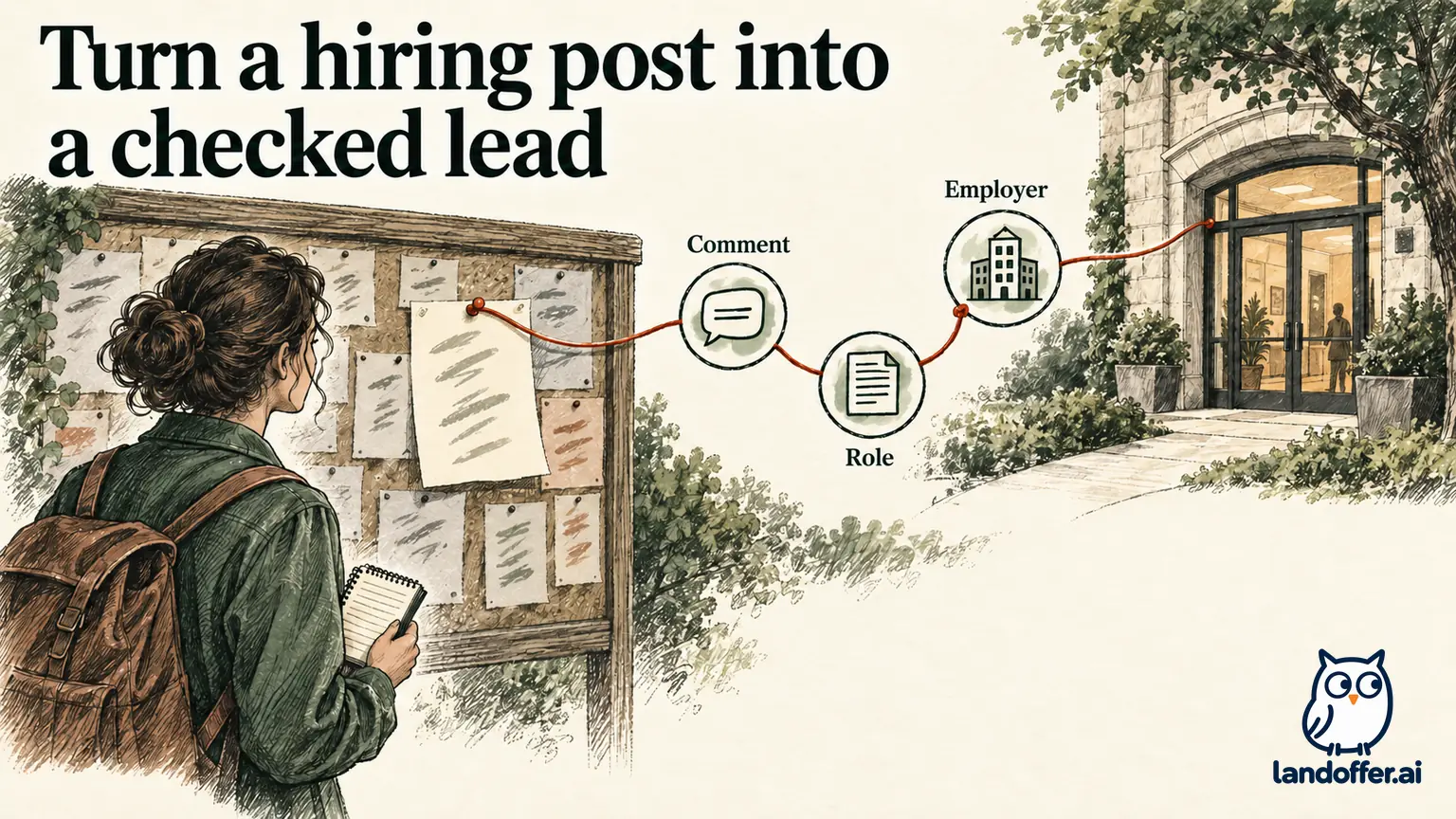
Find the official monthly thread and preserve the specific comment
HN's FAQ says the regular Who Is Hiring thread appears on the first weekday of each month, with a January exception, and only the whoishiring account can submit that thread. The FAQ separately describes HN's Jobs section for YC-funded startup advertisements. These are different discovery surfaces, so save which one produced your lead.
At our check, the current October 2026 thread asked posters to include location, identify remote restrictions, and post only if personally part of the hiring company. It also asked for active openings and a commitment to reply. Those are instructions to contributors. They are not evidence that HN independently authenticated every poster or audited every hiring process.
Save a link to the particular comment rather than only the long monthly thread. HN comment timestamps link to the individual item. A specific source helps you return to the company's wording, distinguish several roles in one comment, and see any later clarification in context.
Record the thread month, comment link, employer job ID when supplied, and the date you checked the lead. A post from a previous month can remain useful, but the older date increases the need to verify current instructions. Conversely, a newly posted comment does not eliminate that need. The employer may change a role or application destination after publication.
Third-party search tools can help locate terms in a large thread. Follow a search result back to the original comment before using its details. A search result excerpt can omit a country restriction or an application instruction. Do not build the entire application decision from a shortened index entry.
Extract the constraints before judging the company pitch
Read the job-bearing details first: role, responsibilities, location, allowed countries, collaboration expectations, employment arrangement, and the stated application method. A company description can explain the product, but it does not establish whether the job fits your circumstances.
Treat REMOTE as an initial category. If the comment says REMOTE (US), a candidate outside the permitted location needs a different decision from someone who can work there. If a post gives no region or hours, mark those fields unknown. Worldwide wording still deserves a reading of any detailed constraints in the linked posting.
Compare technical scope with evidence from your work. A comment mentioning Python may describe a production service, a data-analysis task, or a research prototype. The same keyword can point to different responsibilities. Identify what you would need to explain in an interview before deciding that the stack makes it a match.
Application instructions deserve their own field. Some posters provide an employer form; others name a recruiting email and request particular material. Following an existing route is usually more useful than sending the same generic message to every person who mentioned a technology. The thread asks readers to email only when personally interested in the job.
A real check can end with an unresolved opening
The October thread included a PrairieLearn comment describing a full-stack software role with a US-only remote condition. The commenter supplied an employer-site application link. This is an attributed public posting, not an independent verification of the poster's identity or the opening's current status.
We followed the supplied link to PrairieLearn's Jobs destination. Both the web extraction and ordinary-browser accessibility view showed the company Jobs page shell. In that observation, the specific role details and application controls did not appear. We did not log in or fill any fields.
| Evidence field | What the completed check established | What remains unknown |
|---|---|---|
| Original source | Specific October thread comment retained | Whether later instructions change |
| Location statement | Comment describes US-only remote work | Any additional current employer conditions |
| Destination | Supplied link reaches a PrairieLearn Jobs page | Whether the linked opening is currently available |
| Application controls | Not visible in the observed page | Why the role content did not appear |
| Submission | None attempted | No application receipt or employer response |
The correct record is “employer destination reached; live role unconfirmed.” An empty job area can have several explanations, including rendering limitations or a changed opening. We do not label the role closed, lost, or fraudulent from that observation.
For a real candidate, the next action would be to inspect the employer's current public career route or use an appropriate verified recruiting contact to clarify the exact opening. Until a usable role and route are established, keep it out of the ready-to-submit group. The check identifies exactly what is missing. A candidate who must remain in Toronto can already set aside the comment's US-only role under that stated condition. A US-based candidate may still need the live opening confirmed. The same source can therefore end one candidate's investigation while leaving another with a specific next step.
Rohan builds a shortlist with three different stopping states
Rohan is a fictional backend engineer based in Toronto. He wants employee work he can perform from Canada and can overlap with Eastern Time. His strongest evidence concerns Python services, SQL, and integration tests. Three fictional hiring comments catch his attention.
| Fictional lead | Comment and destination evidence | Completed decision |
|---|---|---|
| Alder API-83 | Canada permitted; employer page shows the same role and application form | Keep for role-specific material review |
| Birch ENG-19 | Remote US-only; otherwise relevant backend duties | Exclude for current location |
| Cedar DATA-26 | Data-service role; company page found, but employment arrangement unspecified | Keep as a clarification task, outside the ready queue |
Rohan has one ready lead, one exclusion, and one unresolved lead. He does not count them as three applications or three equally useful opportunities. He also saves the original comments, because an employer page alone would not preserve the source's particular instructions.
For Alder, he compares the role identifier, location, and duties across the comment and employer page. The matching title helps, but the job ID and responsibilities do more to establish that both sources concern the same opening. He checks his existing records before starting a new form, since he might already have discovered Alder elsewhere.
For Cedar, he drafts a narrow question through the stated verified contact route: “Does DATA-26 support an employee based in Ontario, and is the opening employee work or a fixed-term freelance engagement?” In the completed fictional continuation, the employer replies that it is a project engagement. Rohan moves it out of his employee-role queue while retaining the reply and original lead.
The result demonstrates a useful distinction: clarification can produce an exclusion rather than an application. That does not make the search unsuccessful. It prevents Rohan from spending tailoring time on work that conflicts with his intended arrangement.

Prepare the application the poster actually requested
Suppose fictional Alder's current instructions request a resume, the job ID in the subject, and one relevant project example by email. Rohan prepares those materials instead of pasting a general introduction into a public reply. He verifies the contact against the employer's public route before preparing the message.
His fictional email draft reads:
Subject: Backend Engineer API-83 — Rohan Mehta
Hello Alder team, I found API-83 in your hiring post and reviewed the employer description. I'm based in Toronto and am interested in the backend service work. In my recent role, I implemented reconciliation endpoints in Python, added integration tests, and investigated inconsistent SQL import records with the operations team. I've attached my current resume and included a shareable project link below, as requested. Thank you for considering my application, Rohan.
The message connects the source to one opening and states relevant work. It does not claim that Rohan designed a whole platform, achieved an invented performance improvement, or has an employee referral. The project link would need to be an actual accessible example in a real application; the illustrative draft contains no invented live portfolio URL.
Before sending, Rohan opens the selected attachment and checks the link's public view. He confirms that the document's dates and responsibilities match the message. If the employer instead requests a form, he follows that route and its required fields rather than assuming the email draft is an acceptable substitute.
This example ends with a prepared draft, not a sent application. In a real search, record submission only after sending through the intended route, and retain the corresponding evidence. A saved draft or an opened form is a different state.
Respect the thread while keeping applications private
HN's guidelines govern public submissions and comments. They ask for substantive, considerate discussion and prohibit generated or AI-edited public text. The hiring thread also asks readers not to turn job replies into complaints. Read the current rules if you intend to participate publicly.
Applying to a job is a separate task from commenting on the thread. Use the employer's designated channel for application materials. Do not place a resume, private contact details, or an application explanation into a public comment merely because that is where you discovered the opening.
Keep outreach tied to real interest. A personal recruiting address in a comment is not an invitation to add the person to a marketing list or send unrelated requests. Select the role first, prepare the requested evidence, and avoid repeated messages that ignore the poster's process.
If a company changes its instructions, save the update with the record. Keep the original wording and add a dated update explaining what changed. A dated note can explain why you moved from an email route to a current form or stopped pursuing an opening.
Recheck the ready leads when you are about to act
Before submitting, revisit the employer destination and the latest instructions you have. Confirm the role, location, requested materials, and any deadline. A shortlist prepared earlier is a set of leads to review, not an instruction to send automatically after conditions change.
Use distinct stopping states: ready for material review, needs clarification, excluded, closed with evidence, and submitted with evidence. The names can be simple. Their purpose is to prevent an unresolved link or a country mismatch from disappearing inside a large “jobs found” count.
Choose one promising comment from the current thread, preserve its individual link, and complete the employer check. You can compare it with recent LandOffer roles while keeping a single record for each employer opening. Confirm the role, location, required materials, and current route; leave unresolved leads in the clarification list. Use the stated application route once those checks support the decision.
Sources and Further Reading
- Hacker News: October 2026 Who Is Hiring, current thread instructions; checked October 13, 2026.
- Hacker News: PrairieLearn hiring comment, attributed public role statement and supplied destination; checked October 13, 2026.
- PrairieLearn: Linked Jobs destination, limited public page-shell observation, not confirmation of an active role; checked October 13, 2026.
- Hacker News FAQ, monthly thread and Jobs-section distinctions; checked October 13, 2026.
- Hacker News Guidelines, public participation rules; checked October 13, 2026.