LandOffer
Job search
Embedded Software Engineer Resume: Make Hardware and Firmware Debugging Visible
Three fictional prototype evidence-to-bullet examples and an actually executed synthetic event parser preserve hardware ownership and validation limits.
Make the board constraints, firmware changes and debugging evidence explicit on an embedded software engineer resume. Explain which interface or execution context you worked on, what you observed, what you changed and how far validation went. A generic statement about building reliable software does not show whether you investigated a prototype's pin configuration, a peripheral startup failure or an interrupt-to-thread handoff.
This guide checks official technical and resume sources on October 21, 2026. All candidate records, board names, builds and numbers below are fictional teaching examples. The only executed exercise is an original offline Python parser for synthetic events; no board, serial port, USB device, debugger, firmware flashing or hardware measurement was accessed. LandOffer publishes this guide and offers job-search tools; you can browse recent technical roles while selecting evidence for the actual role.

Identify the hardware and firmware boundary you actually owned
Identify the vacancy's engineering work: board bring-up, drivers, RTOS application logic, verification or a combination. Match your experience to that work rather than replacing backend terminology with “firmware.” Naming C or C++ alone does not explain whether you configured a peripheral, investigated a startup sequence or maintained code that communicates with a device.
Record the relevant platform context in your private evidence: board or product revision, firmware build, RTOS or bare-metal environment, interface and observed condition. Include only the useful subset in a resume bullet. The purpose is to make the claim interpretable, not to publish internal schematics, addresses or build artifacts.
Harvard's resume guide recommends specific, active, fact-based writing and tailoring to the position. For embedded work, specificity often comes from a constraint and a debugging action rather than a percentage. A bounded result on a prototype is useful when you describe it accurately.
Keep ownership clear. A hardware colleague may have checked supply behavior or routing while you inspected the firmware configuration and initialization path. Describe your collaboration without claiming that you designed the board, captured measurements or approved production release unless those were actually your responsibilities.
Show why the board revision mattered to your change
Zephyr's devicetree scope documentation explains that devicetree describes available hardware and its initial configuration, and that the build uses sources and bindings to generate a C header. That is one concrete example of why build configuration belongs in the debugging record. It is not a claim that every embedded project uses Zephyr or devicetree.
For a UART or I2C investigation, distinguish the symptom from the explanation. “No boot message appeared” is an observation. “The UART pin assignment did not match this prototype revision” requires supporting configuration and hardware information. A plausible hypothesis should not become a confirmed root cause merely because it sounds technical.
A configuration-debugging bullet can name the comparison you made: checked the build's selected peripheral configuration against the approved revision information, changed the relevant firmware setting and repeated a named validation. If the board revision or environment changed between observations, retain that difference in your evidence instead of claiming a clean before-and-after performance comparison.
Avoid stuffing every peripheral into the skills section. If your contribution was limited to one interface's initialization path, say so. Describe the checks you performed rather than implying equal depth in UART, I2C, SPI, CAN, DMA and every debugging tool named in the vacancy.
Worked prototype record: constraints, observations and three finished bullets
Fictional engineer Rami worked on an invented Cedar revision B prototype with firmware builds 0.8.3 and 0.8.4. These identifiers and all bench observations are stipulated fictional inputs, not a report of hardware tested for this article. The project was a prototype, with no production reliability or power-consumption study.
| Fictional record | Rami's action | Shared responsibility and limited result |
|---|---|---|
| UART: no expected boot message under build 0.8.3 | Compared the selected UART pin configuration with revision B's approved mapping and corrected the firmware configuration | Hardware colleague confirmed the mapping; the expected message appeared in three stipulated bench starts of 0.8.4 |
| I2C: sensor initialization failed in the recorded startup path | Added initialization-stage logging, reviewed the ordering with the hardware colleague and tested a revised firmware sequence | Colleague checked the hardware readiness condition; a sensor identification read succeeded under the recorded bench setup, without a complete electrical root-cause finding |
| Interrupt path: formatting work ran inside a handler | Moved formatting into a worker thread and added sequence identifiers to event records | Verified association between supplied event records in the limited trace; no worst-case latency or deadline study |
His three complete illustrative resume bullets are:
- Corrected revision-specific UART pin configuration for the Cedar rev B prototype and verified the expected boot message in three bench starts of firmware 0.8.4, using the hardware team's approved mapping.
- Instrumented I2C sensor initialization and tested a revised startup sequence with a hardware colleague, obtaining the expected identification response in the recorded prototype setup while leaving electrical root-cause confirmation open.
- Moved message formatting from an interrupt handler to a worker thread and added sequence identifiers to check event association in prototype traces, without claiming a measured real-time latency improvement.
The first preserves the board and build boundary. The second does not convert a successful identification read into proof that the whole bus is reliable. The third describes the software restructuring and trace evidence rather than inventing a timing percentage.
For a real resume, replace every fictional detail with your own documented work. If someone else performed the bench starts, state that you reviewed their results instead of claiming personal verification. If you only proposed the sequence change, use a verb that reflects the proposal rather than an implemented and checked result.
These examples also show when qualitative results are appropriate. A corrected mapping, a reproducible initialization failure and an auditable event association are technical contributions. None needs an invented battery-life gain, production incident reduction or avoided financial loss to become useful experience.
Describe interrupt work without promising real-time behavior
Zephyr's interrupt documentation advises keeping ISR work brief and offloading time-consuming processing to a thread. It notes that scheduling of the offloaded work can depend on thread priority and other runnable work, and that many kernel APIs are not available in ISR context. Those distinctions make execution context important in a resume.
Explain what you changed in that context. Did you move formatting, transfer data through a bounded mechanism, review ISR-safe APIs or investigate a missing event? Do not claim that offloading automatically guarantees a particular response time. A timing claim needs an appropriate measurement method and a stated workload, not merely a code change that seems sensible.
Keep measurements separate from logs and models. A software timestamp may identify where instrumentation recorded an event; it is not automatically the time a physical signal changed. A host-side calculation can check arithmetic or event pairing, but it does not measure interrupt entry, electrical timing or scheduling on an actual target.
If your experience includes a logic analyzer, oscilloscope or debugger, identify the task you actually performed and the evidence it produced. Do not add those tools solely because a project involved hardware. Reviewing a teammate's capture, writing a parser and personally acquiring a trace are different contributions.
Worked offline project: validate a synthetic event trace honestly
A candidate without access to a board can still build a useful, clearly labeled software project. This article's original example is a Python event validator operating on invented records. It is not firmware, an RTOS simulator, an oscilloscope capture or a real board benchmark.
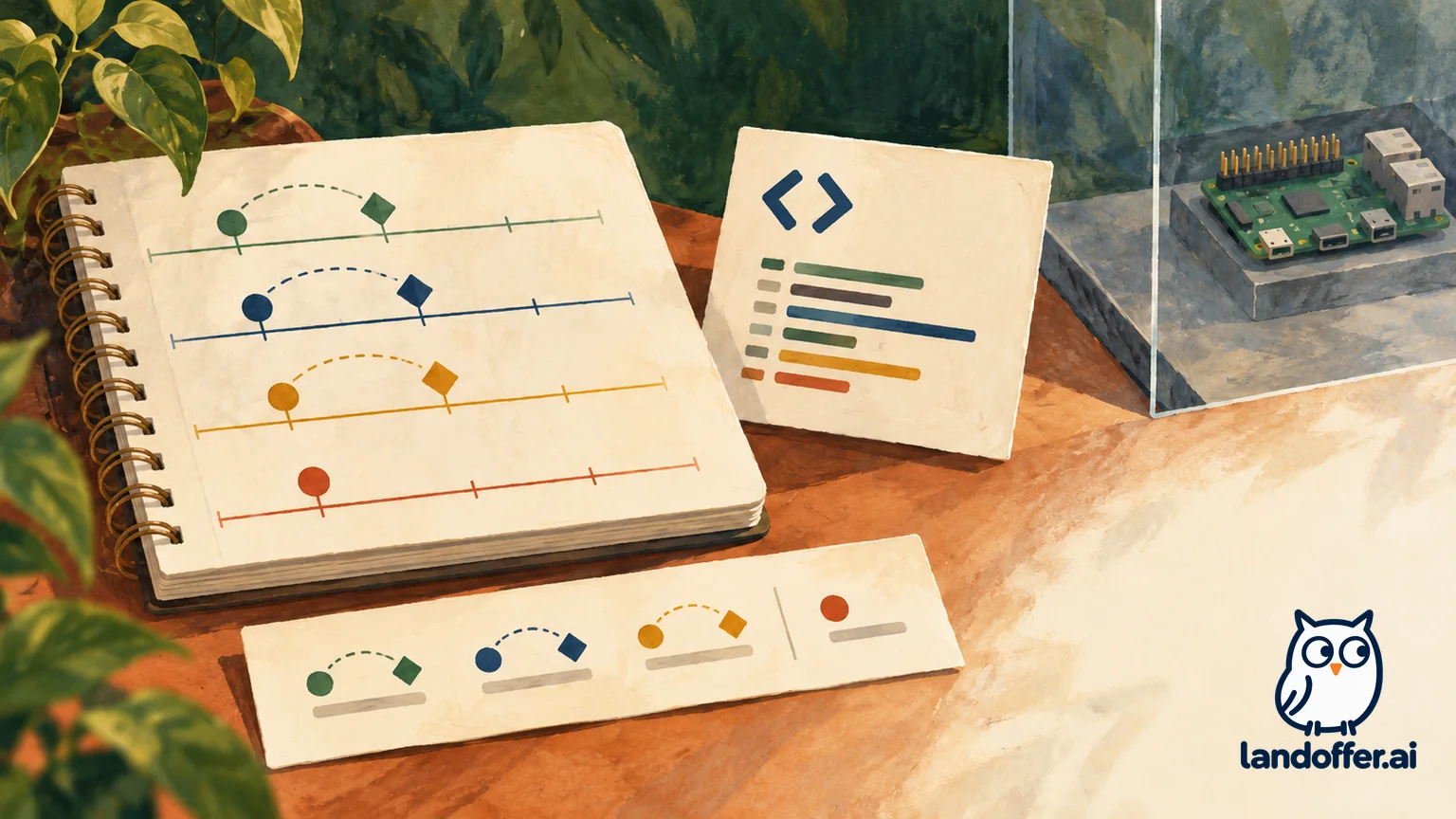
The toy contract uses an event identifier, an event type and a synthetic timestamp named t_us. Each IRQ event may pair with one WORK_START carrying the same identifier. The parser rejects duplicate identifiers for the same event type, a work record without an IRQ, and a work timestamp earlier than its paired IRQ. An IRQ without a work record is reported as unmatched rather than silently discarded.
| Entirely synthetic identifier | IRQ timestamp | Work-start timestamp | Parsed result |
|---|---|---|---|
| A | 100 | 180 | Pair; synthetic gap 80 |
| B | 300 | 460 | Pair; synthetic gap 160 |
| C | 500 | 620 | Pair; synthetic gap 120 |
| D | 700 | Missing | Unmatched IRQ; no invented completion time |
The executed original local parser produced three pairs and one unmatched event. Additional constructed inputs exercised the duplicate, missing-IRQ and reversed-timestamp rejection paths. The saved input hash stayed unchanged. These are executed software checks on artificial data; the timestamp label does not turn the gaps into measured hardware microseconds.
A complete illustrative project bullet is:
Built an offline Python validator that paired three synthetic IRQ/work-start records, reported one unmatched event and rejected duplicate, missing-IRQ and reversed-timestamp fixtures; documented that the event gaps were modeled values, not measured target latency.
This belongs in a clearly identified project section if it reflects work you actually built and can explain. It should not appear as an employer achievement or imply that you used a board you never accessed. The project demonstrates parsing, validation and evidence discipline, not a substitute for hands-on firmware debugging experience required by a particular vacancy.
The limitations are part of the design: it does not handle timestamp wraparound, clock synchronization, concurrent logging loss or every possible malformed record. It does not determine why D's work record is missing. The cause could not be established from the toy input, so the result remains an unmatched event rather than a diagnosed dropped interrupt.
Distinguish a successful build from validation on the target
Zephyr's Twister documentation distinguishes tests that were built from tests run through an emulator or on hardware. Its reports expose how a test ran, and build_only cases verify building rather than driver functionality. The guide also supports selecting a particular board revision. These are useful distinctions when describing your own validation record.
Record the stage you reached. “Built the firmware for the selected target” is different from “ran a host-side unit test,” “ran an emulated configuration” or “verified behavior on revision B hardware.” Use the verb that matches the evidence. A tool reporting success in one stage should not be expanded into all-platform or production validation.
Prototype scope also matters. Three bench starts can support a statement about those starts. They do not establish long-duration reliability, environmental tolerance, power consumption or all peripheral combinations. If you performed a broader study, identify its method and population from the actual report rather than extending a small demonstration by implication.
When a failure involves hardware and software, preserve the handoff. Name the firmware observation and the information you gave the hardware team, then state which findings they supplied. A resume can show effective collaboration without assigning all causes and fixes to a single person.
Keep the resume concise without removing the engineering evidence
Use the skills section for relevant languages, RTOS tools and interfaces you can discuss. Put the actual configuration, diagnosis and validation in experience or project bullets. This makes it easier to see the difference between familiarity with a tool and a contribution made using it.
Before exporting, check each statement against a small evidence record: target context, observed behavior, hypothesis, personal action, collaborator input and validation limit. Remove numbers whose measurement method you cannot explain. Keep confidential board identifiers and artifacts private where necessary, while retaining an accurate public description of the work.
Check the exported document for readable bullets and intact technical terms. No resume format or keyword selection guarantees ATS compatibility or an interview. If a role needs hands-on board bring-up that your experience does not yet demonstrate, keep that gap visible instead of renaming a host-side project as hardware validation.
As you find recent roles on LandOffer, select the recorded evidence that matches the role's firmware responsibilities. A precise explanation of an interface failure, the change you owned and the limits of the check gives a reviewer something concrete to discuss.