LandOffer
Productivity & Workflows
Dropbox vs. Box for a Small Business: Storage, External Collaboration, and Paid Add-Ons
An eight-person photography studio maps raw files, working packages, deliveries, and operations access, then compares current Dropbox storage rules and Box collaborator licensing with a 12-month growth forecast and unquoted add-on costs.
For a small business, Dropbox versus Box is a decision about who works on which files, not just how many terabytes a plan advertises. Dropbox Standard is worth evaluating for shared team storage with controlled external handoffs. Box Business Plus deserves attention when invited external collaborators and larger individual uploads are essential. Check both the largest individual file and each external role before comparing the base subscription.
This LandOffer.ai review uses one fictional eight-person photography studio to compare file layout, annual growth, external access, and incremental cost. Official documentation and rendered US-dollar pricing were checked on October 27, 2026. All file sizes, people, budgets, and decisions in the case are synthetic. No files were uploaded, accounts connected, links shared, permissions changed, or checkout completed.
Match the plan to the business, not an individual storage allowance
An individual subscription does not establish the team ownership, shared capacity, or administration this eight-person business needs. Identify the managed users, outside collaborators, and people who only need a delivery link. Their roles affect both access and the bill.
The current Dropbox page distinguishes Standard, starting at 3 TB for one person or more, from Advanced, starting at 15 TB for three people or more. The support table adds an important detail: current Standard starts with 3 TB for one license and adds 1 TB per additional actively used license. Standard Classic is a separate 5 TB starting allocation for three licenses. Do not attach the Classic number to every new Standard quote. Dropbox storage and license rules.
Box Business Starter lists 100 GB, a 2 GB individual upload limit, and a maximum of ten users. Business lists unlimited storage but a 5 GB upload limit; Business Plus raises that file limit to 15 GB and includes unlimited external collaborators. “Unlimited storage” does not mean every individual file can be uploaded, or that bandwidth and other usage terms disappear. Box plan comparison.
Compare those limits against the files your team must keep and exchange. A studio with a 7 GB source file cannot solve a 5 GB upload limit merely by pointing to its available total capacity. Splitting files might be possible for some workflows, but it would be a separate operational decision requiring the recipient's agreement.
Completed asset: an eight-person file and access layout
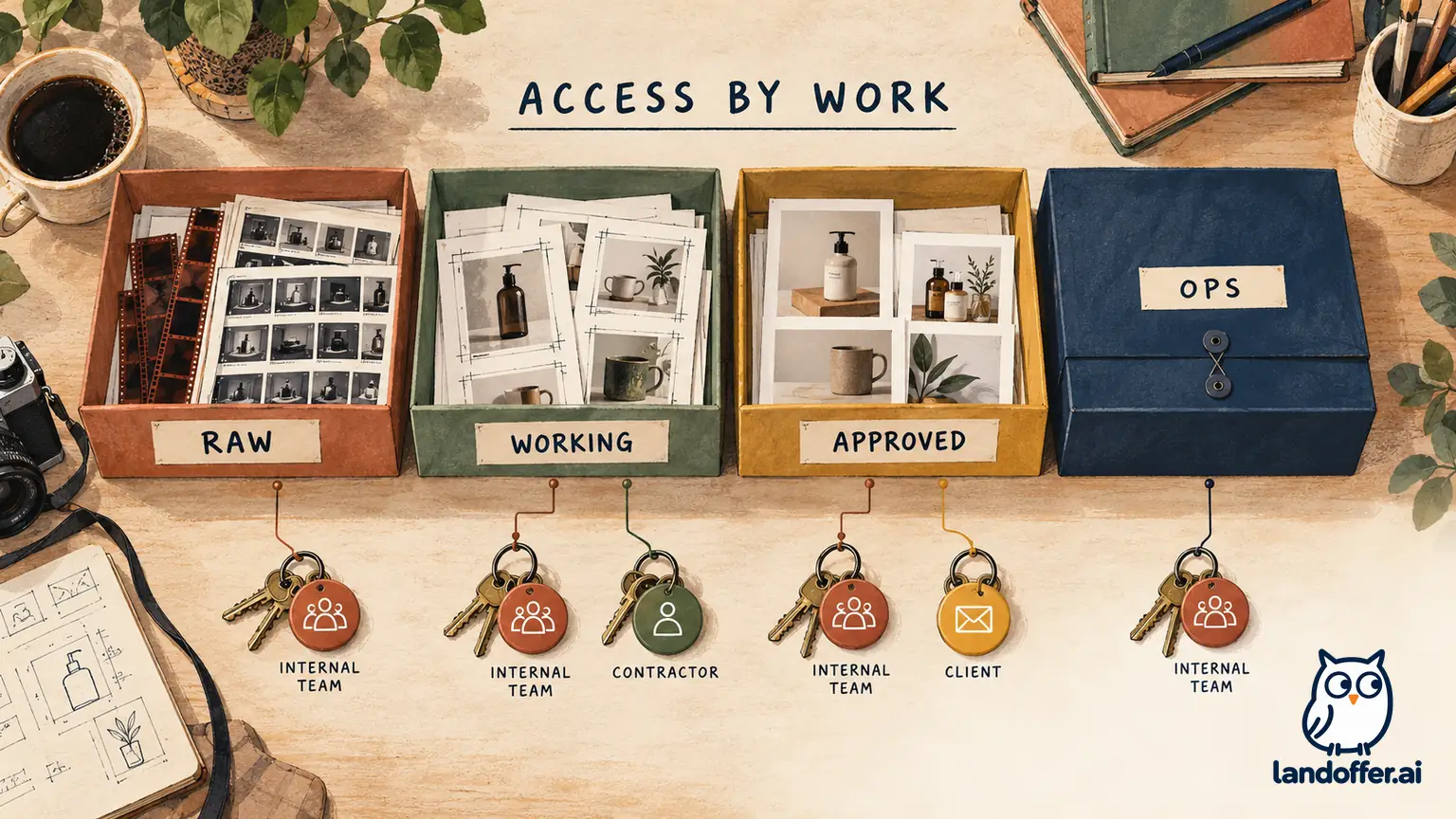
The fictional Alder Product Studio has eight internal people: two administrators, three photographers, two retouchers, and one producer. Four outside retouchers need access to assigned working packages. Two client reviewers only need to inspect and download approved deliveries. Those clients are not being silently counted as folder collaborators.
Producer Mara completes this proposed layout before asking either vendor for a quote:
| File class | Current size | Internal working group | External need | Owner and boundary |
|---|---|---|---|---|
| Raw captures | 1,400 GB | Three photographers, producer, and designated admins | None by default | Photographer Ivo owns the source; largest file is 7 GB |
| Working packages | 300 GB | Two retouchers, producer, and designated admins | Four external retouchers, each limited to their assigned package | Retouch lead Chen checks assignments; no access to unrelated projects |
| Approved deliveries | 120 GB | Producer, relevant photographers and retouchers, and designated admins | Two client reviewers receive approved delivery access only | Mara confirms which revision is ready to release |
| Operations records | 30 GB | Two administrators and producer where appropriate | None | Admin Sana owns access decisions; separate from project handoffs |
The total is 1,850 GB. For a consistent teaching calculation, this case uses decimal units: 1,000 GB equals 1 TB. It assumes 160 GB of net new retained material each month, with no deletion or deduplication benefit assumed. Twelve months add 1,920 GB, producing a forecast of 3,770 GB, or 3.77 TB.
Mara does not make contractors team administrators to simplify sharing. She records which package each person needs, who can invite them, and when the need ends. A client asking to comment inside a continuing folder is a different requirement from downloading an approved delivery. It would reopen the access and licensing calculation.
For Dropbox, the proposed internal structure uses team folders rather than eight individually owned copies. The official folder guide distinguishes team-owned storage from shared folders that can count against members' personal storage. That is relevant to the outside retouchers: their account and capacity requirements need checking for the chosen sharing arrangement. Dropbox team folders and shared folders.
Dropbox's current sharing instructions distinguish account-free view links from editing: editing or uploading to a shared folder requires a signed-in Dropbox account and edit access. A file request offers a different account-free upload route, but it does not by itself meet this case's continuing editing requirement. Sharing with someone outside Dropbox.
For Box, Mara distinguishes invited folder collaborators from shared-link recipients. The official seat explanation says Starter and Business count internal and external collaborators toward paid seats, while Business Plus counts internal users and includes unlimited external collaborators. The same page says shared-link recipients do not count as collaborators. Box's collaborator and seat rules.
Her completed disposition is: “Keep raw and operations material internal. Evaluate assigned working-package collaboration for the four contractors, and use a separate approved-delivery route for the two clients. Do not create any link or invitation until Sana has checked the candidate plan, recipient access, and intended folder boundaries.” This completed design record specifies the intended access. Actual invitations, effective permissions, and recipient experience remain untested.
Completed asset: compare base subscriptions and growth for the same files
The public Dropbox page displayed Standard at US$15 per user per month billed yearly, or US$18 monthly. Advanced displayed US$24 yearly billed or US$30 monthly. Box displayed Business Starter at US$5 yearly billed or US$7 monthly; Business at US$15 or US$20; Business Plus at US$25 or US$33. The Box plans shown require at least three users. Prices below exclude taxes, negotiated terms, migration work, and add-ons. Dropbox pricing, Box pricing.
Sana compares eight internal licenses, four invited external editing collaborators, and two link-only client reviewers; each row states which people enter its base cost:
| Candidate | Annual-billing base estimate | Monthly-billing base estimate | Fit against the case |
|---|---|---|---|
| Dropbox Standard | 8 × $15 × 12 = $1,440 | 8 × $18 = $144/month | Evaluate team allocation and contractor access; no extra contractor team seats assumed in this provisional base |
| Dropbox Advanced | 8 × $24 × 12 = $2,304 | 8 × $30 = $240/month | Higher tier is not justified by capacity alone in this example |
| Box Business | 12 paid collaborators × $15 × 12 = $2,160 | 12 × $20 = $240/month | Eight internal plus four external; its 5 GB file limit fails the 7 GB source requirement |
| Box Business Plus | 8 × $25 × 12 = $2,400 | 8 × $33 = $264/month | 15 GB file limit accommodates the example; external collaborators do not add internal seats under the documented model |
Box Starter is excluded before calculating a tempting low total: 100 GB cannot hold the current 1,850 GB, and 2 GB cannot hold the largest file. Business also fails a specific requirement despite its unlimited total storage. Business Plus is not automatically cheaper than Business with four outside collaborators: its annual base here is $240 higher, with a larger individual upload allowance.
The contractor count changes that comparison. With six external collaborators, Business would have fourteen paid collaborators at the assumed rates: $2,520 annually. Business Plus would remain $2,400 for the same eight internal users, $120 less. That illustrates this scenario's cost crossover, not a universal purchasing threshold; upload limits and contract terms still matter.
For current Dropbox Standard, eight actively used licenses imply 3 TB plus seven additional 1 TB allocations, or 10 TB, under the support formula. Against the 3.77 TB forecast, that leaves 6.23 TB. Sana must confirm the actual plan version, active-license conditions, and displayed team allowance. Buying eight seats is not evidence that all eight already satisfy the activity condition.
Her completed provisional decision is: “Evaluate Standard first for our existing eight internal users, subject to the actual storage allocation and contractor editing check. Keep Box Business Plus as the comparison if its external-collaboration model and file workflow fit better. Exclude Starter and Business for this unchanged file inventory. Do not choose Advanced solely because it advertises more space.” No purchase or migration is approved.
Keep add-ons and unknown charges visible
The base table is not a complete cost of ownership. Sana completes a second budget section with five unresolved lines: any contractor account or storage costs for the proposed Dropbox arrangement; storage expansion if the confirmed allowance proves insufficient; retention or legal-hold requirements; any separate security product needed after requirements review; and staff time for migration and permission checks. She leaves their prices unquoted rather than inventing a tidy total.
Dropbox's storage-add-on guide says eligible plans can buy shared storage in 1 TB increments. It says add-on prices are shown on the billing page and describes prorated charges followed by billing on the subscription cadence. That does not provide a public unit price for this studio. Under the provisional 10 TB model, no expansion is needed for the stated forecast, but a different confirmed allowance would require a new calculation. Dropbox storage add-ons.
Box's pricing page separately lists add-on products including Governance, Shield, and Zones. Their presence in the catalog is not proof that all their capabilities are included in the base Business Plus amount. Ask for the required capability, eligible edition, applicable usage, and written price. Do not buy a feature simply because another organization calls it essential.
The requested quote therefore states: eight internal users, four external editing collaborators, two link-only client reviewers, 1,850 GB currently stored, 3,770 GB forecast, and a 7 GB largest file. It asks for cadence, external-user treatment, actual storage allowance, upload limit, and each separately charged product. Sana has not sent that request or committed money. An unanswered cost line remains unknown rather than becoming a zero-dollar inclusion.
Test the handoff before moving the archive
The final evaluation should use harmless approved sample material in the intended desktop and browser environment. Mara's acceptance checklist has three open items: a contractor can work only on the assigned package; a client can inspect the approved delivery through the chosen route; and an internal owner can retain the correct version and remove future access as intended. These are pending checks, not reported product results.
Keep a record of the sharing arrangement, not merely a screenshot showing that a file opened. For example, a recipient added directly to a folder and a person opening a view link may have different permissions and licensing consequences. Neither this review nor a low base price validates the actual access configuration.
Choose a maintainable sharing model
Evaluate Dropbox Standard after confirming its current team allocation and the four contractors' editing arrangement. Box Business Plus remains a credible alternative for the same files and invited outside collaboration. The cheaper Box tiers fail this case's capacity or individual-file requirement; more expensive Dropbox capacity alone has not earned its place.
Before approving either, finish the file-and-access layout and the unresolved cost lines. More LandOffer.ai workplace-software reviews can support that comparison, but the purchase decision should use your actual users, largest files, growth assumptions, and authorized sharing model.
Sources and Further Reading
- Dropbox current plans and billing options
- Dropbox licenses, current Standard storage, and Standard Classic
- Dropbox team folders and shared-folder storage
- Dropbox account-free viewing versus editing access
- Dropbox storage add-on rules and billing
- Box current plans, external collaboration, file limits, and add-ons
- Box internal and external collaborator seat rules