LandOffer
Career Growth
Disagree with a Performance Review? Prepare a Factual Written Response
Separate factual corrections from rating disagreements, build an authorized evidence packet, and make a precise request without promising a different outcome.
If you disagree with a performance review, write a focused response that identifies the disputed statement, points to relevant records, and asks for a specific correction or reconsideration. Separate a disputed fact, such as a date, from a disagreement about how your work was judged. Before submitting anything, check your employer’s process, deadline, permitted attachments, and the meaning of any acknowledgment you are asked to sign.
A response cannot guarantee a different rating. It can make your position understandable and preserve a clear account of what you challenged. This guide from LandOffer.ai uses public employer guidance and a fictional engineering example to show how to build that account. It does not establish your employer’s rules or determine anyone’s legal rights.
Find the response route before writing the argument
Start with the review form, current employee handbook, relevant agreement, and HR instructions. Find out whether your next step is an employee comment, a request to your manager, a formal appeal, or a separate grievance. These routes can have different recipients and deadlines. Sending a thoughtful email to the wrong person may leave a required step unfinished.
The University of Arkansas performance-management page gives one concrete example: its published appeals procedure starts with a written reconsideration request to the supervisor within ten calendar days of the review conference. It asks for reasons and supporting evidence. Later steps have their own periods, and the page excludes official university holidays from its specified calculations. Those instructions apply to the procedure Arkansas describes; they do not establish another employer’s deadline. The same page announces a changing performance framework, so employees there should confirm which current process covers them.
Record your own applicable recipient, submission method, deadline, and source of those instructions. Ask HR a narrow process question if something is unclear: “Where should I submit comments on this review, and does submitting comments also initiate reconsideration?” Keep the answer with your working notes. Do not assume an informal conversation pauses a formal deadline.
Read acknowledgment wording independently. Case Western Reserve University’s guidance says signing its review records that the review occurred and does not necessarily mean agreement; it directs employees with serious concerns to HR for rebuttal information. That example does not establish the meaning of your employer’s button or form. If the wording is ambiguous, ask what it confirms and how disagreement is recorded before choosing an action.
Decide what you can challenge with evidence
Read the whole review once before annotating individual sentences. The University of Waterloo’s guidance on evaluation comments recommends taking time to consider the evaluation and explaining disagreement through specific examples. Use that pause when the actual deadline allows it; do not miss a required submission while waiting to feel completely calm.
Sort your concerns into three practical types. A factual error is a statement that records can contradict, such as an incorrect delivery date. Missing context is information that changes the interpretation, such as an approved change in project scope. A judgment disagreement concerns how the manager evaluated work, such as whether collaboration met expectations. The first two can support a proposed correction. The third usually needs a discussion of the standard and the examples behind it.
A sentence can feel unfair while still describing an event that occurred. “Several handoffs required follow-up” might be true even if the project ultimately shipped. Likewise, ten completed tasks do not by themselves disprove feedback about communication. Identify which exact observation the evidence addresses before deciding what to contest.
Prioritize statements that materially affect the record. Correcting an inaccurate delivery claim may deserve more attention than replacing an adjective you dislike. Choose a few important points and say what you want changed for each one. A long chronological defense can hide the strongest correction among details that do not change the assessment.
Completed example: compare three claims with the record
The following is a fictional teaching case. Nora Chen is a software engineer whose review covers January through June. All projects, records, dates, and statements below are invented. The records are assumed available in an approved internal workspace; no real employee file or engineering system was accessed.
Nora’s review says the Atlas migration missed its agreed deadline, attributes a team rollback to her change, and criticizes late handoff notes. She initially wants the whole delivery section removed. Checking the records produces a narrower, more credible request.
| Review statement | Record and limitation | Proposed disposition |
|---|---|---|
| Atlas missed its March 31 commitment | E1: March 18 approved scope note changes acceptance to April 12; E2: acceptance recorded April 11. These establish the revised date and acceptance, not a quality rating | Replace the date-based criticism with the revised commitment and actual acceptance date |
| Nora’s change caused the May 7 rollback | E3: incident review identifies two contributing changes and an incomplete staging check. Nora authored one change; the review does not allocate sole causation | Correct sole attribution; retain Nora’s contribution and the staging-check learning |
| Handoff notes were late | E4: two handoff notes arrived after the agreed cutoff. A third was on time. Nora has no record of an approved exception | Accept the two misses and propose an earlier documentation checkpoint |
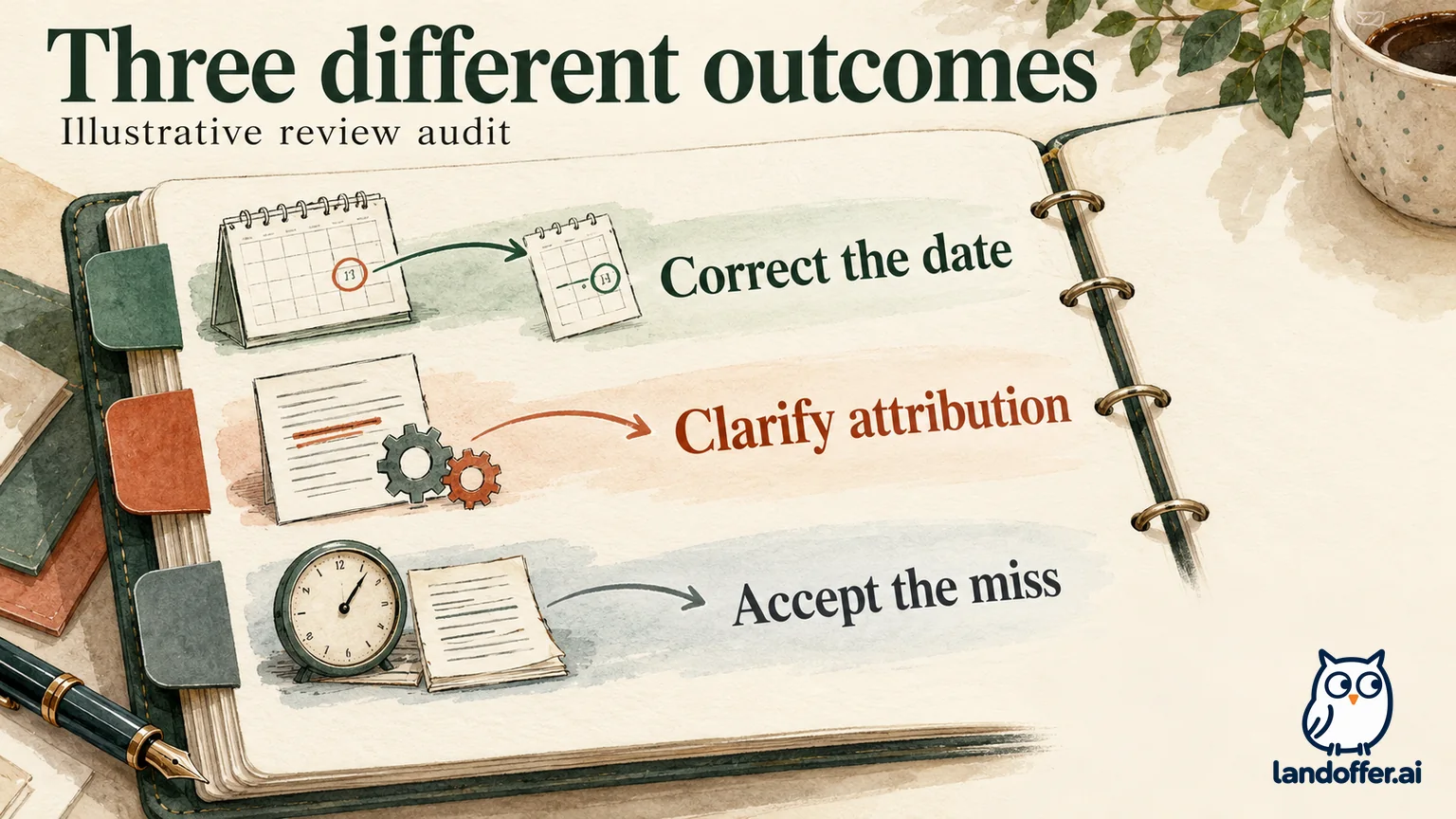
The completed comparison does not produce an “all criticism disproved” verdict. It supports one date correction, one attribution correction, and one accepted improvement area. Nora should not present E3 as exoneration: it still records her involvement. She also cannot use E2 to claim every project requirement was excellent simply because acceptance occurred before the revised deadline.
Notice the references’ limited jobs. E1 establishes the changed commitment; E2 establishes acceptance; E3 addresses incident causes; E4 addresses handoff timing. Grouping them under “proof of strong performance” would erase the distinctions needed for a useful response. An evidence index should help a reviewer locate the relevant fact without guessing which document proves which claim.
Build a small evidence packet that someone can inspect
For each disputed point, keep the original review wording, your proposed correction, and the smallest relevant evidence reference together. Preserve the review version and date so a reviewer can tell which wording you are challenging. If a statement changes during discussion, distinguish the earlier wording from the revision rather than silently replacing your notes.
Use existing authorized records: an agreed goal, a dated scope decision, an acceptance note, or an incident review. A message can show that someone approved a change without proving the implementation was successful. A merged code change can show authorship without proving production deployment. Explain those limits beside the reference.
Keep sensitive material in approved locations. Do not forward proprietary records, private peer feedback, customer data, or source code to a personal mailbox to make the packet easier to assemble. A concise internal reference may be sufficient. If you cannot attach a record, ask how the authorized reviewer can inspect it. Do not alter evidence to make a cleaner story or recruit colleagues to provide statements they cannot independently support.
Label unsupported recollections honestly. “I remember discussing this in February; I have not located a written scope change” is weaker than a contemporaneous record, but more accurate than claiming an agreement you cannot substantiate. Ask whether the reviewer has relevant information you have not seen. There may be another incident, a different evaluation period, or a standard that your selected records do not address.
A complete written response with a narrow request
Here is Nora’s fictional response, based only on the stipulated evidence above. It is a drafting example, not a message that was sent or an employer-approved form. Its structure fits a situation where written reconsideration goes to the manager; change the route to match your actual instructions.
Subject: Request to reconsider two factual statements in my January–June review
Thank you for discussing the review with me. I am requesting reconsideration of two statements in the delivery section. I also agree that two handoff notes were late and describe an improvement below.
The review states that Atlas missed its agreed March 31 deadline. The approved March 18 scope note, E1, moved acceptance to April 12. E2 records acceptance on April 11. Please revise the statement to reflect the approved commitment and acceptance date. These records address timing; I am not asking you to infer a particular quality rating from acceptance alone.
The review attributes the May 7 rollback to my change. E3 identifies two contributing changes and an incomplete staging check. I authored one of those changes and accept responsibility for that contribution. Please revise the wording so it reflects the incident review’s shared-cause finding rather than sole attribution.
E4 supports the feedback that two handoff notes missed the agreed cutoff. I will prepare draft notes before the next handoff review and raise missing information at that checkpoint. I would like to agree on the cutoff and review date with you.
Please confirm whether you will make these factual revisions and whether they affect the delivery assessment. If the assessment remains unchanged, please explain which expectations and examples support it. Please also confirm how this response will be associated with the review under our process.
The evidence index identifies E1–E4 in the approved internal workspace. I can walk through the relevant sections during our follow-up discussion.
The request is specific enough for a manager to answer. It separates correction of the written record from reconsideration of the rating. A manager could agree to correct the deadline while retaining the rating for other reasons. Nora has asked for those reasons instead of assuming the correction settles every issue.
The accepted handoff feedback also has a concrete next step. It does not trade an admission for a promise of a better score. The planned checkpoint is an editorial suggestion for this case; Nora and her manager still need to agree on how it works.
Review the draft for accuracy and escalation risks
Before submitting, read each sentence as someone who did not attend the meetings. Can they identify the disputed wording, find the supporting record, and understand your request? Remove speculation about motives unless it is necessary to a separate concern and you can state the underlying facts accurately. “The review omits the approved scope change” is easier to investigate than “My manager wants me to fail.”
Check that the packet addresses the evaluation period and actual standard. Avoid claiming another employee’s rating proves yours should change; you may not know their responsibilities or evidence. Ask how your work was assessed against the criteria that apply to you.
Concerns involving discrimination, retaliation, harassment, or another serious issue may require a separate reporting route. An ordinary review response does not automatically initiate that route or preserve every applicable deadline. Ask the relevant office or a qualified adviser which process addresses the concern. This article cannot decide the correct legal classification from a review excerpt.
Use the required channel and keep whatever confirmation it provides. An email being sent, a form being saved, and a response being attached to the official review are different events. Ask how to verify the step you actually requested. Do not describe the matter as resolved simply because the system accepted a file.
Follow the response through to a recorded outcome
After the discussion, distinguish three possible results: the wording changes, the rating changes, or your disagreement is retained while the assessment stays the same. Record which statement was corrected, whether the rating changed, and where any continuing disagreement is retained. If a written decision arrives, compare it with your requested corrections before moving to any next stage.
If a further review is available, use its stated sequence and deadline. Carry forward the original request, evidence references, and decision; add new relevant information explicitly. Repeating a longer version of the same complaint without addressing the decision gives the next reviewer little to evaluate.
For the next cycle, agree on observable expectations and a checkpoint for disputed areas. Keeping work records can support that conversation, but it does not guarantee agreement or eliminate workplace risk. Start with the most consequential disputed statement: confirm the submission route and deadline, then write its evidence reference and the exact correction you are requesting. LandOffer.ai publishes this career guidance; the task here is an accurate internal record, not a job application.