LandOffer
Job search
Contract Work on a Tech Resume: Separate the Employer, Client, and Engagement Dates
Show contract tech experience clearly by separating the employer or business, end client, project dates, and engineering contribution.
When you list contract work on a tech resume, put the employer or consulting practice on the main role line and the client or assignment beneath it. Keep the broader work relationship dates separate from shorter engagement dates. A reader should not have to guess whether the client hired you directly or whether one project lasted as long as the overall relationship.
LandOffer publishes this guide and offers tools for finding and organizing a job search. You can browse recent roles on LandOffer.ai. The entries and audit below use fictional organizations, dates, systems, and outcomes. They demonstrate layout choices, not real work history, legal classifications, or hiring results.

Put the relationship in the first line
A contract assignment can involve several names: the organization that recruited or paid you, a staffing or consulting firm, a client whose product you supported, and perhaps an end customer. Those names do different jobs in a resume entry. Start with the organization or business name that accurately represents your work relationship in your records. Use a second line for the client or project when that detail helps a technical reader understand the work.
For example, someone employed by a staffing agency and assigned to a software company could write:
Software Engineer — Northstar Talent Group | 2023–2025
Client assignment: Harborline Payments | March 2024–January 2025
That structure says the relationship to the staffing firm covered the longer period, while the specific client assignment covered a shorter window. It does not suggest that Harborline employed the engineer for two years or that the engineer worked on that account before March 2024. If the agency was only a recruiter and the client hired you directly, reverse the labels: list the direct employer, and mention the recruiting firm only if there is a reason to explain the connection.
CareerOneStop, sponsored by the U.S. Department of Labor, recommends making the role, organization, dates, and relevant accomplishments easy to find; it does not prescribe a contract-specific format. UC Berkeley Career Engagement describes one staffing model in which an agency employs a worker on limited-term assignments. Models vary, so confirm your relationship from your own records.
Separate three kinds of dates
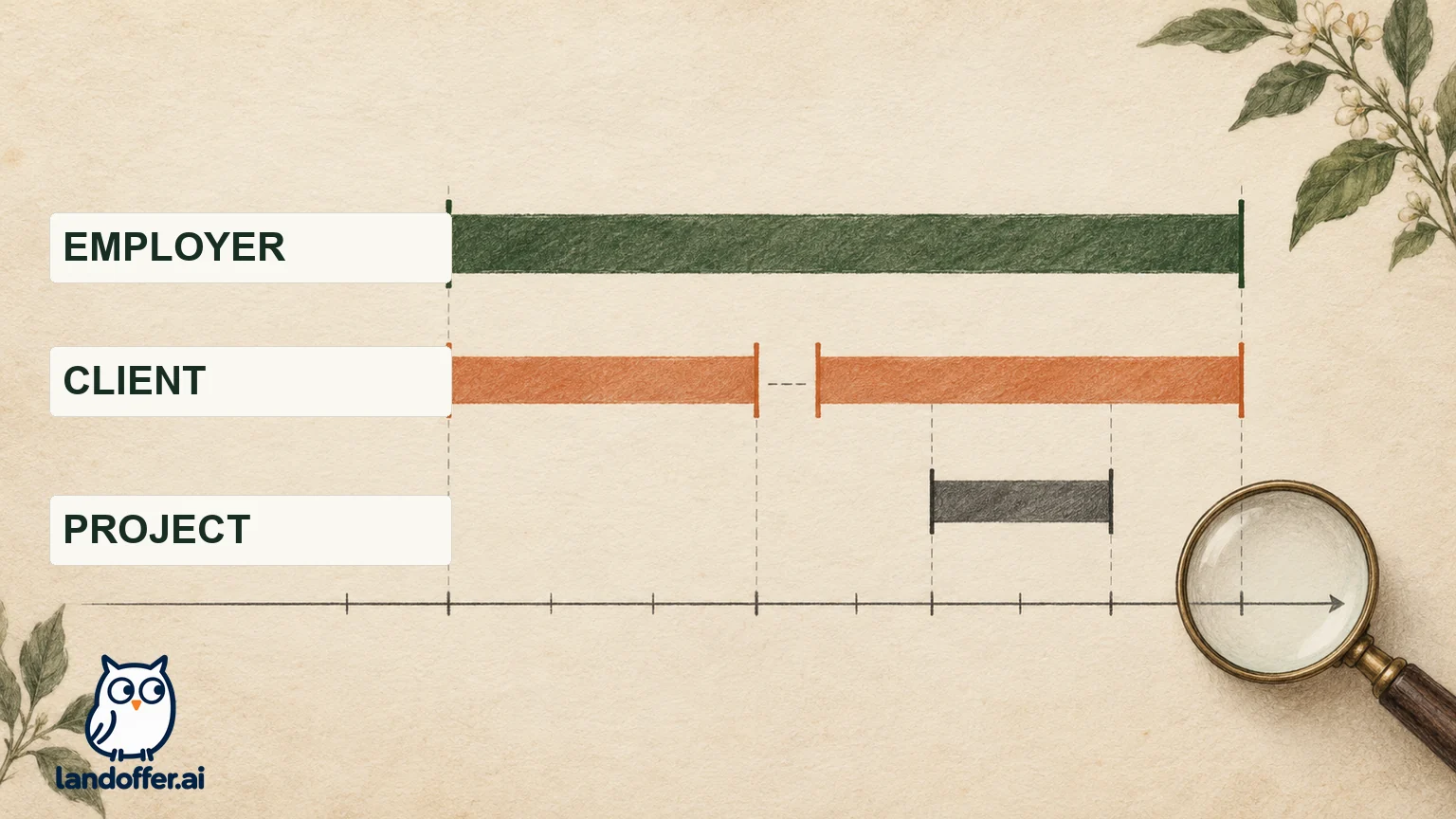
Before formatting an entry, separate the work-relationship dates from assignment and project dates. An agency or business relationship may span several client engagements; a project may cover only one phase. These periods can overlap without matching.
If an agency employed you from January 2023 through December 2025, while one client assignment ran from May 2024 through August 2025, do not use the client dates as though they were the agency's full employment dates. A clean entry might show “Northstar Talent Group | Jan 2023–Dec 2025” and a subordinate “Client assignments: Harborline Payments, May 2024–Aug 2025; internal tooling, Sep–Dec 2025.” Only use the internal tooling phrase if that accurately describes what you did. If there was a period between placements and you were not doing paid work for that agency, avoid wording that implies continuous client delivery. Whether the broader employment relationship remained active is a separate fact to verify.
For a project-based independent consultant, the business or professional name and dates may be the top-level heading, while several client projects sit below it. If you operated under a registered business, the contract or invoice may use that legal name; if you used your own name, a plain “Independent Software Consultant” heading may be clearer. Do not invent a company name to make a resume look more established. If your work arrangement is unclear, verify the documents or ask a qualified professional about classification. This guide addresses resume presentation, not tax or employment law.
For a direct employee who moved between client-facing projects inside one company, retain the company as employer and list client or product assignments as project context. This is different from an agency placement where the agency was the employer. A client name alone does not tell a resume reader which arrangement applied.
Three worked entries for common arrangements
The examples below are fictional and intentionally use different structures. Replace every name, date, title, and result with details you can support. A company name may be shortened to a non-confidential description only when that description remains accurate.
Software Engineer — Northstar Talent Group | 2023–2025
Client assignment: Harborline Payments | Mar 2024–Jan 2025
- Added idempotency checks to a payment-status service used by two internal teams; wrote replay tests for duplicate webhook delivery and documented the handoff to the client engineering lead.
- Built a queue-lag dashboard for the assignment team and documented that production on-call remained with the client team.
Why this works: the staffing firm is named on the employer line, and the client assignment has its own shorter dates. The bullet describes bounded technical work without implying that the engineer owned Harborline's entire payments platform or its on-call policy.
Independent Software Consultant — Mira Chen | 2022–2026
Selected engagements: Beacon Transit, 2022–2023; Fernwell Research, 2024–2025
- Reworked a fictional transit data import in Python, adding schema checks and a reviewable error report before records entered the client's planning dashboard.
- Built a separate experiment-tracking interface for a fictional research group; clarified the handoff boundary between prototype code and the team's maintained service.
Why this works: one consulting practice spans several years, while each selected client engagement has its own period. The dates do not imply uninterrupted full-time work for either client. If “Mira Chen” did not operate under a business name, the individual name is the accurate label; the example does not establish a legal business structure.
Backend Engineer — Cedar Peak Systems | 2021–2025
Product assignments: Atlas API, 2021–2023; Billing migration, 2024–2025
- Maintained an API integration for the first product assignment, documenting version compatibility and the escalation owner for two partner feeds.
- For the later migration, wrote dual-read checks and a rollback note for a staged schema change; partnered with the product team on the release window.
Why this works: Cedar Peak is the direct employer in this fictional scenario, so the employer stays primary. Projects are supporting evidence, not separate employers. If the work was actually delivered through an agency, use the first structure instead.
These entries give you a reusable decision: one role line for the primary work relationship, an optional subline for the assignment, and bullets for verifiable engineering contribution. If a client name adds little or cannot be shared, you can omit it or use a truthful description such as “regional payments provider,” provided the description does not expose confidential information or exaggerate the client's identity.
Work a date-reconciliation audit before sending
Consider a fictional engineer whose agency records show a relationship from February 2022 to November 2025. A client placement record shows June 2022 to February 2024. A second placement document shows May 2024 to September 2025. Their project notes show that the second system's first production migration happened in July 2024. The draft resume currently says “Senior Engineer, Harborline Payments, February 2022–November 2025.” That line merges four different facts: the agency relationship, a client assignment, a later assignment, and a project milestone.
The engineer resolves the dates from records before changing the layout. The engineer checks the agency's employment history for the relationship dates, the two placement notices for client assignment boundaries, and project notes for the migration phase. The revised entry becomes:
Software Engineer — Northstar Talent Group | Feb 2022–Nov 2025
Client placements: Harborline Payments, Jun 2022–Feb 2024; Cedar Peak Systems, May 2024–Sep 2025
- For the Cedar Peak assignment, implemented a staged schema migration beginning in July 2024, with backfill checks and a documented rollback path.
The February-to-November span describes the agency relationship, the subranges describe placements, and July dates the project work in the bullet. If the agency relationship did not continue through the April gap, revise the top line. If it did continue, do not imply active client work during the gap without work to describe.
Use this short reconciliation sequence on your own entry:
- Write down the employer or business name shown by the records relevant to that relationship.
- Add the start and end dates for that relationship, checking month and year against your documents.
- Put each assignment or engagement on its own line if it had a distinct client or date range.
- Place project milestones inside the relevant assignment; do not expand a project to fill the full job span.
- Compare the final resume line with your application form and profile. Explain intentional differences, such as month-only resume dates versus exact dates requested by a federal application.
Useful records might include an offer or employment letter, payroll or HR history, a staffing placement notice, invoices, statements of work, project plans, and your own approved work notes. No one record is automatically decisive for every work arrangement. Use the records that actually apply to your situation; don't send confidential contracts or customer information to an employer unless the process specifically requires it and you are authorized to share it.
Protect client confidentiality without obscuring the work
A client name can add domain context, but you do not need to disclose every client. Check confidentiality terms and your former employer's policy. If naming is allowed, use the accurate public name and discuss only approved work. Otherwise, use a narrow description such as “U.S. logistics platform” and keep architecture, volume, data, and outcomes within what you may share.
Do not use a vague phrase such as “Fortune 50 client” unless you can verify it and are allowed to disclose it. “Confidential enterprise client” protects the name but says little about engineering work; pair it with a concrete, non-sensitive contribution. You can also ask a former manager, agency contact, or client whether a public project description is approved. Avoid attaching internal screenshots, source code, incident tickets, customer records, or contracts to a portfolio without explicit permission.
Group short assignments under one employer or practice only when the relationship connects them. “Selected client engagements” signals that the list is partial. Keep individual dates when they explain a gap, establish recency, or prevent an inflated duration claim; otherwise a continuous employer span with scoped project dates may be clearer.
Match the application form, not just the resume style
Private-sector applications vary. A form may ask for an employer, title, start and end dates, supervisor, or reason for leaving. Enter the fields as requested, and use an explanation box when one is available to clarify that the client was an assignment rather than the employer. Do not place a staffing firm in the client field or vice versa just to make an automated form accept the entry. If the form does not offer room for the distinction, keep the resume attachment clear and ask the recruiter which organization the form means.
Federal applications have more explicit instructions. The Office of Personnel Management's guide to federal employment asks federal applicants to include the employer, job title, employment dates in month/year, and hours worked per week, and directs applicants to follow the specific announcement. These fields are federal guidance, not a universal private-sector requirement. When a federal announcement asks for details that your concise resume does not include, provide the requested information in the designated resume or application fields.
A background-check vendor may ask for dates or contacts in a different format. Keep a private record of the names and dates you used, and answer each form truthfully. If an agency changed its name or a client cannot verify a confidential placement, explain the discrepancy with the relevant records rather than creating a second employer entry.
A final check for contract experience
Before you submit, read the entry once as an engineer and once as a verifier. An engineering reader should see your contribution and its scope. A verifier should be able to distinguish employer, client, and the dates attached to each.
Check these points:
- Is the employer, agency, or consulting practice named accurately?
- Are client and project details clearly subordinate to the employer when they were not the employer?
- Do top-level dates match the work relationship you intend them to describe?
- Are shorter assignments and milestones dated separately where that prevents a misleading timeline?
- Can you explain each tool, result, and ownership verb in an interview?
- Are client names and technical details approved for disclosure?
- Did you follow each application's requested fields and date format?
Use a straightforward work-history layout: label the relationship, client context, and work dates, then support every claim. Browse recent LandOffer roles to see which technical details to foreground while keeping employer and date records accurate.
Sources and Further Reading
- CareerOneStop: Work Experience — U.S. Department of Labor-sponsored guidance on listing organizations, dates, and relevant accomplishments.
- UC Berkeley Career Engagement: Temporary & Gig — overview of temporary staffing and gig-work arrangements, with the caveat that models differ.
- Office of Personnel Management: Guide to Federal Employment for Second Chance Applicants — federal resume fields and instruction to read the announcement.