LandOffer
Career Growth
Pitch a Conference Talk Based on Work You Are Allowed to Share
A complete fictional CSV-error talk packet includes an abstract, audience definition, 30-minute outline, reviewer map, and disclosure-scope ledger. Historical PyCon guidance and current authorship rules are separated from employer permission, with synthetic examples and pending slides or recording review clearly identified.
Build a conference pitch around a useful problem you can explain with material you are authorized to disclose. Identify the audience, state what they will learn, and show an achievable outline. Before submitting, check the target event's current rules and obtain the required review of the actual abstract, examples, and supporting material. Changing the company name does not authorize disclosure of the underlying material.
This LandOffer.ai guide develops an educational proposal example and a completed disclosure-scope record. The employer, speaker, review decisions, and technical scenario are fictional. Nothing was submitted to a conference, and no real employer granted permission. The sample teaches proposal structure; it is not a ready-to-submit account of someone's work.
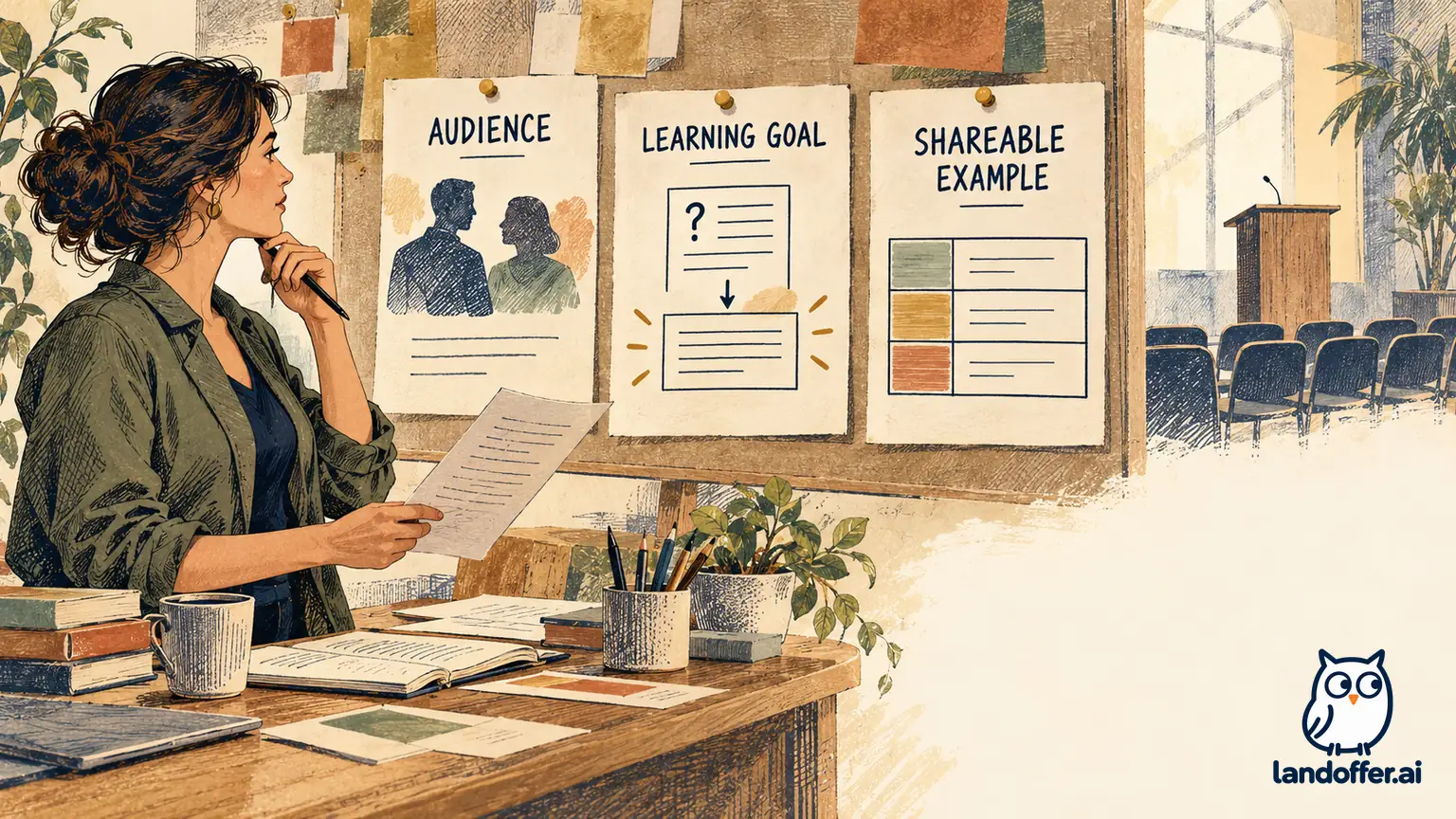
Read the target event’s call before choosing your story
A call for proposals, or CFP, defines the event's expectations. A strong internal presentation can still be unsuitable because of its subject, audience level, duration, authorship rules, or required format. Record the event year, exact deadline and time zone, session type, required fields, review process, and speaker obligations before shaping the pitch around them.
PyCon US 2026's talk guide is a useful historical example. Its CFP is closed, and its talks took place in May 2026. The guidance asks for an audience, learning takeaways, and a detailed outline with time estimates. It also describes anonymous first-round review and cautions against promotional talks. Those are that event's rules, not a universal conference form.
Authorship is part of eligibility. The same guide rejects proposals solely or substantially written by an LLM. The current SREcon27 Americas CFP likewise prohibits entirely or substantively generated talks and requires a primarily human-written content statement, while permitting grammar and clarity assistance. Check your target's exact policy. Do not paste the AI-created educational sample below into an event that excludes such content or present fictional experience as your own.
For your real proposal, write from work you understand and can discuss honestly. A public guide can help you ask the right questions without becoming a substitute for your experience or the event's current instructions.
Find a lesson that survives removing the company story
Fictional engineer Nora works on data-import support at RillWorks. Her original idea is “How our new import platform transforms customer onboarding.” That describes a product and invites claims about customer results she cannot substantiate publicly.
She narrows it to a teachable problem: when a CSV import reports a missing field, the problem might be a missing column, a mismatched header, or an empty cell. Those are different situations and may need different explanations. Her proposed audience is Python application developers who have built a small import feature and now need to make validation messages understandable.
The talk's central claim becomes: identify which validation layer rejected the input before writing the message. It is a design lesson supported by a small invented example, not a promise that a particular message will reduce support volume.
Nora can draw three synthetic cases: a row with a blank start_date under the expected header; a file whose header says begin_date instead; and a file with no date column at all. She will use a conceptual decision diagram to discuss possible feedback. No parser implementation or message-effectiveness experiment is claimed here, and the cases do not establish production-ready date validation.
The Linux Foundation's speaker-advice article recommends tailoring proposals to the event audience and avoiding a sales pitch. Although published years ago, that distinction remains useful for editing this example: attendees should be able to reason about an import error in their own application, without needing the company story.
A completed educational abstract and review map
The following packet is entirely fictional and for analysis. Its proposed 30-minute format is an editorial assumption, not an available slot or a verified fit for any currently open CFP. There is no intended submission destination yet.
Title: “Missing Column or Empty Cell? Explain CSV Import Errors at the Right Layer”
Audience and prerequisite: Python application developers with experience reading tabular input and returning validation messages. The talk introduces the error-design distinction; it does not teach Python syntax or comprehensive CSV parsing.
Abstract:
A user sees “date required,” but the repair depends on what failed. Is the expected column absent, is its name different, or is one value blank? This session uses three deliberately small synthetic CSV examples to separate file structure, header mapping, and row-value validation. We will trace each example through a conceptual decision diagram, compare ambiguous messages with messages that identify the location and next step, and discuss what the diagram leaves unresolved. Attendees will learn to distinguish these failure categories, explain one repair without exposing unrelated row contents, and identify questions that need product-specific validation rules. The examples contain no customer data or production code. This is a walkthrough of an error-design method, not a benchmark, a complete parser, or a demonstration of a commercial import platform.
Proposed timing:
| Minutes | Segment | Evidence available to the audience |
|---|---|---|
| 0–3 | Show the ambiguous “date required” message and define the audience problem. | One invented message and the question it fails to answer. |
| 3–8 | Introduce the three synthetic input cases and scope assumptions. | Clearly labeled illustrative header/row fragments; no customer records. |
| 8–16 | Trace structure, header mapping, and value checks through the diagram. | A conceptual explanation, not executed parser behavior. |
| 16–22 | Compare alternative messages and what each asks the user to change. | Draft message pairs with reasons, without measured effectiveness claims. |
| 22–25 | Name unresolved rules and summarize the method. | Date formats, locale assumptions, multiple errors, and safe content display remain product decisions. |
| 25–30 | Questions. | Responses stay within the approved public scope. |
Nora then completes a reviewer map instead of assuming that a catchy title is enough.
| Review question | Where the packet answers it | Remaining limitation |
|---|---|---|
| Who needs this? | Audience names developers already building imports. | Actual event audience fit remains unchecked. |
| What will they learn? | Abstract names three categories, a repair explanation, and unresolved-rule identification. | No claim that watching establishes implementation competence. |
| Can the material fill the proposed time? | Six segments total 30 minutes, including five minutes of questions. | No timed rehearsal has occurred. |
| Is it a product advertisement? | Examples and diagram work without company architecture or feature claims. | Final slides still need review for accidental promotional material. |
| Is the work honestly represented? | Abstract labels synthetic examples and excludes production code and benchmarks. | Speaker must independently satisfy the target's authorship and experience requirements. |
This completed map checks the packet against stated questions; it does not reproduce any committee’s confidential scoring system. A complete packet can still be rejected for fit, overlap, limited slots, or other selection considerations.
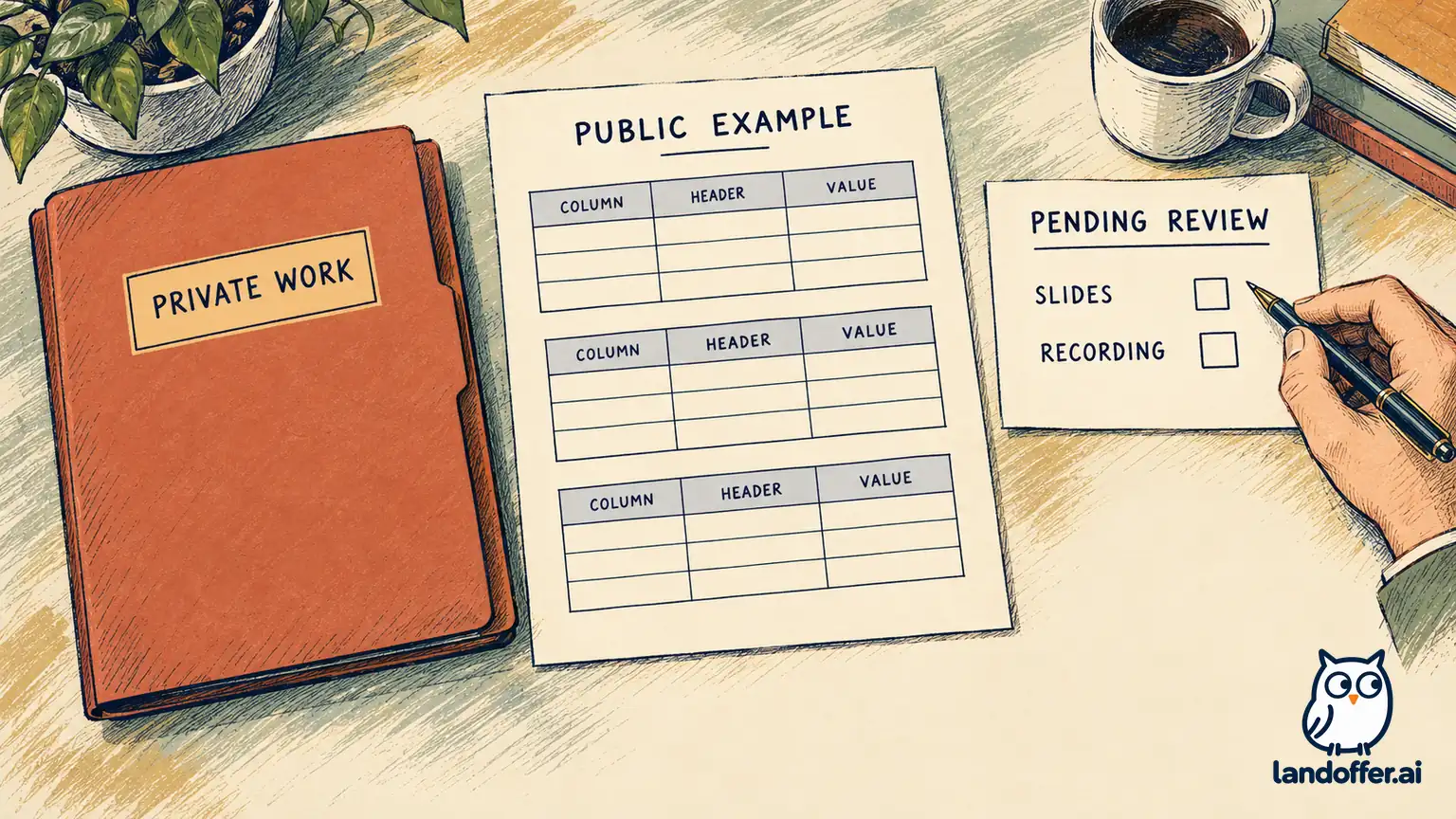
Define exactly what the public version may contain
Permission needs a scope. Nora initially proposes hiding customer names in a support screenshot. Her fictional reviewer points out that ticket identifiers, file paths, rare field combinations, and visible workflow details would still disclose internal information. They choose a new synthetic example rather than treating visual redaction as sufficient.
UCL Ventures' guidance asks its researchers to contact the relevant team before publications, conferences, or public disclosure, and notes that oral presentations can disclose an invention. That is institution-specific guidance. It illustrates why a disclosure review can involve more than customer names; it does not determine your employer's ownership rules or provide permission for your talk.
Nora follows RillWorks' invented review route. Engineering owner Dev checks technical statements and attribution; disclosure reviewer Mei checks material against the company's fictional external-sharing process. Their roles and decisions below exist only in this example. Your actual organization may require different owners or additional review.
| Candidate material | Public replacement or decision | Recorded fictional review status |
|---|---|---|
| Customer CSV and support screenshot | Exclude both. Create the three small synthetic header/value cases described above. | Mei accepts the newly created examples for this educational packet; no customer-derived screenshot may be used. |
| Internal parser source and architecture diagram | Exclude. Use a newly drawn conceptual sequence with no service names or repository paths. | Dev checks the explanation; Mei accepts only the reviewed replacement diagram. |
| Internal claim that the redesign reduced tickets | Remove; publish no ticket counts, percentages, or causal claim. | No public evidence or disclosure approval exists for that result. |
| Team's contribution to the original work | Acknowledge collaboration without naming colleagues in the public abstract. | Dev confirms the contribution wording; individual names and quotations are not approved. |
| Abstract version 2 and synthetic examples version 1 | Keep an internal copy of the exact reviewed packet. | Dev and Mei approve this limited packet within the fiction; changed materials require another check. |
| Slides, recording, downloadable files, and unrehearsed questions | Not covered by the packet decision. | Separate review and event recording terms remain pending; no submission or public sharing is authorized by this record. |
The result is a narrower story with an explicit boundary. Approval of a general topic does not mean every supporting file, live demonstration, or spontaneous detail is included. Retain abstract version 2 and examples version 1 with the scope decision; send changed material back through the applicable review route.
Test the explanation before expanding the pitch
In a fictional internal read-through, colleague Ellis asks whether “missing date” means a date column is absent or a cell is blank. Nora revises the opening to show those two cases side by side. Ellis can now state the intended distinction in the written exchange. This is invented reviewer feedback, not a real audience study or evidence that the talk will perform well.
Ellis also asks how the diagram handles a header that matches after whitespace normalization. Nora does not add an unsupported universal rule. She records it as a product-specific assumption that the session should expose, alongside locale and date-format decisions. The abstract promises a reasoning method with boundaries, so this unresolved detail fits rather than undermines the proposal.
For your own review, ask someone near the target audience to describe the problem, learning outcome, and prerequisites after reading the packet. Record their actual questions. If they expect a live tool tutorial but you plan a conceptual walkthrough, fix the description. Do not answer an unclear abstract by adding three more promised topics.
Then rehearse against the requested duration. The table allocates 30 minutes, but no timed run has established that the explanation fits that allocation. If the event offers less time, remove a segment and revise the learning promise rather than speaking faster through the same deck.
Keep submission, selection, and disclosure separate
Nora's closeout says: “Version 2 is an internally reviewed educational packet. Customer material, code, and result claims are excluded. Target event, authorship eligibility, recording terms, slides, and timed rehearsal remain unresolved.” It contains no acceptance, travel approval, or promise of a public speaking slot.
Your next step is to choose an actual event and compare its current requirements with your own material. Confirm the submission owner, deadline time zone, author restrictions, and disclosure scope before using the real form. A submitted proposal is still subject to selection; an accepted session can still require preparation and permissions you have not completed.
Keep the useful lesson even if a conference is not the right venue. A permitted internal session or a smaller approved public explanation may fit the material better. Start with a specific audience problem, preserve the limits of your evidence, and keep the exact public version reviewable. LandOffer.ai publishes this professional-development guide; no conference submission or employer communication was performed.