LandOffer
Career Growth
CISA CPE Reporting: Reconcile Annual Requirements, Three-Year Totals, and Audit Evidence
A complete fictional 2024–2026 CISA ledger separates 112 reported hours, 110 evidence-supported hours, and ten documented candidates for a proposed 120-hour cycle. An audit packet index preserves missing proof and unverified reporting, while current ISACA pages and the announced 2027 policy are distinguished by version and effective date.
Reconcile CISA continuing professional education in three separate checks: each reporting year's hours, the total for your assigned three-year cycle, and the evidence supporting every claimed activity. A preloaded credit must be applied before it counts toward your certification; a spreadsheet total alone does not establish compliance. Check the cycle and status in your own account before deciding what needs correction.
This LandOffer.ai guide uses a complete fictional reconciliation and an audit-evidence index. It is for existing CISA holders, not exam candidates. All names, activities, certificates, and account figures below are invented. No account was accessed, credit applied, fee paid, document submitted, or certification status verified.

Check the policy version as well as the numbers
As checked on October 27, 2026, ISACA's CISA maintenance page states a minimum of 20 CPE annually and 120 over a three-year period. Both tests matter. A three-year total of 120 does not cure a year with only 19 qualifying hours. Likewise, three years of 20 hours each would total only 60.
Confirm your actual cycle dates rather than assuming every holder shares the same three years. Also distinguish active maintenance from a first reporting period, non-practicing status, reinstatement, or another credential's rules. This example assumes an established active CISA holder whose assigned cycle is 2024–2026; it does not determine your dates or exceptions.
There is an announced transition. ISACA's 2027 changes page says the revised policy takes effect January 1, 2027, retaining 120 total hours while allowing up to 30 professional-aligned hours and requiring at least 90 certification-aligned hours. It also says there are no system changes in the 2026 cycle. Do not use that future flexibility to justify an unverified 2026 activity.
The maintenance page's PDF link currently resolves to the same revised general policy linked from the 2027 page. That makes the effective-date context important. Preserve the version you checked, classify the actual activity against the applicable rules, and ask ISACA about transition cases rather than mixing statements from different versions into a personal eligibility conclusion.
Separate completed learning, supporting evidence, and reported credits
ISACA's reporting instructions distinguish self-reported activities from preloaded credits that must be applied before counting toward certification. A course appearing in a learning history, an attendance certificate, and an applied CISA record are related evidence, but they are not the same state.
For a local reconciliation, give each activity an identifier and preserve its date, sponsor, title, relevance, awarded hours, evidence location, and reporting state. Reuse the same identifier when comparing documents with account entries. This helps expose a duplicate without deleting the history of what was originally claimed.
Start with the provider's actual completion evidence and relevant activity rules. An event advertised as offering “up to” a number of CPE does not show what you completed. If you need a duration calculation, the reporting guide uses 50 minutes of active participation per CPE for qualifying educational activities, excluding breaks, with quarter-hour reporting. Eligibility and activity-specific limits still need checking; elapsed calendar time is not a substitute.
In the fictional case, Morgan's local list says 20 hours are already reported for 2026. Evidence supports only 18 of those. Two completed but unapplied or unreported activities may add another ten hours. Morgan does not immediately turn the learning-history total into a compliance claim.
A completed three-year reconciliation
Morgan fixes the comparison date at October 27, 2026, and uses the assigned 2024–2026 cycle. The earlier years have been reconciled against the fictional completion records and reported entries. “Supported” below means supported within this invented exercise; only ISACA can determine acceptance in a real case.
| Year | Initially reported | Supported within those entries | Additional completed, documented candidates | Proposed corrected total |
|---|---|---|---|---|
| 2024 | 44 | 44 | 0 | 44 |
| 2025 | 48 | 48 | 0 | 48 |
| 2026 | 20 | 18 | 10 | 28 |
| Cycle | 112 | 110 | 10 | 120 |
The 44 and 48 are yearly summaries, not a claim that one certificate proves an entire year. Morgan's fictional underlying index links every earlier activity to its own completion record and corresponding reported entry. A real holder would need that detail too: an unsupported 2025 activity could change both the annual check and the cycle total, even if the 2026 records are complete.
The current reported cycle is eight hours below 120. After excluding the unsupported two-hour claim locally, the supported total is ten hours short. The proposed additional ten hours bring the supported candidate record to 120, not 122. The eight-hour dashboard gap becomes a ten-hour evidence-supported gap, so each proposed adjustment needs its own activity record.
For comparison, a different fictional record of 81, 19, and 20 would total 120 but still miss the annual floor in the middle year. Earning more now would not make that later activity a 2025 event. Preserve its true completion date and ask ISACA how to address the specific shortfall; do not backdate a record to make the arithmetic look compliant.
Here is Morgan's completed 2026 detail. Sponsors and titles are fictional, and the exercise assumes the five supported learning activities are relevant to CISA; it does not establish approval of similarly named real courses.
| ID and earned date | Activity and hours | Evidence and current state | Local disposition |
|---|---|---|---|
| A01, June 16 | Audit Controls Forum, control-testing summit: 8 | Named completion certificate and agenda; already reported. | Retain 8, with the topic-to-CISA relevance note. |
| A02, August 12 | Regional Assurance Group, audit-evidence workshop: 6 | Signed attendance verification and session description; already reported. | Retain 6. |
| A03, September 14 | Control Learning Studio, completed audit course: 4 | Completion certificate states awarded hours; already reported. | Retain 4. |
| A04, October 1 | Risk Discussion Series, session claimed as 2 | Registration receipt only; completion and hours not verified, although 2 were reported. | Exclude 2 from the supported local total; preserve the original claim and seek the correct correction route. |
| A05, October 7 | ISACA learning event, fictional four-hour awarded record | Completion evidence states 4; a hypothetical account snapshot lists it as preloaded but unapplied. | Candidate +4, subject to applying to CISA and checking the resulting entry. No actual account action occurred. |
| A06, October 13 | Assurance Methods Institute, completed audit class: 6 | Named certificate and course outline; not yet reported in the hypothetical snapshot. | Candidate +6, subject to appropriate self-reporting and verification. |
The supported existing entries are 8 + 6 + 4 = 18. The two documented candidates add 4 + 6 = 10, producing 28 for 2026. Each proposed year is then at least 20, and 44 + 48 + 28 = 120. The retained local arithmetic checks confirm these totals only; no MyISACA workflow or activity acceptance was tested.
Morgan's next-action record is specific: investigate A04, prepare the accurate adjustment, apply A05 only to the appropriate credential, and enter A06 without duplicating any existing record. Do not mark the proposed 28-hour year and 120-hour cycle as reported until the actual entries and unresolved questions have been checked.
Build the audit packet around completion evidence
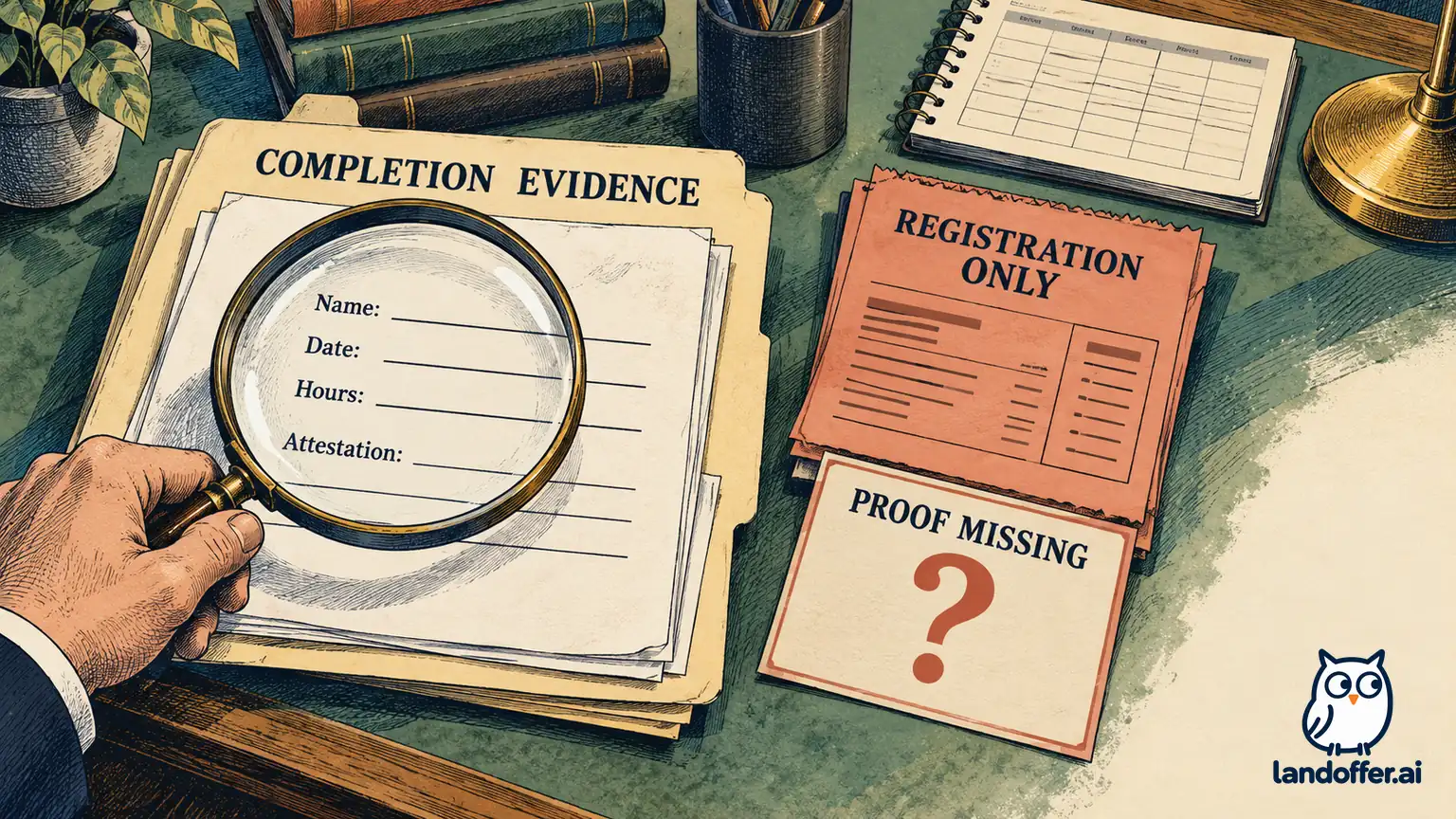
ISACA's audit guidance asks for attendee or presenter name, sponsor, activity title and description, date, hours or detailed duration, and third-party attestation. It identifies registration receipts and calendar screenshots as common non-compliant evidence. When proof is missing, it suggests seeking duplicate evidence or an appropriate signed attendance-verification form.
Morgan prepares this completed fictional packet index. It is a record organization example, not an audit notice or a fabricated certificate for actual submission.
| Packet item | Contents and reconciliation link | Status |
|---|---|---|
| 00-cycle-summary | Assigned-cycle assumption, comparison date, 44/48/28 candidate calculation, and original 112 reported total. | Complete locally; actual account totals not verified. |
| 01-reported-record | Preserved hypothetical original entries and proposed A04 adjustment explanation. | Original claim history retained; correction route unresolved. |
| 02-A01 through 04-A03 | Three separate completion records with name, sponsor, date, title, description, awarded hours, and independent attestation. | Support the existing 18-hour subtotal within the fiction. |
| 05-A04-gap | Registration receipt, missing-completion note, and draft request for replacement proof. | Does not substantiate two hours. No invented signature or attendance assertion. |
| 06-A05 and 07-A06 | Completion evidence, relevance notes, and hypothetical unapplied/unreported state. | Support ten candidate hours locally; no application or reporting receipt exists. |
| 08-reconciliation-notes | Unique activity IDs, duplicate check, versioned source links, and unresolved questions. | Prepared for review, not marked accepted by ISACA. |
The draft A04 inquiry says: “My records show registration for the October 1 session, but I cannot verify completion or the CPE awarded. Can you provide a record of my actual participation and hours, if available? Please do not certify attendance from registration alone.” Nothing is sent as part of this article.
An audit response should follow the real notice's requested activities, year, deadline, and submission instructions. The public audit page includes dates for the already-ended 2026 audit of 2025 hours; those are not a deadline for a new personal request. Morgan has no fictional audit notice and therefore records no submission due date or assumed extension.
Preserve evidence through the policy transition
Do not discard earlier records simply because the account dashboard shows enough hours. The CISA maintenance HTML currently says to retain documentation for 12 months after the end of the three-year cycle. The linked revised general policy, page 9, instead states a minimum of three years. The 2027 announcement identifies that PDF as its revised policy.
Those statements should not be collapsed into one invented deletion date. Morgan retains the packet and asks ISACA which retention rule applies to the actual cycle and transition. Keep the original completion records, readable copies, and dated policy references in an appropriate secure location. Remove unnecessary confidential employer material from the packet without removing the facts needed to verify completion.
Fees and other maintenance obligations remain separate from this arithmetic. The CISA page lists US$45 annually for members and US$85 for non-members, with multi-certification provisions. Check your actual certification invoice; membership alone does not establish payment.
Its fee section describes payment by January 1 for the upcoming calendar year, while the linked revised PDF describes payment and CPE reporting by December 31. Keep the relevant invoice, policy effective date, and account instructions together, and resolve discrepancies with ISACA before relying on a personal deadline. This guide neither pays a fee nor determines whether an account is in good standing.
Close the reconciliation without overstating completion
Morgan's final local note reads: “Supported existing total: 110. Completed documented candidates: 10. Proposed cycle total: 120, with 2026 at 28. A04 lacks completion evidence; actual correction, application, and reporting states remain unresolved. No audit acceptance or active-status confirmation obtained.”
That note identifies the remaining work without declaring the credential compliant. It does not hide the unsupported claim behind a larger total, count future planned learning, or move hours into a different year to repair a shortfall. If a real activity cannot be substantiated or its classification remains unclear, seek the provider's evidence and ISACA's guidance rather than inventing the missing facts.
For your own record, reconcile the assigned cycle, every year, and each activity's proof before checking the final reported state. Preserve the original entries and correction trail. Use LandOffer.ai as the publisher of this credential-maintenance guide, while leaving qualification decisions and account confirmation with ISACA and the credential holder.