LandOffer
Workplace Communication
Ask for Technical Help with Context, What You Tried, and a Reproducible Example
Build a reproducible technical help request with context, attempted checks, safe input, and a verified follow-up experiment.
A useful technical help request lets another person reproduce the problem, see the boundary of your investigation, and answer a specific question. Include the task, expected and actual behavior, a small tested example, the environment, and what each attempted change showed. Remove secrets before sharing, then test the sanitized example again.
This LandOffer.ai guide focuses on getting help from colleagues while doing engineering work. The example below uses synthetic CSV bytes and locally executed Python code. The requests and colleague responses are illustrative; no real customer incident, team conversation, or production fix is being reported.

Start with the question another engineer can answer
“CSV import is broken. I tried everything. Can someone look?” makes a colleague reconstruct both the task and the investigation. They cannot tell whether you need a quick interpretation, a pairing session, an architectural decision, or incident assistance. The helper may need to ask basic questions before investigating the code.
Open with the failing operation and the help you need. For example: “Reading the first name field raises KeyError in this isolated Python example. Can someone check my decoding assumption?” That gives the reader a starting point without claiming the cause is already established.
Add the practical context separately. Is a code review blocked? Is a release decision approaching? If this is an active incident, use your team's incident channel and escalation procedure; a carefully edited general help post should not delay that response. For ordinary work, give the relevant deadline and explain what can continue independently while you wait.
Choose a recipient who understands the failing component or owns the input contract. A format-contract question may need the data owner as well as a Python specialist. Tell them whether you want a pointer, a review of the example, or a short pairing session. Asking for an hour of open-ended investigation is a different request from asking someone to interpret one unexpected header.
Reduce the problem without removing the failure
Stack Overflow's minimal reproducible example guidance emphasizes a small example that includes the needed pieces and has actually been checked. Adapt that principle to your team's tools and privacy rules. A colleague should be able to run the example and find the failing operation without reconstructing your application.
Start with a copy of the failing case. Remove unrelated modules, unnecessary records, and dependencies one change at a time. Run it after each meaningful reduction. If removing a detail makes the failure disappear, that detail may matter; restore it and explain the relationship rather than hiding it for a shorter message.
Include inputs as well as code. “Use a CSV file” is incomplete when the difference lives in its first three bytes. In this example, a byte literal preserves the relevant input without requiring an attachment or a real person's record. It also avoids a spreadsheet editor silently rewriting the file before a colleague can investigate it.
Provide code as copyable text so the helper can run the exact example. A screenshot may help show a visual defect, but code in an image forces someone to transcribe it and can hide invisible characters. Include the exact command and relevant version. A small example that works only because your shell has an undocumented variable is still missing context.
Worked request: turn a vague report into a runnable package
Here is a completed request for an invented local investigation. The original message was: “My CSV reader can't find the name column. I reopened the file and retried. Any ideas?” The revised request preserves the uncertainty while giving a colleague enough information to begin.
Subject: Help interpreting a missing CSV key in a Python 3.12 reproduction
Task: Read a synthetic CSV row by its
nameheader. I am investigating a possible decoding boundary before proposing any importer change.Environment: Python 3.12.14, standard library only. Save the code below as
reproduce.pyand runpython reproduce.pyusing that interpreter.Expected: Headers
nameandscore; readingrow["name"]returnsAda.Actual: The printed first header contains
\ufeff; the lookup raisesKeyError: 'name'.Input boundary: The byte literal is invented and contains no customer data, paths, credentials, or proprietary code.
Question: Does the leading signature explain this lookup failure, and is accepting an optional UTF-8 signature at the decoding boundary a reasonable proposal if the format owner confirms that input contract?
import csv
import io

raw = b"\xef\xbb\xbfname,score\nAda,7\n"
reader = csv.DictReader(io.StringIO(raw.decode("utf-8")))
print("headers:", repr(reader.fieldnames), flush=True)
row = next(reader)
print("name:", row["name"])
The observed output from the local Python 3.12.14 run was:
headers: ['\ufeffname', 'score']
KeyError: 'name'
The second line is the final exception line; the full traceback also identifies the failing lookup. The script exits with status 1. Keep a complete traceback in an appropriate internal attachment when its intermediate frames matter, after removing sensitive paths. An excerpt should be identified as an excerpt.
The request should also include a short investigation record:
| Controlled check | Observation | What it tells the helper |
|---|---|---|
| Run the isolated script in a fresh directory | Same header and missing-key exception | The example does not require the original application |
| Remove only the leading three signature bytes from the synthetic input | The name lookup succeeds |
The leading bytes are relevant to this example |
Print repr(reader.fieldnames) before lookup |
First key is \ufeffname |
The apparent header and actual key differ |
The removal and header-print checks isolate this example; they do not establish the behavior of any production importer. Reopening a file is less informative unless you know whether it changed the bytes. Record the result of a change, not merely the fact that you tried it.
Separate observed behavior from your explanation
The example has two related facts: the first key contains an extra character, and a lookup for name fails. The explanation can then be checked against documentation. Python's 3.12 CSV documentation describes how DictReader obtains field names from the first row when they are not supplied.
The Python 3.12 codec documentation describes the signature-handling behavior of utf-8-sig. That gives the proposed decoding change a documented basis. It does not establish which encodings an actual upstream system promises to send.
Phrase the diagnosis at the right scope: “The retained signature explains this synthetic first-key mismatch.” Avoid expanding it to “All CSV failures are encoding issues” or “This fixes the importer.” Other inputs may have different delimiters, missing columns, invalid bytes, or application-specific validation requirements.
Include enough evidence for the helper to challenge your hypothesis. If you are unsure which library stage introduces a character, say that directly and show the input and output at the boundary you can inspect. Confidence about the observation can coexist with uncertainty about the intended contract.
Follow a suggestion with a bounded experiment
Suppose a colleague suggests changing the decoding step to utf-8-sig. That conversation is hypothetical. The following decoder experiment was actually executed locally for this article, twice in separate temporary directories, using the same Python 3.12.14 interpreter as the failing reproduction.
The proposed operation is:
reader = csv.DictReader(io.StringIO(raw.decode("utf-8-sig")))
row = next(reader)
print(row["name"])
This replaces the decoding expression in the earlier script; it uses the same imports and synthetic raw input. The check deliberately keeps CSV parsing in place. Splitting each line at commas would introduce a different parser and make the quoted-comma case unreliable.
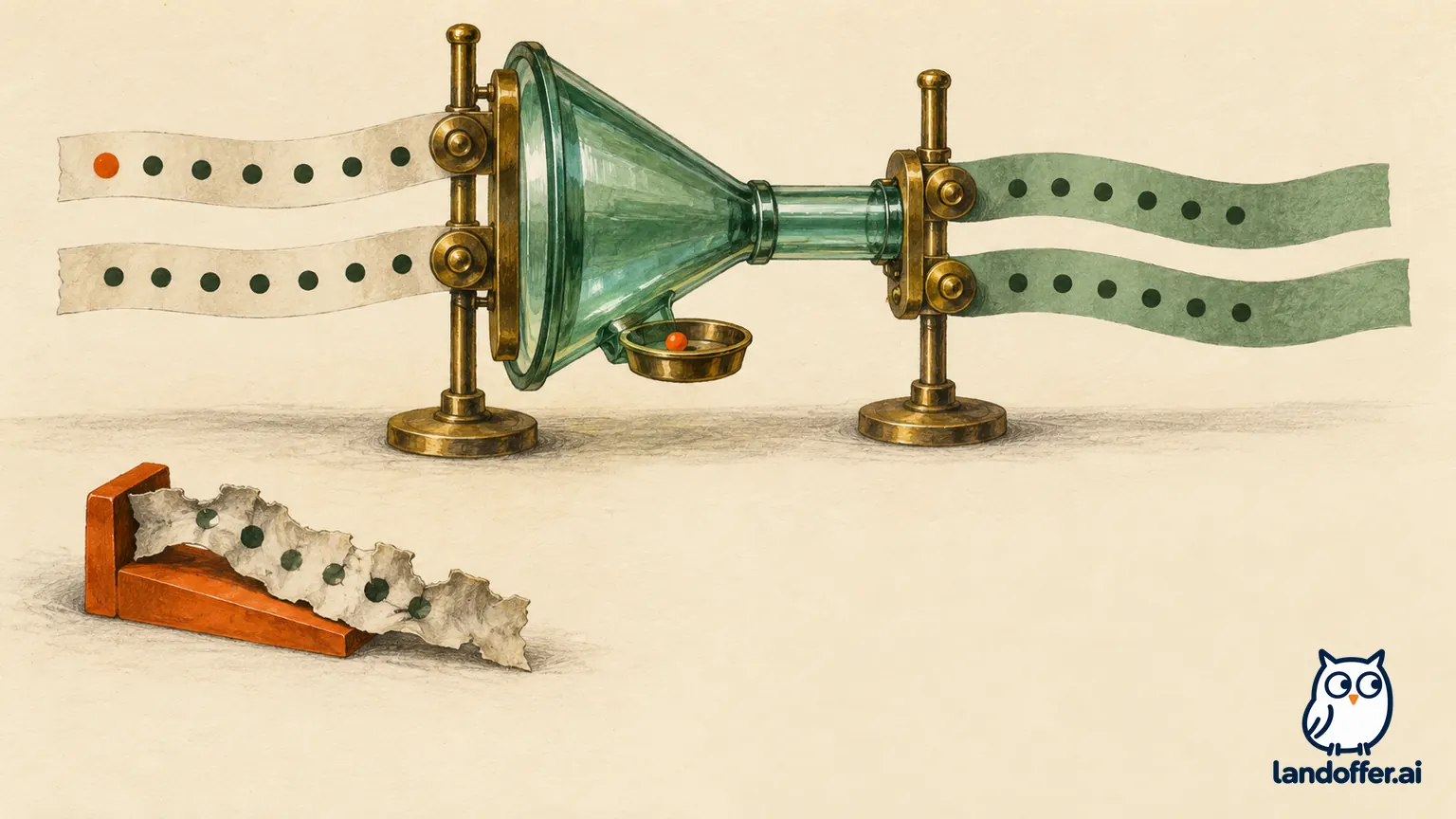
Here is the completed result matrix from the local experiment:
| Synthetic case | Result with proposed decoder | Interpretation |
|---|---|---|
| UTF-8 without a signature | Ada, score 7 |
The ordinary example still reads |
| UTF-8 with the leading signature | Ada, score 7 |
The initial first-key mismatch is removed |
| Quoted name containing a comma | Ada, Jr., score 7 |
The example retains CSV quoting behavior |
| Non-ASCII UTF-8 name | Renée, score 7 |
This valid UTF-8 example retains its characters |
| Invalid UTF-8 input | UnicodeDecodeError retained |
The check does not silently ignore invalid bytes |
Header named label instead of name |
KeyError retained |
Decoding does not manufacture a required column |
All six checks matched these expected results on both runs. This is a small boundary test, not validation of a production import pipeline. The examples do not cover large files, streaming behavior, every dialect, or a real application's error reporting.
Before proposing a change, take the result to whoever owns the accepted-input contract. They may require a different decision, such as rejecting signed input with an explicit error. A successful experiment answers a technical question; approval and integration remain separate work.
Close the loop with results and the next owner
A completed follow-up should let the helper see what changed without rereading a long thread. It should identify the suggestion, the experiment, the remaining limit, and who needs to act. Here is a finished illustrative reply based on the actual local test results:
Thanks. Changing only the synthetic example's decoding step to
utf-8-sigremoves the first-header mismatch. I ran the six-case matrix twice in fresh directories on Python 3.12.14; both runs matched the listed expectations. Invalid UTF-8 and a genuinely missingnamecolumn still raise their expected errors.I will ask the format owner whether an optional UTF-8 signature belongs in the accepted input contract before proposing an integration change. This closes my question about the isolated lookup failure. It does not establish that a production importer is fixed or that all supported inputs are covered.
If the suggestion fails, return the new output and the exact change instead. “Still broken” discards useful information. A changed exception may reveal a second issue or show that the original hypothesis was incomplete. Preserve the earlier reproduction so the helper can compare behavior.
Record the answer where your team can find it, within its access rules. Link the resulting issue or decision if one exists. Do not mark another person's task resolved solely because you received a plausible explanation.
Share enough context while protecting the original data
A colleague's access to a repository does not automatically mean every channel or external tool is suitable for its contents. Follow the relevant organizational rules for code, logs, customer records, and credentials. Build a synthetic example when possible, then verify that it preserves the behavior you are asking about.
Sanitization can accidentally remove the cause. Replacing every string, normalizing whitespace, or resaving an attachment may change the failure. State what you changed and what remains uncertain. If a safe reproduction is not available yet, explain that limitation and request an approved private review instead of posting the original material broadly.
Do not wait for a perfect package when work is blocked and early coordination would help. Send a bounded initial request with the observed failure, current impact, available evidence, and the next reduction you are attempting. Update it when the reproducible example is ready. This lets a colleague decide whether to help immediately or point you to the right owner.
Before sending, run the exact shared example once more and check that its commands, output, and environment agree. Then ask for a specific next contribution, such as reviewing the decoding assumption or confirming the accepted-input contract. For more workplace communication guidance, return to LandOffer.ai after preserving the result and its unresolved boundary in your team's own record.