LandOffer
Job search
Aon Assessment Session Planning: Take Breaks Between Tests and Handle a Blocked Module
Separate the invitation deadline from uninterrupted individual tests; use a worked session plan and a factual blocked-module recovery record.
For an Aon assessment, plan breaks between individual tests. Give each test an uninterrupted slot, keep the invitation's deadline visible and leave time for a technical problem before that deadline. If a module becomes blocked, contact the company that invited you. An available calendar slot does not establish a pause control or an automatic unblock.
This guide reviews public documentation and works through two fictional cases: a completed session plan and a blocked-module support packet. The dates, durations, people and incident details in those cases are invented teaching examples. We did not open a candidate account, start an assessment, request an unblock or verify an employer's response.
LandOffer publishes this guide. You can browse recent roles on LandOffer.ai while organizing your applications, but keep assessment instructions with the company that issued them. LandOffer cannot reopen an Aon module or change a recruitment deadline.
Separate the invitation window from an individual test
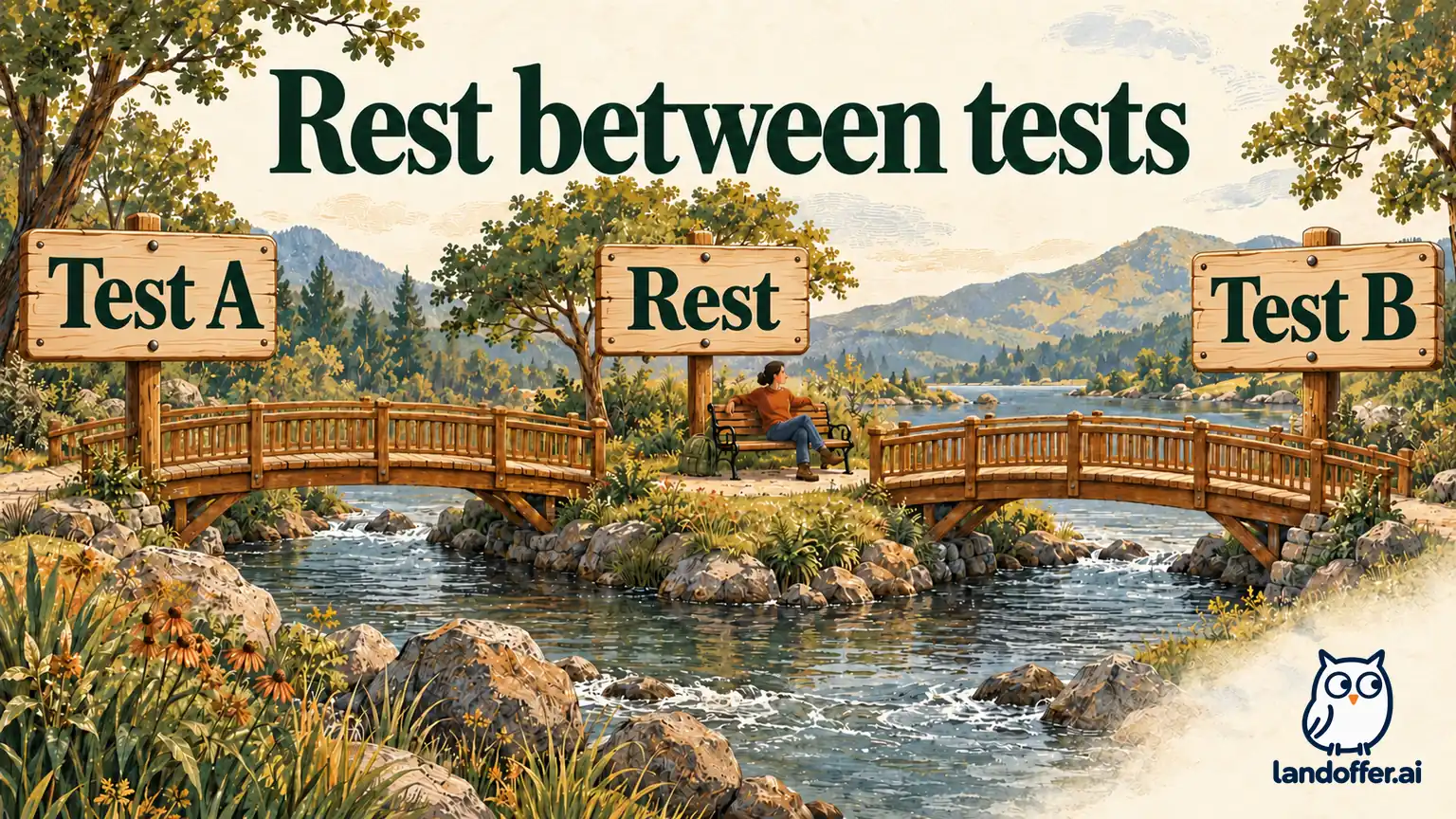
Aon's public preparation page says a battery can usually be spread across sessions, with breaks between tests. Once an individual test starts, it cannot be interrupted and continued later. The invitation supplies the overall deadline. Introductory explanations and examples are untimed; actual tests often have a limit, while personality questionnaires generally do not. For a test blocked by a technical problem, Aon directs candidates to the inviting company for unblocking.
Those are general documented rules. This article does not establish your assigned module list, timer, start button, saved-answer behavior or recovery outcome. Record those details from your invitation and permitted instructions. In particular, an estimate for one named exercise is a poor substitute for information about the exercise actually assigned to you.
Write down the completion deadline and your next uninterrupted working period as separate entries. If your deadline is Friday evening but your next free period lasts only ten minutes, the generous deadline does not make that short period suitable for a longer task. Moving the task to a better slot is a scheduling decision you can make before starting.
Keep the time zone attached to the deadline. “Friday at five” becomes ambiguous when the recruiter and candidate live in different places. If the invitation omits a time zone, ask the inviting company to confirm the zone before converting the deadline. This is a question about your particular invitation, not a conversion rule supplied by Aon.
Aon's public numerical reasoning and verbal reasoning practice PDFs both distinguish their untimed practice from a timed assessment. They suggest completing practice in one session. Use those resources for familiarization if relevant to your assignment; the time you spend reading a practice document does not establish the duration of your assigned module.
Worked example: Lena's three-module plan
Lena is a fictional candidate whose invented invitation lists three modules and a deadline of Friday, October 16, 2026, at 17:00 America/Los_Angeles. In this example only, Module A takes twelve minutes, B takes twenty and C has a twenty-five-minute estimate. These are illustrative inputs, not Aon defaults or a suggested test order.
She has a quiet room Wednesday from 18:30 to 19:20 and Thursday from 18:30 to 19:30. Friday from 09:00 to 10:00 is also available. Her plan leaves Friday available for unresolved administration or recovery; it does not assume someone will answer a support request during that hour.
| Session | Filled plan | Intended stopping point |
|---|---|---|
| Wednesday, October 14 | A: 18:30–18:42; record status by 18:45 | A's completion boundary, before beginning B |
| Wednesday, after a break | B: 18:55–19:15; record status by 19:20 | B's completion boundary; stop for the evening |
| Thursday, October 15 | C: 18:30–18:55; record status by 19:00 | Review the assigned module list afterward |
| Friday, October 16 | Protect 09:00–10:00 as a reserve | Resolve any outstanding question before the 17:00 deadline |
Our local calendar calculation confirms twelve, twenty and twenty-five minutes for those three planned working periods. The reserve ends seven hours before the fictional deadline. We checked these calendar intervals locally; we did not run them inside an assessment. Time assigned to C remains an estimate, so Lena has another thirty-five minutes in Thursday's room booking rather than scheduling a hard departure at 18:55.
Notice what the plan actually resolves. Lena has chosen when to work, where to put a break and when to revisit an unresolved issue. It does not certify that all three modules will be available in that sequence or that the estimate includes every instruction. Before acting on the plan, she compares it with the assigned instructions and changes any incompatible slot.
Keeping that reserve means declining another commitment in the same hour. If she promises Friday morning to another interview, she loses that recovery time. She should then revise the plan, rather than leave an unavailable buffer on her calendar.
Change the slot when an interruption becomes likely
Suppose Lena learns that a building technician will arrive Thursday between 18:40 and 19:00. Her earlier C slot now overlaps a likely interruption. Starting at 18:30 and hoping the visit happens later leaves the conflict unresolved. In her fictional calendar, 19:15–20:00 is available in another quiet room, so she moves C there and keeps Friday's reserve.
If that later room were unavailable, the decision would change. She could investigate an earlier quiet period, reconsider another commitment or ask the inviting company about her situation before starting. None of those choices requires pretending that an active assessment has a pause function. If there is no workable period left, the useful request identifies the actual constraint and deadline.
Lena's example also explains why a plan should name a stopping point. “Take a break at seven” is too coarse when the current module could extend past seven. “Finish the current module, confirm the visible status, then decide whether to begin another” ties the break to a real boundary. The candidate still needs to read what that boundary looks like in the assigned process.
For an adjustment request, use the company or provider route identified in the instructions. Aon's guidance describes adjustments as case-specific. Ask what has been agreed and when it takes effect; a request awaiting a reply is not an approved change to a timer. Keep unnecessary personal details out of a general planning note.
Record the boundary without copying assessment content
After Wednesday's first module, Lena's fictional note reads: “A: completion indicated at 18:42; B not started; break until 18:55; invitation deadline Friday 17:00 America/Los_Angeles.” That note captures the state she needs for scheduling. It contains no question wording, answer choices or attempted solutions.
Use the wording you actually see. If a screen only says that an activity ended, do not translate it into a passing result or a confirmation that every module is complete. If the overall list remains available, compare its remaining requirements with your own note. If it is not available, preserve that uncertainty instead of inventing a status.
For a software candidate managing several applications, the company and role matter too. Two assessment invitations can look similar while belonging to different processes. Put the employer, role and deadline on the private application record. Avoid pasting a token-bearing invitation URL into a shared calendar description merely to make the entry convenient.
This record is intentionally small. A detailed diary of test content would not improve the scheduling decision. The useful question at a break is whether another required activity remains and whether you have a suitable slot for it. Keep the invitation accessible through its original authorized route and follow any rules about recording the assessment.

Worked example: Omar's blocked-module packet
Omar is a second fictional candidate. Module A showed completion before he began B. His browser crashed at 14:12 America/Los_Angeles on October 14. At 14:15, the module displayed “blocked.” His invented deadline is October 15 at 17:00 in the same zone. This is an interrupted activity, not the planned between-module break in Lena's case.
Omar prepares the following incident record. It separates what he observed from what he wants the inviting company to determine.
| Record entry | Completed fictional example |
|---|---|
| Application context | Omar, Software Engineer application; reference A202 is an invented teaching label |
| Last known boundary | Module A indicated completion before B began |
| Failure and time | Browser crashed at 14:12 on October 14, America/Los_Angeles |
| Current observation | B displayed “blocked” at 14:15; no further answer entry attempted |
| Deadline | October 15, 17:00 America/Los_Angeles |
| Still unknown | Whether B's answers were retained, which recovery action is available and whether the deadline will change |
| Requested owner action | Inviting company to review B's access and explain the next authorized step |
The label A202 is not a real candidate identifier and should not be copied into an actual message. Omar would use the application reference already supplied in his own invitation if needed. He would describe his browser and operating system accurately, rather than copy someone else's environment details to fill a field.
A concise, unsent support draft follows:
Hello, I am completing the assessment for the Software Engineer application. Module A indicated completion before I began B. My browser crashed at 14:12 America/Los_Angeles on October 14; B displayed “blocked” at 14:15. My invitation deadline is October 15 at 17:00 in that time zone. Could you review B's access and advise the next step? Please also confirm whether any deadline change is needed. I have not completed B.
This fictional message makes two distinct requests: review the blocked activity and clarify the deadline. It does not say that an unblock has occurred or that an extension is owed. Send your own factual version through the contact route attached to the invitation; this guide has not contacted anyone for Omar.
Keep the recovery outcome open until it is confirmed
Omar's record remains “blocked; company review requested” after he sends a message. A sent email establishes that he asked. It does not establish access, answer retention or a completed battery. If he receives a reply, he should compare the authorized next step with the current module state before changing that record.
For example, a request to revisit the original invitation is actionable without creating a second candidate account. A response that discusses access but says nothing about the deadline leaves the deadline question open. If the module is still blocked after the stated step, a factual follow-up can identify that remaining problem without claiming the earlier instruction was never received.
Do not build a recovery plan around repeated refreshes, clearing browser data or registering under a different address. We have not established those as supported remedies for this situation. Preserve the failure time and current message, then use the inviting company's direction. If the deadline approaches without an answer, follow up through the same application contact with the remaining time and the unresolved module.
Before your next session, choose one whole-test working period and one later review point for outstanding issues. Lena's plan ends with time reserved; Omar's packet ends with a clear request and an unresolved status. Neither example claims a completed assessment or a hiring result. Keep that record with the application, then return to your wider search through recent roles on LandOffer.ai.
Sources and Further Reading
- Aon: Prepare for your Online Assessment — public guidance on test structure, breaks, adjustments and blocked tests
- Aon: Numerical Reasoning practice tasks — introductory guidance distinguishes practice from the timed assessment
- Aon: Verbal Reasoning practice tasks — introductory guidance on a separate practice session