LandOffer
Job search
Yoodli Review for Interview Practice: Speaking Feedback, Rehearsal, and Privacy
Use Yoodli to rehearse before your interview; compare the feedback you need with session allowances, billing commitments and data-use terms.
Yoodli is worth trying when you need to hear and revise how you explain your work before an interview. Its documented interview roleplays combine questions, follow-ups and feedback on answers and delivery. The important buying boundaries are five lifetime free practices, weekly limits on Pro, and plan-dependent data-use choices. A clear explanation still needs a separate check for technical accuracy.
Start with a real preparation gap: perhaps your answer takes too long to reach the decision, or a nontechnical listener cannot follow the terminology. If you first need a relevant opening, browse recent roles on LandOffer.ai and use the posting to choose what to rehearse. LandOffer publishes this review; its job-discovery tools serve a different task from speaking practice.
This is a review of public documentation and pricing controls checked October 14, 2026. We operated the public billing toggle and read the current interview page, policies and help articles. We did not record a session, test AI feedback, buy a subscription or measure hiring outcomes. The worked examples below are original fictional exercises.
What Yoodli can help you rehearse
The current interview-preparation page describes simulated conversations, dynamic follow-ups and personalized feedback, including pace and clarity. That makes it a plausible fit for practicing an explanation aloud and noticing where it becomes hard to follow. These are vendor descriptions, not results from our own recordings.
Yoodli’s practice guide documents entering a role and company, choosing an interviewer’s demeanor, and optionally selecting bank questions or adding your own. Interview mode mixes preset questions with follow-ups based on responses. Finishing with View Analysis saves the recording and requests feedback. The guide says a microphone is the minimum requirement; a camera enables additional feedback such as body language and centering.
The saved recording and feedback give you two artifacts to compare. Those artifacts do not establish that the system will catch a flawed database design or know which project results you personally delivered. Use your code, notes and a knowledgeable reviewer to validate those claims. A question labeled for a company also does not prove that company currently asks it.
The personal-settings guide describes pronunciation feedback aimed at intelligibility rather than removing an accent. Treat that as the stated purpose. We have not established equal feedback quality across accents, microphones or speaking styles. Choose one change a listener can notice: define the unfamiliar term, finish the sentence before adding an exception, or state the decision earlier. A pause that helps the listener follow that explanation may be worth keeping.
Free practice, weekly allowances and actual billing
The subscription guide defines the free allowance as five lifetime practices: speeches, interviews or roleplays over 30 seconds. It is not five new sessions every month. The expanded public pricing FAQ also counts analysis of uploaded recordings toward practice usage.
On the pricing page, Starter showed no charge, Pro allowed ten roleplays per week, and Advanced offered unlimited roleplays. Unused Pro sessions do not roll over. We did not establish the weekly reset time or whether an interrupted recording restores an allowance. The over-30-second definition also does not prove that shorter attempts provide unlimited usable practice. Do not build a practice schedule around those assumptions.
The visible annual setting showed Pro at $8 per month billed annually and Advanced at $20 per month billed annually. Switching to monthly billing changed those cards to $11 and $28 respectively. The annual arithmetic is $96 or $240 before any applicable taxes; the monthly figures have a different commitment. Recheck the selected billing period when purchasing.
The same pricing FAQ says Advanced, Team and Enterprise roleplay data are excluded from AI training by default. It says Starter and Pro session data may improve the platform. Pro is paid, so payment alone does not establish the stated default exclusion. The separate profile opt-out described in the privacy policy also matters; we discuss it below.
For paid plans, Yoodli’s terms describe automatic renewal until cancellation and generally nonrefundable fees except where law requires otherwise. Its subscription help says a confirmed downgrade stops renewal while access continues through the paid term. Cancellation does not turn an annual commitment into a one-month purchase.
A completed choice: twelve practices and a $24 limit
Consider Samir, a fictional data engineer with an interview in twelve days. He has a $24 preparation budget and wants six focused practices in each of two weeks. His example uses synthetic order data; he will not upload employer recordings or private dashboards.
He initially plans three diagnostic practices, then three revised attempts in the first week. A fresh Starter allowance would cover five of those six recordings if each counts as a practice. Across both weeks, his twelve-session plan exceeds the lifetime allowance by seven. Waiting until the second week would not refill Starter.
| Route Samir evaluates | Cash and allowance | Completed decision |
|---|---|---|
| Starter, then offline rehearsal | $0; five lifetime practices if unused | Begin with three diagnostics; preserve two for focused retakes and rehearse other attempts locally. |
| One month of Pro | $11 before tax; ten practices per week | Six in each eligible week fits the stated quota, subject to the actual reset boundary. Review data-use settings before purchase. |
| Advanced or annual Pro | Advanced monthly $28; annual Pro $96 before tax | Both exceed his $24 cap. Do not choose them merely to avoid planning repetitions. |
The decision turns on two constraints. Pro could cover his planned volume within budget. However, Samir also wants to understand how to opt out of platform improvement before supplying recordings. He chooses three sanitized Starter diagnostics first and defers paying until he can inspect that control and decide whether the terms are acceptable.
If default training exclusion is a firm requirement, his volume calculation alone cannot make Pro the right choice. Advanced’s advertised default may be relevant, but its monthly price exceeds his cap. He can keep practicing locally or seek an acceptable institution-provided arrangement instead. His budget remains a constraint even when another plan offers a relevant privacy feature.
His three initial topics are explaining late-arriving data, describing a testing decision, and answering a follow-up about a failed assumption. After each attempt, he writes the sentence he will change and the question that sentence should answer. For the late-data topic, that question is whether the latest dashboard total is final. Repeating six answers without reviewing any of them would satisfy his recording target while leaving the preparation gap unresolved.
A completed rehearsal: explain the watermark to a product manager
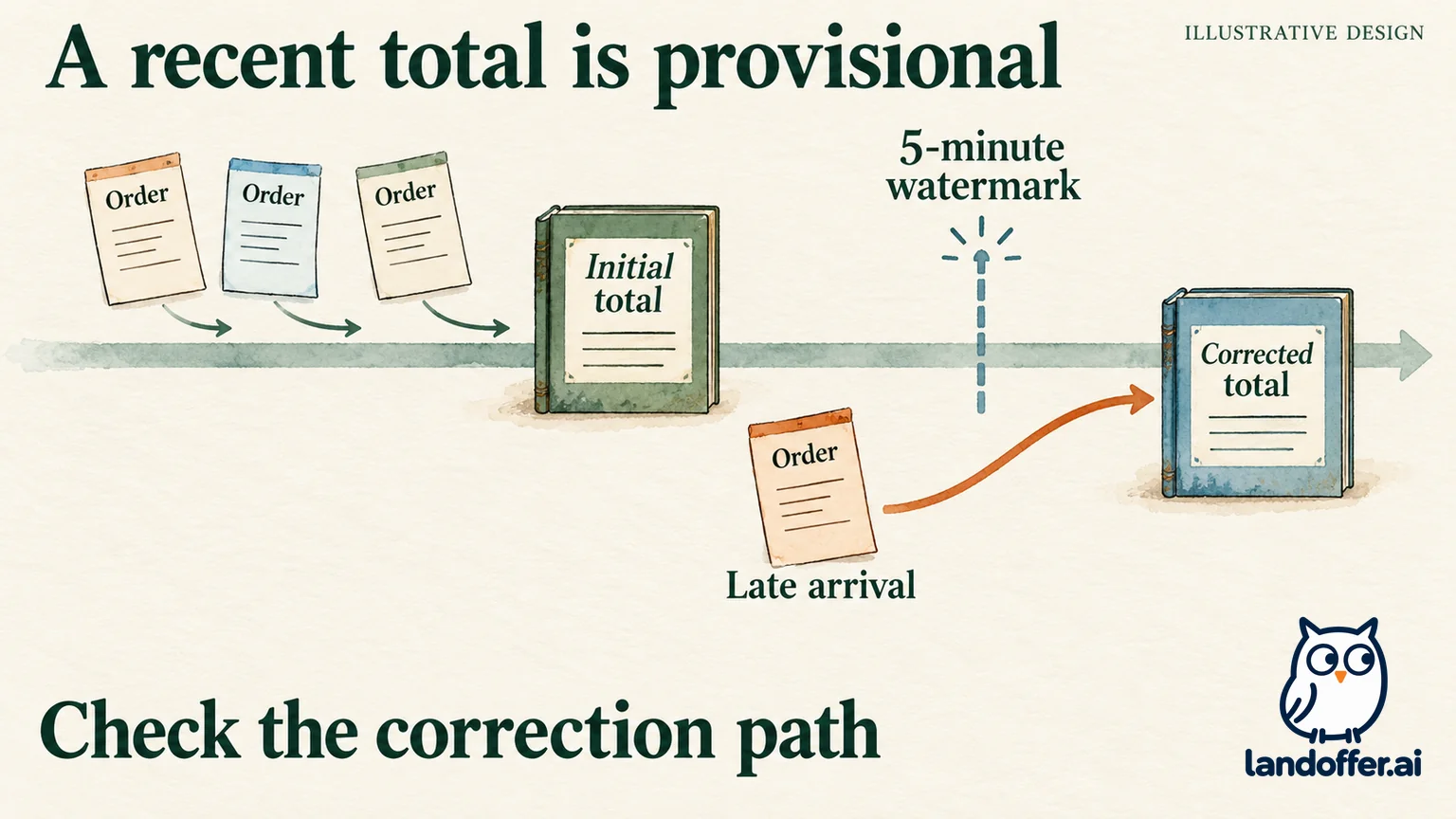
Samir’s first fictional draft is: “We used event-time windows with a five-minute watermark and an upsert sink, so the lateness semantics were handled downstream.” The terms may be familiar to engineers, but a product manager still cannot tell whether the dashboard is final or how a delayed order affects it.
Here is a complete revised answer for this invented design:
“We grouped orders by when customers placed them, even if a message reached us later. The live dashboard showed an initial total. We allowed a five-minute delay before marking a window complete, and our design sent later arrivals through a correction path. That meant an old total could still be revised. I added a test with a deliberately delayed order and checked that the corrected total matched the source records. For the product manager, the important limitation was that a recent total was provisional. I would explain that label before anyone used the dashboard for a final daily report.”
This is an explanation written for the article, not a Yoodli-generated answer, transcript or feedback report. The five-minute choice is a fictional design parameter, not a recommended setting for every pipeline. A watermark’s exact behavior depends on the processing system and configuration; it does not automatically guarantee a correction path.
Samir’s manual review produces four concrete decisions:
| Review question | Finding in this example | Action for the next attempt |
|---|---|---|
| Can the listener identify the business consequence? | The dashboard may show a provisional total. | Keep that consequence near the beginning. |
| Does the answer explain the time distinction? | Customer order time differs from message arrival time. | Keep the ordinary-language distinction before introducing “event time.” |
| Is technical behavior being assumed? | A correction path is claimed as part of this design. | Check the actual SQL, sink behavior and delayed-event fixture before using this story about real work. |
| What deserves another recording? | The opening still takes several sentences to reach the decision. | Start the retake with “The dashboard’s latest total was provisional,” then explain why. |
A speaking tool could help him notice delivery patterns during that retake. It cannot replace the source-record comparison that supports his testing claim. If a teammate finds that the real pipeline dropped late events, Samir must change the story even if the spoken version sounds clear.
He also avoids adding invented numbers about revenue saved or throughput improved. The finished answer names the limit he understands, his own testing work, and the question the listener should ask next. That is a useful preparation artifact even before any automated score exists.
Privacy has separate visibility, training and retention controls
A private recording can still be processed to provide feedback. The settings documentation says new recordings default to Private until shared; its Public option is not findable but can be shared by link. An unlisted link is not equivalent to an audience restricted to you.
The privacy policy, effective September 10, 2024, covers enabled audio and video, uploaded content, generated delivery analytics and service-provider processing. Section 5 says users may opt out of data use to improve the AI speech coach through profile settings. We did not test that setting or its scope for a current individual account. Starter and Pro should therefore not be described as having no opt-out simply because Advanced advertises exclusion by default.
There is also a document mismatch worth resolving before sensitive practice: the terms, effective September 7, 2023, describe a broad, perpetual contribution license and model-training use. The newer pricing statements and profile-control policy do not let this review determine how every clause applies together. Ask Yoodli which terms and exclusions cover your intended plan if that distinction determines whether you can use it. Organizational agreements may change the applicable arrangement.
The Recording Library guide documents download and delete actions. Automatic deletion is limited to eligible plans or organizational arrangements; the guide says it removes recordings and transcripts while retaining analytics and progress. We did not verify that a particular individual plan includes it. The subscription help separately describes a three-day grace period before permanent account-content deletion. Neither description proves immediate erasure of every category of retained data.
For Samir, the practical choice is to rehearse the synthetic explanation above and keep employer names, customer records and production screens out of it. Yoodli’s practice help says shared screens are recorded and available to the AI during practice. A prepared text prompt is enough for this exercise; sharing a work desktop would add material he does not need reviewed.
When to use Yoodli, and when another kind of practice fits
Try the free allowance when your immediate goal is spoken rehearsal and you can use suitable practice material. After an attempt, identify one useful change and verify that the next recording addresses it. Consider Pro when repeated practice is valuable and its weekly allowance and data choices fit. Consider Advanced’s default training exclusion separately from its unlimited volume.
Choose direct coding practice when the gap is implementation, and a knowledgeable human when you need someone to challenge technical decisions or probe ownership. Institution-provided access can be worth checking, but confirm its actual controls and sharing rules. This review supports a bounded trial, not a claim that Yoodli can certify interview readiness.
Before another repetition, Samir saves his provisional-total opening and delayed-event verification task beside the target role. Choose one requirement from a posting and write the listener’s question before recording again: find relevant openings on LandOffer.ai and choose one explanation you can support with your own work.
Sources and Further Reading
- Yoodli: current interview preparation
- Yoodli pricing and roleplay/data-use FAQs
- Practice with Yoodli — August 27, 2026
- Subscriptions — August 27, 2026
- Personal Settings — May 19, 2026
- Recording Library — July 15, 2026
- Privacy Policy — effective September 10, 2024
- Terms of Service — effective September 7, 2023