LandOffer
Job search
Voomer Review: Recorded Interview Practice, AI Debriefs, and Session Bundles
Use Voomer for deliberate recorded-answer rehearsal, while checking AI feedback, session consumption and conflicting six- versus twelve-month validity.
Voomer is most relevant when you need to rehearse a recorded video answer and review how it comes across on camera. Its public offer centers on recordings, AI debriefs, and bundles of practice sessions. It is less suitable as your only preparation for live technical questioning, and its scores should not be treated as an employer's hiring verdict.
This review uses public product pages checked October 20, 2026, including a read-only visit to the pricing page. We did not record a session, upload a video, purchase access, or test a paid debrief. LandOffer.ai publishes this review. If you are still deciding what roles to pursue, browse recent roles on LandOffer.ai and establish the interview format before buying practice.

Start with the interview format
Voomer's public app introduction describes preparation for one-way video interviews, including formats associated with HireVue, Kira Talent, and Spark Hire. Answering a camera without a conversational partner requires different practice from explaining code while an interviewer interrupts.
That focus gives you a concrete way to use the product: you can repeat an answer, watch it back, and decide what to change. But the invitation still governs. Check preparation time, answer duration, permitted retries, equipment requirements, and whether the round includes live follow-up. Familiarity with one practice tool does not establish another platform's rules.
Voomer's disclaimer explicitly says its experience is not equivalent to third-party one-way interview platforms and does not imply their endorsement. That limitation matters alongside marketing about company question banks. A company label may help organize practice; it does not authenticate the questions in your upcoming interview.
For a software candidate, recorded behavioral practice can complement coding or system-design preparation. It cannot demonstrate whether you can implement a solution, defend a database trade-off, or respond when an interviewer changes a requirement. Keep live coding, system-design discussion, or technical peer practice in your routine if those are the tasks you need to improve.
Understand what an AI debrief can tell you
The AI interview practice page describes feedback on delivery and answer content, including speaking pace, filler words, eye contact, transcripts, and STAR structure. STAR means situation, task, action, and result. These are documented capabilities, not independently measured accuracy in this review.
Look for a specific change you can test in the next recording, so the debrief leads to a better rehearsal rather than another score. If you spent most of an answer looking at notes, try moving a short outline nearer the camera. If the transcript shows a long introduction, shorten it and see whether the actual decision becomes easier to follow. A debrief earns its place in your routine when it helps you make and evaluate such a revision.
Avoid turning every indicator into a target. A deliberate pause may make a complex explanation clearer. Looking away briefly is not proof of poor understanding. Apparent confidence is different from the truth or technical quality of an answer. Voomer's own disclaimer acknowledges that AI feedback can be inaccurate or inapplicable.
The provider also advertises comparisons with other candidates. We did not verify the composition, representativeness, or scoring calibration of that comparison group. A percentile reported by a practice service is not the probability of passing an employer's assessment. Read the transcript and replay the relevant moment before treating a relative score as a diagnosis.
Worked debrief: a slow answer or a long recording?
Consider a fictional candidate, Nikhil, rehearsing an explanation of a production incident. This is an original timing exercise, not a Voomer recording or an example of a score the service returned. His local rehearsal log divides a ninety-second file into three parts:
| Segment | Duration | What happened |
|---|---|---|
| Opening | 18 seconds | He silently read the prompt again after recording began |
| Spoken answer | 50 seconds | He delivered 105 words about the decision and result |
| Ending | 22 seconds | He searched for the stop control after finishing |
Across the whole file, the calculation is 105 ÷ 90 × 60 = 70 words per minute. Across the spoken segment, it is 105 ÷ 50 × 60 = 126 words per minute. Both are valid arithmetic; they answer different questions. We calculated these values locally from the fictional log, not from Voomer's analytics.
Nikhil's first revision is to understand the recording controls and remove unintended lead-in and trailing silence. He does not rush his fifty-second explanation merely to raise a number calculated over a ninety-second file. We have not established which timing denominator Voomer uses; this exercise shows why checking the recording is useful before acting on any pace feedback.
Now inspect the answer's content. His outline says: a deployment increased checkout errors; he compared the release timing with the error graph; the team reverted it; he added a pre-release check. The missing explanation is why reverting was the appropriate choice at that moment. Faster delivery would not supply that reasoning.
His revised outline adds one concrete decision sentence: “Because errors began immediately after the release and the previous version was available, we reverted first, then investigated the cause.” This is fictional teaching copy, not a script for claiming someone else's experience. His next recording should test whether that sentence makes the decision understandable while preserving the time limit.
The completed review therefore produces two separate actions: fix avoidable recording silence and clarify the decision. Only the first concerns delivery mechanics. The second needs a listener who can follow the incident. Repetition without distinguishing those actions could produce a smoother answer that still omits the point.
For his second take, Nikhil writes down the invitation's answer limit separately from the length of the saved file. He then checks three moments on replay: when meaningful speech begins, where the decision sentence appears, and whether the ending finishes before the limit. He keeps the result in plain language: “Decision explained; opening silence removed; ending still needs trimming.” That note is useful even if a summary score moves in the opposite direction. It records the change he intended, the evidence he inspected, and the one thing left for another take.
What the session bundles actually promise
On our native read-only pricing-page visit, Voomer listed Warm-Up with eight sessions, Training Block with twenty, Full Prep with forty, and All In with one hundred. The page described the first human-user session as free without a card and called its result a preview debrief. That wording does not establish that the free preview exposes everything in a paid analysis.
The same pricing page said sessions last twelve months from purchase and can be topped up. No dollar amounts were visible on the public pricing page during our read-only browser visit. Following Full Prep opened the app's pricing route, but the page did not produce a readable offer before browser inspection timed out. We did not proceed to checkout, so we cannot responsibly quote a current purchase total or per-session price.
A material documentation mismatch remains: the disclaimer describes analysis tokens as valid for six months unless otherwise stated. Twelve months on the pricing page may be a different or newer offer, but we did not establish that relationship. Confirm the validity attached to your actual bundle and retain the offer before paying. Do not plan distant practice around the more favorable duration alone.
The pricing page also advertises an unconditional refund without a usage minimum or time limit. We have not tested a refund or reconciled that statement with an account-specific purchase agreement. Treat it as a public promise to verify in the selected offer, rather than a refund outcome this review can guarantee.
Worked bundle decision: twenty sessions with a purpose
Suppose a fictional candidate, Marisol, has a recorded interview in two weeks. She wants to prepare four distinct stories: resolving a disagreement, learning a tool, handling an incident, and choosing between competing priorities. She has already tested her camera locally. Her completed rehearsal allocation is:
| Use | Calculation | Sessions allocated |
|---|---|---|
| First recording of each story | 4 stories × 1 take | 4 |
| Revise after replay and debrief | 4 stories × 1 revised take | 4 |
| Rehearse each story to the invitation's time limit | 4 stories × 1 timed take | 4 |
| Try unseen prompts without a prepared script | 4 different prompts × 1 take | 4 |
| Reserve for another targeted revision | 4 selected weak answers × 1 take | 4 |
| Total | 4 + 4 + 4 + 4 + 4 | 20 |
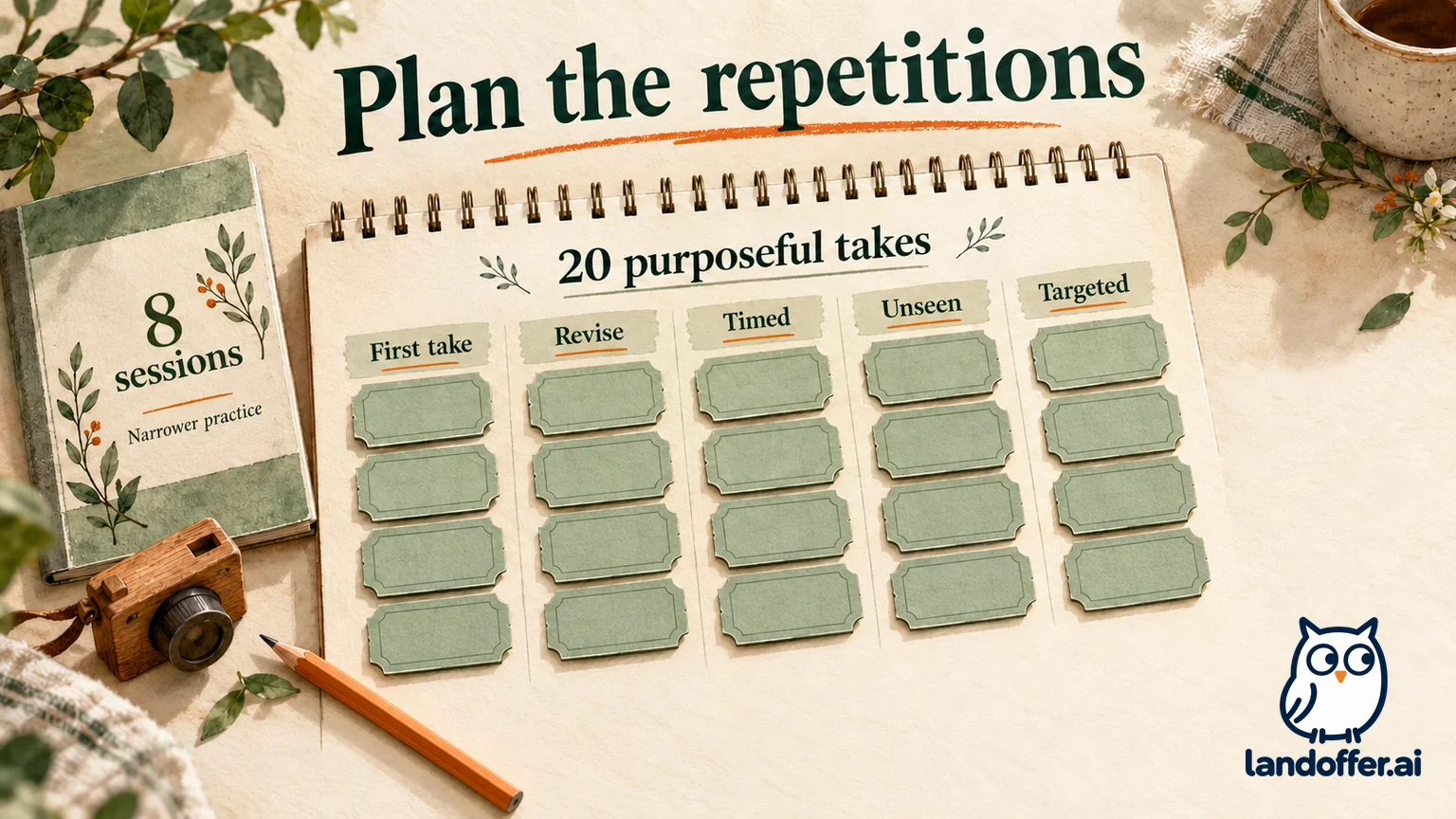
For this plan, a twenty-session bundle matches the allocated work. Eight sessions would cover the first two takes for four stories, leaving twelve planned rehearsals uncovered. Forty would supply twenty more than she has currently assigned. These are capacity comparisons, not a claim that the twenty-session offer is the cheapest: dollar prices were not verified.
She can also reduce the purchase. If she keeps only two stories, an eight-session plan could fund three takes per story plus two unseen prompts: 2 × 3 + 2 = 8. That smaller plan trades breadth for fewer paid repetitions. It is a coherent choice if those two stories cover her immediate gap and the other practice can happen with a peer or local recording.
This budget assumes each planned analyzed take consumes one session. We did not verify treatment of retakes, failed uploads, or incomplete analyses. Before buying, Marisol needs the product's actual consumption rule. She can then revise the allocation; she should not count the free preview as a spare paid session without confirming its entitlement.
The expiry discrepancy does not change her two-week arithmetic, but it affects what unused sessions are worth. She assigns no value to hypothetical use later in the year until validity is clear. Even if a larger pack offers a lower unit price, count only the repetitions you expect to use.
Record material you are willing to submit
A video answer contains more than its transcript. Voomer's privacy policy, marked updated March 16, 2026, describes recordings, gaze and facial analysis, vocal characteristics, transcription, and third-party processing. It also describes retention of analysis, transcripts, and coaching data indefinitely. That is a substantive consideration before uploading personal stories.
The policy provides a route to request deletion, subject to its stated conditions; we did not test account deletion or verify removal from every downstream processor. Use an invented, nonconfidential rehearsal example first if you want to assess the experience. Remove client names, internal incidents, private coworker details, and employer documents from practice material.
Who should try Voomer?
Voomer is a reasonable candidate for someone who avoids watching their own recordings and wants structured prompts for the next take. Its recorded-answer focus and documented delivery analysis can make practice more specific than repeatedly rehearsing in your head. Use the human-user preview before committing to a bundle, and decide whether its debrief identifies a change you can evaluate yourself.
Keep a peer, mentor, or technical interviewer in the routine when your uncertainty concerns reasoning, domain knowledge, or follow-up questions. Keep local recording if replay alone solves the problem and you do not need cloud analysis. Before purchasing, resolve the displayed price, session-consumption rule, expiry mismatch, and applicable refund terms for the exact offer.
Our verdict is conditional on that fit, rather than on a percentile or a company label. Practice should leave you with a clearer, truthful answer and a specific reason for the next repetition. Once your target interview format is clear, explore LandOffer.ai to connect that preparation with your broader search.