LandOffer
Job search
VMock Review: Campus Access, Upload Allowances, and Resume Feedback
Use current campus access and a deliberate revision budget; treat resume feedback as editing guidance with factual and human review.
VMock is worth checking before you buy another resume tool if your university currently provides it. The useful starting point is your campus access page: who qualifies, which modules are enabled, and how many uploads or re-scores remain. A university logo on an old guide does not establish your access today.
For a tech applicant, the strongest use is a deliberate editing pass. Let feedback identify vague language, weak organization, or missing context, then check each revision against your actual work. A higher score cannot establish that a project demonstrates production experience, that an employer will accept the document, or that every applicant tracking system will parse it correctly.
This review checks public VMock and university guidance as of October 14, 2026. We read the rendered campus instructions; we did not upload a resume, obtain a score, or test a student account. You can browse recent roles on LandOffer.ai to choose a target role before deciding which resume changes deserve an upload; then check that employer's requirements and application destination.

Start with your current campus entitlement
VMock describes an AI career platform serving higher education among other audiences. For this review, the relevant purchase question is whether your school already provides resume feedback. Its public feature catalog does not tell you which features your school licenses or which department administers your account. VMock
Two current school examples show why eligibility needs a local answer. Oregon State describes automatic student access through ONID and a personal-email request route for alumni continuing access for twelve months after graduation. Emory's page covers current College of Arts & Sciences undergraduates and alumni within two years, with alumni requesting access separately. Neither policy establishes access for students at another institution. Oregon State, Emory
Begin at your own career center's current resource page, follow its named VMock route, and check the cohort restriction before treating a login problem as a broken product. A graduate student, recent transfer, or former student may need a different office or may not qualify. Having a university email address does not establish that your cohort has an active license.
Record the department, student or alumni category, expiration information, and support route beside your local resume folder. This gives you a place to check eligibility again when you graduate or the next term starts. If the page does not address your situation, ask the institution a narrow question: whether your cohort has access this term and which login route it should use. Do not borrow another campus's credentials or assume a general VMock account reproduces the school arrangement.
An old campus guide can survive the service
USC's current resource notice says its VMock access ended on June 30, 2026. It also states that profiles would become inaccessible and previously uploaded documents would be deleted after that date. We read the announcement, not an account-side deletion record. A separate current USC resource page now lists Quinncia for currently enrolled students, with unlimited resume uploads and mock interviews while enrolled; alumni are excluded. Check that page's current route rather than relying on the older transition announcement. USC Quinncia resource USC Career Center
That date has already passed at this review's October check. Instructions to download saved files before June 30 are historical instructions, not a recovery path available today. A student encountering that page should check USC's current support resources rather than keep trying the former VMock route.
This is a USC access change. The Emory and Oregon State pages separately describe their own arrangements; neither is evidence of your account entitlement. It demonstrates why a search result, bookmarked tutorial, or older orientation slide is insufficient access evidence. Keep your editable resume and final exports outside any campus platform so a license transition does not become the only place your application history exists.
Budget uploads and re-scores together
Emory explicitly describes ten opportunities to upload or re-score per academic year, and directs students who exhaust them to CPD for assistance. That is a support route, not a promise of extra credits. Oregon State lists ten resume uploads per year; its wording should not be silently converted into a universal academic-year reset rule. Emory, Oregon State
Before pressing a scoring control, read the counter and the current explanation of what consumes it. Uploading a new version, rescoring within an editor, and requesting another kind of analysis may have different accounting. Confirm what your account actually says rather than applying a different school's policy to every module.
A useful budget reserves submissions for material changes. Correct several related bullets, dates, and layout problems in the editable source before uploading again. You do not need a fresh score after each punctuation change. If a failed file appears to reduce the counter, save the error and before-and-after balance for support instead of repeatedly submitting the same document.
Worked example: four remaining opportunities
The following is a fictional planning exercise using a ten-opportunity arrangement, not an observed VMock account or score. Tessa has already used six opportunities this academic year. She therefore has four left. Her next application is for an entry-level data engineering role, and her current source file mixes coursework with a part-time laboratory project.
| Planned submission | Changes completed before submitting | Total opportunities used afterward | Remaining afterward |
|---|---|---|---|
| Seventh | Fix dates, section order and inconsistent formatting in the master resume | 7 | 3 |
| Eighth | Clarify her own Python ingestion work and remove unsupported ownership claims | 8 | 2 |
| Ninth | Check the target-role version after a career advisor reviews project relevance | 9 | 1 |
| Reserved tenth | Use only if a material error or a substantially different application warrants it | Not used yet | 1 held |
The arithmetic is ten minus six equals four; three planned submissions leave one in reserve. The table does not forecast a score increase or claim that VMock will charge precisely these actions in Tessa's real account. It gives her a schedule to compare against the verified counter rules.
Tessa labels the three planned local files master-v7, python-project-v8, and data-engineering-v9, with a revision note for each. These are example filenames, not documents created or stored in VMock. Her eighth version explains what she coded; the ninth decides whether that project deserves more space for this role. If her advisor identifies only a comma change, she corrects the source without spending the reserved opportunity merely to see another number.
The plan gives Tessa room to address a substantial error close to an application deadline without repeatedly scoring minor edits. Exhausting all ten opportunities is not a measure of preparation quality.
Separate resume feedback from engineering evidence
Feedback can make a bullet easier to read while leaving its factual weakness untouched. For technical work, check the system, your individual contribution, the test conditions, and the limits of the result. A fluent sentence that overstates ownership is a worse application claim even if a scoring tool prefers its wording.
Emory advises focusing on feedback because scoring is subjective. Oregon State supplies a local green-zone submission recommendation. Treat such guidance as a school preparation benchmark, not an employer's cutoff or a prediction of ATS success. A recruiter may care about a specific language, domain, or scope that a general score does not establish. Emory, Oregon State
Worked example: preserve the limits of an embedded project
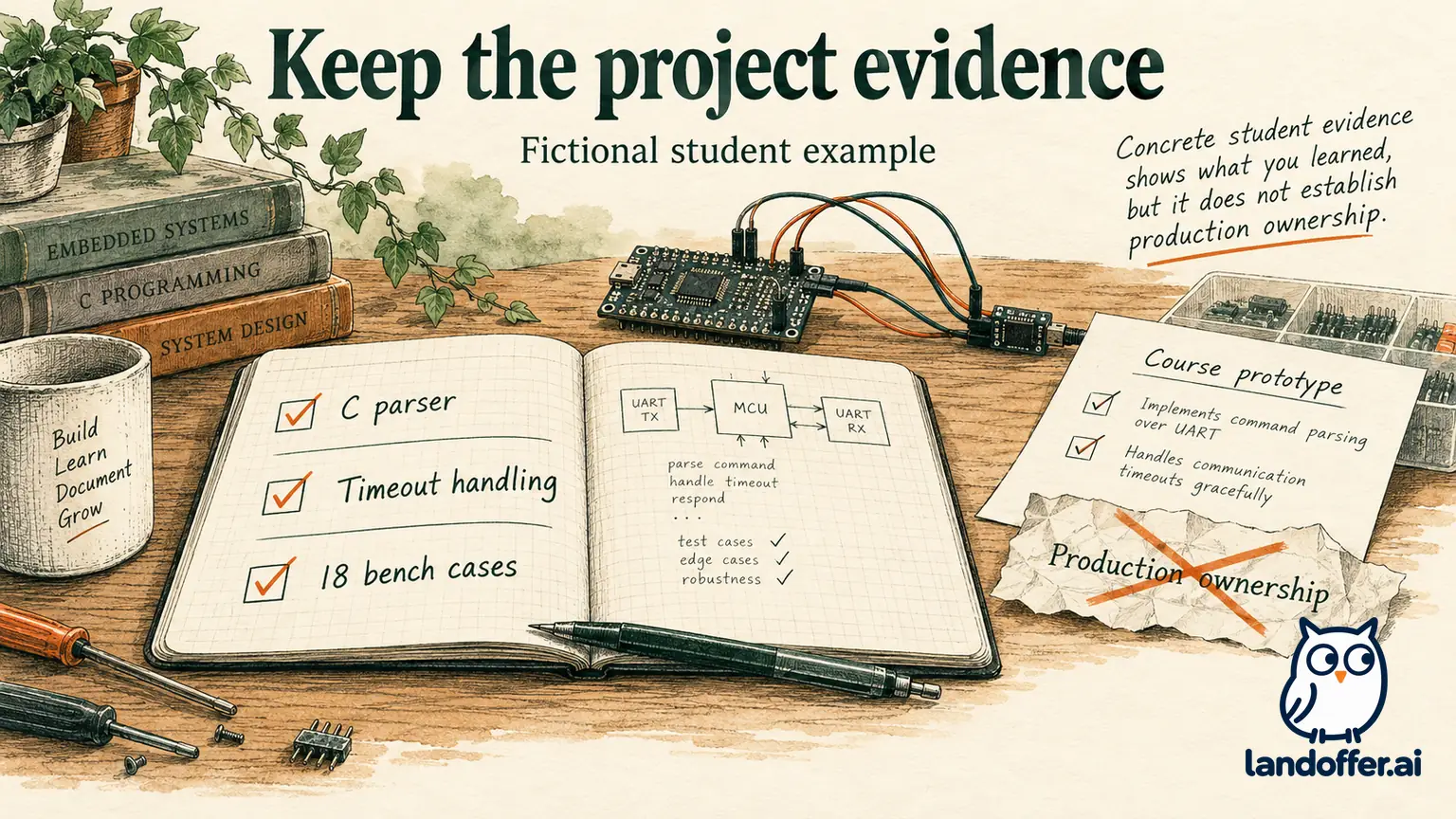
This fictional example is an editorial revision exercise. The questions and revised bullets below are not VMock-generated feedback. Noah's source resume says, “Worked on embedded systems and improved performance.” His project notebook provides more useful evidence: a course-team STM32 sensor board, a UART message parser he implemented in C, a timeout path he added, and eighteen malformed-frame cases in a bench test log. A teammate owned the board layout. The log contains no production deployment, safety certification, or measured speed improvement.
| Revision question | Evidence in Noah's notebook | Decision for the resume |
|---|---|---|
| Which code did he own? | C parser and timeout handling commits | Name those components; avoid claiming the whole board |
| What did he test? | Eighteen malformed-frame cases on the course bench | Describe the cases and setting |
| Can he claim a performance gain? | No comparable timing measurements | Remove “improved performance” |
| Was it a production or certified system? | Course prototype only | Keep the course-project context |
His two revised bullets are:
- Implemented a C UART message parser and timeout handling for an STM32 sensor-board prototype in a team course project.
- Tested parser behavior against eighteen malformed-frame cases on the project bench and documented results for the team's integration review.
These bullets make the work legible without turning a class prototype into professional firmware ownership. Noah rejects a suggested rewrite claiming faster real-time processing or safety-critical deployment because his evidence supports neither. Adding a number is useful only when its meaning is clear: eighteen is the count of test cases, not a performance improvement or a coverage percentage.
He also retains the test log and contribution notes for interview preparation. If asked how the timeout worked, he needs to explain the implementation, failure behavior, and remaining limitations. A resume score cannot supply that explanation for him.
Keep the source file and check the export
Emory's guidance recommends editing the original file for unusual or creative formats, and describes processing PDFs created through conventional word processors. This is a campus instruction, not a guarantee that every PDF producer or every layout will work. Emory
For a tech resume, a practical sequence is to maintain one editable master, save a named application version, export it, and inspect the exported document. Check whether dates wrap into the wrong entry, links remain usable, and project bullets still belong to the right heading. Feedback about layout is helpful only if the document you send contains the corrected layout.
If the platform extracts a project title or skill incorrectly, distinguish extraction trouble from weak experience. Simplifying the source layout may be appropriate; inserting misleading keywords to compensate is not. Keep the original evidence of your work intact while changing its presentation.
Before applying, open the actual file attached to the application, not just the editor preview. Check the employer's requested format and naming instructions. This review did not test VMock exports or an employer parser, so it does not establish a preferred format for every destination.
Use extra modules and human review deliberately
Emory describes resume editing, job-description optimization, and LinkedIn feedback modules. Their presence on that school's page does not prove they are enabled in every campus account. Check your own module list and allowances before replacing another tool or planning a task around a feature name. Emory
A job-description analysis can prompt a useful question about missing experience. It cannot make that experience true. If a role asks for production Kubernetes work and you have only read a tutorial, keep that gap visible while deciding whether other qualifications justify applying. Do not translate every missing keyword into a skill claim.
Oregon State describes optional Network Feedback for sharing with reviewers. Sending a resume for human input is a separate action from receiving automated feedback; check the recipient and document first. This review did not send a request or inspect reviewer permissions. Oregon State
Bring a focused question to the reviewer: whether the evidence demonstrates the target role, whether the strongest project is prominent, or whether a career transition needs explanation. Include the job description and the specific version you want reviewed. That makes the conversation more useful than asking someone to raise a score without discussing the work.
When campus access is enough
VMock is a sensible first pass when you have current access, understand its quota, and need help making an existing resume clearer. It is less useful as the sole answer to a disputed technical claim, an unusual career history, or a role-specific judgment requiring someone to discuss your experience.
Before paying for another service, identify what remains unfinished. If the problem is vague bullets, use your available feedback and source evidence first. If it is deciding which experience qualifies you for a particular role, seek a targeted human review. If access has ended, ask the institution about current resources rather than buying a substitute solely because an old login fails.
A reasonable stopping point is a resume whose claims you can defend, whose exported file you have checked, and whose emphasis fits the actual opening. Keep your remaining quota for meaningful changes. Explore LandOffer.ai as you organize the next application around those same role requirements.