LandOffer
Workplace Communication
Unclear Work Request? Turn a Vague Assignment into an Agreed Brief
Two fictional clarification cases turn an ambiguous demo request into a prototype brief and an undefined customer analysis into a bounded definition task.
When a work request is vague, confirm the problem, audience, deliverable, constraints, and acceptance owner before treating your interpretation as the assignment. Bring a short proposed brief rather than an open-ended list of questions. Mark which requirements the requester has confirmed, which are still assumptions, and which unanswered question could change the deliverable.
You do not need a full specification for every small task. You need enough shared understanding to choose the next useful piece of work without inventing the requester’s intent. This guide from LandOffer.ai uses two fictional workplace cases to show that process. Neither case is a real client engagement, product test, or message that was sent.

Find the uncertainty that changes the work
Look for the choices the request leaves unresolved. “Improve the experience” might mean investigating a problem, preparing a concept, changing production behavior, or reporting progress. Those are different deliverables. Ask what decision the requester needs to make and who will use the result.
Atlassian’s project-poster guidance separates understanding the problem, validating assumptions, and preparing to make the solution. It treats the document as something that develops through discussion. That is useful for ambiguous work: an attractive solution is not evidence that the underlying problem or delivery scope has been agreed. You do not need to adopt Atlassian’s tool or run its full exercise for a short assignment.
Prioritize uncertainty by its consequence. If the answer determines whether you should research, prototype, or implement, resolve it early. A minor formatting preference can often wait. If the deadline is unclear, ask for the actual date and time. If you are missing permission to use the necessary data or environment, identify that before promising a result that depends on it.
A concise opening question might be: “For Thursday, do you need a prototype to discuss, or a change customers can use?” It offers two plausible interpretations without quietly choosing one. Follow with the problem and audience, then the boundary that matters most. Keep the discussion focused on the next useful artifact and the information needed to prepare it.
Confirm the problem before choosing the solution
Ask what people are struggling to do, which evidence prompted the request, and what remains unknown. A stakeholder’s proposed feature can be useful input without being a validated user need. Preserve that distinction when drafting the brief.
The GOV.UK Service Manual’s user-needs guidance recommends understanding users and their problems, and treating suggestions not grounded in user evidence as assumptions to investigate. This is government-service guidance, not your employer’s mandated process. The transferable writing discipline is to label what you know and what you are proposing rather than turning an opinion into an observed fact.
For example, “The product manager reports that trial administrators confuse two notification settings” is different from “Research proves the settings are unusable.” The first accurately attributes the starting information. A prototype can help explore a proposed explanation, but it does not establish a measured reduction in confusion before anyone has evaluated it.
Keep the brief at the level of the current decision. You can record a future research question without committing to a full study in a two-day prototype task. Conversely, if the task is to investigate the problem, do not call a production redesign its agreed deliverable merely because you already have an implementation idea.
Worked example: from “improve it” to a reviewable prototype brief
The following is a fictional teaching case. Lina, a software engineer, receives this request from product manager Maya on Tuesday, October 27, 2026: “Improve notification setup before Thursday’s demo.” All people, dates, product behavior, and confirmations below are invented. No prototype was built or product account accessed.
Lina could start changing the settings screen, but she does not yet know whether the demo needs working software. She asks Maya what the audience needs to understand and what evidence started the request. Maya explains that the demo is for internal product reviewers and describes confusion between immediate alerts and a weekly digest. There is no completed user study or baseline measurement in this example.
They agree that Lina will prepare a clickable prototype for discussion, not deploy a feature. The completed brief captures the difference.
| Brief field | Agreed fictional content |
|---|---|
| Problem and starting evidence | Maya reports confusion about immediate alerts versus the weekly digest during trial setup. This is stakeholder input, not validated research |
| Audience and purpose | Internal product reviewers need to compare a proposed explanation of the two settings before deciding whether to investigate further |
| Deliverable | Clickable prototype with three views: settings overview, explanatory summary, and confirmation of the simulated selection |
| In scope | Labels and explanations for the two existing preferences, using synthetic example content; a short note listing assumptions and open questions |
| Out of scope | Backend changes, actual notification delivery, changes to existing customer preferences, deployment, and a claim that usability has improved |
| Timing and capacity | Draft ready Wednesday, October 28, at 4 p.m. Pacific time for Maya’s review; demo Thursday, October 29. Manager confirms two working days for this prototype task |
| Acceptance owner and checks | Maya checks that both preferences are explained, the prototype shows the simulated choice consistently, and the artifact is clearly labeled as a prototype |
| Dependencies and open questions | Maya provides the current product wording; user interpretation remains untested. Any request for functioning delivery or customer release needs a separate scope decision |
| Confirmation | Maya confirms this brief in the approved team issue on October 27; Lina records the current version there |
This is an agreed brief, not a final product specification. It resolves the immediate ambiguity about what should exist for Thursday. It also retains important uncertainty: the proposed wording has not been tested with users. Maya’s acceptance of the prototype cannot be represented as evidence that customers understand it or that notification delivery works.
The acceptance checks are observable at the artifact level. Maya can inspect the two explanations and trace a simulated selection through the three views; this checks the agreed prototype, not real notification behavior. “Make the experience better” would not tell Lina how the current task is accepted. Future product success needs its own evidence and decision.
Put the confirmation where the work will be followed
After the conversation, update the issue or document that people will actually use. Name the deliverable, acceptance owner, deadline, exclusions, and unresolved items in one place. Link related work and name the input owner so a missing dependency does not look like part of your completed deliverable. Do not make the next reader reconstruct the agreement from a long chat thread.
GitLab’s marketing issue-management guidelines provide one concrete company practice: describe a clear deliverable and responsible individual, distinguish dependencies, and keep the issue description current when discussion changes the answer. That is a documented GitLab workflow, not a requirement to use its issue system or copy its internal time weights.
Use the confirmation to expose a misunderstanding while it is still inexpensive to correct. Lina’s recap might say: “I will prepare the three-view prototype for your Wednesday review. It will simulate preferences and will not send notifications or change saved customer settings. Please confirm those limits and provide the current wording.” In the fictional case, Maya answers and the brief records that confirmation. An unanswered recap would still be a proposal.
For routine low-risk details, you can state an assumption and explain how it affects the work. Do not use “I will proceed unless you object” to create permission for a production change, access to restricted information, or a materially different deliverable. Follow the actual approval process where one applies.
A different constraint: the requested result needs evidence you do not have
Not every vague request becomes a small build task. Consider a second fictional case. Analyst Dario receives: “Give us a customer churn-risk list for Monday’s planning meeting.” The request does not define risk, the population, the data window, or who is allowed to see account-level information. Dario has access to a published field dictionary but not the underlying customer records.
His first question is about the decision the list would support. The requester, operations lead Jules, wants to decide what analysis to commission, not start an immediate customer-contact campaign. That answer changes the appropriate deliverable. Dario should not invent account rankings, treat an arbitrary usage threshold as a prediction, or retrieve restricted records through an unofficial route.
The clarification conversation and its completed record look like this:
| Dario’s question | Jules’s answer and recorded consequence |
|---|---|
| What decision will Monday’s meeting make? | Choose a follow-up analysis approach; no account-level action at this meeting |
| What does “risk” mean here? | Not yet agreed. Renewal timing and product use are candidate inputs, not a validated definition or predictive model |
| Which population and period apply? | Also unresolved; the brief must present these as decisions needed before analysis |
| What information can I use now? | The approved field dictionary only. Jules will seek the required data-owner review for any later account-level work |
| What can I deliver for Monday? | A two-page definition brief: intended decision, candidate inputs, population/window questions, access dependencies, and proposed next analysis step |
| What is explicitly excluded? | Customer names, account scores, predictions, outreach lists, and claims that a model or dataset has been evaluated |
Jules confirms the revised deliverable in the team’s approved work record. Dario’s assignment is now a definition brief, not a disguised churn-risk list. Its acceptance check is whether the unresolved definition and access decisions are clear enough for the planning discussion. No risk score has been calculated, and the example supplies no evidence about actual cancellations.
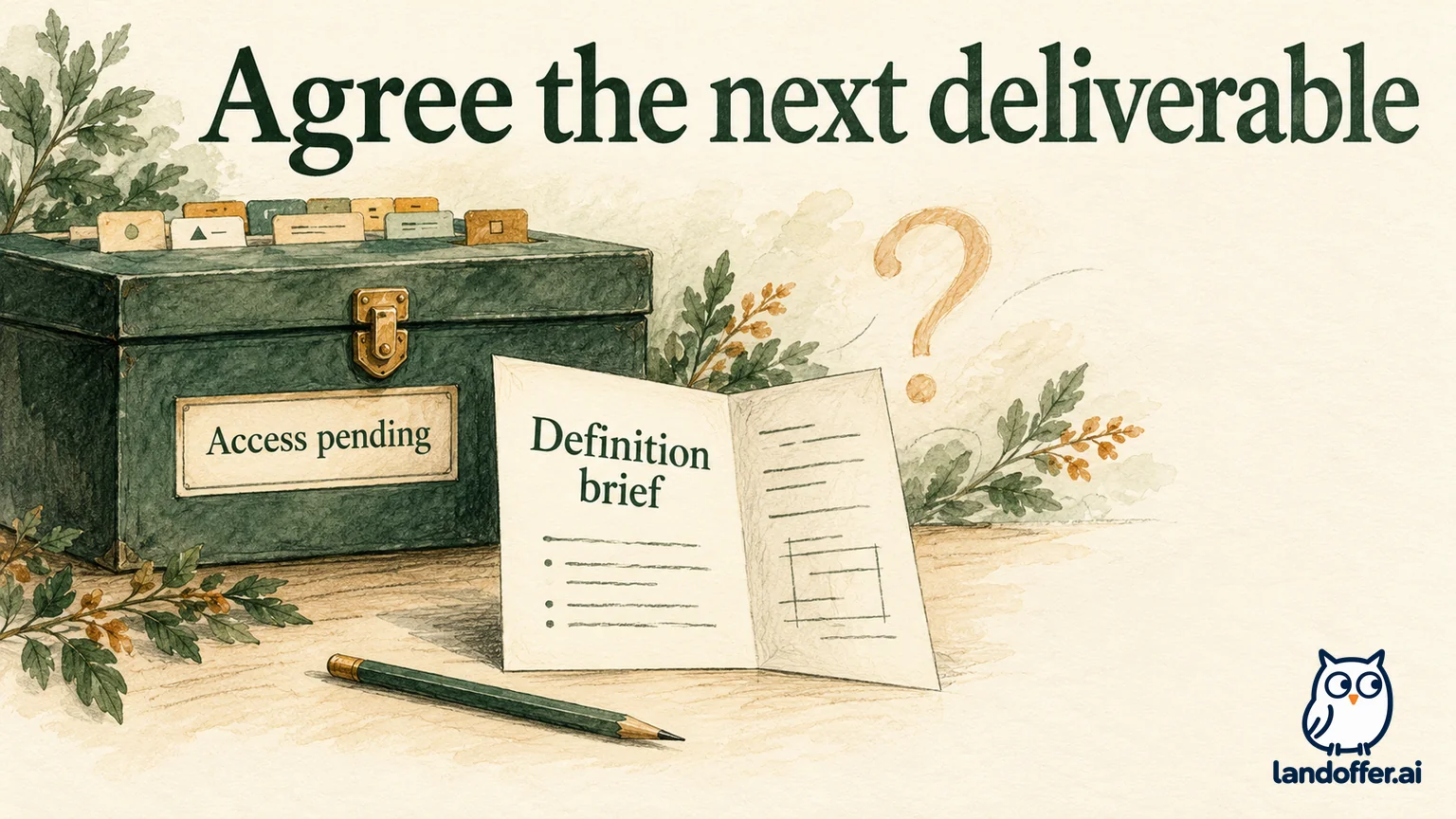
This case differs from Lina’s. Her team can prepare a bounded prototype using synthetic material once the desired artifact is agreed. Dario lacks the definition and permitted evidence for the requested analysis. The useful next step is to define that analysis and its dependencies. Writing a more detailed template would not manufacture the missing data or validate a prediction.
Handle conflicting answers without quietly becoming the approver
You may hear incompatible interpretations from different stakeholders. One person expects a concept; another expects a release. Record the conflict and ask the actual work owner to resolve it. State the consequence: a release needs implementation and testing, while a discussion prototype does not include those commitments. Ask which artifact is required.
Clarifying an assignment does not automatically delegate decision authority. You can propose an approach, identify trade-offs, and recommend a next step while the requester retains the scope decision. If your role includes independent choices, state which ones those are. The brief should reflect the existing authority rather than create it through confident wording.
If the requester is unavailable, separate work that is already authorized from work that depends on an answer. You might gather non-sensitive background or draft an explicitly provisional outline. Name what is blocked and when you need a decision. Do not describe a saved draft as an agreed brief simply because no one has replied.
Keep the brief useful as the assignment changes
When a new request changes the boundary, update the relevant fields and obtain the needed confirmation. If Maya later asks for functioning notification delivery, the prototype brief no longer covers the task. Identify implementation, testing, access, and release questions before promising that expanded result. Keep the earlier agreement’s date visible so the change can be understood.
Use acceptance to check the agreed artifact, then distinguish it from the broader business outcome. A prototype accepted for a demo is not a successful feature launch. A definition brief accepted for planning is not completed customer analysis. This distinction prevents a clear handoff from becoming an exaggerated progress report.
For your next vague request, draft three sentences: the problem as currently understood, the artifact you propose to deliver, and the uncertainty that could change that artifact. Send those three sentences through your team’s normal clarification channel, ask for confirmation or corrections, and keep any unanswered item explicitly provisional. LandOffer.ai publishes this workplace guidance; your team’s actual responsibilities and approval rules govern the assignment.