LandOffer
Workplace Rights
Preparing an Unpaid-Wage Complaint: Organize Hours, Pay Records, and Employer Details
A complete fictional California packet connects daily hours, payroll entries, employer identity, a wage statement, and an unresolved correction request. The worked comparison and neutral prepared complaint preserve missing explanations and distinguish gross-pay arithmetic, agency intake, investigation, and actual recovery.
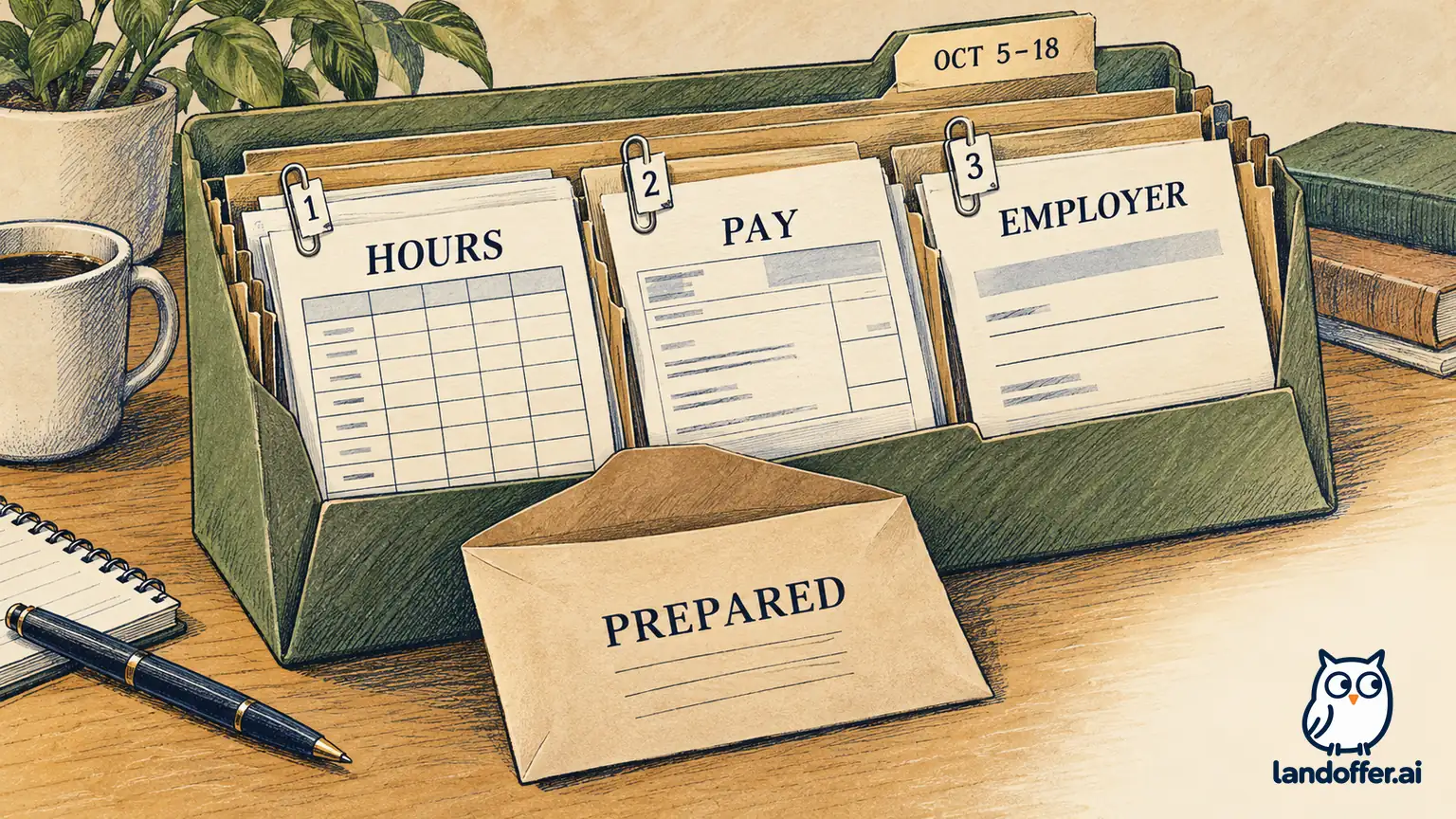
Prepare an unpaid-wage complaint by identifying the employer, separating actual work records from payroll entries, and organizing the difference by workweek and pay period. Attach payroll’s actual response and identify the hours, payment, or explanation still missing. Check which federal or state agency handles the issue and its filing requirements promptly; a neat spreadsheet does not establish entitlement or guarantee recovery.
This LandOffer.ai guide builds a complete fictional packet for an hourly employee whose internal correction request remains unresolved. It shows a records-based gross-pay comparison and a neutral complaint summary. It does not submit a complaint, calculate anyone’s legal damages, or decide whether a particular agency must accept a claim.
Identify the issue and the right agency
Start with the actual discrepancy. Missing straight-time hours, an overtime calculation, a bounced check, unpaid commissions, and an unlawful deduction may require different facts and legal analysis. “My deposit is smaller than expected” is a starting observation, not yet an explanation: gross earnings, deductions, and bank receipt need separate review.
The federal Worker.gov complaint guide describes WHD enforcement of federal minimum wage, overtime, recordkeeping, and other specified laws. It asks for employer identity, work performed, event dates, and how and when payment occurred. A dispute about a promised rate or another state-law benefit is not automatically a federal minimum-wage or overtime claim. Explain the facts and ask about coverage instead of choosing an agency merely because it has an online form.
State procedures differ. The California Labor Commissioner’s wage-claim page, for example, describes claims for unpaid wages or benefits and different time limits for different issues. Its wage-claim submission route is not the route for every retaliation, public-works, or other complaint. This example uses California work facts; its procedures are not instructions for every state.
Sources were checked October 27, 2026. Worker.gov displays a notice that updates are suspended and its last update was February 2, 2026. Therefore, its process overview is useful, but a displayed callback expectation should not become a promised current response time. Confirm the current route and instructions with the responsible agency.
Build an employer record before estimating a total
A trading name, payroll processor, worksite, and legal employer can differ. Copy names exactly from the records you have and label their sources. Do not resolve a disagreement by guessing that a familiar brand or payment-service name is the employer.
For the fictional case, Nico works in San Jose, California, as an hourly desktop-support employee. The wage statement names Rookbridge Services LLC, while the workplace uses Deskline Support as its trading name. His employment notice uses the same LLC name. His supervisor is Rafael, and the payroll correspondence is signed by coordinator Dana. No conclusion about anyone’s personal liability follows from recording their roles.
Nico’s private employer-information sheet contains the worksite address and company contact details copied from those two records; those invented contact fields are not reproduced here. It also records the San Jose work location, his desktop-support duties, employment continuing at the packet date, and the stated hourly rate of $28 effective September 14, 2026. A payment processor appearing on a bank entry is listed separately, with its role unresolved.
The sheet should answer which entity employed you, where you worked, and which record supports each detail. If you worked at several sites or through a staffing arrangement, preserve those distinctions rather than forcing them into one inaccurate employer field.
Completed asset: one pay-period packet with daily support
All numbers and records below are fictional. Nico’s stated employer workweek is Monday through Sunday. The pay period is October 5–18, 2026, covering two such weeks, with a designated payday of October 23. He is paid one hourly rate; the comparison excludes bonuses, commissions, paid leave, and deductions.
His daily notes record eight hours of work on each of the ten weekdays, after excluding a fully relieved meal interval. No day exceeds eight hours and neither workweek exceeds 40 in these stipulated facts. That simplifies the arithmetic; it does not determine every possible wage claim or exemption question.
The payroll time export totals 76 hours. Three entries differ from his notes:
| Work date | Work recorded in Nico’s notes | Payroll time export | Difference and supporting detail |
|---|---|---|---|
| October 5 | 8.0 hours | 6.5 hours | 1.5 hours; notes describe workstation setup after a ticket handoff |
| October 8 | 8.0 hours | 7.5 hours | 0.5 hours; notes describe end-of-shift device inventory |
| October 14 | 8.0 hours | 6.0 hours | 2.0 hours; notes describe equipment preparation and ticket documentation |
| Other seven weekdays | 56.0 hours | 56.0 hours | No numerical difference identified |
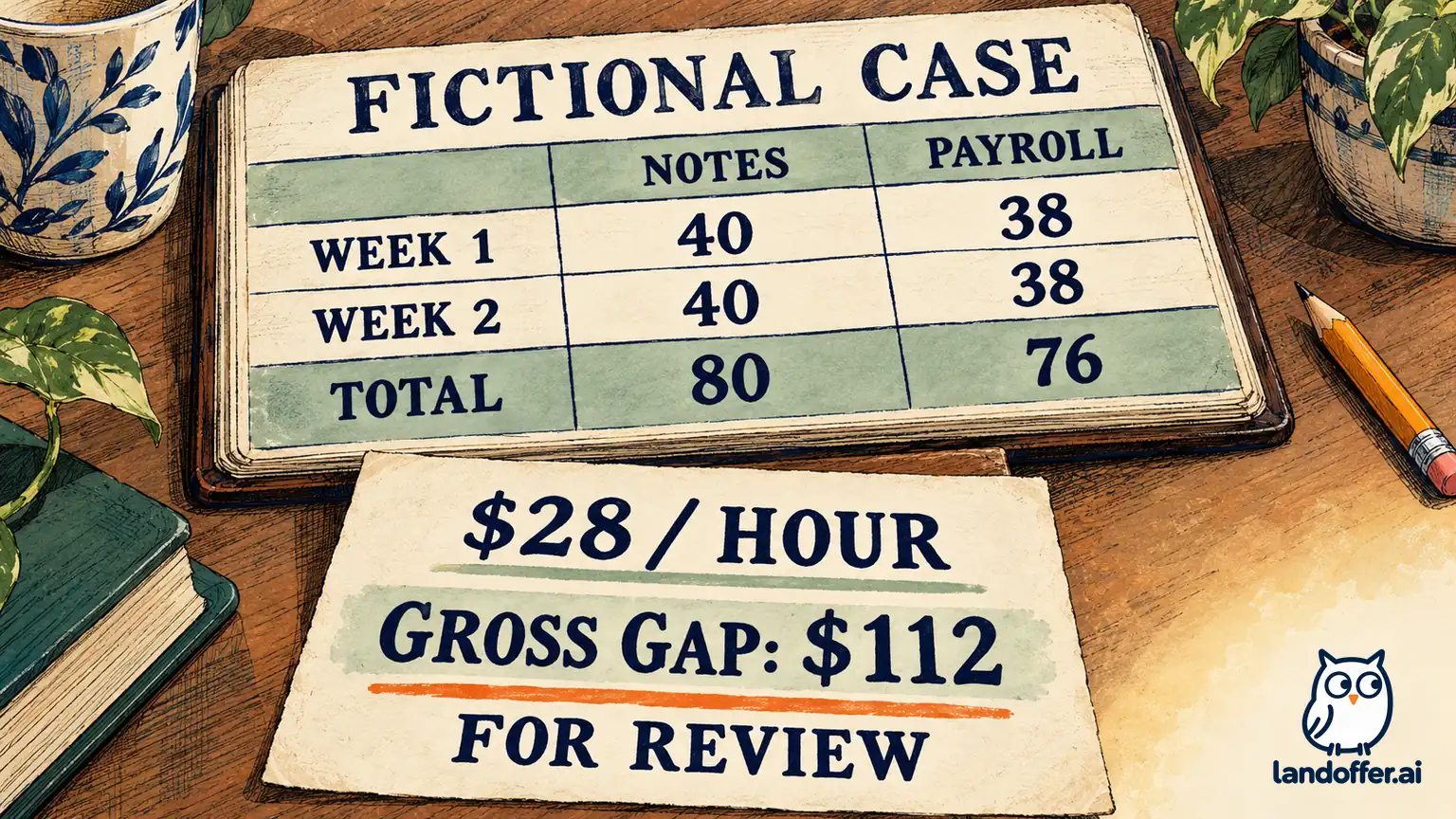
| Pay-period total | 80.0 hours | 76.0 hours | 4.0 hours requiring review |
Keeping the weeks separate shows the reviewer two 40-versus-38 comparisons, rather than hiding both differences inside a single 80-hour total. A ticket timestamp may support an activity’s existence, but it does not prove every minute in the claimed interval. Nico labels his notes as contemporaneous personal records and the ticket references as corroborating context, not continuous activity monitoring.
His packet index connects the comparison to specific records:
| ID | Record and period | What it supports; what it does not |
|---|---|---|
| E01 | Employment notice and employer-information sheet | Stated employer, location, $28 rate and effective date; not proof all claimed work occurred |
| T01 | Daily notes, October 5–16 | Start, end, meal interval and task notes; personal account subject to review |
| T02 | Payroll time export, October 5–18 | Employer-system entries totaling 76 hours; not an explanation for the three differences |
| P01 | October 23 wage statement for October 5–18 | 76 hours at $28 and $2,128 straight-time gross; not proof of full payment for all work |
| B01 | Limited bank receipt record, October 23 | Deposit matching the statement’s net amount; not a gross-wage entitlement calculation |
| C01 | October 26 request and November 2 payroll reply | Specific correction raised; acknowledgment received without a decided amount or payment date |
Using E01’s stated rate and T01’s hours produces $28 × 80 = $2,240; P01 shows $28 × 76 = $2,128, leaving a $112 gross straight-time difference for review. This is Nico’s records-based estimate for review, not a legal award or expected net deposit. He has not added penalties, interest, damages, or a guessed tax adjustment.
Preserve useful records without making gaps disappear
Keep the records as received and work from copies. A corrected comparison should retain its previous version and explain the change. If you reconstructed an interval later, identify when you reconstructed it and the basis; do not give it the appearance of a contemporaneous timecard.
The California supporting-documents instructions request copies of available time records, pay statements, and relevant employment information. They state that workers are not required to keep their own time records and need not possess every document to file. Missing an export is a gap to disclose, not a reason to invent one or automatically abandon the inquiry.
Federal employer recordkeeping requirements also matter. 29 CFR 516.2, for employees within its scope, includes daily and weekly hours, the workweek’s start, pay basis, deductions, total wages, payment date, and period covered. That is an employer obligation, not an instruction for an employee to produce a flawless private payroll system.
Retain only records you may lawfully access and keep. Do not copy coworkers’ payroll, customer data, passwords, or unrelated confidential business files to strengthen a complaint. Use the agency’s instructions for sensitive identity information and transfer methods. Redact irrelevant bank account details in a working copy while keeping an original available when appropriately requested.
Completed asset: a neutral summary with unresolved questions
On October 26, Nico asked payroll to review the three dates and attached his comparison. Dana’s November 2 reply says payroll is checking the entries with the supervisor. It does not concede unpaid wages, reject the hours, authorize an adjustment, or promise a deposit. As of the fictional packet cutoff on November 4, Nico has no later correction statement or identified correction payment.
His prepared agency summary reads:
I am an hourly desktop-support employee working in San Jose, California. My employment notice and October 23 wage statement identify Rookbridge Services LLC; the worksite uses the trading name Deskline Support. My supervisor is Rafael. Employer contact details and my contact information are in the private intake fields.
I am asking for review of the October 5–18, 2026 pay period. My contemporaneous notes show 40 hours in each Monday–Sunday workweek, totaling 80. The payroll export and wage statement show 76 hours at the stated $28 hourly rate. The differences are 1.5 hours on October 5, 0.5 on October 8, and 2.0 on October 14. T01 describes the work and meal intervals; T02 contains the different system entries.
P01 shows $2,128 straight-time gross. At the stated rate, my recorded hours produce $2,240, a $112 gross difference before any legal review or deductions. B01 shows receipt of the statement’s net payment, so my concern is not an entirely missing bank deposit.
I requested review on October 26. Dana acknowledged the request on November 2 and said payroll was checking with the supervisor. The attached reply contains no decided adjustment or payment date. As of November 4, the difference remains unresolved in my records. Please advise whether this issue is within your office’s scope, which filing procedure applies, and what further information is needed.
The accompanying questions are equally specific: Does another statement or payment address these dates? What explains the three shortened entries? Does the agency need a different hours worksheet? Which legal rules and filing deadline apply to this fact pattern? Should any other relevant work periods be reviewed separately?
Nico has prepared the summary but has not submitted it. There is no agency receipt, case number, investigation decision, or finding that the $112 is recoverable. His next action is to verify the appropriate intake route and provide accurate information through it, without waiting indefinitely for payroll’s internal check.
Treat intake, investigation and payment as different states
After a real submission, retain the submitted version, attachments, date, receipt, and assigned reference if one is issued. “Prepared,” “submitted,” “received,” and “assigned for review” mean different things. A portal confirmation does not prove an investigation has started or that an amount is owed.
When updating a submitted case, include its reference and identify the new record, its date, and the pay period it addresses. If payroll later issues a correction, preserve the statement, the period it addresses, and evidence of actual receipt. Update the unresolved amount transparently rather than leaving the original total unchanged or declaring the entire matter resolved from an unexplained deposit.
Deadlines depend on the claim and forum. California’s page, for example, distinguishes an oral pay promise from a written contract and specified statutory wage violations. Do not turn one category’s period into a universal deadline or assume an internal payroll request stops an external time limit. Ask the agency or an appropriate adviser promptly about the particular dates and issue.
Also ask how information will be handled and how to raise any retaliation concern; do not assume every forum offers identical confidentiality or uses the same complaint form. Use the responsible office’s instructions for your case rather than treating a coworker’s timeline or outcome as a prediction.
Use the packet to make the facts reviewable: employer identity with sources, dated hours, gross earnings and payment records, prior responses, and explicit gaps. Related workplace guides are available from LandOffer.ai. Verify the intake route promptly, provide the facts you have, and preserve the receipt and next instructions without treating submission as a recovery decision.
Sources and Further Reading
- Worker.gov: Filing a complaint with the Wage and Hour Division, including its site-update notice
- California Labor Commissioner: How to File a Wage Claim
- California Labor Commissioner: Supporting documents for a wage claim
- eCFR: 29 CFR 516.2, records for employees within its minimum-wage and overtime scope