LandOffer
Job search
Turing Review for Developers: Distinguish AI Training Projects from Software Engineering Jobs
Turing role titles can cover AI evaluation, structured training data, or product development. A role comparison, completed candidate triage, and original review example explain how to inspect the actual engagement.
Turing should be evaluated one opportunity at a time. Its public pages include AI-training and coding-evaluation contracts as well as software-development marketing. A role can require strong engineering skills while its main deliverable is an evaluation, benchmark, or training-data artifact. Before applying, establish what you will produce, how the engagement is paid, where you must be located, and how long the work is expected to last.
LandOffer publishes this review and offers recent tech-job discovery. We inspected public Turing pages on October 13, 2026. We did not join its talent network, complete an assessment, or work a contract. Public examples below describe advertised roles; the candidate and coding exercises are fictional. An accessible listing is not proof that its original hiring batch is still open.

Start with the work product
Turing’s Senior Software Engineer—AI Evaluation / Coding Agents listing expressly describes evaluating coding agents across repositories rather than primarily building production applications. That distinction is useful precisely because the title begins with Software Engineer. The skills can overlap with product engineering, while the reason the client buys the work differs.
Ask what a completed day produces. Is it a feature merged into a maintained product, an evaluation of competing model patches, a carefully specified prompt, a reference solution, or a dataset of structured tasks? Each requires judgment, but each creates different evidence of experience. “I used Python” leaves the deliverable unclear; specify whether you built a feature, evaluated a patch, or prepared training data.
AI-evaluation work may suit developers who enjoy debugging, testing, and explaining failures in writing. It can also be a poor substitute for someone specifically seeking ongoing feature ownership, customer interaction, or a stable product-team career path. Neither preference makes one category inherently better. It changes which opportunity deserves your application time.
Your objective determines which of these opportunities deserves attention. If you want additional contract work applying engineering judgment, some evaluation roles may be relevant. If you want a conventional software-engineering employee position, look for an explicit engagement description supporting that goal rather than interpreting every technical title as equivalent.
Compare specific advertised engagements
The reviewed senior evaluation listing advertised $100–$150 per hour, approximately three months, independent-contractor status, North America only, and 20–40 weekly hours with at least six hours of Pacific-time overlap per day. Those details belong to that listing. They are not Turing-wide pay, duration, or eligibility rules.
A different Agentic Coding Evaluation Specialist listing advertised $75 per hour, about two to four weeks, a minimum of 20 hours on weekdays, and a tentative May 4, 2026 start. Its work includes repository-grounded prompts and side-by-side model comparisons. Because that tentative date is in the past, confirm whether the posting is still recruiting before investing in its process.
A third LLM Agentic Trainer listing describes JSON/function-calling task preparation and data validation. It lists a one-month contractor assignment, specified eligible countries, and Pacific-time overlap. Its title and technologies do not make it the same engagement as either repository-evaluation example.
| Public example inspected | Main advertised output | Important constraint |
|---|---|---|
| Senior AI evaluation engineer | Review coding-agent work in repositories | North America; significant Pacific overlap; approximately three months |
| Agentic evaluation specialist | Prompts, comparisons, structured justifications | Short duration; past tentative start date needs confirmation |
| LLM agentic trainer | Structured JSON tasks and validated training data | Listed countries and one-month contract |
This comparison is a snapshot of three public descriptions, not an inventory audit or a ranking of current vacancies. Similar skills can lead to different deliverables, schedules, and compensation structures. Use the role’s current written terms when deciding whether to proceed.
Do not import broad development promises into a short contract
Turing’s remote SaaS developer page uses full-time, long-term development language and describes support finding another project after one ends. That page is part of the public developer proposition. It does not establish that an AI-evaluation contract advertised for a few weeks will extend, replace itself, or become an employee role.
Read the narrower opportunity alongside the broader page. When they appear to point in different directions, ask which terms apply to the specific engagement. A statement about a developer network and an individual contract’s end date can describe different offerings. You do not need to assume that every technical opportunity has the same employment relationship.
Read “full-time” alongside the engagement type. It may describe the expected workload rather than employee status. A listing can ask for 40 hours and still explicitly identify the worker as a contractor. Confirm the written arrangement, benefits if any, payment basis, and expected availability instead of relying on a single label near the title.
The same applies to extension language. Potential extension based on performance and project need is conditional. A planning assumption that the initial term may end is more defensible than budgeting as though another project has already been assigned. Public descriptions do not prove a particular candidate’s continuity of work.
Worked example: one developer sorts three opportunities
Priya is a fictional backend engineer in Canada with four years of experience. She can provide 25 weekly hours, but only two hours of Pacific-time overlap per day. She wants a short contract that lets her apply testing and code-review skills while continuing a separate employee-job search.
The senior evaluation listing is interesting on skills and geography. Its stated six-hour daily overlap does not fit her availability. She records that conflict and asks whether an alternative schedule exists before taking an assessment. She does not quietly assume that remote means asynchronous.
The short evaluation-specialist listing appears closer to her weekly availability. Its past tentative start date remains unresolved. Priya’s completed decision is “request current batch confirmation,” rather than “accepted contract starting next week.” The past tentative start date makes the recruiting status uncertain even though the page remains accessible.
The JSON/function-calling trainer example lists countries that do not include Canada. Priya sets it aside under the published location conditions. She does not change her profile country to make a promising technical match appear eligible.
Her three entries are therefore a schedule question, an availability question, and a location exclusion. None is yet booked work. This is a useful outcome: she has avoided spending several assessment sessions on assumptions that a brief role review could expose.
A coding-evaluation deliverable needs an explained judgment
The evaluation-specialist description emphasizes dimensions such as code quality, instruction following, testing, and clear justifications. It can be tempting to favor the cleaner-looking patch. A reviewer must still connect the judgment to the requirements and test evidence. Merely choosing the cleaner-looking patch is inadequate when the alternative behaves more correctly under the stated requirements.
Consider this original fictional exercise, unrelated to any Turing assessment. A task asks a model to fix a pagination function without changing its public interface. The returned patch adds an attractive helper and passes the ordinary example, but it returns one extra item at the page-size boundary.
A weak evaluation says, “The code is good overall, but there may be an edge case.” It neither identifies the requirement nor gives another reviewer a way to reproduce the failure. It also leaves unclear whether the defect is cosmetic or changes the function’s result.
A completed evaluation is more useful:
Requirement: return at most the requested page size and preserve the existing function signature. The patch preserves the signature and passes the ordinary example. With a requested size of 3 and four available items, it returns four items. The upper bound is inclusive where the task requires an exclusive limit. I added a boundary test expecting three items; it fails on the proposed patch. This is a correctness failure despite the readable helper structure.
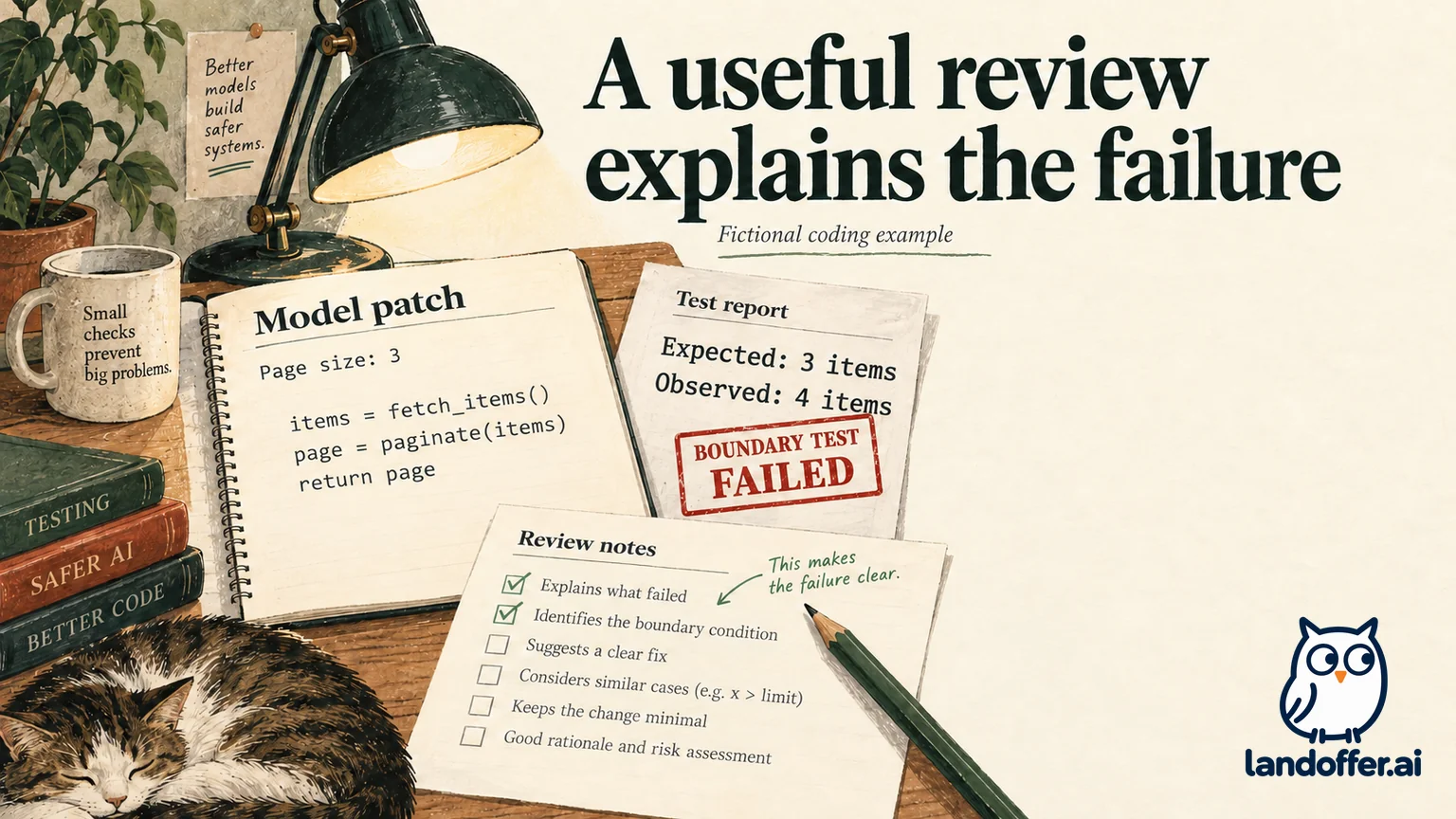
The numbers belong to the teaching example, not a live assessment. Its purpose is to show the reasoning chain: requirement, observation, reproducible check, consequence. That chain is the deliverable when your job is to assess model work. Writing the eventual production fix may be a separate task or may not be requested at all.
Respect the instructions governing an actual assessment or project. This example is a preparation method, not an answer key or permission to use external tools on restricted tasks. Be explicit about which checks you ran and which conclusions remain untested.
Distinguish hourly rates from approved-task payments
A quoted hourly range does not answer every payment question. Ask which activities are paid, how time is recorded, whether there are limits, and what acceptance criteria apply. If an opportunity instead pays per approved task, identify the deliverable and rejection or revision rules before translating the amount into an hourly estimate.
For a fictional calculation, a $300 approved task that takes six hours corresponds to $50 per hour of that task work. If the same task takes ten hours, it corresponds to $30. Neither calculation includes unrelated preparation or guarantees approval. This arithmetic is not a claim about the rates of the three reviewed roles.
The important point is the denominator. A task price and an hourly rate are different offers. Do not compare them by assuming every task will take your best-case time. A complicated repository, unclear requirement, or revision request can materially change the work involved.
For a real contract, resolve whether required calls, onboarding, tool setup, and revisions count toward compensation. Public marketing may not specify these details. An unanswered payment question is a reason to request written clarification, not to invent a generous or unfavorable policy.
Ask questions that separate qualification from assignment
Applying, passing a technical screen, being selected for a project, signing an agreement, and beginning authorized work are distinct events. Keep your records precise enough to distinguish them. A completed test demonstrates your action; it does not by itself establish a client assignment or payable work.
A focused message might ask: “Does this listing still have an active batch, does my location qualify, and is the stated overlap mandatory? If selected, what starts the paid engagement and what is its expected end date?” Those questions resolve whether the opportunity is actionable before you invest more time.
If a recruiter offers a different project after your assessment, review that project afresh. The technologies, deliverables, rate, country restrictions, and term may differ from the opportunity that originally attracted you. General platform admission does not make every later assignment suitable.
Keep the role description and date checked, the recruiter’s schedule clarification, your assessment confirmation, and the final agreement as separate records. This is especially useful when a short contract changes scope. You should be able to reconstruct which terms you accepted without treating an older marketing page as the final contract.
Describe completed work accurately in your career story
Evaluation experience can demonstrate valuable engineering skills. If permitted by the engagement’s confidentiality rules, describe the judgment you exercised: reproducing a model-generated defect, designing a regression check, or writing structured comparisons. Do not present confidential code, private client names, or internal rubrics as public portfolio material without permission.
Also preserve the nature of your role. Reviewing model patches is not the same as owning a customer-facing service in production. A truthful description can still be strong: “Evaluated generated repository changes against task requirements and documented reproducible correctness failures.” Add only actual scope and results you can support.
If your long-term goal is product engineering, consider what evidence the contract will add and what it will leave unchanged. You may gain review and testing practice while still needing examples of deployment, collaboration, or sustained maintenance. That is a career-fit assessment, not a reason to dismiss AI-evaluation work.
Our verdict: useful opportunities require a specific contract fit
Turing is worth investigating for developers whose skills and schedules fit a named opportunity, including AI-evaluation work. The public role descriptions provide concrete responsibilities and constraints that make an initial decision possible. Broad long-term development language should carry less weight than the exact role and written engagement you are considering.
Before an assessment, ask about the deliverable, location, overlap, active batch, payment basis, and expected term. If a required condition conflicts with your availability, resolve it before investing in the screen. If you want ongoing product-engineering work, keep a separate search for that objective. You can browse recent tech roles on LandOffer.ai and classify each by the work it actually requires. No platform title, matching claim, or assessment result establishes a guaranteed job.