LandOffer
Job search
TopStack Resume vs. ResumeGo: Payment Timing, Revisions, and Refund Policies
Compare TopStack Resume and ResumeGo on first-draft payment, writing bundles, revision allowances, refund triggers and deadlines before ordering.
TopStack's current Launch and Propel packages let you view a first resume draft before paying the base writing fee, then provide up to two further revisions. ResumeGo takes payment up front and describes a refund that changes after the first draft of any purchased document arrives. Compare the documents included, when payment is due and how you can respond to the draft. Neither “pay after” nor “money back” establishes an unconditional free trial of a finished resume.
LandOffer publishes this documentation comparison, checked October 13, 2026. We inspected official pages, public package displays and ResumeGo's current terms; no order, consultation, payment or refund was tested. All examples are fictional. Choose a realistic target among recent roles on LandOffer before deciding which writing deliverables are worth buying.
Match the package contents before comparing prices
TopStack's current pricing page displays Launch at $189 for a resume and cover letter, and Propel at $279 with LinkedIn optimization and a senior writer. Their listed first-draft periods are five and three business days respectively. We inspected the actual cards because excluded features remain visible in lighter text.
ResumeGo's order page lists Professional at $360 for the resume, with optional $80 LinkedIn, $40 cover-letter and $40 thank-you-letter additions. Executive is $600 and includes those additional documents, with a stated C-suite audience of more than 25 years' experience. It is not the necessary choice for every experienced engineer.
| Comparable writing task | TopStack public package | ResumeGo public package |
|---|---|---|
| Resume and cover letter | Launch, $189 | Professional plus letter, $400 |
| Resume and LinkedIn | Propel, $279, also including a letter | Professional plus LinkedIn, $440 |
| Discussion with a writer | Email standard; optional 30-minute call for $40 | Optional consultation described in its process |
| Feedback after the first draft | Up to two additional resume revisions after payment | Unlimited revisions described for up to two weeks |
These public totals compare scope, not writing quality. They exclude unconfirmed checkout amounts and do not measure the work of an assigned writer. For your own budget, compare the named documents, communication and review allowance; the lowest package figure alone cannot settle the choice.
TopStack Recruiter is a different monthly service, displayed at $1,449 with recruiting work. Its payment and remedy descriptions should not be imported into a Launch or Propel writing purchase. This article compares the writing packages.
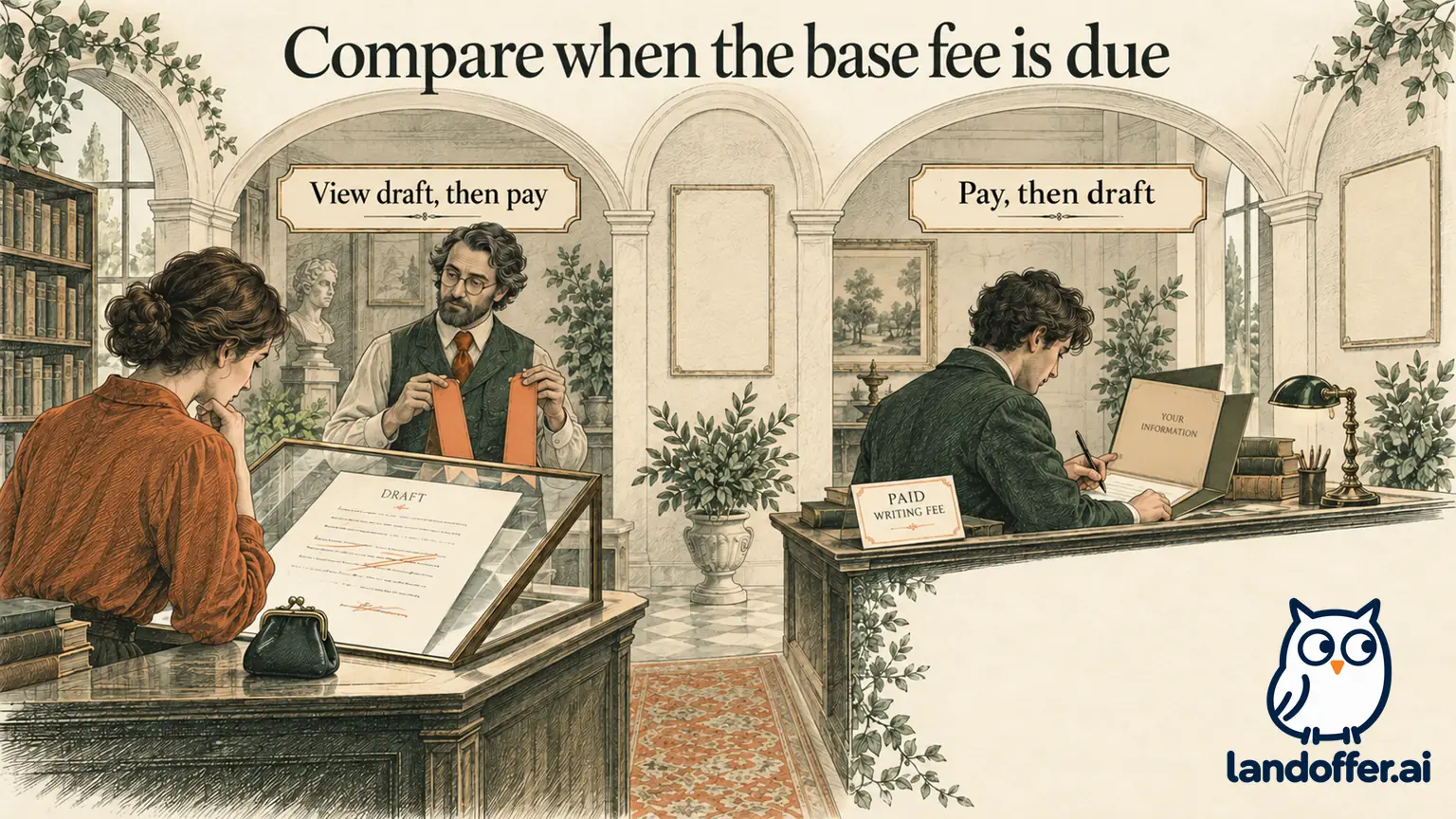
First-draft review is a payment milestone
TopStack's process description places the base payment after viewing the first draft. The pricing FAQ then describes completing up to two additional revisions and other ordered services. Its refund page describes previewing elements such as formatting and content before payment.
Seeing the initial direction can help you decide whether to proceed. It does not establish that the preview is a complete, unrestricted final file you can use without paying. Nor does “after viewing” mean payment waits until every cover letter, LinkedIn section and revision is finished.
ResumeGo's terms, last revised January 1, 2024 and read in the current browser, describe up-front payment. Its refund process therefore addresses returning money already paid. TopStack's base-payment timing addresses a different event: when the writing fee first becomes due.
Separate those events in your notes. “I saw a draft,” “I paid,” “I requested a revision” and “the remaining document arrived” are different facts. That sequence helps you assess both the service still needed and the policy stage, without treating a marketing headline as a complete purchase record.
Sofia completes a budget and first-draft decision
Sofia is a fictional business analyst applying to software implementation teams. She has a current resume and reliable source notes, but her experience section obscures requirements work. She needs a resume and cover letter, wants a short conversation and has a $350 ceiling.
Her task fits TopStack Launch's displayed document scope. Adding the optional $40 call gives a modeled $229 total before any other applicable amounts. ResumeGo Professional plus its $40 letter would be $400 from the displayed figures, exceeding her ceiling for that two-document task.
She also checks the expedited option. TopStack advertises a $195 up-front rush fee. Launch, the optional call and that fee would total $424, above her budget. Sofia chooses the ordinary Launch route to evaluate and keeps her current resume usable rather than treating a rush purchase as necessary.
| Decision | Completed result in Sofia's case | Reason |
|---|---|---|
| Documents | Resume and cover letter | Both have a named application use |
| Communication | Budget for the optional short call | Explain the requirements-work boundary |
| Modeled ordinary amount | $189 + $40 = $229 | Within the $350 ceiling before extras |
| Add expedited service | Decline in this case | $424 would exceed the ceiling |
| Initial review focus | Check source accuracy before styling | A polished responsibility claim can still be wrong |
Her notes support documenting invoice-exception cases, mapping required fields with operations reviewers and maintaining acceptance criteria for engineers. They do not support ownership of company strategy or the engineering implementation.
Her finished original bullet is: “Documented invoice-exception cases, mapped required fields with operations reviewers and maintained acceptance criteria for the engineering team's implementation.” It identifies analysis and a useful handoff without claiming she built the system.
For an imagined draft saying “owned company-wide billing strategy,” she prepares this feedback: “Replace the strategy claim with the exception cases, field mapping and acceptance criteria in my notes. Operations reviewers validated the requirements; engineers implemented the changes.” This is an original teaching example, not a TopStack draft or writer response.
She reserves the first additional revision for substantive corrections and the second for checking the complete revised document and remaining presentation issues. That is her proposed use of the allowance, not a promise of a particular writer's schedule. She asks how the purchased letter will be reviewed rather than assuming every resume revision includes unlimited changes to every additional service.
Compare revision counts with revision periods
TopStack describes up to two additional resume revisions after payment. ResumeGo's expanded order-page explanation, opened during this inspection, describes unlimited revisions for up to two weeks. One limits rounds; the other limits a period. Neither means editing continues indefinitely.
Decide whether you can participate in the feedback process. Two well-prepared responses may fit a candidate with a stable target and complete source record. A two-week period may suit someone who expects several short exchanges and can read drafts promptly. An iteration allowance describes access to changes; it does not measure the quality of those changes.
In either case, consolidate related corrections. Identify the passage, the accurate fact and the requested change. A list of contradictory preferences sent over several days can consume time without making the resume clearer. Factual boundaries should remain stable while wording and emphasis improve.
Ask how the allowance treats a new target or an extra document. Revising a sentence for the agreed role is different from requesting a second resume for a new profession. A writing package's generous revision language does not settle every scope change.
Adrian separates the documents in a bundle
Adrian is a fictional application engineer who wants a resume and LinkedIn work. His existing letter is adequate. He compares TopStack Propel at $279, which also includes a letter, with ResumeGo Professional plus LinkedIn at $440. He is especially interested in what happens if one document arrives before the other.
He completes the following original stage comparison. The amounts illustrate the displayed offers and do not establish an actual refund entitlement.
| Fictional order event | TopStack Propel interpretation | ResumeGo $440 interpretation |
|---|---|---|
| Order placed, no draft received | Base payment follows the described preview event | Payment is up front |
| First resume draft is viewed | This is the base-payment milestone; further work follows | A purchased-document draft changes the refund stage |
| LinkedIn draft arrives first | Keep it in the delivery record; confirm the exact order sequence | The terms' first-draft trigger is not limited to the resume |
| Resume supplied, LinkedIn still undelivered | Ask for the policy treatment and value of the undelivered service | Read the applicable first-draft stage and request deadline |
Adrian does not calculate an undelivered TopStack LinkedIn refund as $279 minus $189. The two packages also differ in writer level, stated turnaround and other inclusions. That $90 difference is not an established standalone price for LinkedIn work.
For the ResumeGo order, half of the assumed $440 base is $220. That is arithmetic illustrating the post-draft percentage, before excluded amounts and policy conditions. It is not a prediction that $220 will be returned, and a first LinkedIn draft cannot simply be ignored because the resume has not arrived.
His completed choice is to request a clear itemized scope and sequence before ordering. Propel is the lower displayed bundle for his named documents; ResumeGo's bounded iteration period may still matter if his preferred collaboration requires it. He does not buy either on the assumption that unused bundle value can be reconstructed later from unrelated package differences.
This makes the comparison concrete without fabricating a vendor reply. The unresolved allocation is a recorded purchase condition. If the amount would determine his choice, he keeps his current documents until it is established.
The refund policies use different triggers
TopStack's refund page says services already provided are not refundable, while an undelivered part of a writing order can be considered separately. It does not supply a universal allocation formula. Dissatisfaction after delivery may lead to review or another writer's work rather than a cash refund.
ResumeGo's FAQ describes the full-refund stage before a draft and a 50% stage afterward. Its terms specify the first draft of any purchased service, a request limit of 14 days after that draft, and excluded transaction fees or sales tax. They also describe restrictions for orders using discount codes, previous refund recipients and specified chargeback circumstances.
The practical records differ. TopStack's question may be which paid services have actually been delivered and what remains. ResumeGo's question includes when the first purchased-document draft arrived. Preserve the order and communications rather than relying on which file you personally consider the most important.
Neither policy summary determines an individual's rights or an amount owed. We did not request money back or test how either service resolves a disagreement. A refund description is relevant evidence for a purchase decision, not a measured customer-service result.
Keep the writing clock and the remedy clock separate
TopStack lists first-draft timing from order placement, with qualifications for missing information or moved calls. Its expedited offer concerns the first draft within 24 hours and refund of the expedited fee if missed. It should not be described as a guarantee of a complete final bundle or automatic refund of the entire order.
ResumeGo's terms start production after sufficient completed intake and a chosen consultation. Weekends, national holidays and revisions are excluded from the described turnaround. Its FAQ's 48-hour rush wording differs from the terms' three-day description; obtain an accepted schedule rather than selecting the more convenient headline.
TopStack's qualifying Propel interview remedy is another separate event: the public refund page describes one hour of consulting or writing help after the specified 60-day and application conditions. It explicitly distinguishes that help from a money-back guarantee. A refund request, revision allowance and additional-service remedy should not be treated as interchangeable.
Choose the payment and feedback process you can use
Sofia's two-document task and ceiling support evaluating the ordinary Launch route with an optional call. Adrian's bundle comparison requires an itemized scope and an honest record of the first delivered document. Both cases reach a decision without treating either provider as a verified quality winner.
Choose one recent role on LandOffer, write the documents you need and identify the payment milestone. Use that target to prepare one factual correction, then confirm any deadline or undelivered-service value that would change your purchase.
Sources and Further Reading
- TopStack current package pricing and additional revisions
- TopStack process and timing
- TopStack refund and additional-service remedies
- TopStack general terms
- ResumeGo current packages and expanded revision explanation
- ResumeGo FAQ and refund stages
- ResumeGo intake and consultation process
- ResumeGo terms, last revised January 1, 2024