LandOffer
Job search
Technical Product Manager vs. Technical Program Manager Jobs: Resolve the TPM Title Before Applying
Resolve product versus program from the decisions owned; technical depth and delivery can occur on both sides.
“TPM” can mean Technical Product Manager or Technical Program Manager, and sometimes Technical Project Manager. The label alone cannot tell you which job you are reading. Compare the decisions and artifacts the person owns: product direction and customer trade-offs, or the dependency map and coordinated delivery plan that move shared work forward.
A Technical Product Manager may work closely with engineering and make technical trade-offs; a Technical Program Manager may shape delivery and escalate scope risks. The useful distinction is the role’s decision boundary, not whether one is “strategic” and the other merely updates schedules. The examples below use one fictional export launch to show the difference. Use recent roles on LandOffer.ai to find a target, then check its full title, organization and responsibilities. Official Amazon examples were inspected on October 13, 2026; they are specific company materials, not a universal title dictionary.
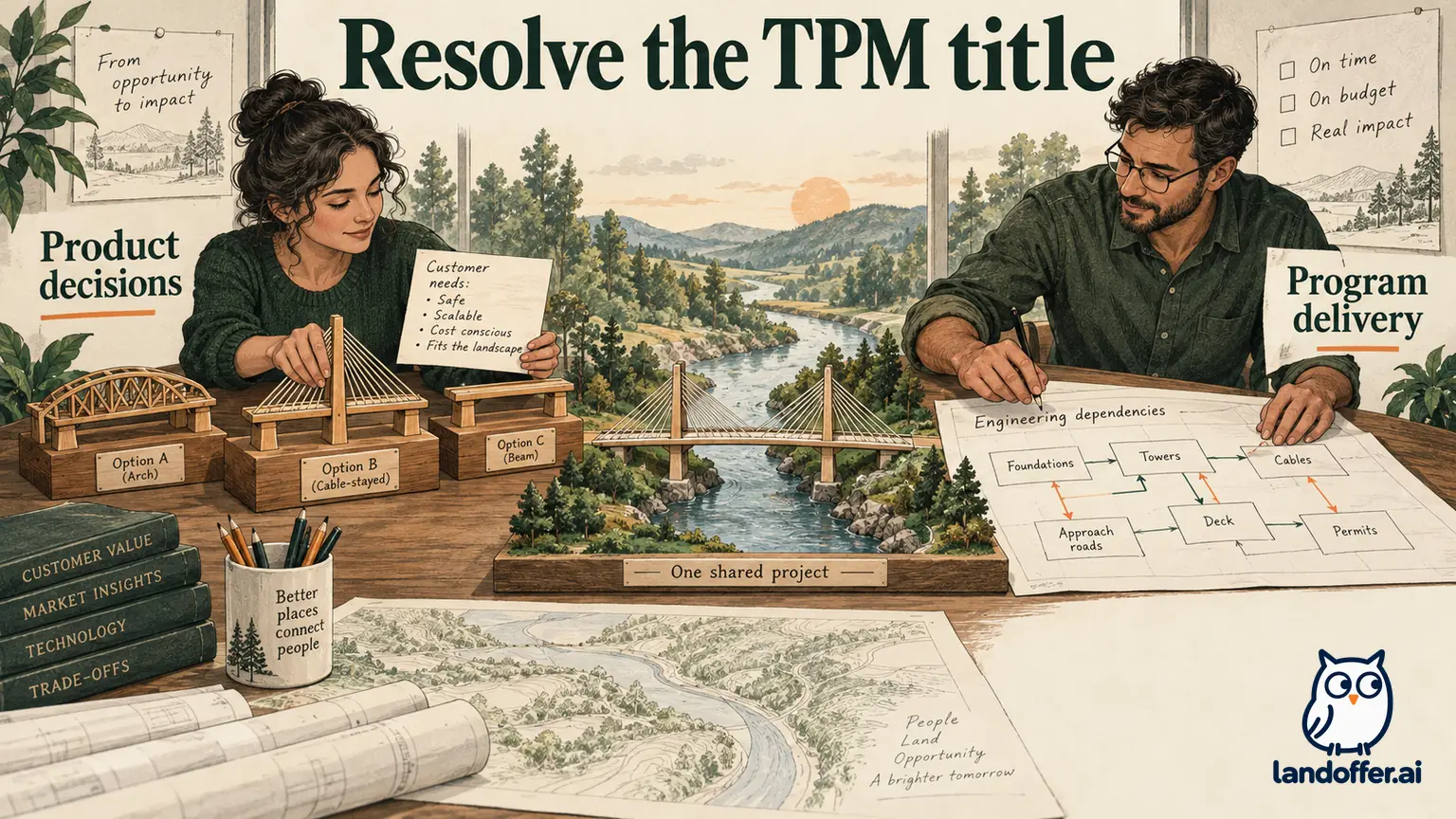
Expand the acronym before you compare the work
First confirm what the employer means by TPM. If the title is Technical Product Manager, expect to see decisions about which problem to solve, for whom, what the product should do and how success will be measured. If it means Technical Program Manager, look for cross-team dependencies, technical risks, milestones, integrated delivery and escalation. A third possibility is Technical Project Manager, where the description may center on a bounded project, schedule, resources and handoffs. Employers do not use these labels consistently.
The word technical does not settle the question. A product manager may need to understand system architecture, APIs, data flow or reliability to make a sound product choice. A program manager may need enough technical depth to see that a schema change, service limit or security review threatens the plan. Both can negotiate scope, influence engineering and communicate trade-offs. Technical depth alone does not identify the job; ask which decision or result remains theirs when teams disagree or a dependency slips.
Amazon’s Senior Product Manager—Technical example describes ownership of product vision, strategy and roadmap; requirements and narrative documents; technical direction with engineers; product-success metrics; and build/no-build choices. Amazon’s TPM interview guidance describes a different company-specific role: TPMs identify dependencies and technical risks across teams, manage milestones and schedules, and help teams deliver their responsibilities. These materials illustrate one employer’s usage: one PMT posting and one TPM interview guide. They do not define every Technical Product Manager or Technical Program Manager job.
Follow one launch through both roles
Imagine a software company planning scheduled exports of audit events to a customer’s cloud storage. Security, identity, platform engineering, support and customer teams all have work to do. The product question and the program question are connected, but they are not identical.
| Decision area | Technical Product Manager | Technical Program Manager |
|---|---|---|
| Starting point | Which customer problem warrants an export feature? | Which teams and systems must cooperate to deliver the agreed feature? |
| Typical owned output | Problem statement, scope boundary, roadmap choice, requirements and success measures | Integrated plan, dependency map, risk register, milestones, escalation and readiness view |
| Trade-off to surface | Which export formats, filters, access rules or retention options belong in the first release? | What sequence, interface, review or fallback keeps delivery feasible and safe? |
| Evidence of progress | Customer need validated, agreed scope shipped, adoption or outcome measure moving | Critical dependencies resolved, owners and dates credible, risks visible, integrated tests complete |
| Decision to clarify | Who can change product scope or reprioritize the roadmap? | Who can escalate a date or dependency, and who approves a scope change? |
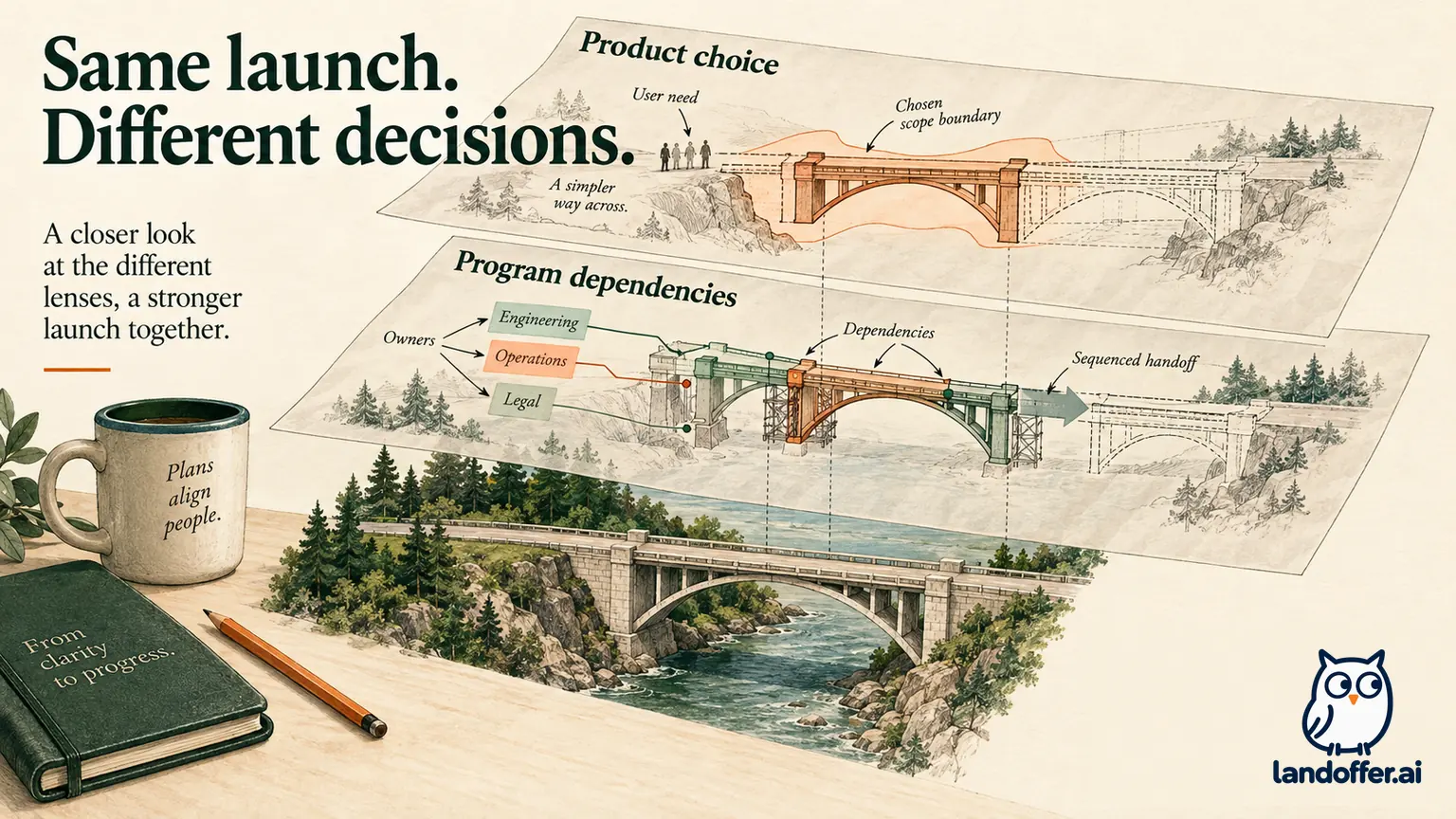
The product manager should be able to explain why an export matters, which users need it first, what the first version includes and which metric will inform the next decision. The program manager should be able to explain how the identity, storage, audit and deployment teams fit together, what is on the critical path, which technical risk threatens delivery, and who must decide when the plan no longer fits.
That division can shift. A small team may give one person both sets of decisions. A program manager may propose a safer scope when a dependency is late. A product manager may run the launch plan closely. Those overlaps do not erase the difference. Ask who owns the final call and who carries the result if the launch misses its target.
Build a completed product decision record
A fictional product decision for the export launch could start with a narrow customer need: administrators at multi-region companies need a dependable way to send a chosen set of security events to their existing storage account. A first-release choice might support one destination type, a documented event set and a defined time window, while deferring custom transformations and multiple destinations.
The product record should state the user, problem, alternatives, selected scope and reason. For example: “For the first release, support one customer-managed destination and a fixed event schema. This gives administrators an export path without creating a general-purpose data pipeline. Defer configurable transformations until support demand and adoption data show which formats matter.” The record should name the assumptions to validate, such as whether customers can configure access with the available permissions and whether the event set answers their audit need.
It should also describe what would count as useful progress. A team might track successful export setup, recurring delivery completion and support contacts about missing events. Those are proposed measures for the fictional product, not observed results. The product manager should confirm which can be measured reliably and which would change a later scope choice. If setup succeeds but recurring delivery fails, the next product decision differs from a case where customers never configure the feature.
This record is more useful than a feature list because it shows the judgment behind the boundary. An interview answer can explain why a simpler first release was chosen, what evidence supported the choice, which trade-off remained, and what new evidence would prompt a change. It should not claim ownership of engineering implementation or customer outcomes that another team produced.
Build a completed program dependency record
For the same fictional launch, the program manager can turn the agreed scope into a cross-team delivery record. Identity must authorize a destination. The audit service must produce the agreed schema. Platform engineering must store and retry exports. Security must review credentials and retention. Release engineering must define the rollout and rollback. Support needs a way to diagnose failed delivery.
The program record could name each accountable team, its input and output, the sequence, target date, validation evidence and the person who resolves a blocked decision. It should flag the critical dependencies: the storage interface cannot be integration-tested until the schema and authorization model stabilize; the rollout plan cannot be approved until retry behavior and error visibility are verified. A risk entry should include a trigger, owner, impact and next action, such as “if the destination permission model is not agreed by the interface checkpoint, request a scope or date decision from the product owner.”
A status of “on track” is not enough. The program manager should explain whether the teams have compatible assumptions, whether an unowned dependency exists, what evidence supports the target date, and what changed since the last review. If the plan no longer fits, the program manager makes the delivery choice visible and brings the right decision to the product owner or engineering leader. The program manager can recommend options and quantify their delivery effects; the designated product owner still makes the final product-scope trade-off.
Read job descriptions for ownership verbs
Mark every phrase that describes an output or a decision. Product-oriented evidence often includes “own the product roadmap,” “define requirements,” “prioritize customer problems,” “set success metrics,” “make build/no-build decisions” or “shape product strategy.” Program-oriented evidence often includes “manage dependencies,” “drive cross-functional delivery,” “identify technical risks,” “maintain milestones,” “coordinate launch readiness” or “escalate blockers.”
Then inspect the surrounding nouns. A “roadmap” could be a product investment sequence or a delivery schedule. “Launch” could mean deciding what customers receive, coordinating readiness across teams, or both. “Technical strategy” may mean system architecture, product direction or a program’s integration approach. Use the job’s concrete examples, reporting line and decision authority instead of counting keywords.
| Description language | What to verify | Question for the hiring manager |
|---|---|---|
| Own customer needs, product requirements and roadmap | Can the role prioritize and change scope? | “Which product decisions would I make directly, and which belong to a product or engineering leader?” |
| Coordinate multiple teams, dependencies and milestones | Does the role own a cross-team plan or only track it? | “What decisions can this TPM make when a dependency threatens the target date?” |
| Define technical direction or architecture | Is the person deciding design, advising engineers or mapping program risk? | “Can you describe a recent technical decision this role owned?” |
| Drive launch or delivery | Is success measured by customer outcomes, integrated readiness, or both? | “Who approves readiness, and who owns the post-launch outcome?” |
Look for authority as carefully as responsibility. “Accountable for delivery” without the ability to surface risk, secure owners or escalate a trade-off may describe an impossible job. “Own the roadmap” without customer access, prioritization authority or success measures may be a title with little product control. Ask for one recent decision and the person who made it.
Match your experience to the actual decision
Two candidates can work on the same technical launch and have different evidence. Maya, a fictional candidate, interviewed customers, compared an API integration with a simpler export, wrote requirements and chose which event types belonged in the first release. She measured setup completion and recurring use. Her strongest story supports a Technical Product Manager role, even if she also coordinated engineering reviews.
Ravi, also fictional, organized identity, platform and security dependencies for that release. He found that the destination authorization design arrived too late for integrated testing, mapped the schedule impact, brought options to the product owner and tracked the agreed recovery plan. His strongest story supports a Technical Program Manager role, even if he influenced the technical fallback.
Neither story guarantees fit. Maya should check whether the target role expects technical architecture decisions beyond her examples. Ravi should check whether the role expects independent product prioritization or customer discovery. A hybrid posting may fit either candidate if the employer explains the division of authority. In an application, each should state the decision they personally made, what other teams owned and the outcome they actually observed.
Resolve the title before tailoring
Before applying, write one sentence for each of these points: the user or business problem the role owns; the product, program or project decisions it can make; the teams and dependencies it coordinates; the outcomes used to measure success; and the person who can approve a scope, date or launch change. If the description leaves those boundaries unclear, ask the recruiter or hiring manager to walk through a recent initiative.
Also check the conditions that change your decision: level, reporting line, technical expectations, customer contact, meeting load, travel, onsite schedule and whether the role is an individual contributor or manages people. A Technical Product Manager role can be deeply technical without building the product code. A Technical Program Manager role can require system-design judgment without owning product strategy. Neither is necessarily the better route; fit depends on which decisions you want to make and can support with evidence.
When you find a target opening, browse recent roles on LandOffer.ai and compare the exact posting’s authority, artifacts and outcomes with one completed example from your experience. Use that comparison to resolve the acronym and authority boundary before tailoring an application.
Sources and Further Reading
- Amazon Jobs: Senior Product Manager—Technical, Region Flexibility & Efficiency — one company-specific PMT example of product direction, technical trade-offs and outcome metrics.
- Amazon Jobs: TPM Interview Prep — Amazon’s own description of its Technical Program Manager work and interview process; not a universal hiring template.
- Amazon Jobs: How We Hire — general employer process information; confirm the specific requisition and recruiter instructions.
These examples do not establish a universal definition of TPM, predict an interview format at another employer, or guarantee a hiring outcome. Check each vacancy’s current requirements and scope before applying.