LandOffer
Job search
SpaceTalent Review: Find Space-Enabled Software Jobs Beyond Rocket Companies
Explore the current Space Talent and Space Capital job-board routes across infrastructure, distribution and application companies, then verify the software work and eligibility.
SpaceTalent is useful for software engineers who want to discover space-related employers beyond launch vehicles and spacecraft. Its current Space Capital job board includes geospatial platforms and downstream application companies alongside flight-software teams. Search its technology layers, then judge each opening by the system you would build, the experience requested and the actual work location. A space-economy label alone cannot tell you whether a job involves satellites.
As of October 13, 2026, the SpaceTalent homepage redirects to Space Capital's talent page, and its jobs route leads to the Space Capital job board. We tested public software searches across three layers and read original employer descriptions at Esri, Sierra Space and Uber. We did not create a profile, submit an application or test recruiting outcomes.
LandOffer publishes this review and offers job-search tools. Compare these leads with recent roles on LandOffer.ai, applying the same employer-page checks to both sources. The candidate decisions below are fictional examples grounded in the inspected postings.
Why the board includes companies beyond rockets
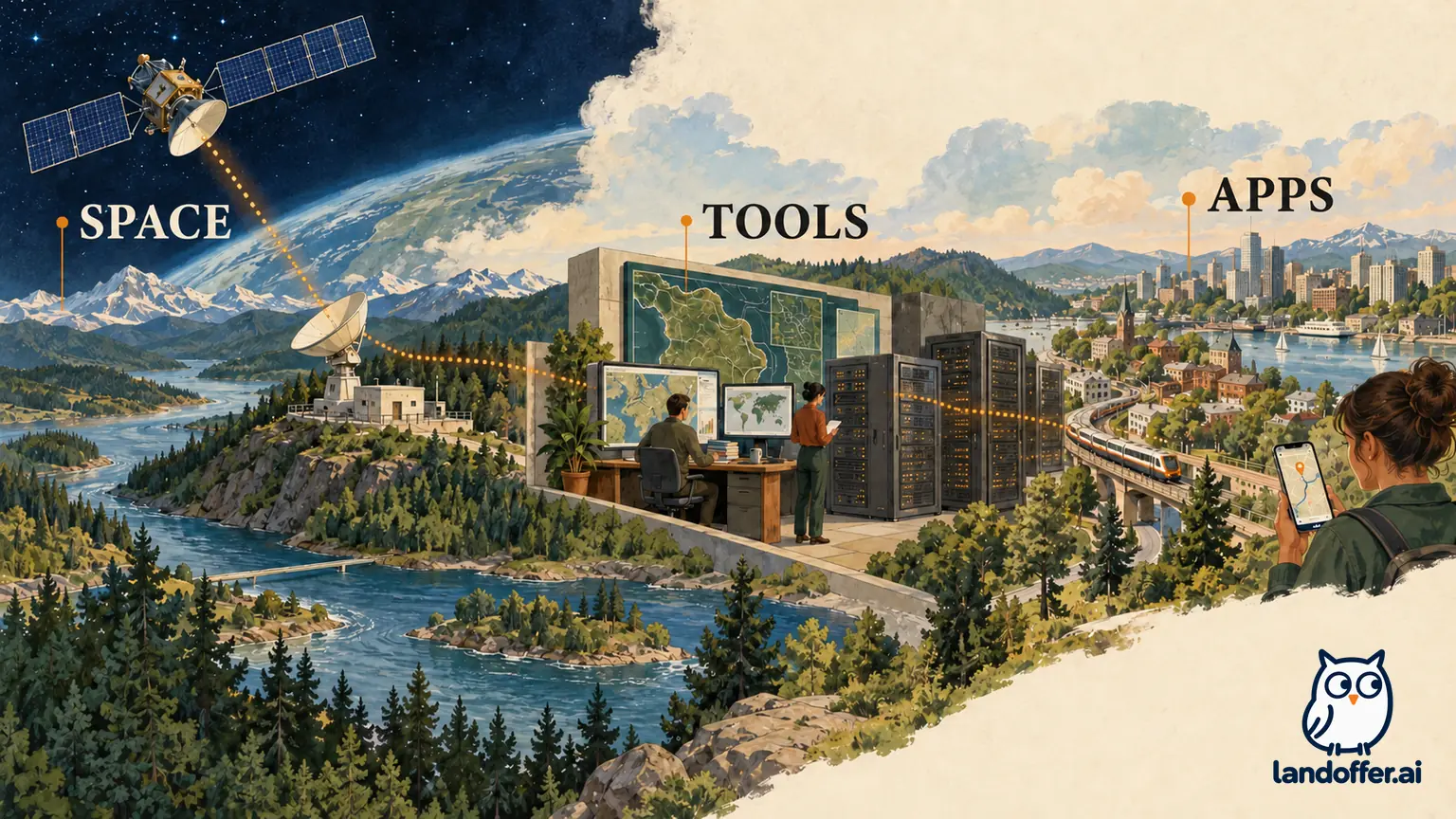
Space Capital's GEOINT Playbook summary, published in 2022, describes Infrastructure, Distribution and Applications as layers of a geospatial technology stack. Its point is that space-based technology reaches into other industries. The public summary provides the framework; we did not obtain the gated report or use its market forecasts to estimate hiring.
The firm's historical GPS Playbook discussion uses consumer applications including Uber to explain downstream use of GPS. That helps explain why a space-economy board can contain a familiar consumer technology company. It does not establish that every engineering team at that company works on positioning, satellite data or spacecraft.
For a job seeker, the layers are different places to investigate. Infrastructure can lead toward flight and embedded systems. Distribution can surface geospatial tools that make information usable. Application can lead toward products and services further downstream. Use each layer to find leads, then read the description to identify the engineering work.
Define how directly you want your work to involve space technology. Someone who wants to write flight-control software may find an ordinary checkout-platform role irrelevant. Someone who wants backend engineering with a connection to location-enabled services may welcome it. Neither preference makes the broad board inherently better or worse; it changes which leads you should retain.
Run a layer search without losing your location constraint
In the current public interface, we entered software engineer, selected the exact United States location suggestion and tested each Technology option separately: Application, Distribution and Infrastructure. The selected layer appeared as a removable chip. The board also had job-function, seniority, salary, company-size, company and a separate Space Capital control.
The separate controls matter. A technology layer describes one way of grouping companies; investor affiliation describes another. Broad results should not become “Space Capital portfolio vacancies” in your notes merely because the site belongs to Space Capital. Likewise, a United States match is a discovery filter. It does not grant remote eligibility or establish your authorization to work.
Our completed search produced the three representative leads below. We opened each board description and followed its employer route to verify the responsibilities. The table records a dated sample, not a census, coverage ranking or guarantee that these requisitions remain open.
| Search layer and real lead | Work verified on the employer page | Conditions that change the decision |
|---|---|---|
| Infrastructure: Sierra Space, Sr Software Engineer – Flight Software, R26403 | Architecture and development of complex safety-critical embedded flight software; technical leadership | Louisville/Centennial, Colorado; typically eight or more years of related experience; specific minimum qualifications and trade-regulation notice |
| Distribution: Esri, Software Development Engineer II – ArcGIS Enterprise, employer ID 5261447007 | Java server-side software, web services and distributed geospatial systems deployed on premises and in the cloud | Redlands, California; onsite marker; two or more years of relevant experience and a specified bachelor's requirement |
| Application: Uber, Software Engineer II (Backend) – Fulfillment Shopping, 303402 | Product discovery, planning and checkout services within a high-scale fulfillment platform | New York City; four or more years of professional software experience; degree or equivalent experience; office-attendance policy |
Do not add the layer totals to estimate unique jobs. We also saw the same outbound employer requisition under different company cards in a mixed search. Count a retained opening by its employer identity and requisition, keeping additional source cards as references. A repeated result can add context without creating another distinct opportunity.
Read the geospatial role as software engineering
The inspected Esri employer posting centers on ArcGIS Enterprise services. Its requirements include Java and web-service technologies, cloud experience and relational databases. The stated work concerns a scalable distributed platform for geospatial workflows. That gives a backend engineer something concrete to compare with their record.
Compare the requested Java services, cloud deployments and database work with systems you can explain from your own experience. Prior rocket-company employment is not listed as a requirement in this description. That is evidence about this role, not a finding that all GIS jobs accept the same background or that spatial knowledge never matters.
Read the employer's level and conditions carefully. The board card labeled the Esri opening Mid-Senior Level, while the employer page categorized it as Early Career and specified two or more years of relevant experience. The employer also named Redlands and included an onsite marker. Those details are more useful than treating the board's seniority tag as an exact screening rule.
A candidate with matching Java experience still needs to assess the degree requirement and the rest of the technical criteria. A candidate who requires fully remote work has a separate location problem even if the engineering match is strong. Save “Redlands, onsite” alongside the service responsibilities so the location remains part of your decision.
Flight software changes the evidence you need
The Sierra Space R26403 description describes senior responsibility for complex safety-critical software and embedded-system architecture. It also asks for leadership and decisions affecting technical performance, cost and schedule. This is a different engineering brief from a geospatial web-service role.
The employer says the role typically requires eight or more years of related experience. Its minimum-qualification wording allows equivalent work experience in place of a degree and names a master's-plus-six-years route. Preferred qualifications include flight-software experience, real-time operating systems, hardware interfaces and awareness of memory, timing and throughput constraints. Preserve the distinction between minimum and preferred language; do not silently promote every preference into a mandatory credential.
For an embedded engineer, relevant evidence might include an architecture decision under timing constraints, a difficult hardware-interface defect or leadership through a design review. Those are editorial examples of work to investigate, not extra requirements invented by the employer. General API experience may be useful, but it does not demonstrate the same embedded-system responsibility.
The posting also includes a trade-regulation notice. It lists US citizens, lawful permanent residents, protected individuals and applicants eligible to obtain the required government authorizations. Record that role-specific wording and resolve your situation through the employer's process. Do not shorten it to “citizens only,” infer a security clearance requirement, or apply it to every company on SpaceTalent.
An application company may offer familiar backend work
The Application search surfaced Uber's Fulfillment Shopping opening. Its employer description discusses order and trip lifecycles, reusable business APIs, transient data, events and distributed services. The team builds product-discovery, planning and checkout systems. Those are concrete backend responsibilities; the description does not turn them into spacecraft software.
This can widen a search for someone whose existing evidence concerns production services. It can also create noise for someone determined to work directly with space hardware. Decide which connection matters before interpreting the board's breadth as an advantage. A company's place in an investment framework is background context, not a substitute for the team's actual product.
The inspected opening asks for at least four years of professional software development, distributed-systems experience and proficiency in a language such as Go, Java, C# or C++. It accepts a relevant degree or equivalent experience. Its office policy says employees generally spend at least half their time in the office unless approved for fully remote work, with role details to be discussed with the recruiter.
Keep those conditions attached to the New York City lead. Do not convert the board's broad geographic filter or an employer's general remote exception into permission to work from anywhere. A role can be technically relevant and still fail a condition that matters to you.

Complete a shortlist that can reject interesting roles
Kaia is a fictional candidate with three years of Java API work, a computer-science bachelor's degree and experience maintaining services backed by relational databases. She can consider relocating to Redlands. She has no professional embedded or flight-software experience. Her completed notes for the three real openings look like this:
| Opening | Kaia's supported match or gap | Completed disposition |
|---|---|---|
| Esri ArcGIS Enterprise | Java services and databases overlap; spatial workflows and the remaining requirements need review | Keep for focused evaluation; retain the onsite condition and ask about expected starting GIS knowledge |
| Uber Fulfillment Shopping | Service work overlaps, but her three years fall below the posted four-plus requirement | Set aside under her current screening rule; do not relabel her experience to meet the number |
| Sierra flight software | No evidence of the requested senior embedded architecture and leadership scope | Remove from this shortlist; interest in space does not fill that gap |
Kaia's usable evidence sentence is: “Maintained Java API services backed by relational databases and investigated failures across service logs.” That is a fictional example of truthful wording supported by her stated background. It cannot become “built ArcGIS Enterprise” or “delivered flight-critical systems.” Her next question for Esri is whether the team expects existing GIS workflow knowledge or develops that knowledge alongside service engineering.
Change one constraint and the choice changes: if Kaia requires fully remote work, the inspected Esri onsite role leaves her shortlist too. Her completed search note records a technical match and a location exclusion; she moves on to another requisition.
Otis is a second fictional candidate, with nine years of embedded software, RTOS work and design-review leadership. He investigates Sierra first because the system responsibilities match evidence he can discuss. He still checks the Colorado work setting, the role's authorization wording and which flight-specific knowledge is expected. He does not claim spaceflight experience unless he has it. His decision is to investigate a plausible match, not to declare himself qualified or predict an interview.
Separate profile visibility from the employer application
On all three sampled board pages, Apply now opened a prompt offering to make a LinkedIn profile visible to the Space Capital team and its companies. The prompt also provided “No thanks, take me to the application form.” Through that route, we reached each public employer description without entering a profile URL. Public browsing and these sampled redirects required no purchase.
The skip route does not establish how every listing behaves, what a talent-network profile later exposes, or how an employer's application will proceed. We stopped at public descriptions. If you want network visibility, inspect the current information request and visibility terms as a separate decision. If you only want the selected opening, follow its employer instructions and keep a record of what you actually submitted.
Use SpaceTalent when its layers introduce employers and work you would otherwise overlook. Keep your existing source when it already supplies enough suitable roles; this review does not establish unique coverage or better hiring results. If you need another discovery source, compare recent roles on LandOffer.ai under the same constraints. Open one layer search and save one employer-verified requisition. Record its duties, work setting, your relevant evidence and the condition you still need resolved before preparing an application.
Sources and Further Reading
- Space Capital talent page — current destination for SpaceTalent's homepage.
- Space Talent job board at Space Capital — public controls and three layer searches inspected October 13, 2026.
- The GEOINT Playbook public summary — October 27, 2022 framework; gated PDF not reviewed.
- The GPS Playbook discussion — May 19, 2020 transcript, used for the historical downstream-application explanation.
- Esri ArcGIS Enterprise opening — original employer responsibilities, qualifications and work setting.
- Sierra Space flight-software opening R26403 — original employer scope, requirements and notice.
- Uber Fulfillment Shopping opening 303402 — original employer backend scope, experience requirement and office policy.