LandOffer
Job search
Solutions Engineer vs. Implementation Engineer: Check Pre-Sales, Launch, and Ongoing Support Ownership
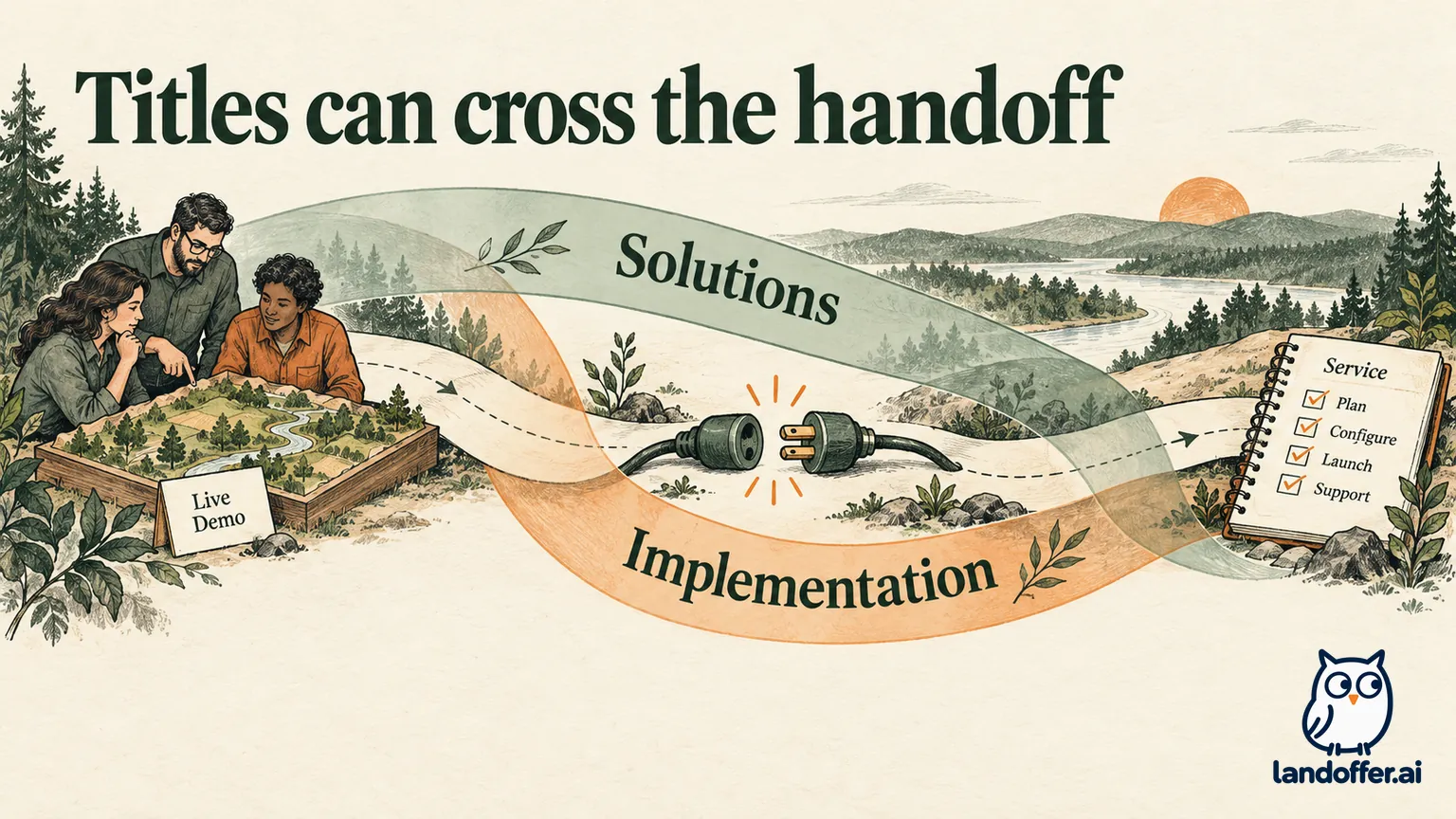
Customer lifecycle ownership crosses solutions/implementation titles; code use alone does not establish maintained delivery.
Compare these jobs by the customer task, deliverable and handoff you will own. Solutions engineering may center on discovery and evaluation; implementation may center on integration and launch. The examples below cross that usual pattern: Adyen includes pre-sales in implementation, while Samsara continues solutions work into maintenance and support. Read the lifecycle in the posting, not just the title.
LandOffer publishes this guide. Choose a target through recent roles on LandOffer.ai, then verify the employer's full description. The official occupational and employer sources below were checked on October 13, 2026. They illustrate scopes rather than universal definitions. The customer projects and candidate decisions are fictional; no sales result or employer hiring decision was observed.
Start with the customer's unfinished task
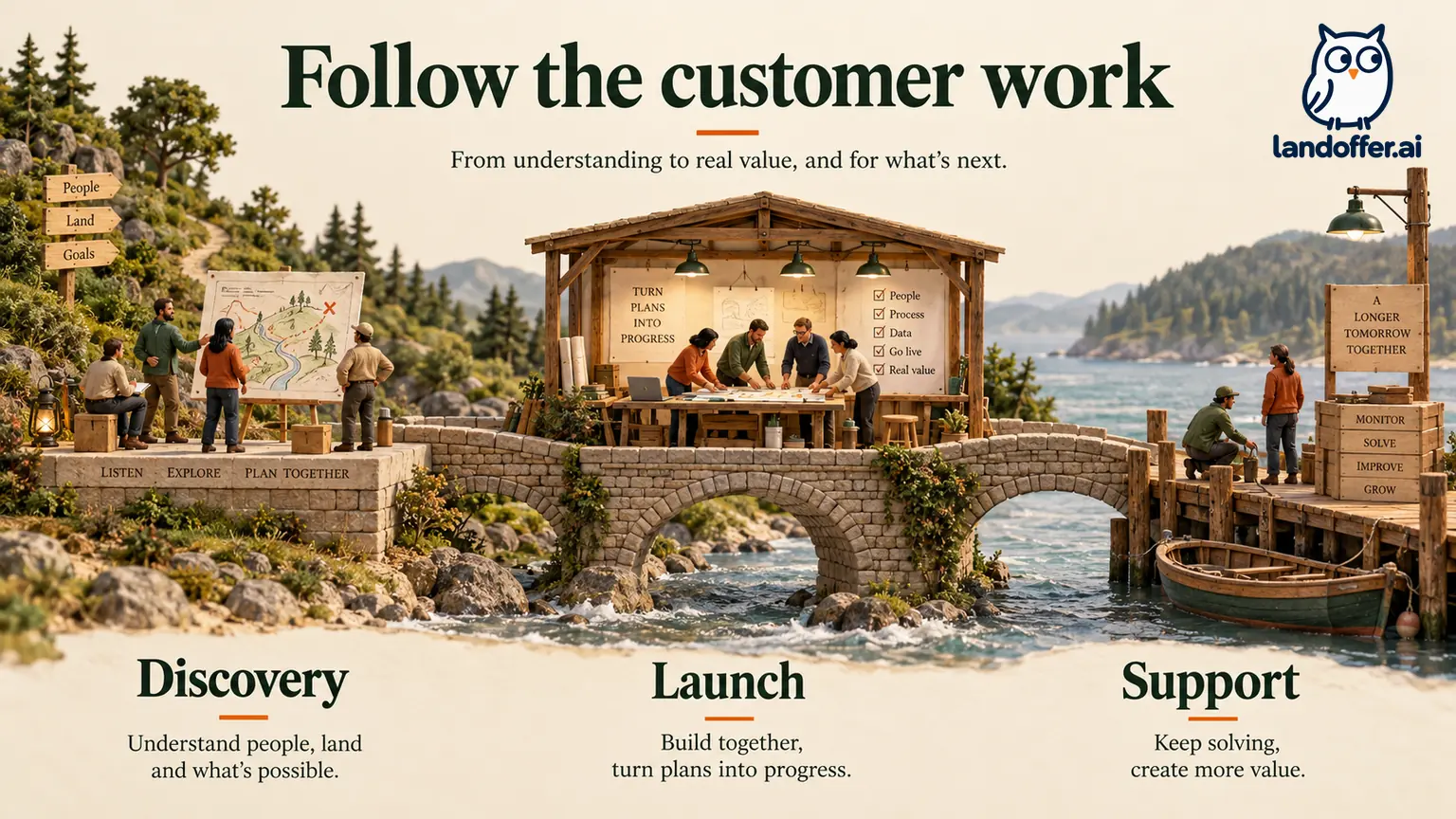
A customer may be deciding whether a product can solve a problem, trying to connect it to existing systems or attempting to operate a deployed integration reliably. All three situations can involve technical explanation, code, troubleshooting and stakeholder meetings. Their purpose changes what successful work looks like.
Before comparing titles, write the customer's unfinished task in one sentence. “Determine whether the platform can support this workflow” is different from “Complete the approved integration and prepare it for launch.” “Investigate recurring failures in an existing connection” is another task again. These are editorial distinctions to apply to a posting, not formal job families.
The Bureau of Labor Statistics description of sales engineers includes technical presentations, requirement gathering, sales support and customer troubleshooting. That broad occupational reference helps explain the range of customer-facing technical work; it does not define each employer's “Solutions Engineer” role or its compensation plan.
Look for the deliverable beside each verb. Does “build” mean a disposable proof of concept, a customer-owned integration or software maintained by the vendor? Does “support” mean answering technical questions during evaluation or joining an operational escalation? The answers are more useful than deciding whether one title is more technical.
Two employer examples that cross the usual boundary
Adyen's Implementation Engineer in New York describes integration design, development, testing and launch, but also expressly includes pre-sales calls and enhancements for existing customers. It expects technical consultation and project coordination. An applicant who assumes implementation begins only after a sale would miss part of that scope.
Samsara's Solutions Integration Engineer IV sits in Professional Services and describes customer integrations from ambiguous requirements through delivery, maintenance and operational support. Its solutions title therefore does not describe a purely pre-sales job. The sample also states particular US location exclusions and a citizenship requirement tied to its public-sector customers; those conditions belong to that opening, not the entire profession.
| Sample | Work explicitly described | Conclusion supported |
|---|---|---|
| Adyen Implementation Engineer | Pre-sales, integration design, testing, launch and customer enhancements | Implementation can include evaluation-stage customer work |
| Samsara Solutions Integration Engineer IV | Requirements, integration delivery, maintenance and support | A solutions title can include continuing delivery responsibility |
| BLS sales-engineer occupation | Presentations, requirements, sales support and troubleshooting | Customer-facing technical work is broader than giving demos |
The examples disprove a rigid title split. They do not establish that these companies organize every customer-facing engineering role the same way. Read the exact team and level, including whether the employer expects you to lead a project or contribute under another lead.
Build a lifecycle map from the posting
Divide the description into discovery, evaluation, implementation, launch and continuing support. Under each stage, record its stated output and accountable owner. If the description is silent, mark the stage “unknown” and ask who owns it; do not assign that work to the role by default.
A lifecycle map can distinguish the outputs: discovery may produce a requirements summary; evaluation, a bounded demo or proof of concept; implementation, a configured integration and test record; launch, acceptance and handoff; support, diagnosis, maintenance or escalation. Treat these as prompts for reading, not requirements every role must cover.
These examples are a reading aid. A small company may combine several stages in one role. A larger organization may split them across sales engineering, professional services, customer engineering and support. Neither structure automatically makes the work better; it changes the responsibilities you should want and be ready to discuss.
Also record who approves commitments. A person who explains feasibility may not decide commercial terms. A person who builds an integration may not approve the customer's production change. A person who diagnoses a defect may need product engineering to fix it. These boundaries matter when you describe “ownership” in an application.
A completed customer handoff example
Consider a fictional inventory-software vendor, Harborline, and its customer, Cedar Supply. The customer wants shipment events to appear in its internal dashboard. The teaching record contains an evaluation demo, an integration design, test evidence, a launch decision and a support handoff. It is not a description of either cited employer.
During evaluation, Priya demonstrates the event flow using synthetic data and records that the demo has no production monitoring. After the customer approves the approach, Marcus implements the connection and tests duplicate and delayed events. A customer owner approves launch. A support team receives the runbook; Marcus remains the integration escalation contact.
| Stage | Completed fictional output | Ownership retained |
|---|---|---|
| Evaluation | Priya's synthetic-data demonstration and documented limits | Demonstrated feasibility; did not launch the customer's system |
| Integration | Marcus's connection, mapping and test record | Built and verified the stated integration |
| Launch | Acceptance checklist and customer approval | Customer owner authorized the production change |
| Support | Runbook, known limits and escalation route | Support handles routine issues; Marcus handles integration escalation |
Priya's resume can describe translating the customer's workflow into a demonstration and surfacing a production requirement. Marcus's can describe implementation and the specific failure conditions checked. Neither should claim sole ownership of the customer's entire shipment process or invent revenue attributed to the project.
The handoff reveals a role preference. Priya enjoys technical discovery and explaining tradeoffs. Marcus enjoys carrying an approved design into a maintained integration. A hybrid job could suit either person, but only if the person wants the additional stages and has enough relevant experience. A title alone cannot make that decision for them.
Compare code ownership, not the presence of code
Either role may write code; the deciding question is who maintains it after the engagement. A demo script used to explain a workflow has a different life from a customer integration that remains in operation. Both require technical skill, but their completion evidence differs.
For a proof of concept, explain the question it answered, the assumptions and the conditions it did not cover. For maintained delivery, explain interfaces, tests, deployment responsibility and escalation. Do not turn a synthetic-data demo into a production-service claim simply because the code used the same language.
Similarly, implementation does not always mean writing every component. You might configure a platform, guide the customer's developers, review integration behavior or coordinate a third-party implementer. State the contribution you actually made. “Guided the customer's webhook integration and diagnosed a payload mismatch” can be stronger than a vague claim to have built the whole solution.
In the Harborline example, Priya keeps her demonstration code labeled as evaluation material. Marcus keeps the maintained integration and runbook together. Their application evidence follows the real use of the artifacts, preventing a handoff from becoming an inflated end-to-end ownership claim.
Two decisions for the same hybrid posting
Now suppose Priya and Marcus read the same hybrid description: lead technical discovery, build integration examples, coordinate launch and remain the technical escalation point. The fictional employer has not stated the split between new evaluations and existing customers.
Priya's evidence supports discovery, demonstrations and explaining limitations. Marcus's supports implementation, testing and escalation. They complete different decisions instead of sending identical “customer-facing engineer” applications.
| Candidate | Strongest supported work | Material unknown | Completed action |
|---|---|---|---|
| Priya | Requirements translation and bounded demonstrations | Whether continuing support dominates the role | Ask about the lifecycle split before prioritizing this hybrid opening |
| Marcus | Integration delivery and maintained escalation | Whether independent pre-sales leadership is required at entry | Apply with the delivery record and clarify the discovery expectation |
Priya's finished question is: “How is the role divided between new-customer evaluations and supporting integrations already in production, and who handles the recurring support queue?” Marcus's is: “Will this person independently lead technical evaluations, or partner with a sales engineer while owning implementation?” These are unsent teaching questions, not reported recruiter responses.
Neither candidate assumes that the other path is easier or less technical. Their decisions reflect preferences and evidence. If the answers reveal a different scope, they can change their application priority without rewriting their past work.
Check the commercial and working arrangement
Customer-facing engineering may be evaluated through different measures: technical wins, integration completion, customer adoption or service quality. Ask which measures the specific team uses and which decisions you control. Do not infer an individual sales quota, commission structure or performance target from the word “solutions.”
The same caution applies to travel and location. A customer-facing job can be office-based, remote within a restricted region or dependent on customer visits. The inspected Adyen description is New York and office-first. The Samsara sample is remote within stated US boundaries. These facts should inform decisions about those openings, without becoming a general comparison of the titles.
If the description mentions several simultaneous customers, ask how projects are assigned and prioritized. If it mentions ongoing support, ask about coverage and escalation. A role can match your preferred technical work while conflicting with your available hours or travel constraints. Record those constraints before investing in a long tailored application.
Read success measures alongside responsibility
A measure can sound attractive while describing work you do not want to own. Priya would want to understand whether success means completing technical evaluations, supporting an account team or maintaining customer integrations. Marcus would ask how launch quality and recurring escalations are assessed. Neither can infer those answers from a title or a broad promise of customer impact.
Use a concrete question: “Which outcomes does this person directly own, and which are shared with sales, product engineering or support?” That helps you interpret the role without assigning yourself a fictional quota or claiming another team's result. If the description supplies measures, retain their exact context when comparing the opening with your experience.
Choose the evidence that matches the stage
For a discovery-heavy role, lead with a customer problem, the technical uncertainty, the demonstration or recommendation and its limits. For delivery-heavy work, lead with the integration, verification, launch boundary and support handoff. For a hybrid role, show where your experience crosses stages and where another owner takes over.
Keep project outcomes bounded. A successful demo does not prove a sale. An accepted integration does not establish that you caused a customer's business growth. A support improvement does not establish that every incident was prevented. Use the result you can explain, and retain the team contributions that made it possible.
Priya will prioritize evaluation-focused openings after clarifying support coverage. Marcus will prioritize delivery roles after checking how much independent discovery they require. Either can revise that choice when the employer explains the remaining split.
Browse recent roles on LandOffer.ai, map one customer-facing role from discovery through support and select a project that demonstrates the stages the employer actually needs.
Sources and Further Reading
- BLS: Sales Engineers: occupational background for technical selling and customer support.
- Adyen Implementation Engineer: pre-sales and integration-lifecycle responsibilities in one New York sample.
- Samsara Solutions Integration Engineer IV: delivery, maintenance, support and opening-specific work-location conditions.