 LandOffer
Job search
Software Engineering Internship Applications: A System for Roles and Deadlines
An internship system joins student eligibility, availability and separate application, assessment and offer deadlines; it does not invent a universal recruiting calendar.

Build an internship application system around three things: the roles you are eligible for, the dates you can actually work, and the next deadline that requires action. A saved job is useful only when those details are attached to it. Keep application deadlines separate from assessment invitations and offer decisions; they describe different commitments.
Start with a small set of suitable roles and one reliable record per employer requisition, meaning the employer's specific job opening. The example below covers applications in October 2026 for internships in 2027. You can use recent roles on LandOffer.ai as discovery leads, then verify the internship period and requirements on the employer's page. A recent listing does not establish student eligibility or reserve a place in the program. This guide uses official guidance checked on October 8, 2026, and a fictional student case to show a complete workflow. LandOffer publishes this guide and offers job-search tools; keep your existing tracker if it preserves these decisions.
Define the internship you can attend
Before collecting postings, write down your expected graduation month, current enrollment, whether you will return to school afterward, available start and end dates, and locations you can attend. Record the source of each fact. A planned graduation date should agree with your academic record; availability should account for exams and required attendance rather than a guessed summer window.
Employer requirements differ. Microsoft's public internship eligibility page says its University Interns in the United States, Canada, and Latin America must be enrolled in a relevant full-time program during the academic term immediately before the internship and return for one full academic term afterward. The page gives different rules for other regions and programs. Those are Microsoft's published rules for that regional program. They are useful eligibility checks, but another employer or Microsoft program may use different requirements.
A posting may also specify graduation ranges, degree level, required coursework, a minimum duration, attendance in an office, or work authorization questions. Read the exact posting alongside general program guidance. If they appear inconsistent, record the conflict and ask the employer through its published contact route. Do not quietly choose the version that makes you eligible.
For this fictional example, Leila Patel expects to graduate in May 2028, will return to classes in September 2027, and can work from May 24 through August 13, 2027. She is looking for backend or developer-tools internships and can attend an employer's Seattle office. Her circumstances are teaching inputs, not a statement about a real applicant. Any authorization question remains a separate eligibility check based on her actual situation.
Her enrollment record helps evaluate returning-student requirements. It does not answer whether a particular employer supports her location, whether a twelve-week program fits her calendar, or whether a role requires experience she lacks. Those decisions stay attached to individual jobs.
Turn discovered roles into a screened queue
Use the employer, requisition ID, official URL, internship period, eligibility decision, deadline, material dependencies, and next action as your core fields. You can add a title and team description for readability. The ID matters when one company advertises several internships with nearly identical titles.
In the fictional queue below, every company, ID, date, and requirement is invented to demonstrate the method. They are not open roles or advertised recruiting deadlines.
| Fictional role | Requirement or scheduling issue | Leila's decision | Next action |
|---|---|---|---|
| Redwood R-411, backend intern | May 24–August 13; returning students; application closes October 15, 2026, 5 PM Pacific | Retain: calendar and student status align | Request transcript and review materials |
| Pebble P-205, developer-tools intern | Ten weeks within her available period; rolling review; no closing date shown | Retain: no date conflict identified | Confirm active employer page, then prepare |
| Solstice S-98, software intern | Sixteen consecutive weeks beginning May 24 | Remove from active queue: extends beyond availability | Archive with duration reason |
| Holloway H-62, engineering intern | Restricted to December 2026–August 2027 graduates | Remove: May 2028 falls outside range | Archive; do not alter graduation date |
| Juniper J-310, infrastructure intern | Office attendance in a city she cannot reach | Remove: attendance constraint | Archive with location reason |
| Copper C-77, API intern | Suitable period; transcript required; closes October 20, 2026 | Retain: material dependency remains | Prepare after R-411; obtain transcript once |
The result is three active records, not six unfinished applications. Leila can reuse her transcript request and baseline resume across retained roles, while choosing different project evidence for backend and developer-tools duties. Archiving an ineligible listing gives you a clear stopping point. You can spend the next review block on a role you can attend, without rewriting your graduation date or stretching an experience claim.
Use “unclear” when a material requirement is unknown. Do not label a job eligible because the posting omits a detail. A missing duration belongs in a clarification task; an explicit incompatible graduation range belongs in the archive. Leila records work-authorization requirements separately and answers them from her own circumstances. Enrollment and willingness to relocate cannot establish permission to work, and this workflow does not determine it. This distinction stops a calendar full of reminders for roles you cannot attend.
Give each date a name and a source
An application close date tells you when the initial application is due. An assessment deadline belongs to an invitation after or during that process. An interview time is a scheduled event. An offer deadline is the time allowed to make a decision. Putting all four in a single “deadline” field makes the record difficult to interpret.
Keep the exact wording and time zone from the authoritative page or message. Then add your own earlier preparation date in a separate field. If a posting shows only a calendar date, do not invent a midnight cutoff. Finish earlier when possible, and seek clarification when the time determines whether you can submit.
MIT's recruiting guidelines illustrate why context matters. Its current campus guidance asks employers to give students until November 20, 2026, or four weeks, whichever is longer, for internship offer decisions. That is an offer guideline connected to MIT recruiting, not an application deadline for all employers. Its student guidance also explains that coverage varies and the requested deadline is not guaranteed.
A rolling listing has no known final application date unless the employer supplies one. Give it a review date for your own queue, and identify that date as yours. Review its status and material readiness alongside fixed deadlines. “Rolling” does not mean indefinitely open or justify submitting an unchecked file immediately.
When a date changes, retain the previous value in a note and replace the active date with the newly verified value. Record where the update appeared. When a campus portal and employer page differ, identify the route you will use and the instructions that govern it. Do not average the dates or assume the later one applies.
Work backward from a real material dependency
Leila's R-411 application requires a resume and an unofficial transcript. Her resume is available, but the transcript export is not. She uses the fixed application deadline to plan the work without treating every calendar entry as an employer requirement.
| Date in the fictional case | Source or owner | Completed action and resulting state |
|---|---|---|
| October 8 | Leila's preparation plan | Requested transcript; R-411 marked “materials pending” |
| October 10 | Leila's review plan | Exported readable transcript; selected backend project; checked graduation month |
| October 12 | Leila's review plan | Reviewed attached resume, imported fields, and required answers; submitted once |
| October 12 | Employer confirmation in the fictional case | Saved confirmation with R-411 and file version; application marked “submitted” |
| Assessment due October 18, 2026, 6 PM Pacific | Fictional invitation received after the October 12 submission | Recorded the assessment due date separately; reserved a work block |
The fictional application closes on October 15, 2026. The later assessment invitation gives a separate deadline of October 18, 2026. The application record stays submitted while the next action changes to completing the assessment. Deleting the application deadline would erase history; keeping it as the only active reminder would hide the new task.
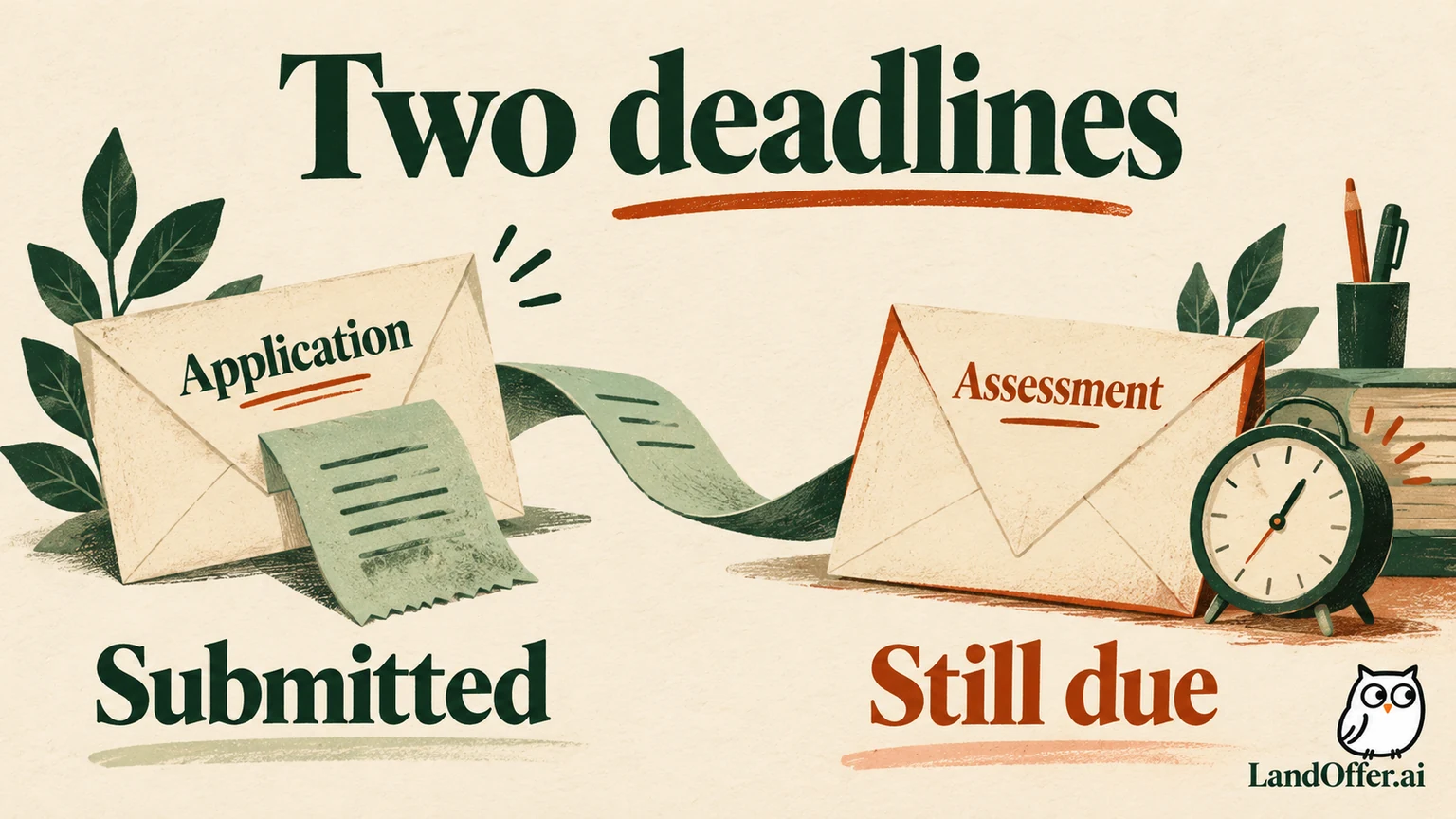
This is a completed teaching example, not an application performed for a candidate. Its useful result is a record with one current next action and a preserved submission receipt. It also shows why a generic “applied” checkbox cannot manage the entire internship process.
Build preparation buffers around dependencies you can identify. A transcript request, faculty reference, required portfolio export, or project explanation may take different amounts of time. Estimate your own work and arrange help early. A universal three-day buffer would disguise those differences, so keep both the dependency and its owner visible.
Prepare one factual base and select relevant evidence
Keep one factual baseline for contact information, education dates, project facts, employment or volunteer dates, and skills you can explain. For each retained role, select the evidence that matches the advertised work. Do not turn a class assignment into a production deployment or a team project into solo ownership because a deadline is approaching.
For R-411, Leila selects a course API project where she implemented request validation and wrote tests for invalid inputs. For P-205, she emphasizes the setup instructions and command-line troubleshooting she wrote for the same project. The factual project stays the same; the duties highlighted differ. Neither version claims paid engineering experience.
Michigan's resume guidance recommends consistent placement of job titles, organizations, dates, and locations, and bullets that explain action and context. Apply that discipline to the education section too: an expected degree should not become a completed degree when a form imports it.
Store the selected resume filename in the job record before uploading it. Open the exported file rather than relying on its name. Check readable links, page breaks, contact details, and the expected graduation date. Then inspect any parsed education and experience fields independently; a correct PDF does not establish that the form imported it correctly.
Keep the routine small enough to maintain
Separate finding roles from reviewing applications. A discovery session can add leads without producing submissions. A review session can finish one retained role or resolve a missing requirement. Use a calendar block that leaves enough time to inspect the final application. In Leila's fictional week, a lab deadline limits her to two review blocks. She finishes R-411 in the first and prepares C-77 in the second; P-205 remains a verified rolling lead for the following review. This keeps the plan workable without quietly replacing class time or rushing all three applications.
At each review, look first for an assessment or interview commitment already received, then approaching application deadlines and unresolved material dependencies. Reopen rolling listings before spending more time on them. Keep classes and existing commitments in the calendar so the plan reflects your actual week.
If an application is interrupted, record the last verified state. “Draft saved,” “upload failed,” and “confirmation received” require different next actions. Before retrying a submission, inspect the employer account or confirmation route available to you. A missing email alone does not prove the application failed, and a duplicate application will not repair an unknown state.
If you discover a missed deadline, check the official page or invitation before acting. A closed application is an archive decision unless the employer offers another route. An expired assessment invitation may require clarification through its contact channel. Do not assume resubmitting the original application resets an assessment invitation; use the invitation's contact or recovery instructions. Record what you verified and leave the outcome unknown until the employer confirms it.
After an outcome, close the corresponding action while retaining the record. A rejection can remove a pending reminder; a new invitation can create another. This gives you a manageable queue without losing the history needed to understand which files, dates, and roles you used.
Choose one suitable internship lead from recent roles on LandOffer.ai. Open its employer page and verify student requirements, attendance period, and the official application route. Add the source link and checked date, then attach one stated deadline or one specific clarification task before starting the form. A record you can act on is the starting point for the next application.
Sources and Further Reading
- Microsoft: Internship eligibility and qualifications — program and regional requirements.
- MIT: Recruiting guidelines for employers — campus recruiting and offer-decision guidance.
- MIT: Recruiting guidelines for students — deadline coverage and limits.
- University of Michigan: Resume resources — consistent materials and evidence-based descriptions.