LandOffer
Productivity & Workflows
Slab Review: A Focused Team Wiki or Another Place for Documents to Go Stale?
A fictional equipment-loan team sorts a current return guide, a historical decision, and live inventory into clear sources, then evaluates an eight-member, three-guest Slab rollout with retrieval tasks, plan costs, permissions, and accepted maintenance time.
Slab is a plausible choice for a team that wants a focused place to publish and find shared knowledge, provided someone owns the content, the access boundaries, and the route back to the authoritative source. Paying for a wiki does not settle which document is current or who will repair it. Start with the questions people need answered, then decide whether Slab's organization, search, and plan limits fit that work.
This LandOffer.ai review uses current official documentation, an October 27, 2026 public pricing inspection, and a fictional equipment-loan team. We did not create a Slab workspace, connect a source, run a search, verify a post, or change access. The completed examples are editorial exercises with expected answers, not measured product results.

What the current plans actually change
The public pricing comparison showed Free, Startup, Business, and Enterprise. Startup was $6.67 per user per month billed annually or $8 monthly; Business was $12.50 or $15. The captured interface displayed dollars without an explicit ISO currency code. Tax, discounts, seat minimums, and the exact annual invoice remain unverified.
Verification and Unified Search were included across the plans. Private Topics began at Startup. Standard integration allowances were ten on Free and unlimited on paid plans; Business included three Premium integrations. Those differences can matter more than the number of documents. A team that needs a private internal topic or a specific Premium connection should identify that requirement before comparing per-seat prices.
The guest-account guide clarifies the Free limit: guests count toward the ten-user total. Startup includes three free guests per paid seat; Business includes five. Guests beyond the included allowance can become paid seats. A guest is not automatically read-only: topic and post permissions still determine what the person can do.
The purchase question is therefore concrete: which people need access to which knowledge, which integrations must work, and who will maintain the content? Match each guest to the knowledge they need, even when the plan includes more guest places.
Completed asset: sort three knowledge questions before importing
The following team, documents, conversations, and future dates are fictional. Leah coordinates an eight-person equipment-loan service team. Three external repair technicians need selected return instructions. The team currently has a return guide PDF, a decision note in an old project folder, and a changing inventory spreadsheet in Google Drive.
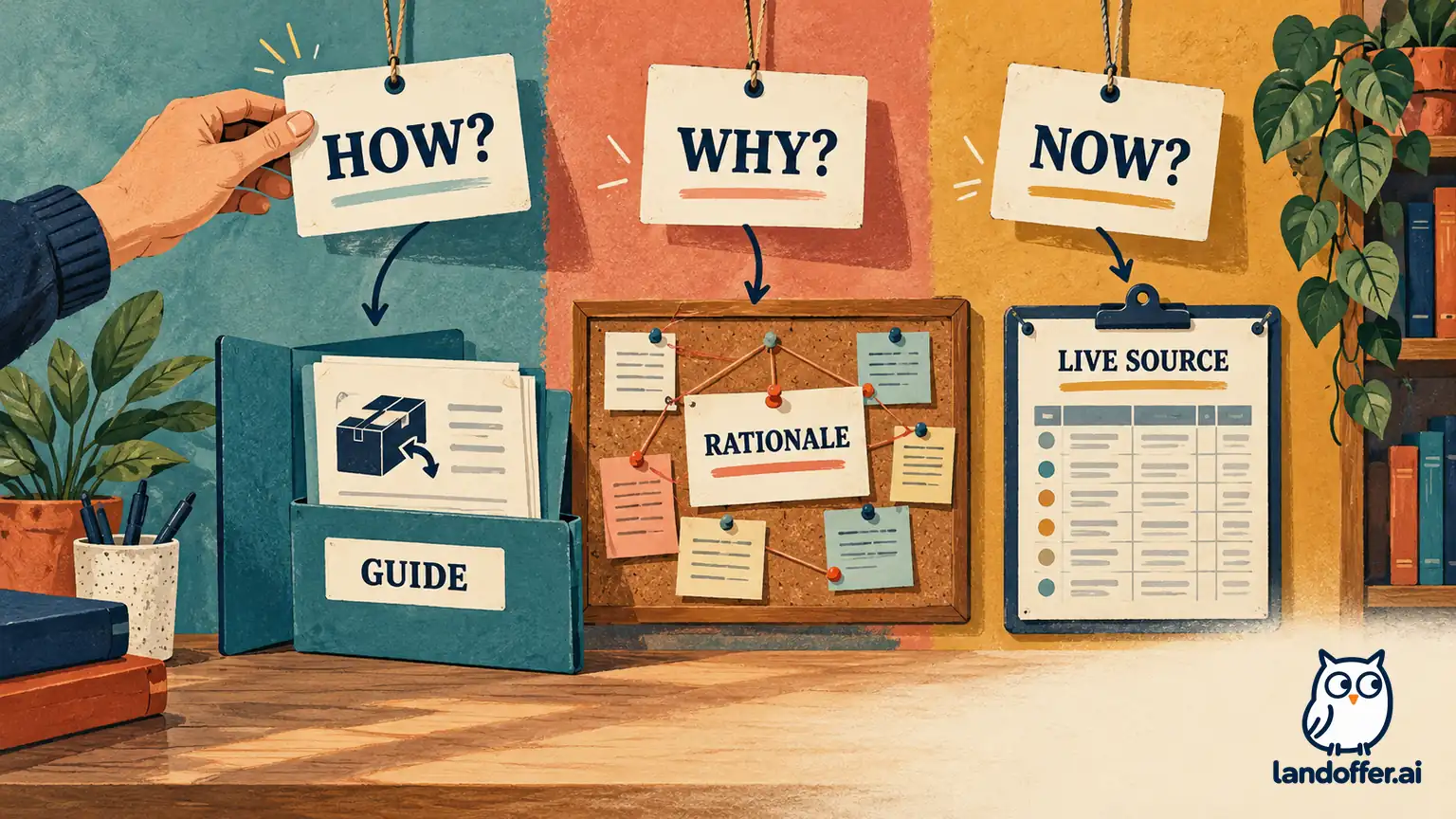
Leah gives each item a specific home instead of importing three independently maintained copies. Her completed source map keeps their different purposes visible:
| Knowledge item | Actual question to answer | Proposed Slab treatment | Authority and maintenance owner |
|---|---|---|---|
| K1: Loan-kit return guide R3 | Where does a technician return a kit, and what happens if the counter is closed? | Publish a maintained procedure in a scoped technician topic after review; retire the old PDF entry point | Dev owns the procedure; service lead confirms operating arrangements |
| K2: One-kit-per-case decision | Why did the team stop combining equipment from different cases in one return? | Publish a concise decision record with date, rationale, scope, and a link to its original evidence | Jae owns the rationale and revisits it if the case-tracking system changes |
| K3: Live loan inventory | Which kit is currently assigned to a case? | Keep the spreadsheet authoritative; add a source pointer and, only if authorized, evaluate Drive search or embedding | Sumi owns inventory data and source permissions; the wiki does not become a second stock ledger |
K1's fictional source record is R3, effective November 3, 2026. Dev's agreed operating text reads: “Bring the complete kit to the service counter by 14:00 local time on the agreed return date. Ask the desk worker to record the case ID and contents. If the counter is closed, contact the service desk for a new handoff arrangement. Do not leave equipment outside the room or treat an unattended drop-off as a recorded return.”
The earlier R2 PDF directs people to reception and lacks the closed-counter instruction. Leah's migration disposition is to replace its prominent team-directory link with the reviewed procedure's link, label the retained R2 copy as superseded, and preserve its history where the team requires it. No real file has been moved, archived, deleted, or published. Replacing an entry point does not prove everyone has stopped using an old bookmark.
K2's completed decision summary says: “One case per returned kit keeps the case ID attached to a single contents check. This decision concerns return intake only. It does not prohibit staff from arranging shared courier transport, provided each kit remains separately identified. Revisit if the intake system gains an approved way to track mixed-case contents.” The statement explains a boundary; it does not establish a universal logistics rule.
K3's pointer says: “Use the inventory spreadsheet for the current kit-to-case assignment. The return guide explains the process, and the decision record explains its rationale. Neither records current availability. If you cannot access the source, ask Sumi; do not reconstruct the assignment from an old wiki excerpt.”
That source map gives the team a reason to evaluate a wiki: one maintained procedure, an accessible rationale, and a reliable route to a live source. It also defines what should stay outside it. Keeping assignments in the live source avoids making the wiki owner reconcile a second inventory copy after every change.
Make the search evaluation return useful answers
Leah next writes three retrieval tasks and their answer keys. The answer keys are complete, but actual Slab queries, result relevance, and reader access remain untested.
| Reader task | Expected answer from the fictional materials | Failure worth recording in an authorized evaluation |
|---|---|---|
| “I am returning a kit and nobody is at reception. What now?” | Current R3 names the service counter and says to arrange a staffed handoff if closed; no unattended drop-off | Old R2 is mistaken for the current procedure, or the reader cannot identify its superseded status |
| “Can two separately labeled kits travel with one courier?” | K2 addresses case-level intake, not a ban on shared transport | A rationale is misread as a broader prohibition |
| “Which kit is assigned to case L-27 today?” | Open the permitted live inventory source; the wiki itself has no current assignment answer | A historical excerpt is presented as current stock, or a denied source is treated as missing data |
In a fictional desk rehearsal of the written materials, Omar reads the R3 draft and asks whether leaving a kit near the closed counter counts as a return. Dev points to the no-unattended-drop-off sentence; Leah moves it beside the closed-counter instruction in the proposed page layout. Omar's readback then says: “I need a staffed arrangement and a recorded handoff.” This invented exchange tests the example's clarity on paper, not Slab's interface or a real technician's behavior.
The advanced-search documentation describes topic, owner, state, and date filters, including verified, expired, and archived states. During an authorized evaluation, Leah could record the exact query, reader role, result chosen, source state, and whether the answer key was satisfied. For the return question, Leah must check whether the reader chooses R3 and understands the staffed handoff, regardless of how quickly results appear.
For K3, the Google integration guide describes live embeds and team or individual Unified Search. It says Drive permissions still apply and team setup requires an administrator. That is documentation, not evidence that this team's spreadsheet will index successfully. Connection approval, account scope, actual access, and the treatment of an inaccessible file must be checked before promising a single search box for everyone.
Completed asset: choose a plan and fund maintenance
Leah's proposed rollout has eight internal users, including herself, and three external technician guests: eleven people in total. That exceeds the ten-person Free allowance. Verification alone would not justify paying, since it is already included on Free; the combined headcount and proposed private internal topic are the relevant requirements.
Under Startup's documented guest formula, eight paid seats include 24 guest places, so three fit without adding another paid seat under these assumptions. Business would include 40, which adds no necessary guest capacity for this case. Leah records the access proposal before any invitation:
| Audience | Proposed scope | Responsibility retained |
|---|---|---|
| Leah, internal administrator | Configuration and access administration | Reviews actual plan, invitations, integration approval, and access checks |
| Dev, Jae, Sumi and four internal colleagues | Open internal knowledge, with editing assigned by content responsibility | Owners keep K1–K3 current; broad membership does not assign everyone maintenance duty |
| Three technician guests | Published K1 in the scoped technician topic; viewer access proposed | No inventory, internal decision discussion, or unrelated operational notes proposed |
| Staff handling any sensitive commercial material | Separate private topic only if there is an approved need | Keep that material out of the technician topic and out of shared document titles |
The post-permissions guide makes two cautions especially relevant: topics add access rather than narrowing it, and publishing a post without a topic can leave it accessible and searchable within the organization. Mentions can also reveal a referenced post's title even when its contents are restricted. Leah therefore avoids adding an open topic to sensitive content and uses a neutral source pointer instead of mentioning a sensitive title. These are proposed safeguards, not a completed access audit.
Her eight-seat Startup budget is $64 per month at the monthly rate, or $768 for twelve months. Multiplying the rounded annual-equivalent display gives $53.36 per month and $640.32 for twelve months; the exact annual checkout amount must be confirmed rather than treating rounded display multiplication as an invoice. Business would be $120 monthly, or $1,440 over twelve months, and $1,200 on the displayed annual equivalent. Those figures exclude unverified taxes and other terms.
The Premium integration catalog identifies Microsoft, Okta, OneLogin, and Zendesk as Premium. The Standard catalog includes Google Workspace. The initial proposal requires only a permitted route to Drive content; it does not require Zendesk search, AI answers, or Premium identity features. If the real team later requires Zendesk integration, Leah must reconsider Business and validate the exact connection scope; she cannot count it as included in Startup's unlimited Standard allowance.
Leah's completed purchasing recommendation is: “Evaluate Startup for eight internal users and three scoped guests, contingent on confirming billing and private-topic behavior. Keep the live inventory in Drive. Do not upgrade merely for a larger guest allowance or an untested AI answer. If the source-access test fails, preserve direct source navigation and resolve the requirement before expanding the rollout.”
She also records actual maintenance commitments within the fictional team: Dev accepts a 30-minute monthly K1 review, Jae a 30-minute quarterly K2 review, and Sumi a 15-minute monthly source-link and permission check. Leah accepts 30 minutes monthly to inspect ownership, expired content, and misleading entry points. That is 75 recurring minutes per month plus one 30-minute review each quarter, or 255 minutes over a three-month quarter. It is a capacity allocation, not a measured time saving.
Verification helps only when someone does the review
Slab's verification guide describes a primary verifier, review frequency, optional additional verifiers, reminders, and an expired state. It applies to published posts and requires edit access for verifiers. Treat the banner as a record of human review and confirm that the operating arrangement still matches the post.
For K1, Dev's review must confirm the counter, handoff rule, owner contact, and effective version against the service lead's current arrangements. A staffing change should prompt review before the next monthly slot. If nobody can confirm the instruction, the team should mark the uncertainty and provide the responsible contact rather than reverify by habit.
Slab can be a focused wiki when the team keeps those ownership and source boundaries intact. It becomes another stale repository when importing is treated as the finish line. For more workplace software evaluations, visit LandOffer.ai. Before committing, retain results for all three retrieval tasks, named owners, tested access boundaries, approved integration scope, the full bill, and accepted review time.