LandOffer
Job search
SDET vs. QA Engineer Jobs: Compare Test-Code Ownership, Exploratory Testing, and Release Duties
Read test-code ownership, exploratory investigation and release responsibility directly; QA is not a synonym for no coding.
An SDET role often puts more weight on creating and maintaining test code, frameworks or quality tools; a QA Engineer role can range from exploratory and release testing to automation engineering. Read the duties, artifacts and decision rights in the posting. The title alone does not tell you whether the job is hands-on, how much code you will write, or who can stop a release.
A useful comparison starts with three questions: What test assets will you build or maintain? How will you investigate behavior that scripted checks miss? Which release decisions and follow-up work belong to you? Employer examples show how widely these responsibilities can overlap. Use recent roles on LandOffer.ai to find a specific opening, then verify its full description and location. The examples below were inspected on October 13, 2026; they are snapshots, not a promise that a vacancy remains open.

Start with the work product, not the title
SDET commonly expands to Software Development Engineer in Test. In some teams it means a software engineer who builds automation frameworks, integration suites, test data systems or CI checks. In others, the work may be narrower or share a quality team with manual and systems testing. “QA Engineer” is just as variable: it may involve test strategy, automation, exploratory sessions, customer-impact investigations, release checks, or a blend.
The U.S. Department of Labor’s O*NET profile groups software quality assurance analysts and testers across several titles, including QA Engineer, Quality Engineer and Software Test Engineer. It describes work such as developing and executing tests, documenting defects, maintaining known-defect records and contributing to design reviews. That US occupational grouping is useful context; it does not define every employer’s titles or establish a universal coding threshold.
Make a small evidence list before applying. Circle verbs such as design, implement, maintain, investigate, triage, approve and release. Then connect each verb to an artifact and a decision: code, test plan, reproducible defect, coverage report, or release recommendation. “Test features” is too broad to tell you who builds the test system or who acts when a check fails.
Compare what the postings actually assign
The inspected employer descriptions make a practical contrast, while also showing why titles cannot settle it. Standard Bots’ SDET description emphasizes building and owning automated end-to-end and integration tests, developing tools, reviewing designs and pull requests for testability, and creating software mocks for hardware. It also expects daily production-quality coding and lists five days a week at the company’s Glen Cove factory. Its separate Manual QA Tester contract describes exploratory and regression passes, careful defect records, release-candidate validation and basic recovery of test hardware; scripting is a plus rather than the role’s central stated output.
Replicant’s Senior Software Engineer in Test description asks for a senior technical contributor to improve automation, platform tooling, testing strategy and quality gates, while coaching QA engineers and connecting customer feedback to validation work. That is broader than writing scripts for an existing test plan. These descriptions come from different levels and settings. Use their duties as employer-specific samples, not definitions of SDET or QA across the market.
| Posting evidence | Likely work to investigate | Clarify before you apply |
|---|---|---|
| Own frameworks, suites, mocks, CI checks or test infrastructure | Software development is part of the quality output | Which language and codebase will you maintain? Who reviews and supports the framework? |
| Execute manual regression, smoke or exploratory sessions | Structured observation and defect evidence are central | How much time is scripted execution versus open-ended investigation? |
| Validate release candidates or report a quality gate | Release readiness is in scope | Do you recommend, approve, block or simply report? Who accepts residual risk? |
| Partner with product and engineering on acceptance criteria | Quality work starts before a feature is complete | At what point do you join planning and design? |
| Test physical, regulated or customer-configured systems | Test setup and failure consequences shape the work | Is a lab, customer site, hardware, clearance or specific region required? |
Separate test-code ownership from test execution
A role that says “automation” may still mean maintaining a set of scripts someone else designed. Look for the ownership chain: Are you expected to choose the test boundary, build the harness, maintain test data and fixtures, diagnose flaky runs, review changes, and decide which checks belong in continuous integration? Or do you execute and report on an established suite?
For example, a checkout service might reserve an item, charge a payment method and later release inventory after a cancellation. A useful automated test could verify the reservation state, the payment response, the cancellation path and the resulting inventory record across service boundaries. The asset is not just a line of test code. Someone must decide what invariant matters, set up reliable data, keep the check deterministic and repair it when the product changes.
Ask for a recent example of a test that the team added because a production or staging failure exposed a gap. What layer caught it? Who implemented the fix to the test system? How does the team distinguish a product defect from a flaky environment? These answers reveal whether the role owns a maintained quality capability—its design, reliability and follow-up—or mainly contributes test executions to a system owned elsewhere.
Do not use code volume as a proxy for engineering depth. A short, well-chosen test can protect a critical boundary; a large suite can be fragile and low-value. Conversely, a QA Engineer may write substantial automation even when the title does not include “SDET.” Evaluate the maintained artifact, design responsibility and expected collaboration rather than screening yourself out based on a label.
Treat exploratory testing as a reproducible investigation
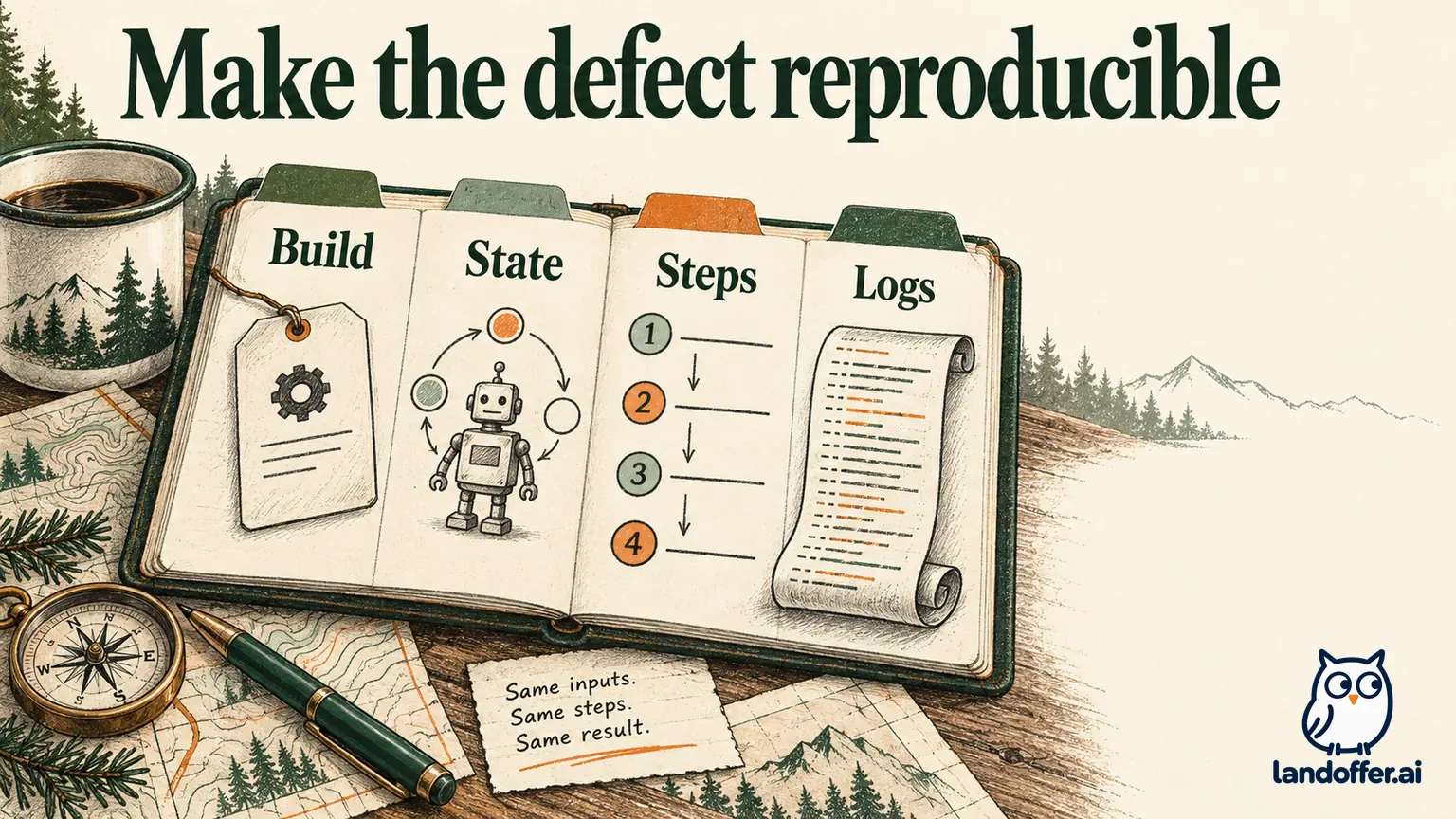
Exploration is not random clicking. The tester chooses a meaningful risk, varies inputs or sequence, observes the system, and records enough context for another person to reproduce the result. A finding becomes useful when it identifies the build, starting state, steps, expected behavior, observed behavior and supporting evidence.
Consider this explicitly fictional exercise for a warehouse app. An operator cancels an item reservation while a pick task is open. On build demo-42, the test account has two units available, one active reservation and a pick task linked to that reservation. After cancellation, the UI marks the reservation “released,” but the open pick task still permits the operator to confirm the shipment. Repeating the same sequence on the same build produces the same result. The scenario does not claim that any real product has this defect.
A useful defect packet would read:
Title: Cancelled reservation can still be shipped from an open pick task
Build and setup: demo-42; test warehouse W-3; two units available; reservation R-17 linked to pick task P-08.
Steps: Open R-17; cancel it; leave P-08 open; return to P-08; confirm shipment.
Expected: The cancelled reservation cannot be shipped; the pick task asks the operator to refresh or close it.
Observed: The shipment confirmation succeeds although the reservation view says “released.”
Evidence to attach: Timestamped screen recording, request or application logs with sensitive values removed, and the reservation and pick-task IDs.
Impact to assess: Possible inventory mismatch or shipment against a cancelled order; confirm severity with product and operations before assigning priority.
A tester should not inflate impact or label a security or financial consequence without evidence. The concise reproduction and state history are what let an engineer investigate. An exploratory QA specialist may produce this kind of evidence without owning the automation framework; an SDET may turn a confirmed failure into a durable regression check. Teams can split, combine or rotate those steps.
Read release duties as decision rights
“Support release testing” can mean running a checklist, investigating failures, assembling evidence, recommending readiness or having authority to block a release. Those are different jobs. Find the decision verb and the escalation path. If a test fails late in a release, do you own the risk assessment, give input to the release owner or wait for another team to decide?
A quality gate also needs context. Is it a required CI check, a dashboard signal, a manual sign-off or a policy owned by engineering leadership? What happens when the check is flaky or the environment is unavailable? An SDET who builds gates may still not be the person authorized to approve a release. A QA Engineer who runs release validation may have strong influence without unilateral sign-off.
For hardware, customer-specific or regulated products, ask how a lab or production-like environment is scheduled and who can restore it. The Standard Bots manual contract, for example, calls out software on real robots, release regression, logs and build or firmware versions, plus basic test-cell recovery. Its SDET posting instead emphasizes automated suites, mocks and tooling that reduce reliance on physical hardware. The difference follows from the outputs described in these particular roles; it does not mean all QA roles are manual or all SDET roles avoid hardware.
Match your evidence to the role’s stage
A candidate’s experience can support different parts of the same quality lifecycle. Choose a role based on evidence you can explain and work you want to own, rather than recasting every test as automation or every release as a quality decision.
| Candidate | Strongest evidence | Better-supported target | Material question |
|---|---|---|---|
| Maya built a Playwright suite, maintained fixtures, investigated intermittent CI failures and reviewed pull requests for testability | Test-code ownership, framework maintenance and developer workflow | SDET or automation-heavy QA Engineer | Does the team expect broader system design, languages or infrastructure than she has used? |
| Jordan planned exploratory sessions, reproduced multi-step defects, captured logs and led release-candidate checklists | Investigation, defect communication and release evidence | QA Engineer or product-quality role | Is scripting optional, expected, or a core deliverable in this opening? |
These are fictional profiles. Maya should not claim release approval just because her checks run in CI. Jordan should not describe exploratory work as “non-technical”: risk selection, state control, reproducibility and evidence quality all require judgment. Either candidate might apply to a hybrid role if the posting and interview confirm a workable split.
Questions that expose the real job
Use the posting’s own language to keep a recruiter or hiring-manager conversation concrete:
- What are the main artifacts this person is expected to own in the first six months: frameworks, test cases, environments, defect analysis or release reports?
- Which tests will this person design and maintain, and which suites will they execute or extend?
- How do engineers handle flaky checks, test-data problems and failures that appear only in a shared environment?
- When a release check fails, who makes the go/no-go decision and how does this role contribute?
- How much work is exploratory, scripted manual regression, automation engineering, systems testing or customer feedback triage?
- What level of coding is expected in the actual work, and what languages and review practices are used?
- Where does testing happen: local or cloud environments, customer configurations, a lab, physical devices or an onsite facility?
A strong answer names a workflow, owner and example. “Everyone owns quality” can be a healthy principle, but it does not answer who maintains the framework, writes the defect report or decides whether the release proceeds. If the split remains unclear, ask for a representative week or a recent feature from design through release.
Choose by ownership and evidence
Lean toward an SDET opening when the description makes you accountable for production-quality test code, reusable automation, infrastructure, CI reliability or quality engineering strategy—and you want that coding and maintenance work. Lean toward a QA Engineer opening when the role centers on test design, exploratory investigation, regression, defect communication or release validation that fits your experience and interests. Treat either title as a starting clue only; many teams combine these duties.
Before tailoring your application, match each requirement to one concrete example: a test asset you maintained, an unexpected behavior you investigated, or a release decision you informed. State your contribution and the result you actually observed. Then check location, onsite expectations, level, contract terms and release authority in the specific posting. That comparison gives you a concrete basis for deciding whether to tailor an application. When you have a target opening, browse recent roles on LandOffer.ai, then map its stated ownership and constraints to evidence you can explain.
Sources and Further Reading
- O*NET: Software Quality Assurance Analysts and Testers — occupational duties and related titles.
- Standard Bots: SDET — Senior Software Developer Engineer in Test — employer-specific automation, tooling, testability and factory-location example.
- Standard Bots: Manual QA Tester (Contract 3+ months) — employer-specific exploratory, regression, defect-reporting and release example.
- Replicant: Senior Software Engineer in Test — senior quality engineering, automation strategy and cross-team example; the sample is a Canada-based role.
Employer postings can change or close. Their wording is evidence about those descriptions, not a universal hiring standard or a guarantee of what a team will ask in an interview.