LandOffer
Job search
Scientech Resumes Review: Technical Writing Scope, Intake, and Quote Requirements
Check technical evidence, deliverables and the intake-to-delivery schedule before accepting a Scientech proposal.
Scientech Resumes is worth considering when your technical experience needs substantial positioning work and you can participate in a detailed intake process. Its current services explicitly include software, data, infrastructure and cybersecurity professionals. The purchasing decision depends on the written proposal: which documents, strategy sessions, revision opportunities and deadlines it includes, at what total price.
The public writing process gives useful information about intake alternatives and rush fees, but we did not obtain a base project quote. Treat this as a review of public service descriptions and terms, checked October 14, 2026. We did not commission a resume, attend a consultation or test a delivered file in an applicant tracking system.
LandOffer publishes this review. You can use recent roles on LandOffer to identify the work you want to target; a writing engagement still needs evidence from your own experience and a clear agreement about what will be produced.
Technical scope includes software and data careers
The current STEM resume service covers technical careers beyond laboratory science. Its information technology page names software engineers, data engineers, cloud and infrastructure specialists, security professionals and technology leaders. The stated approach is to retain technical substance while explaining its significance to people evaluating the candidate.
That published scope is a useful fit signal if your resume lists systems and tools without explaining your contribution. It does not establish that a writer knows your particular database, regulated workflow or compiler architecture. A consultation should reveal whether the service can ask the right questions about your projects and preserve the answers accurately.
The site also distinguishes deeper specialization, career changes and leadership goals. Those directions require different evidence. If you want to move from an individual contributor role into management, the resume needs evidence of the leadership work you have done. A writer can clarify transferable experience; the candidate must be able to support the resulting claims.
Scientech describes resume development as part of its wider career system and says it typically pairs resume and LinkedIn development. Depending on the partnership, other materials or coaching may be available. It does not tell you which documents your payment includes. The current terms limit deliverables to the applicable proposal and give that proposal precedence for specific services, pricing and timelines.
Bring evidence that can survive a different audience
The writing process starts with a free discovery consultation described as 25–30 minutes. After that meeting, the provider supplies a proposal. The new-client page describes the conversation as having no obligation to proceed. Neither step means a resume has been written or that a paid project has begun.
Standard intake uses a customized questionnaire, existing career materials, target opportunities and a 60-minute strategy meeting. That workload is part of the service. You should expect to explain what you did, the constraints and the significance of the result, rather than supply a job title and wait for a finished narrative.
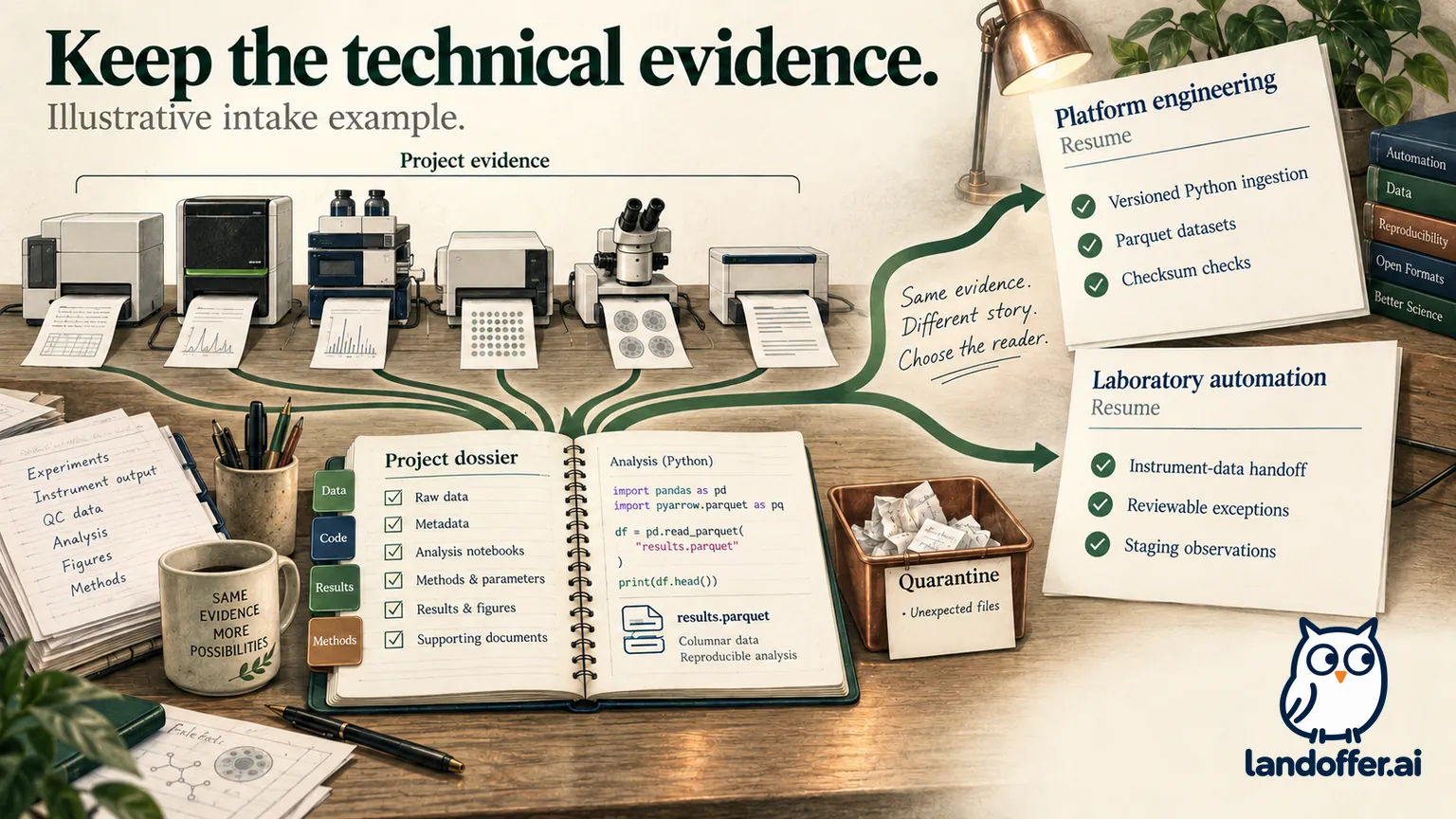
Consider Nia, a fictional laboratory-data engineer comparing platform data engineering with laboratory automation roles. Her completed intake pack contains these facts:
| Evidence supplied | What it supports | What it does not establish |
|---|---|---|
| Python importer for files from six bench instruments | Specific ingestion and integration work | Ownership of the instruments or the whole laboratory platform |
| Versioned transformations producing Parquet datasets | Reproducible processing choices | A production-scale data lake |
| Checksum checks and quarantine for unexpected files | A concrete validation and exception path | Regulatory certification or clinical validation |
| Fourteen staging batches; manual handoff reduced from eight steps to three | A bounded workflow observation | The same result across every production batch |
The first resume direction could describe her work as: “Built a versioned Python ingestion workflow for six bench instruments, producing Parquet datasets with checksum validation and quarantine for unexpected files.” It keeps the technical design visible to an engineering reader. The staging result can appear separately with its scope intact.
For laboratory automation, the same evidence could become: “Developed an instrument-data handoff workflow with reviewable file exceptions; across fourteen staging batches, the manual handoff fell from eight steps to three.” This foregrounds the laboratory workflow while retaining the limited setting of the observation.
Both are illustrative outputs created for this review, not Scientech samples. Nia would supply the underlying facts and select a target before agreeing on positioning. Neither version claims clinical production deployment, compliance certification or team leadership. Her missing evidence remains missing after a professional rewrite.
The useful intake result is a decision about emphasis. For platform engineering, she retains the versioning, storage format and failure path. For laboratory automation, she emphasizes instrument handoffs and exception review. She does not need to erase the technical detail to make the work understandable.
The intake alternative changes more than meeting length
The current process page offers a 90-minute live strategy and career-intelligence session in place of the questionnaire. It lists an additional $597, three revision rounds and two post-delivery strategy sessions of 60 minutes each. The standard writing engagement lists two rounds plus final review and one 60-minute post-delivery strategy session.
That makes the alternative a different allocation of discovery and follow-up work. It is not evidence that the provider can infer your career history without preparation. Nia would still bring project notes, target roles and the boundaries of her staging result. A live interview changes how those facts are gathered.
The word “fast-track” also needs care. The intake alternative and an expedited writing deadline are separate options. Paying for the 90-minute session should not be read as purchasing three-day delivery. The proposal needs to identify both when both are wanted.
The terms say an engagement begins when the client accepts the proposal or service agreement, agrees to the terms and makes the required initial payment. A free conversation is therefore a useful place to resolve scope before accepting that commitment. We did not book the meeting or inspect a private proposal.
Price the additions without inventing the base quote
Current public pages list these delivery additions, subject to availability:
| Addition | Listed fee | Purchasing boundary |
|---|---|---|
| Five-business-day turnaround | $297 | Confirm availability before payment |
| Three-business-day turnaround | $697 | Confirm the actual delivery deadline |
| Weekend work or consultation | $497 | Can apply alongside a rush fee |
The process page says rush and weekend charges are separate, and the current terms repeat that they can accumulate. We did not obtain a quote for the base writing engagement. A published add-on price cannot be used to manufacture a complete service price.
Here is a completed purchasing decision for Rowan, another fictional candidate. Rowan prefers the live intake alternative and needs the initial documents within six business days after the required intake is complete. Rowan does not need weekend work.
The provisional selection is the $597 intake alternative plus the $297 five-day rush option: $894 above the unknown base investment. With base price B, the subtotal is B + $894. Adding weekend work would increase the additions to $1,391. Selecting three-day rush instead, without weekend work, would make them $1,294.
Rowan keeps the five-day option because three-day delivery does not solve an additional stated need. This is conditional on Scientech confirming an available slot and the written deadline. Rowan does not pay while B, the documents and the intake date are unresolved. No tax treatment, payment discount or actual vendor quote is assumed in this arithmetic.
The completed acceptance decision looks like this:
| Proposal item | Rowan’s required answer | Current decision |
|---|---|---|
| Documents | Resume and LinkedIn work identified individually | Obtain the actual scope |
| Intake | Live alternative, with its included revision and meeting allowances | Request explicit inclusion |
| Delivery | Named initial-delivery date after completed intake | Require availability confirmation |
| Price | Base investment plus the selected $894 additions | No payment until total is supplied |
| Weekend work | Not requested | Exclude unless the schedule changes |
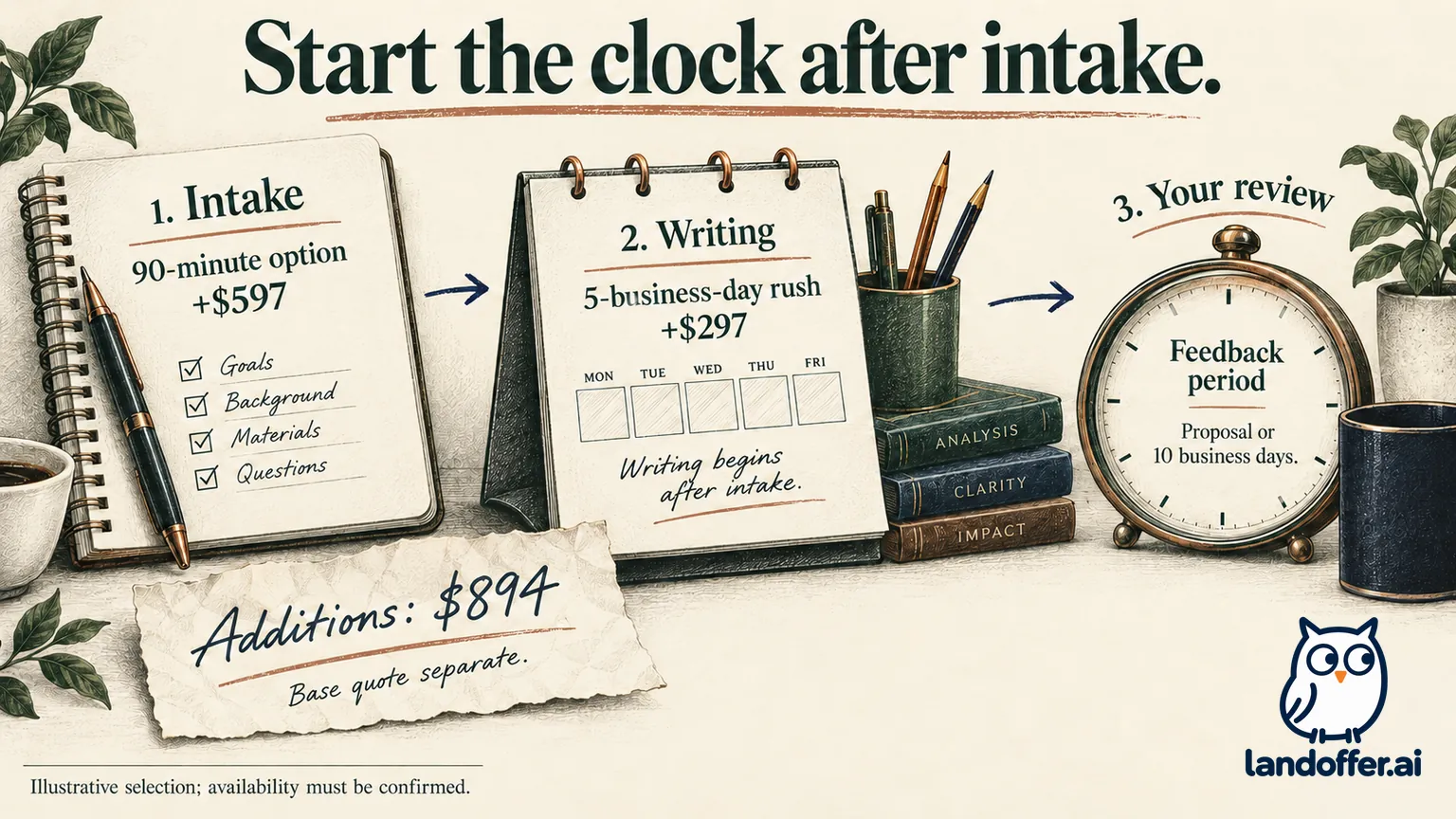
A six-day need measured from today would be different. The discovery consultation, proposal, scheduling and intake may occur before writing turnaround begins. Rowan’s calculation only works because the fictional requirement is measured after intake.
Delivery, revisions and follow-up have different clocks
The current terms, marked updated October 6, 2026, describe standard writing turnaround as generally seven to ten business days unless the proposal says otherwise. An estimated timeline is not guaranteed unless expressly identified as guaranteed in writing. The provider gives an estimated delivery timeline after the required intake and strategy process.
The service page says revision requests are completed in one to two business days. The terms separately require the client to provide feedback within the proposal’s review period, or ten business days if none is specified. The one-to-two-day figure describes handling a revision request; the ten-day default describes your time to submit feedback. Neither promises an indefinitely open project.
A changed target direction, substantial new information, an additional document or substantial rewriting after included revisions may incur separate charges. For Nia, clarifying the number of staging batches fits factual review. Commissioning a second version for a different career direction needs a scope discussion. The writer’s ability to describe multiple technical specialties does not automatically include multiple resumes.
The terms also distinguish reasonable email questions from unlimited consulting, document updates or rewriting. A post-engagement check-in does not reopen the original scope. If ongoing support is part of the appeal, identify what the benefit covers rather than treating “lifetime” language as a perpetual document-development contract.
Review payment, file use and data handling before intake
Cancellation terms change with the stage of work. Before work begins, the current terms say Scientech may issue a refund less transaction fees and a ten-percent cancellation fee. After work begins but before initial deliverables, it may retain fifty percent of the total project investment plus applicable transaction fees. Once initial deliverables have been supplied, the client is responsible for the full investment. These are the provider’s published terms, not a promise of an automatic refund in a specific dispute.
The terms do not guarantee interviews, offers or recruiter responses. They also leave applications, networking and other client-controlled job-search work with the candidate unless specifically included in the proposal. A commissioned resume should not be confused with a recruiting relationship or managed application service.
The process page lists final documents in Word and PDF, with additional formats available on request. We did not download a deliverable or test how an employer’s software parses it. The terms preserve the client’s use of completed personal career documents for their own career purposes while retaining ownership of the provider’s proprietary frameworks and training materials. A Word file gives you a document you can revise when your experience changes; it does not transfer ownership of the provider’s underlying methodology.
Scientech says it does not use AI to write or generate client-facing deliverables, while allowing limited technology-assisted research and workflow functions. This is a vendor description, not an audit. Its confidentiality provisions also permit necessary third-party service providers, and project records may be retained. Before sharing technical material, remove employer secrets and provide a permitted factual summary instead of proprietary source code or restricted research documents.
Scientech offers a plausible route for technical candidates who need help choosing and explaining a career narrative and can make time for collaborative intake. Bring one target role, one evidenced project and the documents you want to the free consultation; review the resulting proposal before accepting or paying. Before accepting a proposal, compare those targets with the roles you are pursuing through LandOffer and require the documents, total investment, review period and delivery date in writing.