LandOffer
Pay & Benefits
Salaried Does Not Always Mean Overtime-Exempt: Gather the Facts Behind Your Classification
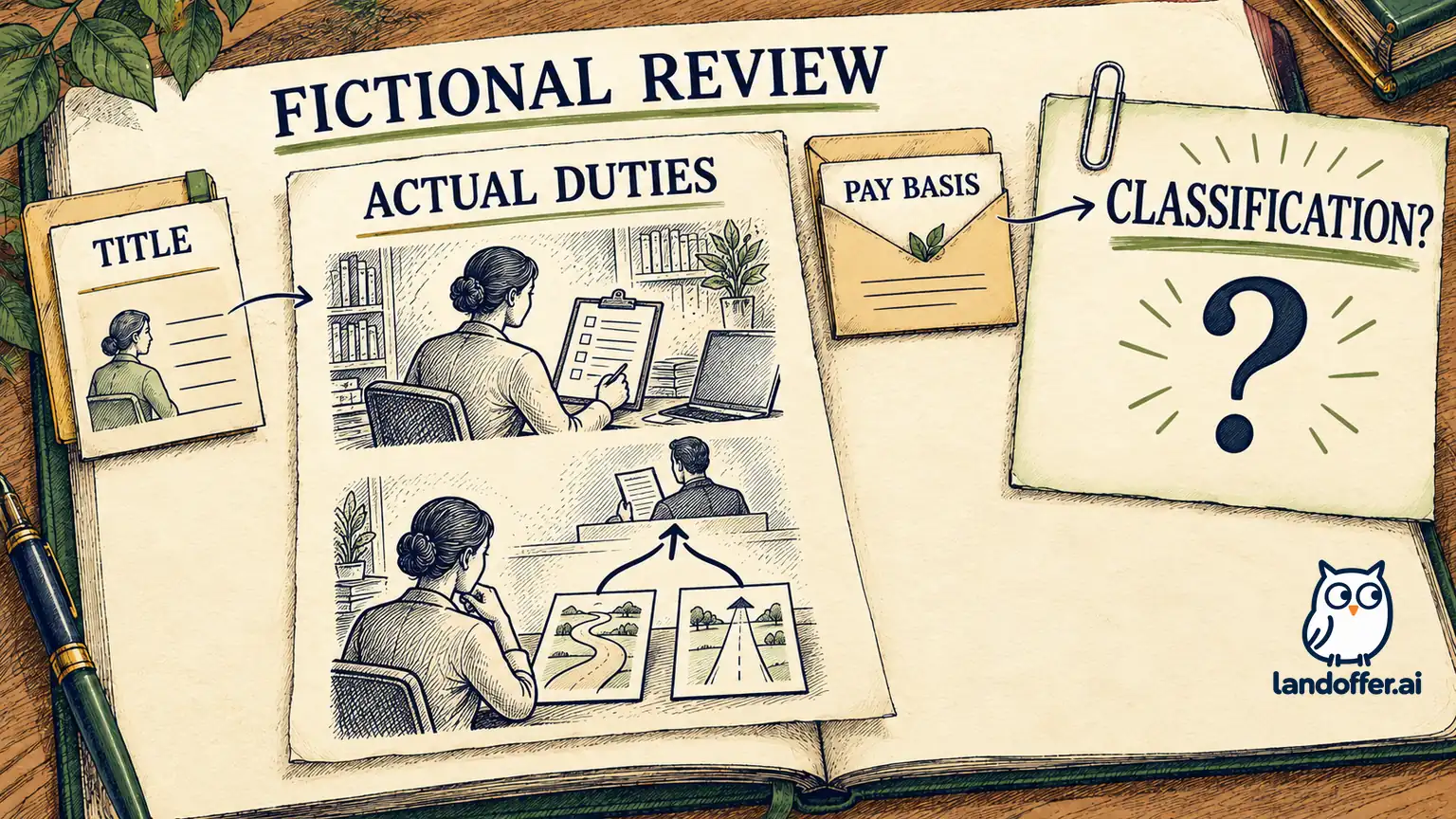
A completed fictional Washington analyst record compares five job-description statements with actual responsibilities, including routine work and a reviewed recommendation. A neutral HR request and mixed response identify the claimed exemption while keeping the classification, hours, and any pay conclusion unresolved.
Being paid a salary does not automatically make an employee overtime-exempt. To understand your classification, gather the employer's stated exemption, actual duties, pay arrangement, work location, and relevant dates. Ask HR or the designated compensation team to explain how those facts meet the applicable requirements. Read the title, pay, and payroll label alongside the actual duties and applicable exemption requirements.
This LandOffer.ai guide helps you prepare a classification review, using official public material checked October 27, 2026 and a completed fictional record. It does not decide anyone's exemption, calculate wages owed, or recommend changing a payroll setting yourself. Federal and state requirements, occupation-specific rules, and the facts of the particular job matter; a useful request preserves that uncertainty while making the actual work clear.

Ask which exemption the employer is using
“Salaried” describes how compensation is arranged. “Exempt” describes an exception to particular wage-and-hour requirements. Ask which exemption the employer relies on, which laws it reviewed, and the effective date of the classification. Do not assume every salaried person follows the same exemption test.
The federal regulation 29 CFR 541.2 explicitly makes job titles insufficient. For the administrative exemption, section 541.200 combines compensation requirements with primary-duty requirements concerning management or general business operations and discretion on significant matters. An office-based role does not become administratively exempt just because someone calls it “administration.”
Keep salary level and salary basis distinct. Section 541.602 describes a predetermined amount not reduced because of variations in the quality or quantity of work, subject to specified exceptions. A net paycheck changing because of withholding or benefit deductions is not, by itself, evidence that the salary-basis requirement failed. Preserve gross-pay details and ask about the specific deduction or change rather than diagnosing it from take-home pay.
State requirements can differ. Washington L&I's current overtime Q&A describes salary basis, salary level, and duties. Its published 2026 white-collar salary threshold is $1,541.70 weekly, or $80,168.40 annually, compared with the federal $684 weekly standard shown in the current administrative regulation. These are scoped examples, not universal thresholds for every occupation, location, or exemption.
Check whether a threshold is currently operative before relying on an older article’s scheduled increase. The current federal regulatory text matters more than a search result advertising a past future threshold. Record the year and jurisdiction next to any amount you use.
Describe authority and work products, not only task names
Compare the job description with what you actually do. “Analyzes operations” could mean following a prescribed checklist, evaluating important alternatives, or doing both in different contexts. Describe the inputs, choices, work product, and authority to change rules or commit resources so the reviewer can compare actual responsibility with the exemption claimed.
The federal discretion regulation, section 541.202, distinguishes judgment about significant matters from applying established procedures. It also says recommendations can involve qualifying discretion even when a higher-level person reviews them. Therefore, “my manager approves everything” is not a complete exemption analysis. Explain what you recommend and its significance, as well as the review that follows.
Describe the job over a representative period. Section 541.700 evaluates the job as a whole and identifies factors beyond time spent, including the importance of duties and freedom from supervision. A time log can inform the review, but a percentage of routine work is not a self-executing legal verdict.
For technical roles, ask whether the employer is relying on a computer exemption or another category. Section 541.400 identifies specified systems-analysis and development-related primary duties; it does not make every employee who uses software exempt. Conversely, an internal title that sounds nontechnical does not settle what work the employee actually performs.
Worked asset: a job-description-to-work evidence record
All people, employers, documents, work products, and responses in this case are fictional. Leena works physically in Washington for Alderstone Services as a Business Systems Analyst II. A payroll record labels the job salaried exempt; the offer states a fixed $1,600 weekly salary. The example assumes fifty-two such salary weeks for an $83,200 annual illustration, with no bonus used in that arithmetic.
Leena has a 2023 job description but moved to a different operations assignment in 2025. She prepares a November 2026 record to show the difference without asserting a legal result.
| Description or existing record | Actual work and decision authority in the sample | Evidence and question for review |
|---|---|---|
| “Establishes exception-handling policy” | Leena applies a maintained decision tree to routine service exceptions. Departures go to the operations owner, who decides the exception. | Redacted procedure revision and two permitted task references. Does the classification reflect this actual responsibility or an older policy-owning role? |
| “Independently analyzes business performance” | Weekly reporting uses established fields and formulas. Leena investigates missing entries but cannot change metric definitions independently. | A reporting instruction and completed output description. What work, if any, is the principal significant advisory responsibility? |
| “Recommends operating improvements” | In one recent assignment, Leena compared two routing approaches and wrote a recommendation about service delays; the manager made the final decision. | A sanitized description of the alternatives and recommendation. This could matter even though it was reviewed; how important and recurring is it in the job as a whole? |
| “Owns systems changes” | Leena files requirements questions and coordinates requested changes. Another team determines the design and writes the implementation. | Ownership map and two change-request descriptions. Is the employer relying on systems-analysis duties, and which actual activities support that position? |
| Payroll classification and pay record | The system shows exempt and the stated fixed weekly amount. Leena has not identified an unexplained gross salary reduction. | Offer, permitted pay statements, work location, and assignment-change date. Which exemption, salary-basis review, and state requirements were used? |
The third row deliberately preserves evidence that may support the employer's analysis. Leena retains the reviewed recommendation alongside the routine examples so the record does not omit relevant responsibility. The question is the actual responsibility and its role in the whole job, not whether every fact points in one preferred direction.
Leena records time for the same sample week, November 2–6, without calling it a calculation of legally payable overtime. Her fictional record shows Monday 09:00–17:30, Tuesday 09:00–18:30, Wednesday 09:00–18:00, Thursday 09:00–17:30, and Friday 09:00–18:30. Each day includes a recorded thirty-minute meal interval during which she was fully relieved of work. The resulting sample is 8, 9, 8.5, 8, and 9 hours: 42.5 recorded work hours.
That is a factual sample, not proof that 2.5 hours must be paid at a particular rate. Classification, coverage, the employer's workweek, and any wage calculation need their own review. Leena records each thirty-minute interval as fully relieved because that is stipulated in this sample; she does not apply a meal deduction automatically to other days.
Her $1,600 weekly amount exceeds the two published threshold figures discussed above, but this answers only a numerical comparison. It does not establish the salary-basis or duties requirements, waive state rules, or prove the payroll label correct. Leena keeps the sample and asks HR which additional period would make the duty review representative.
Worked asset: a neutral classification question and a recorded response
Leena prepares the following fictional request through the employer's designated HR channel. It contains no client data, coworker pay information, or confidential work products copied outside permitted systems. Nothing was actually sent.
Subject: Request to explain and review my overtime classification
My payroll record lists my Business Systems Analyst II role as salaried exempt. Please confirm which exemption category and federal and Washington requirements the company relies on, the classification's effective date, and the team responsible for reviewing it.
My current assignment differs from the 2023 job description. I generally apply an established exception procedure and reporting definitions, while the operations owner decides departures. I also prepared one comparison of routing alternatives and a recommendation, which my manager reviewed. I have included a short factual duty record showing both types of work and the decision authority involved.
My offer states a fixed $1,600 weekly salary. I am not treating the amount alone as proof of exemption. Please explain the compensation basis and the actual primary duties used in the analysis, and whether the 2025 assignment change has been reviewed.
I recorded a November 2–6 sample showing daily work intervals and fully relieved meals. Please confirm the employer's workweek and how I should accurately record all work while this question is reviewed. I am not asking to change my classification or pay settings myself.
Please let me know which additional facts or representative work period you need, who will respond, and when I should follow up. I would appreciate a written explanation of the determination and any further process available if questions remain.
The fictional HR response on November 10 identifies the administrative exemption as the recorded basis and says the classification file relies on the 2023 description. HR does not yet conclude that the current assignment meets or fails the applicable tests. It asks the manager to explain the present role's decision authority and the importance of Leena's recommendation work by November 13.
HR also confirms that Leena should use its designated record to capture actual work while the review proceeds. That instruction is part of this fictional exchange, not a claim that every exempt worker uses the same timekeeping procedure. HR schedules a November 16 discussion after receiving the manager's facts; this is a follow-up appointment, not a promised reclassification, payment, or legal deadline.
Leena's readback is specific: “The file identifies an administrative exemption using the earlier description. Current duty evidence and the manager's explanation are being reviewed. I will preserve the work record and bring the requested additional facts. The classification result remains open.” This prevents acknowledgment of the question from being recorded as agreement that the exemption is wrong.
Keep the record accurate while the question remains open
Retain your permitted copy of the relevant offer, job descriptions, pay statements, classification response, dates, and work record. Distinguish direct observations from estimates and a representative example from a claim about every week. If you cannot safely retain a confidential document, identify its date and authorized location for the reviewer rather than exporting it to a personal account.
Do not replace actual duties with an inflated job description to preserve an exempt label, or minimize genuine responsibility to support a challenge. Record changes when a project ends, authority shifts, or a new assignment becomes the principal work. The relevant facts can change without the title changing.
If HR explains the classification, compare the stated facts with the record you supplied and identify any unresolved difference. A correction to the job description is not automatically a classification correction; a classification change is not, by itself, a complete explanation of any historical pay adjustment. Ask what effective dates, time records, or follow-up process apply to each.
If you need an independent assessment or cannot resolve the explanation internally, consult the appropriate federal or state labor agency or a qualified employment professional. This article's evidence packet does not decide your entitlement or preserve every possible deadline. Avoid assuming an informal review pauses other time limits.
Start with the actual classification record and one representative description of your work. Ask which exemption and current duties support the classification, then record the response, unresolved factual differences, and the next responsible reviewer. LandOffer.ai publishes this workplace guide; it does not determine overtime exemptions, provide a personal legal opinion, or modify payroll records.
Sources and Further Reading
- 29 CFR 541.2: Job titles insufficient.
- 29 CFR 541.200: Administrative employees — current text includes the $684 weekly standard and duties requirements.
- 29 CFR 541.602: Salary basis — general rule and specified exceptions.
- Washington L&I: Changes to Overtime Rules Q&A — scoped 2026 salary threshold and duties discussion.
- 29 CFR 541.202: Discretion and independent judgment — reviewed recommendations versus routine procedures.
- 29 CFR 541.700: Primary duty — whole-job assessment; time alone is not the sole test.
- 29 CFR 541.400: Computer employees — specified primary duties rather than title alone. All public material checked October 27, 2026; no employee classification test performed.