 LandOffer
Job search
How to Review AI-Written Job Application Answers for Accuracy
A written answer needs two independent decisions: whether every candidate and company claim is supported, and whether the corrected text answers every requested part. Fluent wording establishes neither.

Review an AI-written application answer by checking every claim about you and the employer against an independent source, then confirming that the answer covers the whole question. Correct unsupported statements before polishing the wording. A fluent paragraph can still misstate your contribution, invent company facts, or skip the part the employer actually asked you to explain.
Choose a role from LandOffer's recent jobs, open the employer's application, and work from its current question and instructions. LandOffer publishes this guide. Sources were checked on October 8, 2026. The candidate, companies, question, draft, and corrections below are fictional editorial examples. We did not test a generation service or submit an application; the audit is a suggested review method, not an employer scoring formula.
Check permission before checking prose
Read the instructions for the particular application stage. Permission to edit a resume does not automatically permit generated assessment answers. IBM's candidate policy permits specified editing and preparation uses, prohibits invented qualifications, and restricts assistance during live interviews and assessments. Its assessment scenarios recognize explicitly stated permission. It also encourages disclosure of significant assistance. Those are IBM's rules, not a universal policy.
Oxford's careers guidance likewise advises checking each employer's stance and verifying references. If the question belongs to an assessment with rules restricting assistance, follow those rules rather than applying this editing workflow. A truthful answer can still violate an instruction about how it must be produced.
Identify any word or character limit, required example, and disclosure field at the outset. Save the question with the employer and role reference so that later edits stay tied to the correct application. Do not rely on a familiar-looking prompt from another application: an added clause such as “what would you change?” changes the work your answer must do. This article concentrates on written-answer content. Form mapping and reused responses require their own checks.
Assemble facts before revising the draft
Keep three small references beside the generated answer: your verified experience notes, the employer's current posting or official pages, and the complete question. A generated explanation of why a claim is true is not an independent source for that claim. Likewise, a link in the answer needs to support the specific assertion, not merely mention the company.
For your experience, note the setting, personal action, contribution boundary, result, and anything you cannot establish. A project note or accurate recollection can support the account without being attached to the application. Use nonconfidential summaries when seeking writing assistance. Harvard's AI writing guidance recommends treating generated text as a proposed edit, maintaining an authentic account, and protecting personal or proprietary data.
For company claims, prefer the current employer posting and relevant official pages. Distinguish “the posting asks for API debugging” from “the company has a mature reliability culture.” The first can be checked directly; the second may be an inference. Your personal interest can be genuine without claiming facts about an internal team you have never met.
Work through a sentence-level claim audit
Consider Nora, a fictional software candidate, applying to fictional Cedar Queue. The question asks: “Why are you interested in this backend role? Describe a time you found and corrected an error, and explain what you would do differently next time.” Its invented limit is 150–250 words.
The posting lists Go HTTP APIs, debugging, and collaboration. Nora's notes describe a Software Engineering Internship at Stonefield Software from August through November 2025. She wrote a Go request validator, found that it accepted duplicate request IDs contrary to the requirements, added a rejection check, and added tests for duplicate and missing IDs. A teammate reviewed the change and handled integration. Nora has read Cedar Queue's public documentation but has never used its product. She has no latency measurement or evidence of customer impact.
An illustrative AI-written draft reads:
I have used Cedar Queue for years and admire its market-leading platform serving millions of customers. During my internship, I led our reliability team and redesigned the backend. I reduced latency by 40% by improving request validation. My solution eliminated duplicate processing across production. I am excited to bring this expertise to Cedar Queue and continue delivering exceptional results.
Split each sentence into separate assertions. The opening contains a claim about Nora's product use and two claims about the employer. The internship sentence claims both team leadership and a backend redesign. Checking only whether the paragraph describes backend work would miss those changes.
| Draft assertion | What the references establish | Completed decision |
|---|---|---|
| Used Cedar Queue for years | Nora read public documentation; no product use | Delete the use claim. Describe interest in the posted work. |
| Market-leading; millions of customers | Neither statement appears in the supplied official material | Delete both; praise adds no necessary answer. |
| Led the reliability team; redesigned the backend | Nora implemented one validator; a teammate handled integration | Replace with the actual component and personal action. |
| Reduced latency by 40% | No before-and-after timing or comparable observation | Remove the percentage and latency claim entirely. |
| Eliminated duplicate processing across production | A test exposed duplicate-ID acceptance; Nora corrected that check | State the test result and correction without a production-wide claim. |
| Will deliver exceptional results | A future aspiration stated as an assured result | Replace with the specific work Nora wants to contribute to. |
The audit resolves every material assertion in this draft. It retains the useful connection between validation work and backend responsibilities, while replacing its factual basis. Nora does not need to invent a different metric after deleting 40%. The completed correction is a test-backed validation change, which is meaningful within its actual scope.
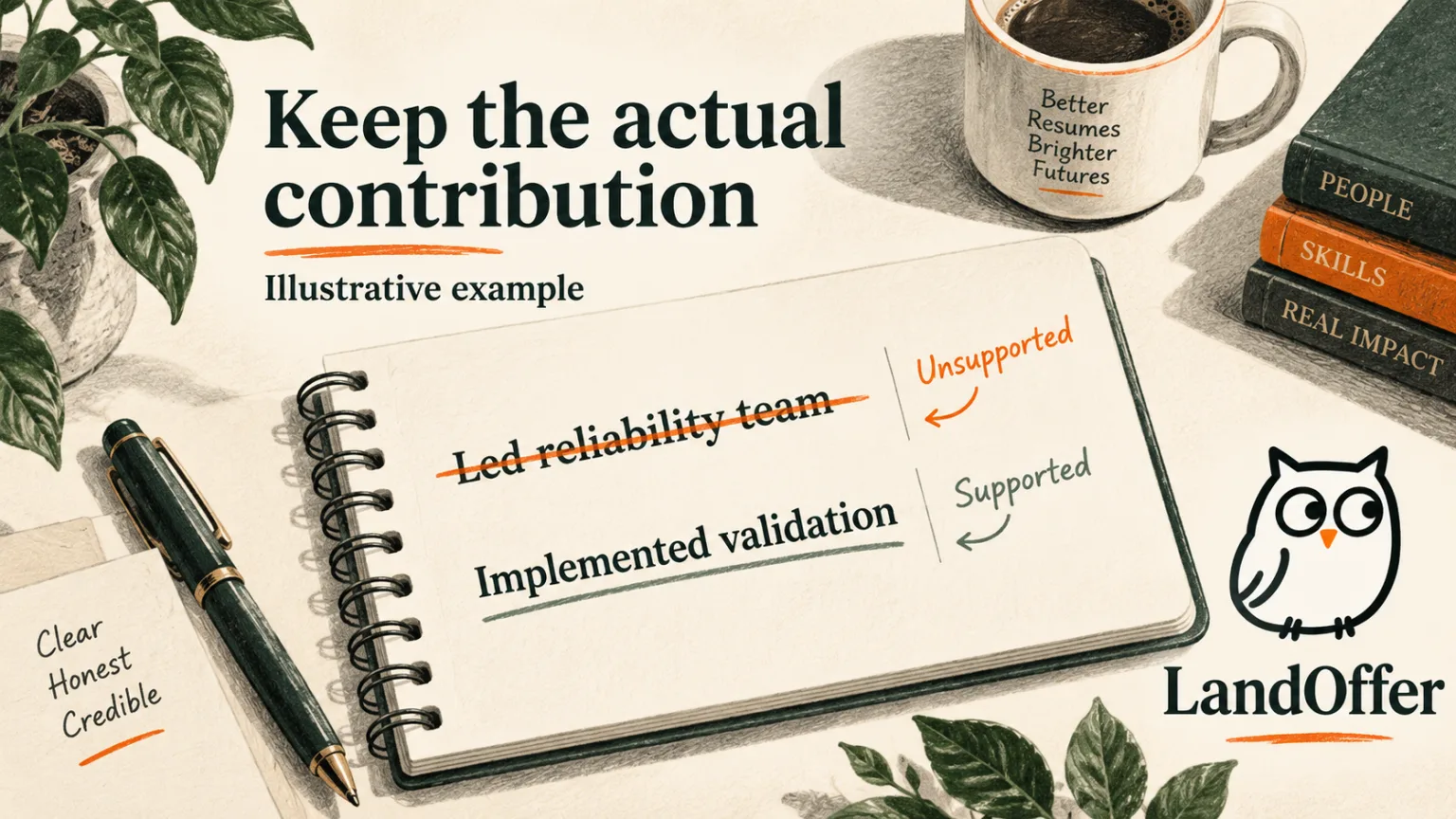
Check small words as carefully as numbers. “Led” assigns responsibility; “redesigned” expands the work; “across production” changes the environment. In this example the problem is not merely whether 40% is plausible. Even without the number, the draft would still overstate Nora's role and result.
Treat an unknown claim differently from a contradicted one. Nora knows the product-use claim is false. Customer volume is unsupported by her references. Both leave this answer, but for different reasons. If a company fact is essential to your argument, find a current source. If it contributes only generic admiration, removing it may make the answer clearer.
Check question coverage, then write a complete corrected answer
An answer can contain only true statements and still fail to address the prompt. Nora's original draft never explains how she found the error or what she would change next time. Factual repair and question coverage therefore need separate checks. Map each requested part to an identifiable passage, not to the overall feeling that the answer sounds relevant.
| Question part | Original draft | Resolved coverage |
|---|---|---|
| Why this backend role? | Generic praise plus untrue product use | Connect Go API and debugging responsibilities to Nora's interest. |
| A time you found and corrected an error | Unsupported outcome; no diagnostic sequence | Explain duplicate-ID test, missing check, correction, and review. |
| What would you do differently? | Absent | Identify boundary-case planning before implementation. |
Using the references above, Nora's full corrected answer is:
I am interested in this backend role because the posting combines Go HTTP API work with investigating errors and collaborating on fixes. During my internship, I found that I enjoyed tracing an unexpected request through the validation path and making the behavior easier to check. I would like to contribute to that kind of work at Cedar Queue.
At Stonefield Software, I implemented a Go request validator. While testing it, I found that a repeated request ID was accepted when our requirements called for rejecting it. I reproduced the behavior with a focused test and traced it to a missing duplicate-ID check. I added that check and tests for duplicate and missing IDs, then asked a teammate to review the expected behavior and implementation. The tests confirmed that these cases were rejected after the change; my teammate handled integration.
Next time, I would list boundary cases against the requirements before implementing the validator and discuss unclear cases with a teammate earlier. That would give me a clearer checklist for review. This experience strengthened my interest in backend work where a small, explicit check can make behavior easier to understand and maintain.
The corrected answer covers motivation, discovery, action, bounded result, collaboration, and a concrete change for next time. It stays within the fictional limit without a company superlative or invented measurement. It does not establish how Cedar Queue would score it or predict a hiring result. Nora finishes with an answer she can explain consistently from her own experience.
Separate facts, interpretation, and motivation
Facts describe what happened or what an official source says. Interpretation connects those facts: Nora's validation work is relevant to the posting's debugging responsibilities. Motivation describes her own interest in that work. These categories can coexist in one paragraph, provided their wording does not make an inference sound like inside knowledge.
Compare “Your team values careful review” with “I am interested in the collaboration described in the posting.” The second names its basis. Likewise, “I learned to plan boundary cases earlier” is a personal reflection, while “this method prevents defects” makes a wider claim requiring different evidence. Keep the lesson tied to your actual experience.
Check emotional claims too. “I have always dreamed of joining” or “I am passionate about your mission” may be generated embellishments rather than your view. You can express interest through a task, product aspect, or public problem that you genuinely want to work on. Plain motivation is easier to sustain in a later conversation than exaggerated enthusiasm you do not share.
Use another editing pass without reopening settled facts
If assistance is permitted, give the tool the corrected facts and ask for a limited task: “Suggest clearer wording using only these facts. Preserve my role and result. Flag gaps separately; do not add company claims, numbers, or experiences.” This narrows the instruction but does not verify the output. Compare every proposed revision with the approved version again.
Read the answer aloud and check whether you can explain each sentence without discovering a claim you did not intend. Harvard's guidance specifically recommends knowing your material and checking authenticity. Voice editing should preserve the concrete discovery and decision, rather than replace them with impressive abstractions.
Use the last pass to check instruction compliance, factual accuracy, question coverage, and your ability to discuss the answer. A plain account you recognize is easier to stand behind than polished wording that introduces unfamiliar claims. College Board's application guidance allows that AI can help with formatting or proofreading, while warning that misrepresenting generated experience may disqualify an applicant. That statement concerns its process; it does not establish a detector or a rule for every employer.
Verify the text that will actually be sent
Review the final application field after pasting. Confirm that the complete answer survived the transfer, meets the displayed limit, and remains attached to the correct question and role. If you shortened it, rerun the coverage check: cutting the final paragraph might remove the entire next-time answer. Keep the exact final text with your application record when you choose to submit.
If a statement remains uncertain, narrow it to what you can establish or remove it. If you cannot supply a truthful example, choose another experience or answer honestly within the question's instructions. A polished substitute does not create evidence. Seek a career adviser or trusted reviewer when the distinction between your role and a team's result remains unclear.
For your next application, browse recent roles on LandOffer, select a relevant employer question, and make two passes: resolve each candidate and company claim, then match the corrected answer to every requested part. Finish with the exact text you intend the employer to read.
Sources and Further Reading
- Harvard: AI for resumes and cover letters — official career guidance on suggested edits, accuracy, voice, and privacy.
- Oxford: AI in job applications and assessments — employer-specific instructions, authenticity, and source checking.
- IBM: Application steps and candidate AI policy — one employer's distinction between permitted editing and restricted uses.
- College Board: AI in application materials — one employer's expectation that experience and voice remain authentic.