LandOffer
Job search
ResumeUp.AI Review: Resume Checks, Autofill, and Practice Tools in One Plan
Buy recurring access for the actual paid operation, not the suite feature count; keep vendor test claims and inconsistent automation descriptions bounded.
ResumeUp.AI is most interesting when several parts of your search need attention: resume writing, document checks, application organization and interview practice. Its public free tier already includes more than an editor, so paying simply to collect the full feature list is a weak reason to upgrade. Identify the operation you need and whether your account requires payment for it. Also keep the provider's ATS tests and scores in perspective: they are vendor descriptions, not our employer-side validation or a prediction of an interview.
This review examines official public pages checked October 13, 2026. We inspected the browser pricing page, but its embedded plan table did not expose usable prices in our session; we did not sign in, install the extension, upload a resume or run a mock interview. The examples are fictional. LandOffer publishes this review and offers job-search tools; recent roles on LandOffer.ai can provide a target for whichever preparation tools you choose.

Buy access for a task you will actually repeat
The homepage's free-tier explanation lists twenty AI credits, basic templates, LinkedIn optimization, an unlimited application tracker, a free Chrome extension and two to three mock sessions without a credit charge. It distinguishes AI writing consumption from tracking and autofill. These are public allowances, not counters we verified in an account; an exact credit cost for each operation was not established.
That distinction changes the purchasing question. Someone who mainly needs a tracker may not need paid AI writing. Someone who has already finished a good resume may benefit more from a few practice sessions than repeated rewrites. The shared workspace is useful when it helps you finish a task that is currently difficult to manage.
The same homepage advertises a $29 monthly plan in its FAQ. The standalone pricing page loaded an embedded pricing area without readable plan cards in our browser. The homepage supports a $29 monthly reference. We did not verify a checkout total, annual charge or account-specific discount. Paid scan, interview and export entitlements should come from the current offer you can inspect before purchase.
You can still make a useful decision with that limitation. Start with the documented free tasks that match your needs. If your actual work reaches a limit, identify the restricted operation and compare the visible upgrade with the remaining work. An unavailable price table is a reason to narrow a budget recommendation, not to fill in a familiar subscription amount from an older review.
A completed suite-purchasing decision
Reese is a fictional data engineer with one usable resume, a spreadsheet of seven roles and an upcoming interview about data validation. They are considering ResumeUp.AI because keeping several tools open feels fragmented. Their immediate need is practice and one resume review, rather than generating a new document for every posting.
The following decision record uses public allowances but does not describe a signed-in product test. Reese's chosen actions and exclusions are complete; actual account access remains to be checked.
| Reese's task | Relevant documented tool | Completed decision |
|---|---|---|
| Review the existing resume against one role | Resume checker | Use the feedback to identify specific changes; retain the source document |
| Rehearse a data-quality explanation | AI mock interview | Try the free practice allowance before buying further sessions |
| Store seven role records | Application tracker | Keep the spreadsheet until the seven records, notes and next actions are recoverable in the new workspace |
| Rewrite every bullet repeatedly | AI writing credits | Do not spend credits on already accurate wording merely to use the feature |
| Fill an unfamiliar employer form | Chrome extension | Evaluate separately when that form is relevant; do not purchase solely on a coverage headline |
Reese decides against paying immediately. The documented free tasks are sufficient for their initial evaluation, and the current paid entitlement table was not available to this review. That is a specific choice for a limited workload, not a claim that the free tier suits every search.
If Reese later needs frequent tailored writing, the credit allowance can become a real boundary. At that point, a paid plan may be reasonable if its visible terms cover that work. The reason to upgrade would be a repeated writing requirement, not the number of tools advertised on the homepage.
Resume checks should lead to defensible edits
The resume checker page describes a score out of one hundred and checks spanning document structure, job-description alignment, grammar and recruiter readability. Its upload control accepts PDF or DOCX up to ten megabytes. It also describes AI corrections within the workflow. We did not upload a file or examine a resulting report.
The provider names Workday, Greenhouse, Lever, iCIMS and Taleo in its testing claims. That is useful information about what the company says it evaluates. It does not establish our independent test result, every employer's configuration or a universal passing threshold. The checker FAQ itself qualifies the score as no guarantee of an ATS pass or interview.
For Reese, useful feedback would identify a missing explanation of a real validation task. A suggestion to add a technology they have never used would be a different kind of finding. The first may improve communication; the second cannot create evidence. A larger score should not settle the choice between them.
Reese's assumed project notes say they compared daily shipment records with a source manifest, found duplicate identifiers and documented the correction with an analyst. They did not design the warehouse or own a production streaming system. Their reviewed resume sentence is:
Compared daily shipment records with source manifests, flagged duplicate identifiers and documented corrections with an analyst before the reporting handoff.
This is an authored example, not output captured from ResumeUp.AI. It identifies the records, check and handoff without adding unsupported architecture. If a checker recommends “streaming” because the target role uses that word, Reese leaves it out unless their real work supports it.
Use a checker report as a list of hypotheses to inspect. Correct an actual misspelling, clarify a real contribution and remove a broken link. Keep a copy of the original wording so you can review what changed. The separate ATS score guide explains why tool scores and employer decisions should remain distinct.
Autofill has its own evidence boundary
The autofill page describes a Chrome extension that reads a saved profile and selected resume, maps information into forms and can add a job to the tracker. It names several supported boards and systems, including Greenhouse, Lever and Workday. These are documented capabilities; no extension or employer form was tested for this review.
The page also mixes autofill with broader auto-apply and submission language. Meanwhile, the homepage labels auto-apply as coming soon while other copy describes submission on the user's behalf. Those public descriptions do not establish one reliable final-submission rule across the product. We would not recommend granting unattended application authority based on that wording alone.
Treat the extension's actual controls as a separate evaluation. Identify which resume is selected, what action fills fields and what action submits the employer application. If those controls are unclear, complete the application manually. Keeping this boundary explicit is more useful than assuming either universal automation or universal final-click confirmation.
A saved tracker entry also answers a different question from an employer receipt. The feature can help keep a role visible in your workspace; the employer's confirmation tells you whether the actual submission completed. You need both when maintaining a faithful search history.
Keep the same contribution consistent through practice
The mock-interview page describes questions based on a resume and job description, answer evaluation and follow-up questions. This can be useful for practicing how you explain your contribution. It is not proof that the questions predict a particular employer's interview or that a practice score measures future hiring performance.
Reese uses the shipment-record example to prepare an answer to an invented question: “How did you check whether the data was reliable?” Their first answer is vague: “I ensured data quality and worked with the business.” The completed revision says:
I compared the daily shipment records with the source manifest before the reporting handoff. Duplicate identifiers made the row totals look plausible while hiding repeated shipments. I flagged the duplicates, reviewed the affected records with an analyst and documented the corrections. My responsibility was the comparison and handoff record, rather than redesigning the warehouse.
The answer explains a problem that a row count alone could miss. It also makes the role boundary audible. Reese can rehearse it in a mock session or with a colleague, but should adapt it to the actual question rather than memorize it as a universal answer.
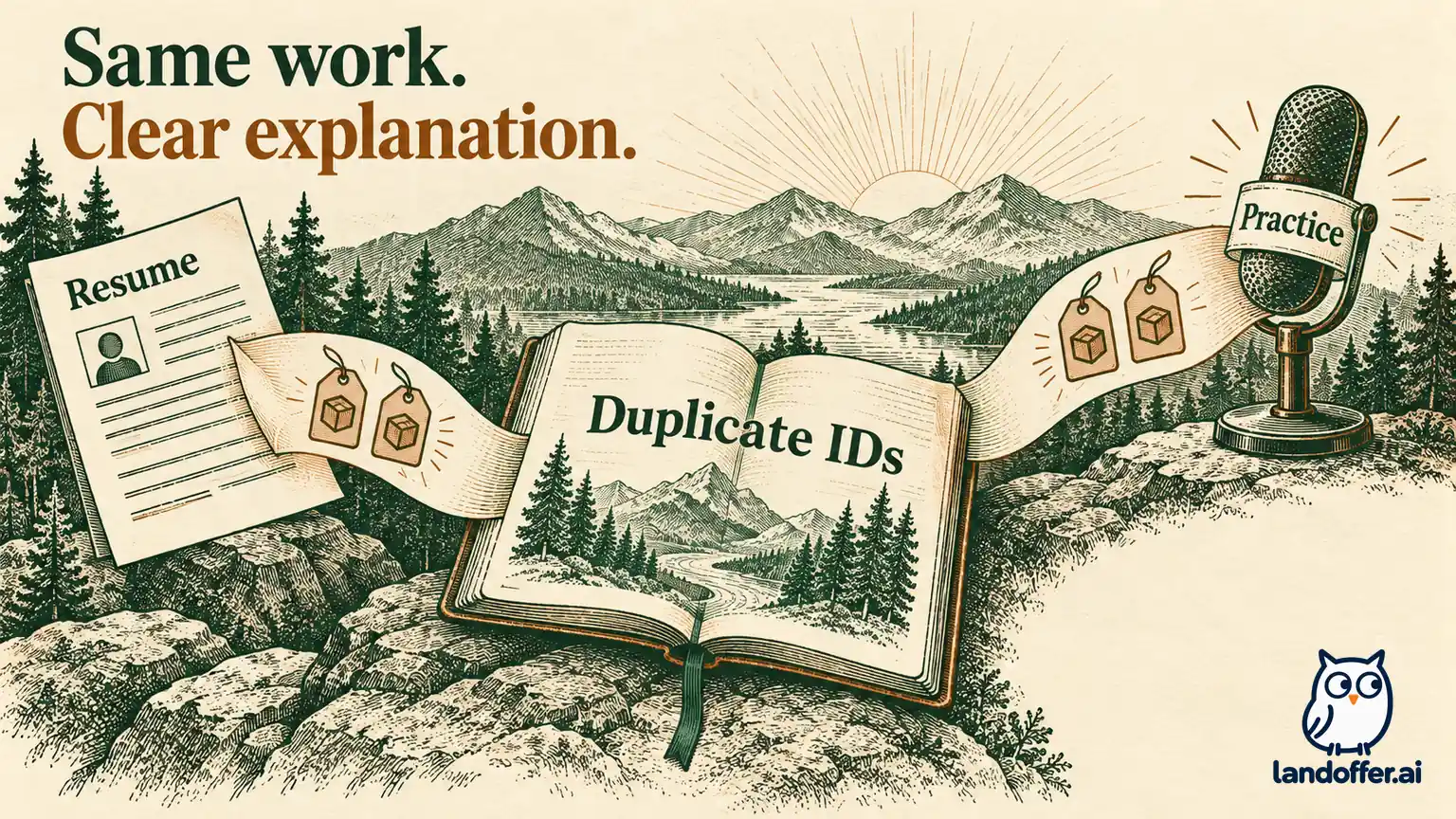
The completed consistency review below joins writing, reusable information and practice. All content is fictional; it is not a set of observed product outputs.
| Surface | Reese's approved content | Rejected expansion |
|---|---|---|
| Resume | Shipment comparison, duplicate identifiers, analyst handoff | Ownership of the warehouse architecture |
| Reusable profile | Same title, dates and supported tools as the source history | Copying every technology from the target posting |
| Employer answer | Explain the comparison and correction | Claiming a measured business improvement without records |
| Practice response | Describe why the check mattered and what Reese did | Presenting the analyst's judgment as solely Reese's work |
Reese finishes with one consistent explanation that can survive follow-up questions. Reese can now answer a follow-up about the duplicate identifiers without switching to a different, inflated version of the work. The suite's potential convenience lies in keeping relevant material nearby; the candidate still has to resolve contradictory content.
Export and billing details still matter in a bundle
The homepage describes PDF, DOCX and shareable-link outputs. Those are different delivery formats, and we did not establish which are available in every current plan. For an employer requiring Word, confirm the actual DOCX entitlement and inspect that file. For a PDF attachment, reopen the saved document after the last edit rather than relying only on the preview.
Keep source notes, the reviewed target wording and the exact delivered attachment independently. A future change to the profile or shared resume should not make it difficult to identify what you actually submitted. This matters even more when several tools reuse the same material.
The refund policy, updated June 9, 2026, provides a twenty-four-hour request window with exclusions. It says a completed, successfully downloaded resume may affect eligibility and distinguishes approval from the time the money appears in the account. That is a narrower arrangement than an unconditional refund after prolonged use.
Do not buy a subscription merely to see whether you like the full workflow and assume a later refund is assured. Use the free allowance first, inspect the actual paid offer and record the billing period if you upgrade. Cancellation language does not by itself establish a refund of an earlier charge.
Who should try the suite
ResumeUp.AI is plausible when resume revision, role records and practice are all active needs, and its free allowance offers a concrete starting point. It is less compelling when a working editor and tracker already solve your main tasks. If your requirement is verified employer-side automation or a fully established paid entitlement matrix, this public review does not supply that evidence.
Select one relevant posting from LandOffer's recent roles, identify the single task currently slowing your preparation and try the documented free tool for that task. Upgrade only if that task reaches a limit and the current offer clearly includes the access you need. Keep the resume, profile and spoken explanation consistent with the work you can actually defend.
Sources and Further Reading
- ResumeUp.AI homepage: free allowances, advertised monthly reference, export descriptions and conflicting auto-apply wording, checked October 13, 2026.
- ResumeUp.AI pricing: browser visit recorded; embedded plan prices were not readable in our session.
- ATS resume checker: documented checks, upload limits and score qualifications; no independent ATS test performed.
- Autofill job applications: selected-resume, form-filling and tracking descriptions; no extension installed.
- AI mock interview: role-based questions and feedback descriptions; no practice session run.
- Refund policy: June 9, 2026 notice with request window and exclusions.