 LandOffer
Job search
How to Add Resume Keywords Naturally and Keep Every Claim Defensible
A useful keyword identifies explainable work; evidence controls inclusion and readable context controls placement.

Add resume keywords where they name relevant work you can explain accurately. Choose terms from the job's actual responsibilities, connect each one to evidence, and place it in a readable skills entry or contribution statement. Leave unsupported technologies and responsibilities out. The goal is to make relevant experience recognizable without turning the resume into a copy of the posting.
Use a specific role, perhaps from LandOffer's recent jobs, to decide which terminology matters. LandOffer publishes this guide. Official sources were checked on October 8, 2026. The project and candidate examples are fictional editorial demonstrations, not output from a tested resume service, a recipe for an ATS pass, or a claim about interview results.
Choose words that describe the work, not everything on the page
A description contains several kinds of language: technologies, responsibilities, qualifications, company values, and promotional wording. Extract the terms that help explain what the employee will do. For a data-oriented role, SQL queries, data validation, and reporting may be central. Words such as “dynamic,” “world-class,” or “fast-paced” usually add less information about your contribution.
Read a requested tool in context. “Maintain PostgreSQL reporting queries” describes different work from “operate a highly available PostgreSQL cluster.” Both contain the same product name, but the responsibility differs. Naming PostgreSQL in a skills list does not establish either level of responsibility. Your experience statement should make the context clear enough for a reader to distinguish them.
MIT's career-writing overview describes resumes as fact-based documents and recommends tailoring them to the job. Apply that principle at the word level: use the employer's terminology when it accurately identifies your work, while preserving your own scope and history. Relevance begins with evidence, then wording.
Prioritize a small set of important terms over every phrase a scanner flags. A repeated database requirement deserves investigation. A missing company slogan usually does not deserve a new sentence in your summary. If a report fails to distinguish central requirements from incidental language, use the job's responsibilities to make that distinction yourself.
Create a keyword ledger with an inclusion decision
Consider Luis, a fictional early-career candidate applying for a Data Analyst role. The description emphasizes Python, SQL, pandas, data validation, and Tableau. Luis's personal project imports public CSV records, normalizes dates with pandas, checks duplicate identifiers, stores results in SQLite, and uses SQL joins for a local report. He presents the results in Streamlit and has never used Tableau.
| Requested term | Luis's actual evidence | Decision and placement |
|---|---|---|
| Python | Wrote the local import and validation script | Include in Skills and the project contribution. |
| SQL | Used joins to combine cleaned records with category data in SQLite | Include, with a bullet explaining the query task. |
| pandas | Used it to normalize dates and check duplicate identifiers | Name it beside the relevant Python work. |
| Data validation | Checked date formats and duplicate identifiers before loading | Describe those checks rather than repeating the abstract phrase alone. |
| Tableau | No use in this or another project | Leave out; identify a genuine tool gap. |
This ledger gives Luis four supported terms to express and one requirement he cannot claim. It does not establish the employer's willingness to accept Streamlit experience instead of Tableau. He can evaluate whether Tableau is required or preferred, but swapping the product name would misdescribe the project rather than improve its relevance.
Keep the evidence column concrete. “I probably know this” is too weak for a professional claim. A project note, an implementation you remember, a course assignment, or an accurate account of employment work gives you something to explain. Preserve the setting: a local exercise, a personal project, and an employer's production service are different contexts.
Use the ledger privately as an editing aid. You generally do not need to attach a separate proof packet to the application. Its purpose is to make your resume choices deliberate and to prepare you to answer ordinary follow-up questions. Confidential source material should remain protected; a truthful description need not disclose private datasets or internal documents.
Turn a keyword list into a defensible contribution
Luis's original project bullet says:
Worked on data with Python and made reports.
It names Python but hides the data work. An unsupported keyword-heavy rewrite might say:
Expert in Python, SQL, pandas, ETL, Tableau, analytics, automation, and scalable production data pipelines.
That sentence adds unsupported tools and scope. It also removes the actual task. A reader cannot tell what Luis built, how he used the technologies, or why the work belongs on this application. More vocabulary has made the account less informative.
A defensible editorial revision, using only the project facts above, is:
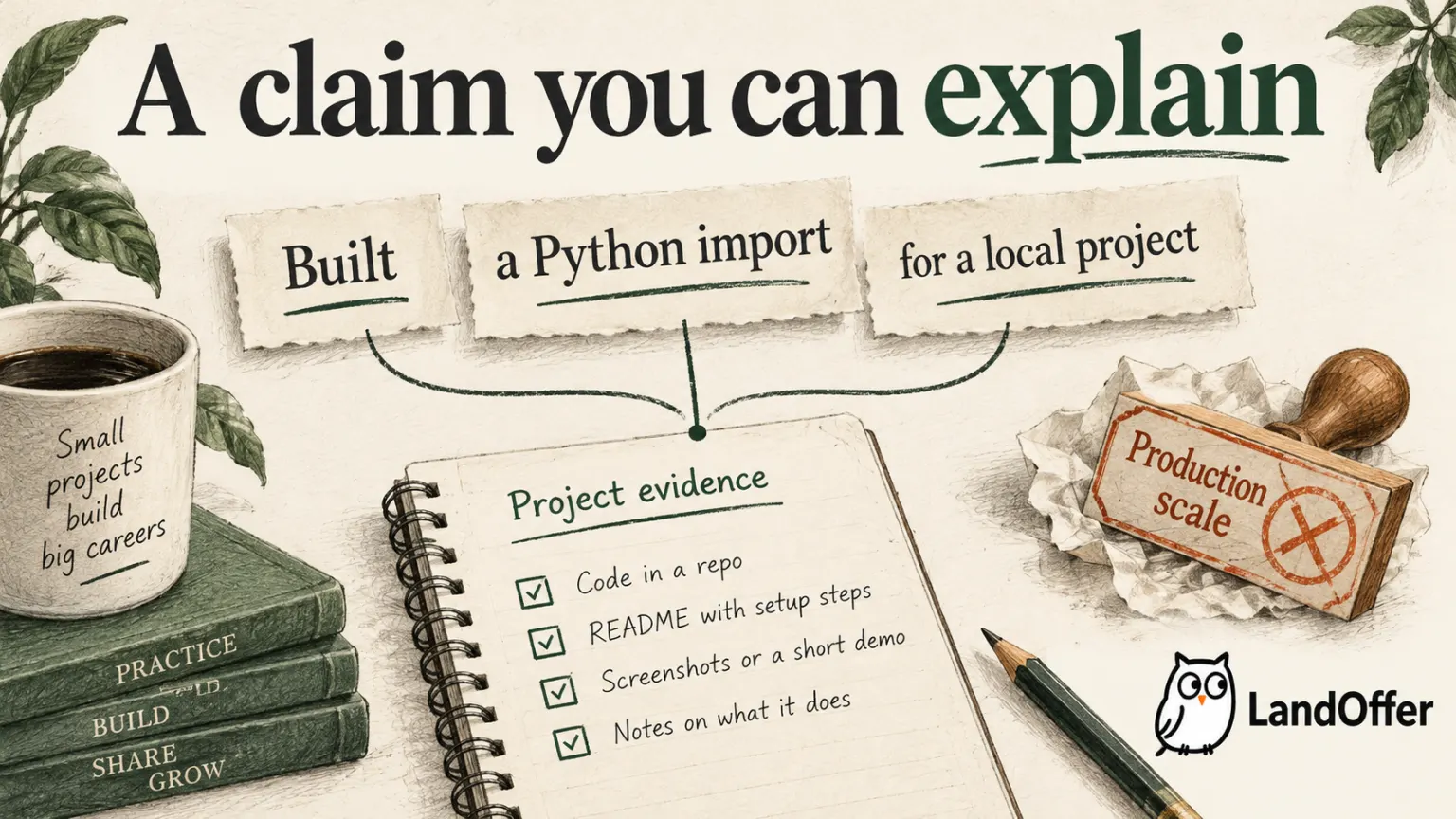
Built a local Python import using pandas to normalize dates and check duplicate identifiers before loading public CSV records into SQLite.
A second bullet can cover a different contribution:
Used SQL joins to combine cleaned records with category data and presented the resulting report in a Streamlit app.
The two bullets communicate tools through work. They preserve the local setting, identify the data, and explain the check and output. They do not claim production deployment, business revenue, or a measured speed improvement. They also avoid forcing every relevant term into one crowded sentence.
Luis can list “Python, SQL, pandas, SQLite, Streamlit” in Skills if that reflects his actual capabilities. The project bullets provide context for that list. Repeating a term in a concise skills entry and an evidence-bearing bullet can be natural; repeating it in every bullet merely to increase frequency usually makes the writing harder to follow.
Use exact names and expanded terms when they clarify
Spell product and library names accurately. Python, pandas, PostgreSQL, and SQLite identify different things; a requested PostgreSQL skill is not automatically established by using SQLite. You may have transferable SQL experience, but describe the actual database and let the reader assess that connection. Avoid renaming a tool to match the description.
An abbreviation can be paired with its expanded form when useful. If Luis's actual workflow extracts records, transforms them, and loads them into SQLite, he could describe a “local extract-transform-load (ETL) workflow” and then state the steps. That is defensible because the process fits the term. It still does not establish orchestration, cloud infrastructure, or production reliability.
Be careful when a familiar acronym carries several meanings. Use the form that identifies your real work instead of adding every expansion. A reader should be able to understand the sentence without consulting the job posting. If the keyword only works as a loose label detached from the task, either explain it or leave it out.
Jobscan's keyword-help guidance says hard skills and job titles influence its match rate and recommends attending to term frequency. That is vendor advice about its report. It does not justify changing an official title or adding unsupported expertise. Use terminology to clarify evidence, with accuracy taking priority over a recommendation to raise a number.
Show responsibilities through actions and scope
Responsibility words deserve evidence too. “Leadership,” “stakeholder communication,” “ownership,” and “cross-functional” can make stronger claims than a tool name. If you coordinated a project, explain what you coordinated and who made the decisions. If you attended meetings, do not convert attendance into leading a team.
For example, a candidate who gathered reporting requirements from two colleagues might write “Clarified report requirements with finance and operations colleagues before implementing the query.” That explains communication without claiming ownership of both departments. A candidate who only received the specification should describe the implementation work instead. Both can be useful; the appropriate wording depends on the contribution.
Distinguish a team outcome from your role in it. If the team launched a dashboard, explain the component you built or the checks you performed. “Built the filter controls for the team's dashboard” may be more accurate than “Delivered the analytics platform.” A narrow contribution with clear detail often gives an interviewer a better starting point than a broad phrase with uncertain ownership.
Results also need a basis. Include a measured reduction or count when you can explain where it came from and what it covers. When you cannot, describe the completed function, verified behavior, or scope. Luis can describe duplicate-ID checks without inventing a percentage reduction in errors. Specificity can come from the task itself.
Review missing-keyword feedback without accepting every suggestion
A missing term can indicate hidden evidence, a spelling mismatch, a parsing problem, or an actual gap. Investigate before editing. If the resume says “database queries” and you used SQL, naming SQL can clarify existing work. If the report asks for a framework you never used, the correct result of the check may be to keep that term absent.
Simplify's Keywords Score guide describes comparing one resume with one job description and showing matched and missing terms. Teal's tailoring guide likewise distinguishes existing content from skills the candidate does not have. Those documented distinctions support reviewing a gap; they do not establish that a suggested rewrite is factually correct.
When using AI, provide the actual project facts and ask it to flag unsupported suggestions separately. Read the output for changes in tool, scale, setting, role, and result. A model may preserve the main story while adding “production,” “led,” or “expert” as apparently harmless polish. Each of those words can change what you are claiming.
If a suggested keyword remains unsupported, evaluate its importance in the posting. A required Tableau skill may make Luis's target role less suitable. A preferred Tableau skill might leave room for a candidate with strong relevant evidence in other areas. The resume should communicate that evidence honestly; it cannot decide or guarantee the employer's trade-off.
Keep the document readable and the text visible
Place important terms in ordinary visible text, in sections where they belong. Do not hide a copied description, use white text to conceal a keyword block, or add a disconnected list of tools you cannot explain. These tactics produce an inaccurate or unreadable document and give you no dependable basis for assessing how an employer will process it.
Check the exported file rather than only the editor view. Select or extract the text if possible and read it in order; inspect headings, symbols, and dates. When an application displays imported fields, verify them individually. Greenhouse's parsing documentation lists formats that can cause failure or partial imports. No independent keyword report proves that every employer's system will read the document correctly.
Ask a reviewer to explain your project after reading the two bullets. If they can name what you built, which tools you used, and what you checked, the keywords are serving the writing. If they can only recite a technology list, revise the task description before adding more terms. Human readability and defensible context remain useful checks even when a score looks favorable.
Finish with a claim-by-claim audit
For each material keyword, ask: Where did I use it? What did I personally do? What setting and scope does this wording imply? What result can I support? You can protect private implementation details while explaining your task, contribution and result consistently.
Luis's final audit retains Python, SQL, pandas, SQLite, and Streamlit; it keeps the two project bullets above. It excludes Tableau and production-scale claims. The outcome is a readable account of a relevant local project with an honest remaining gap. We do not assign it a fictional score increase or claim it passed an employer's screening.
For your next resume edit, choose one description, build the inclusion ledger, and add only words that make supported work clearer. Find a starting role on LandOffer, then open the employer's description and connect its important terms to your actual experience. Keep the version you submit so that every later explanation starts from the same claims.
Sources and Further Reading
- MIT career-writing overview — factual resumes and tailoring.
- Jobscan: Improving a match rate — vendor-specific keyword advice, bounded by truthful claims.
- Simplify: Keywords Score — matched and missing terms for one description.
- Teal: Resume tailoring — existing content versus genuine gaps.
- Greenhouse: Resume parsing — file and imported-field limitations.