LandOffer
Job search
How to Respond to a Recruiter When You Need the Role Details Before a Call
Verify the contact, ask for the details that determine fit, and choose whether to schedule, clarify, or decline.
You can respond positively to a recruiter without agreeing to a call before you understand the role. After verifying the contact, thank them, state your level of interest, ask for the few details that determine fit, and explain the next step. If a known requirement already conflicts with your search, decline plainly. If the role appears suitable, use the call to investigate the remaining questions rather than repeat information a job description could provide.
LandOffer publishes this guide for tech candidates. We checked current public career guidance and identity-verification sources on October 14, 2026. We did not inspect a real recruiter thread or send any reply. All messages, candidates, job descriptions, and decisions below are fictional worked examples. Browse recent roles on LandOffer.ai to compare an approach with the kind of work you actually want.

Verify the contact before discussing the opportunity
An official-looking message does not establish that the sender represents the employer. The FTC's July 2025 recruiter-scam alert describes impersonation messages that include plausible duties and benefits, then press for sensitive information before an interview. Check the sender and the claimed company rather than treating a polished invitation as verification.
When the identity is uncertain, independently find the company's or agency's contact information and confirm the approach through that route. The FTC recommends using contact information you know is legitimate, not merely the number or address provided by the person contacting you. A website's existence alone is insufficient.
This is a verification step, not an accusation that every unsolicited recruiter is fraudulent. A genuine external recruiter may represent a client rather than use the client's email domain. Confirm which organization the person works for and how that organization relates to the opportunity.
Do not send bank details, a Social Security number, identity-document images, or payment to obtain basic role information. If the approach requires those items before the role and contact are established, pause the conversation and verify independently. This guide's reply examples begin after that identity question has been reasonably resolved.
Ask for the information that would change your decision
Before an introductory call, establish whether the work and arrangement fit. A software, data, or security title alone may leave both unclear.
| Detail | A useful early question | Decision it supports |
|---|---|---|
| Team and work | Which team is hiring, and what would this person own? | Whether the work fits your experience and direction |
| Location | Is it remote, hybrid, or onsite, and which locations are eligible? | Whether you can meet the work arrangement |
| Employment arrangement | Is this direct employment or an agency/client assignment? | Which organization's terms to investigate |
| Compensation | What is the budgeted range and its pay unit? | Whether further discussion is plausible |
| Process | What would the first call cover, and what follows it? | How to prepare and allocate time |
Indeed's recruiter-question guide, updated June 15, 2026, recommends asking about duties, the recruiter's relationship with the hiring manager, compensation, and the interview process. Use those categories to prioritize your own questions; they are not proof that every recruiter knows every answer.
Select the gaps that matter in your situation. If the message already includes the team, location, and employment type, do not ask the recruiter to repeat them. If you can only consider remote work, location may be the first question. If you are open to different locations but only want product development, ownership and team scope matter more.
Ask for the description, then add the one or two unanswered points that determine fit. This lets the recruiter send existing information rather than complete a long questionnaire. Save architecture details, team practices, and a full benefits discussion for the appropriate later conversation when they do not determine whether to start.
Worked exchange: Leah needs the basics before scheduling
Leah is a fictional backend engineer seeking remote, direct-hire service-development roles. A verified recruiter sends: “We have a Senior Engineer opportunity that matches your background. Can you do a 30-minute call this week?” The message provides no team, duties, location arrangement, or employment type.
Leah's complete initial reply is:
Hi Alex, thanks for reaching out. I'm open to hearing about backend service-development roles. Before we schedule, could you send the job description and confirm the team, work location or remote requirements, and whether this is a direct-hire role or a contract assignment? If available, the budgeted compensation range would also help me assess the fit. Once I've reviewed those details, I can suggest times for a short call. Best, Leah
Leah shows interest, asks for a usable brief, and leaves scheduling until review. She neither apologizes for the question nor invents availability.
Now suppose the recruiter answers: “It is a six-month agency assignment on an incident-response team, with three onsite days each week.” This resolves three important unknowns and reveals a mismatch with Leah's stated search.
Her follow-through is:
Thanks, Alex. That clarifies the role. I'm currently focusing on remote, direct-hire backend development, so I won't pursue this hybrid incident-response contract. Please feel free to contact me if you have an opening aligned with that scope. I appreciate you sharing the details. Best, Leah
The result is a decision, not a booked call. Leah names the mismatch without criticizing the job, employer, or recruiter. She also gives specific future criteria instead of saying that she is available for “anything better.”
If Leah could consider fewer onsite days, she could clarify that requirement instead. Her decline follows her fictional constraints; use your own.
Worked brief: Owen is open to an assignment
Owen is a fictional platform engineer who can consider contract work. A verified agency recruiter describes a six-month infrastructure assignment, but the message mixes the client's name with the agency's and calls the opportunity “full-time.” Owen wants to establish who would employ or engage him and what the work actually involves.
His reply is:
Hi Priya, thank you for the overview. The infrastructure scope could be relevant to my platform experience. Could you confirm the employing or contracting organization, the client team, expected assignment duration and weekly hours, and whether the quoted range is hourly pay or annual salary? I'd also like to understand the work location requirements and whether on-call work is part of the assignment. With those basics, I can decide whether to arrange an introductory call. Best, Owen
These are questions, not assumptions about how every staffing engagement operates. “Full-time” might describe a schedule while leaving the duration and employment relationship unresolved. Owen asks for those terms directly rather than substituting an employee-benefits page from the client company.
Suppose the fictional recruiter provides the following brief:
| Field | Answer received | Owen's interpretation |
|---|---|---|
| Organization | Agency is the employer; work is for a named client team | Ask the agency about employment terms |
| Duration | Six months initially | Extension is not established |
| Schedule | Expected 40 hours weekly | Confirm approved hours and any variation |
| Pay | An hourly range | Do not treat it as annual salary |
| Location | Remote within specified US states | Compare the list with his location |
| Work | Infrastructure automation and incident support | Potentially relevant to his background |
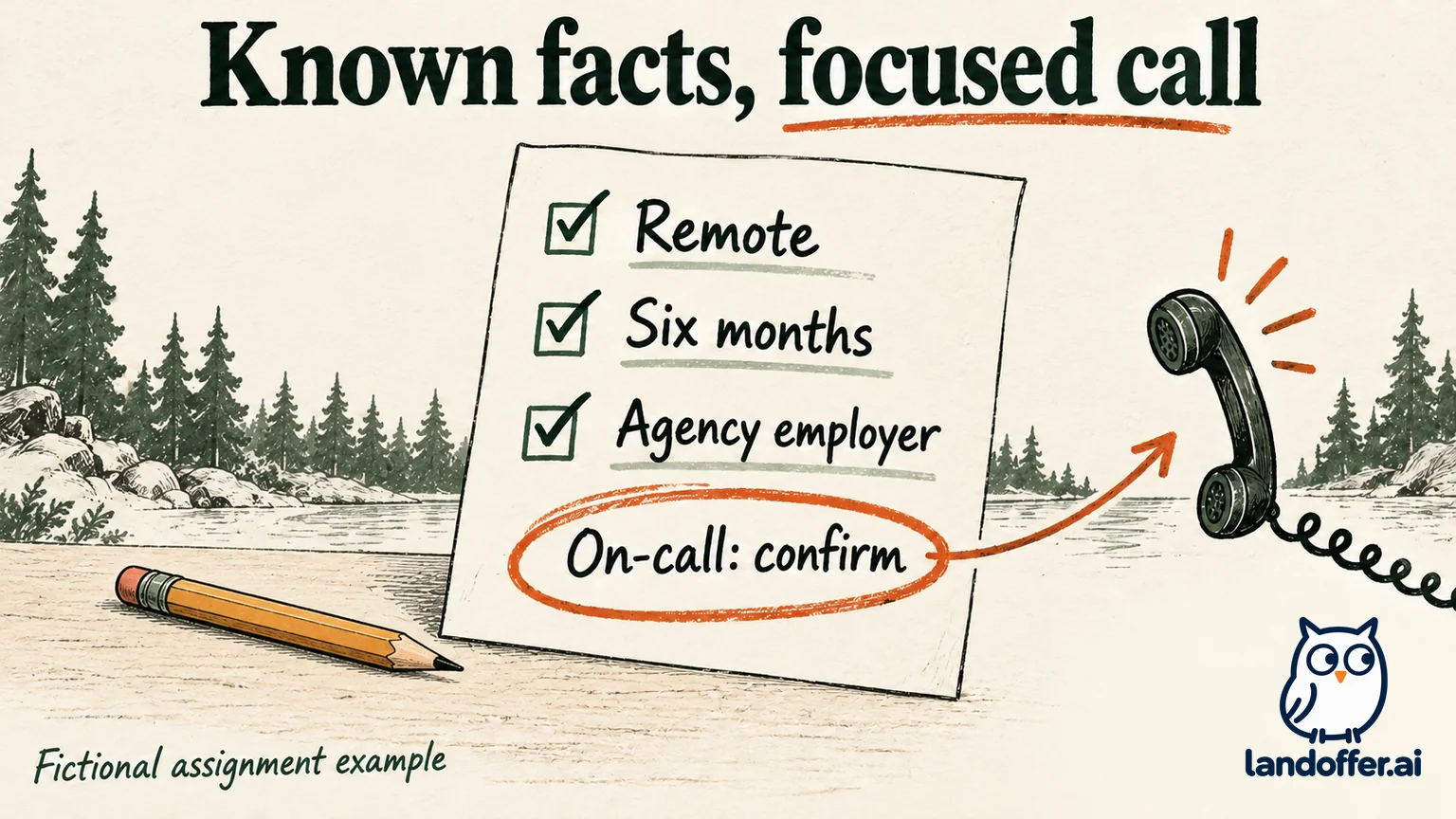
| On-call | Not yet confirmed | Keep as a question for the call |
Owen lives in an eligible state, accepts the initial duration, and is comfortable exploring incident support. Those facts make a call reasonable in this fictional case. He still needs to understand on-call expectations and the agency's benefits or leave terms; the initial brief is not a final offer.
His scheduling reply is:
Thanks, Priya. The initial duration, location, and infrastructure scope are compatible with what I'm considering. I'm available Tuesday, October 20, at 10:00 a.m. Pacific, or Wednesday, October 21, at 2:00 p.m. Pacific. Would either work for a 20-minute introduction? I'd like to cover the day-to-day work, on-call expectations, and the agency's employment terms. Please confirm the meeting format and time zone. Best, Owen
We checked these fictional 2026 dates locally: the Tuesday option corresponds to 1:00 p.m. Eastern, and the Wednesday option to 5:00 p.m. Eastern. No appointment was booked. A real reply should use your own available dates and the time zone in the meeting invitation.
Match the wording to your actual interest
When you are interested and only one important detail is missing, say so. You do not need Leah's longer basic-information request if the recruiter already supplied a clear description.
Hi Morgan, thanks for sharing the description. The data-platform ownership looks relevant to my current work. Could you confirm which locations are eligible for the remote arrangement? If my location is included, I'd be glad to arrange a short introduction. Best, Casey
This version makes the gating question explicit. It does not imply that all details must be settled before the call. Once location fits, Casey can use the introduction to learn about the team and process.
When you are undecided because the work is unclear, explain the distinction you need resolved:
Hi Morgan, thank you for reaching out. I'm primarily exploring software development roles. Does this position own application code and delivery, or is the main responsibility customer implementation and support? A current description and the hiring team's name would help me decide whether a call makes sense. Best, Casey
The question is more useful than asking whether the role is “technical.” Both kinds of work can require technical skill, while their outputs and career fit differ. Casey identifies the distinction without dismissing either role.
When you are not exploring new opportunities, a brief answer can close the conversation:
Hi Morgan, thanks for thinking of me. I'm not considering a move at the moment, so I won't schedule an introductory call. I appreciate the outreach. Best, Casey
Only invite future contact if you want it. Only promise a referral if you have an appropriate person in mind and their permission. A brief decline is enough; keep private circumstances to yourself.
Handle partial answers without turning uncertainty into certainty
A recruiter may be able to provide location and pay information while still confirming team details. Identify what is known, what remains unknown, and whether the unanswered point prevents you from deciding. Then ask one focused follow-up rather than repeat the entire first message.
For example: “Thanks for confirming the location and arrangement. Before scheduling, could you clarify whether the team builds the service or primarily handles deployment support? That distinction determines whether it matches my search.” If the answer would change your decision, it is reasonable to wait for it.
If the remaining questions are exploratory, a short call may be the efficient next step. State its purpose and duration so both sides know what you are agreeing to. An introduction can establish scope; it does not need to imply commitment to an application or acceptance of representation.
Sometimes the client name is not disclosed immediately. You can ask what can be shared now, why the name is withheld, and when it will be disclosed. Decide whether the available information is enough for your own comfort. Do not describe confidentiality as proof of a scam, or treat it as a reason to abandon independent verification of the agency.
If asked for a résumé, share a relevant version only after you are comfortable with the identity and purpose. Clarify how it will be used when that matters to you. A request to discuss a role should not be mistaken for broad permission to submit your information to unnamed employers.
Use the call to resolve the next decision
Before a call, write down the facts already supplied and the remaining questions. Owen's call should explore on-call duties and employment terms rather than spend its first ten minutes rediscovering that the assignment is six months. Leah's mismatched opportunity does not need a call at all.
Afterward, record the answers on work, location, arrangement, and process. Use them to decide whether to proceed.
If you proceed, confirm who sends the description, whether to apply, and what the next conversation covers. If you decline, name the mismatch briefly.
The first reply should lead to one of three outcomes: enough information to schedule, one specific clarification still needed, or a clear decline. Verify the contact, ask for the decision-critical details, and state that next step. Explore LandOffer.ai to keep your target work and current role requirements in view when assessing recruiter approaches.