LandOffer
Product & Project Delivery
Turn Research Notes into Findings Without Counting Every Comment as a Vote
An original fictional museum-loan analysis follows ten notes into nine events, bounded findings, and a completed decision. Duplicate observers, repeated preferences, contradictory accounts, and unequal task exposure stay visible instead of becoming misleading votes.
Turn research notes into findings by preserving what happened, linking each observation to its source and context, and separating interpretation from the decision you recommend. Grouping comments can reveal patterns, but a large pile of notes is not a vote count. Repeated remarks from one person, duplicate observer notes, and unequal exposure to a task can all distort that pile.
This LandOffer.ai guide follows a fictional museum-loan tracking team through a completed analysis. It includes the observation trail, contradictory evidence, revised findings, and a bounded decision. Every participant, note, quote, and team exchange is authored teaching material. No interviews or usability sessions were conducted, and no real museum records were accessed.

Preserve the observation before naming the theme
“Users need more notifications” is already an interpretation. “P01 asked for an email when a shipment arrived” records a specific request. “P02 treated ‘Arrived’ as permission to prepare the object, although the condition check was pending” records a different problem with potentially different consequences.
The fictional service, Collection Relay, helps museum staff track objects arriving on loan. Its team is considering automatic arrival emails. Researcher Lena reviews notes from five fictional participant sessions with product owner Mateo and collections specialist June. Their question is what prevents staff from knowing whether an object can move to exhibit preparation.
Beside each note, they retain the participant code, task context, event identifier, and observer attribution. These are useful references, not proof that a sample represents all museum staff. Real records also need appropriate access, consent, retention, and anonymization practices; replacing names with codes does not automatically make sensitive material safe to circulate.
The original GDS account of research analysis in agile describes capturing what people say or do, identifying the participant, then grouping observations and recording insights and actions separately. That distinction prevents an analyst's explanation from quietly becoming the raw evidence.
Give each note a retrievable source before treating it as evidence for a finding. Preserve an unclear note as unclear until you can check its source. Do not polish a rough paraphrase into a supposed quotation, invent a missing action, or count a facilitator's suggestion as an independently expressed need.
Completed asset 1: the observation-to-finding trail
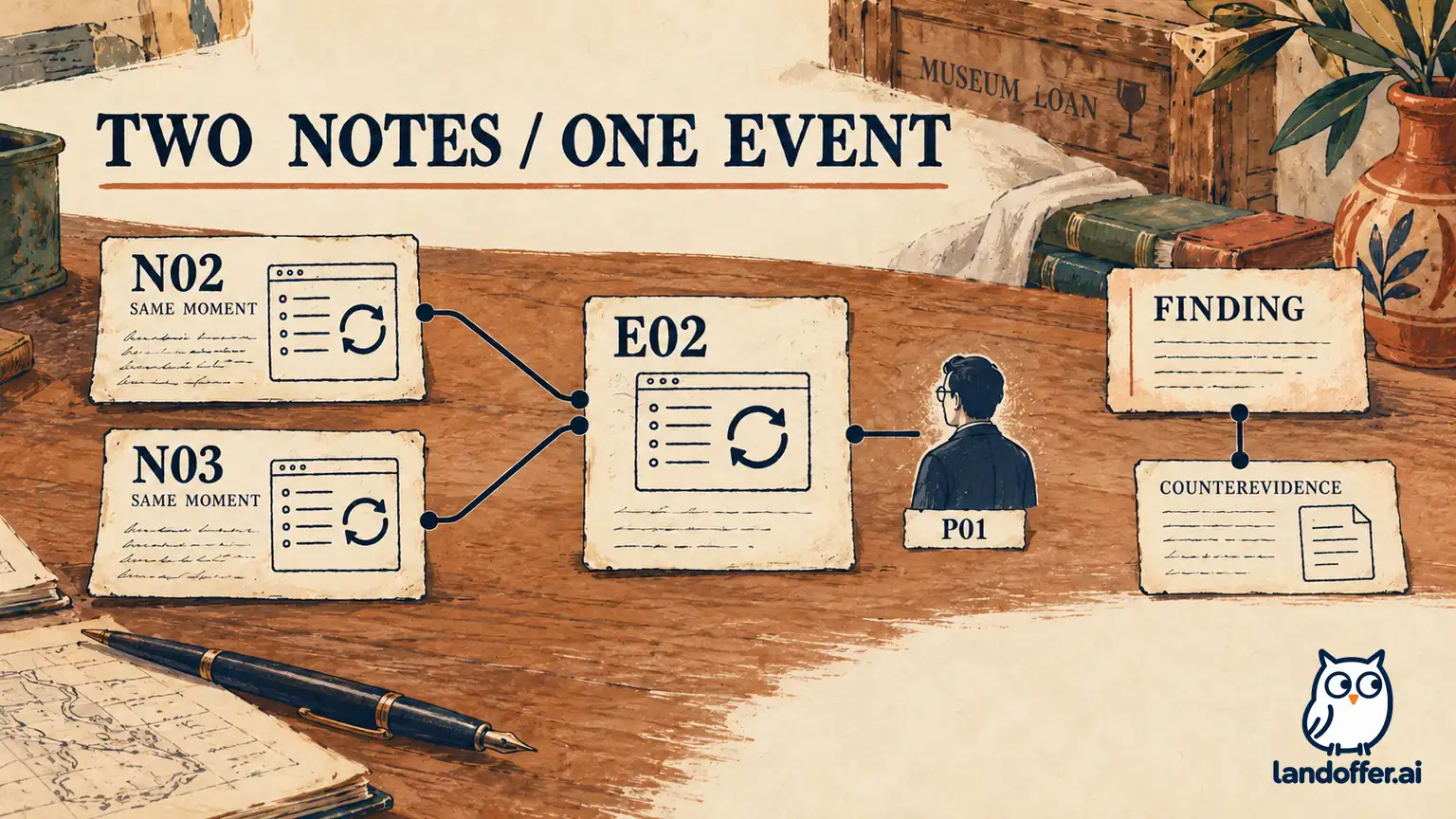
Lena's fictional packet contains ten raw notes describing nine distinct events. N02 and N03 are two observers’ records of the same E02 refresh action, so they add source corroboration without adding an event. The table retains both records while identifying their shared origin. Quotation marks below indicate authored dialogue within the example, not real participant quotations.
| Raw note and event | Participant and context | Authored observation | Treatment in analysis |
|---|---|---|---|
| N01 / E01 | P01, off-site loan coordinator | “Email me when it arrives.” | Channel preference; does not establish readiness requirements |
| N02 / E02 | P01, arrival-tracking task | Refreshes the shipment list twice | Observed checking behavior; reason not established by the action alone |
| N03 / E02 | P01, same moment, second observer | Also records the two refreshes | Duplicate source for E02; retain attribution, do not count another event |
| N04 / E03 | P01, follow-up discussion | “I need arrival updates without opening this page.” | Further explanation from the same person, not another participant supporting emails |
| N05 / E04 | P02, exhibit-preparation task | Reads “Arrived” as ready for preparation despite a pending condition check | Direct evidence of a status interpretation problem in this task |
| N06 / E05 | P03, on-site collections assistant | “Please don't send me more email.” | Contrasting channel preference; keep it visible |
| N07 / E06 | P03, exhibit-preparation task | Opens details and says, “Received isn't the same as cleared.” | Finds the distinction through details; useful context against a universal confusion claim |
| N08 / E07 | P04, same preparation task | Checks the condition record before deciding whether preparation can start | Counterexample: completes the readiness distinction |
| N09 / E08 | P04, follow-up discussion | “Physical condition has to be cleared first.” | Explanation consistent with E07, not a second independent person |
| N10 / E09 | P05, interrupted session | Session ends before the preparation-status task | No evidence about success, failure, or preference on that task |
There are five participants, but only P02, P03, and P04 reach the preparation-status task. P05's missing opportunity is neither success nor failure. P01's arrival-tracking task contributes context about checking for updates, not an observed attempt to judge preparation readiness.
Lena forms three provisional groups: obtaining arrival information, interpreting readiness, and notification preferences. A note may inform more than one group, but its identity stays attached. Moving N04 into two groups does not create two participants or two new events.
For the readiness group, the completed chain is N05/E04 → possible ambiguity between arrival and clearance → finding F01 → a design-and-research action. N07/E06 and N08/E07 constrain the finding: the distinction was discoverable or already understood by other staff. The team therefore rejects “Everyone thinks arrived means ready.”
F01 becomes: In this fictional preparation task, P02 treated the arrival label as readiness; P03 used details and P04 checked the condition record to establish clearance. The summary status may not communicate the prerequisite clearly enough for every role. The first sentence summarizes observations. “May not” marks the team's interpretation, which still needs investigation.
The Service Manual's analysis guidance similarly separates extracting observations, sorting them, determining findings, and deciding actions. Use affinity mapping to organize evidence, then write a finding that explains what the group supports. A topic label such as “notifications” does not yet tell the team what happened or what decision the evidence can inform.
Do not substitute note volume for importance
A presenter could put N01, N02, N03, and N04 under “more updates” and announce four votes for email. That would combine a duplicate, an observed action, and two statements from one person. It would also assume refreshing a list means wanting email rather than checking an unclear status or waiting for someone else's work.
Count carefully when counts answer a defined descriptive question. Here, four raw notes relate to P01's arrival-update discussion and behavior, covering three distinct events from one person. Only N01 explicitly asks for email. N06 records one different person's opposing preference. Those facts do not produce a defensible email demand score.
Do not turn P02’s one misinterpretation among three preparation-task attempts into a claim that one-third of users are confused. One of the three fictional people exposed to a particular task misinterprets the label, but their recruitment, roles, and task conditions do not establish a population rate. Reporting the observation with its denominator can clarify coverage; presenting it as prevalence would overstate the evidence.
Frequency is also different from consequence. N05 deserves attention because starting preparation before a required condition check could violate the intended workflow, even though it appears once in these authored records. June confirms that the prerequisite matters within the fictional service. That is a domain constraint, not evidence that harm actually occurred or that every museum follows the same process.
Keep unusual but relevant evidence in an exceptions area with a reason for retaining it. A visually small cluster may contain an important boundary. Do not let the size or color of a sticky-note group decide priority before the team considers context, consequence, uncertainty, and the actual decision.
Completed asset 2: resolve the conflicting accounts
Mateo initially proposes a compulsory arrival email for every staff member. Lena presents the evidence chain rather than averaging the two channel preferences into a compromise. The team records the following completed synthesis.
| Finding | Supporting and contrasting evidence | Interpretation and limit | Recorded disposition |
|---|---|---|---|
| F01: arrival and clearance are not consistently distinguished in the summary | N05 shows misinterpretation; N07 and N08 show staff finding or already using the distinction | A summary-label problem is plausible; this does not show universal confusion or prove a replacement label works | Draft a clearer summary and test whether staff can identify the prerequisite |
| F02: preferred update channels differ in these accounts | N01 asks for email; N06 opposes more email; N04 explains P01's off-site checking burden | Off-site and on-site circumstances may matter, but two accounts cannot establish a segment rule | Do not commit to compulsory email; investigate channel and timing in context |
| F03: task coverage is incomplete | N10 contains no preparation-status attempt; P01 had a different task | No conclusion about P05's understanding; no readiness result for P01 | Record the gap in the research summary and plan appropriate follow-up |
The conversation is resolved as follows:
Mateo: “I treated the biggest pile as support for sending an email. That overstates P01's contribution and doesn't answer the readiness question. I withdraw the compulsory-email proposal from this decision.”
June: “Any next version must preserve the distinction between arrival and clearance. I can review wording against our fictional workflow, but I cannot certify that users understand it.”
Lena: “I'll prepare a comparison of the current summary with a proposed ‘Arrived — condition check pending’ summary. The next research question is whether people can identify what remains before preparation. Channel preference stays a separate question.”
Mateo accepts preparation of that comparison and assigns Lena the draft, with June responsible for reviewing the prerequisite wording. Their agreement authorizes the draft comparison and wording review only; production implementation, notification policy, and release timing remain undecided. No later test results are supplied, and improved understanding remains unproven.
The final stakeholder summary reads: “Our authored case suggests a readiness-communication issue and conflicting channel preferences. We are preparing a focused comparison, retaining the arrival/clearance constraint, and leaving automatic emails undecided. Evidence covers three preparation-task attempts; one session ended before that task. These records are illustrative, not customer research.”
Make the write-up reviewable and useful
Write a finding with its scope, linked observations, counterevidence, and the decision it informs. A recommendation belongs beside it with its own owner and status. “Draft a clearer status” does not mean “clearer status validated,” and a product owner's acceptance of a research action does not establish technical readiness.
The GOV.UK guidance on sharing user research findings recommends explaining the essential facts of a finding, its importance, and the user context, then sharing it so the team can act. That supports a concise summary with a retrievable trail, rather than a wall photograph whose conclusion only the original facilitator can explain.
Before sharing real material, check whether recipients may access the underlying notes and whether excerpts expose participants or confidential work. Where access must be restricted, provide an appropriate summary and retain a controlled route to evidence. Anonymization, consent, and sharing permission require their own review; a compelling quote is not permission to publish it.
Finally, keep the analysis open to correction. Another analyst should be able to challenge a grouping, find the event behind a claim, and distinguish an alternative explanation from a contradiction. Version the finding when new evidence changes it; preserve the earlier decision and explain the revision instead of quietly editing history.
Start with one proposed finding in your current research summary. Identify its source events, unique contributors, task exposure, strongest counterexample, and next decision. If those do not line up, repair the claim before adding another chart or counting more comments. More practical workplace guides are available from LandOffer.ai.